Leave your message to get our quick response
edoxi automated message icon

Python Network Automation Course

A professional developer working on a laptop displaying Python code, representing network automation, programming, and IT infrastructure management.
Edoxi’s 40-hour Online Python Network Automation course offers hands-on learning to help you automate and manage modern network infrastructures efficiently. Gain practical skills in Python scripting, network automation, and multi-vendor device management through real-world labs and projects. Earn Edoxi’s online course completion certificate and enhance your career. Enrol now!
Course Duration
40 Hours
Corporate Days
5 Days
Learners Enrolled
25+
Modules
13
star-rating-icon1
star-rating-icon2
star-rating-icon3
Course Rating
4.9
star-rating-4.9
Mode of Delivery
Online
Certification by

What Do You Learn from Edoxi's Python Network Automation Training

Python Programming Fundamentals for Network Engineers
You learn Python basics, including data types, operators, and control flow to build a solid programming foundation. You also develop problem-solving skills to automate routine networking tasks without prior programming experience.
Multi-Vendor Configuration Management with NAPALM
You learn to retrieve device facts, manage configurations, and perform safe rollbacks across multiple vendors. You also implement network state validation to ensure configuration consistency and accuracy.
Ansible Playbooks for Network Infrastructure
You learn to build structured automation workflows using Ansible playbooks and networking modules such as ios_command and ios_config. You also execute ad-hoc automation tasks across network devices and Linux servers.
SSH-Based Device Automation with Paramiko and Netmiko
You learn to automate network device access using secure SSH connections. You also execute configuration changes and operational commands across Cisco, Arista, and Juniper devices in multi-device environments.
Asynchronous Network Operations with AsyncIO
You learn to develop concurrent network automation applications using async/await patterns. You also build high-performance scripts with libraries like asyncssh to manage large-scale network environments efficiently.
Serial and Telnet Connection Automation
You learn to automate device access through console and legacy interfaces using PySerial and Telnet libraries. You also streamline initial device provisioning and effectively manage older network equipment.

About Our Online Python Network Automation Course

Edoxi’s 40-hour online Edoxi’s Python Network Automation course offers virtual hands-on learning to help you automate and manage modern network infrastructures efficiently. Gain practical skills in Python scripting, network automation, and multi-vendor device management through virtual labs and projects. The course builds practical expertise in automating and managing modern network infrastructures. 

Our course is designed for professionals with or without prior Python experience and is suitable for network engineers, system administrators, DevOps professionals, and Cisco-certified experts. It delivers structured training in Python scripting, network automation frameworks, and software-driven network operations. 

Here is a visual roadmap illustrating the structured learning pathway to becoming a Network Automation Engineer, from Python fundamentals to scalable multi-vendor automation frameworks.
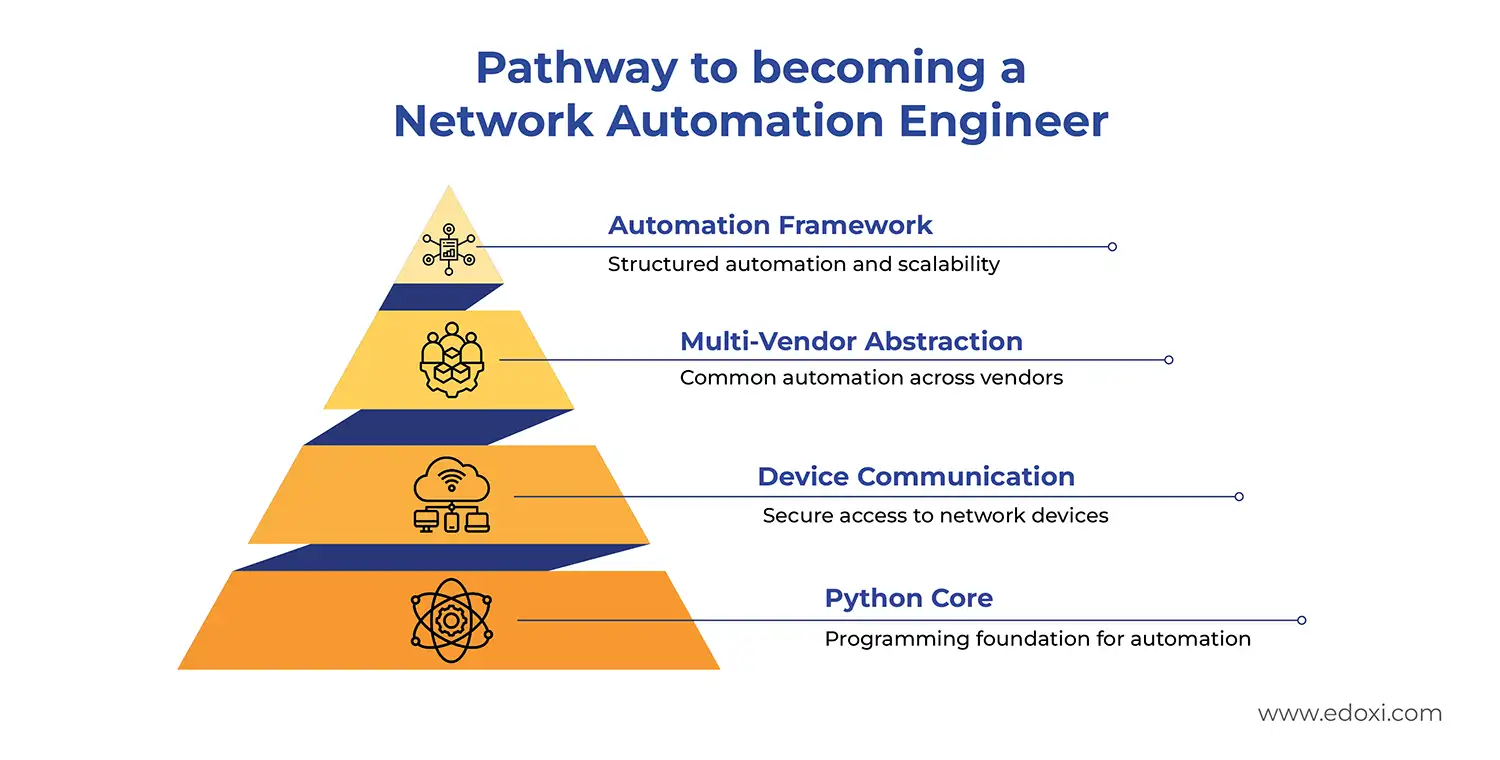
Network Automation Career pathway

Our programme features immersive, lab-based learning focused on real-world networking scenarios. You work extensively in GNS3 labs using Cisco IOS and Arista vEOS to simulate enterprise-grade network environments. These hands-on sessions develop practical skills in SSH-based automation, configuration deployment, asynchronous network operations, and REST API integration.

By completing the course, you gain job-ready competencies in automating network configuration, monitoring, and maintenance tasks. Our curriculum prepares you to reduce manual workloads, minimise configuration errors, and support the transition toward software-defined networking and DevOps practices. It enables you to manage multi-vendor network environments efficiently while improving operational reliability and scalability.

Key Features of Edoxi's Python Network Automation Training

GNS3 Multi-Vendor Lab Environment

You can practise network automation scripts on simulated Cisco, Arista, and Juniper devices within realistic, enterprise-grade network topologies.

GitHub Code Repository Access

You can access production-ready Python scripts, YAML playbooks, and network automation templates for immediate implementation in real-world environments.

Live Device Configuration Sessions

You can execute real-time configuration changes on network devices using SSH, Telnet, and serial connection methods to gain hands-on operational experience.

Asynchronous Programming Projects

You can build high-performance, concurrent automation applications using AsyncIO, asyncssh, and aiofiles to manage large-scale network operations efficiently.

Ansible Playbook Development

You can create infrastructure-as-code solutions using Ansible modules designed for Cisco and multi-vendor network environments.

Object-Oriented Automation Framework

You can develop reusable Python classes using Paramiko and telnetlib to streamline network automation development and improve code maintainability.

Who Can Join Our Online Python Network Automation Course?

Network Engineers & Cisco Professionals

You can join this course if you want to automate repetitive network configuration tasks and improve operational efficiency.

System Administrators

You can join this course if you manage servers and network devices and want to streamline device management through Python scripting.

DevOps Engineers

You can join this course if you aim to integrate network automation into CI/CD pipelines and support modern infrastructure workflows.

IT Professionals

You can join this course if you want to upgrade your skills for managing programmable and software-defined network infrastructures.

Career Switchers

You can join this course if you are transitioning from manual networking roles to automation-focused careers.

Corporate IT Teams

You can join this course if you want to upskill staff to support software-defined networking and automation-driven operations.

Tech Enthusiasts

You can join this course if you are interested in exploring practical network automation using Python and industry-standard tools.

Network Operations & NOC Professionals

You can join this course if you are responsible for monitoring and maintaining large-scale networks and want to reduce downtime through automation.

Python Network Automation Course Modules

Module 1: Course Introduction & Setup
  • Chapter 1.1: Getting Started with Network Automation

    • Lesson 1.1.1: Why Network Automation with Python
    • Lesson 1.1.2: Course Resources and Tools
    • Lesson 1.1.3: Setting Up Python, PyCharm, GNS3, and Cisco IOS/IOU
    • Lesson 1.1.4: Getting Started with GitHub Copilot
Module 2: Python Programming Basics
  • Chapter 2.1: Python Environment Setup

    • Lesson 2.1.1: Python Installation and Virtual Environments
    • Lesson 2.1.2: Running Code in IDEs (VS Code and PyCharm)
  • Chapter 2.2: Basic Python Syntax and Logic

    • Lesson 2.2.1: Variables, Comments, and Constants
    • Lesson 2.2.2: Data Types and Operators (Assignment, Comparison, Identity)
    • Lesson 2.2.3: Python Program Flow: Conditionals and Booleans
Module 3: Loops and Data Structures
  • Chapter 3.1: Iteration and Control Structures

    • Lesson 3.1.1: For Loops and While Loops
  • Chapter 3.2: Core Data Structures

    • Lesson 3.2.1: Lists and Tuples: Operations and Methods
    • Lesson 3.2.2: Sets, Frozensets, and Dictionaries
  • Chapter 3.3: File Handling

    • Lesson 3.3.1: File Handling Basics: Read/Write and CSV Processing
Module 4: Functions and Exception Handling
  • Chapter 4.1: Working with Functions

    • Lesson 4.1.1: Defining and Using Functions
    • Lesson 4.1.2: Scope, Arguments, *args, and **kwargs
    • Lesson 4.1.3: Lambda Functions
  • Chapter 4.2: Managing Exceptions

    • Lesson 4.2.1: Handling Errors Using Try and Except
Module 5: Object-Oriented Programming Essentials
  • Chapter 5.1: Python Classes and Objects

    • Lesson 5.1.1: Classes and Objects
    • Lesson 5.1.2: The init Method and Magic Methods
    • Lesson 5.1.3: Instance Attributes vs Class Attributes
Module 6: Data Serialisation and APIs
  • Chapter 6.1: Data Serialisation Techniques

    • Lesson 6.1.1: Using Pickle and JSON Modules
    • Lesson 6.1.2: Writing and Reading Serialised Data
  • Chapter 6.2: REST APIs with Python

    • Lesson 6.2.1: Introduction to REST APIs and the Requests Library
    • Lesson 6.2.2: Mini Project: JSON Data and REST API Automation
Module 7: Automating with Paramiko (SSH)
  • Chapter 7.1: SSH-Based Network Automation

    • Lesson 7.1.1: Connecting to Cisco Devices Using SSH
    • Lesson 7.1.2: Running Remote Commands
    • Lesson 7.1.3: Automating Configuration Changes (e.g. OSPF)
    • Lesson 7.1.4: Secure Authentication and Password Handling
    • Lesson 7.1.5: Multithreading with Paramiko
    • Lesson 7.1.6: Project: Backing Up Configurations Across Devices
Module 8: Automating with Netmiko
  • Chapter 8.1: CLI Automation with Netmiko

    • Lesson 8.1.1: Netmiko vs Paramiko
    • Lesson 8.1.2: Command Execution on Cisco Devices
    • Lesson 8.1.3: Batch Configuration from Files
    • Lesson 8.1.4: Multithreading and Performance Optimisation
    • Lesson 8.1.5: Project: Interface Status Checker and Enabler
Module 9: Asynchronous Network Automation
  • Chapter 9.1: Asynchronous Python Programming

    • Lesson 9.1.1: AsyncIO Concepts in Python
    • Lesson 9.1.2: Asynchronous SSH Connections Using AsyncSSH
    • Lesson 9.1.3: Building an Asynchronous Web Scraper
    • Lesson 9.1.4: Running Shell Commands Asynchronously
Module 10: NAPALM for Multi-Vendor Automation
  • Chapter 10.1: Network Device Abstraction

    • Lesson 10.1.1: Introduction to the NAPALM Library
    • Lesson 10.1.2: Retrieving Device Facts, Interfaces, and ARP Tables
    • Lesson 10.1.3: Configuration Merge and Rollback
    • Lesson 10.1.4: Network State Validation
Module 11: Telnet Automation
  • Chapter 11.1: Automating with Telnet

    • Lesson 11.1.1: Telnet Protocol Basics
    • Lesson 11.1.2: Python Telnetlib Integration
    • Lesson 11.1.3: Refactoring with Object-Oriented Programming for Telnet
    • Lesson 11.1.4: Automating Device Configurations over Telnet
Module 12: Serial Connection Automation
  • Chapter 12.1: Serial-Based Device Management

    • Lesson 12.1.1: Serial Communication Basics Using PySerial
    • Lesson 12.1.2: Automating Device Access via Console Ports
    • Lesson 12.1.3: Creating and Enhancing a Custom Serial Module
    • Lesson 12.1.4: Initial Device Configuration Scripts
Module 13: Hands-On Challenges
  • Chapter 13.1: Real-World Problem Solving

    • Lesson 13.1.1: File Processing with Python
    • Lesson 13.1.2: Paramiko Automation Challenge
    • Lesson 13.1.3: Netmiko Automation Challenge
    • Lesson 13.1.4: Telnet Automation Challenge
    • Lesson 13.1.5: Serial Communication Automation Challenge

Download Network Automation Course Brochure

Real-World Exercises and Case Studies in Python Network Automation

Edoxi’s online Network Automation with Python and Ansible course includes hands-on exercises and real-world lab scenarios designed to simulate enterprise network environments. The following practical exercises reflect real operational challenges faced by modern network engineers.

Multi-Device Configuration Backup

In this exercise, you automate router and switch configuration backups using Netmiko with multithreading. You implement error handling and logging to ensure reliable and scalable backup operations.

OSPF Deployment and Validation

In this exercise, you deploy OSPF configurations across multiple network devices using Jinja2 templates. You also verify routing stability and neighbour relationships to ensure consistent network performance.

Asynchronous SSH Operations

In this exercise, you use AsyncSSH and AsyncIO to collect interface and operational data concurrently from multiple network devices. This approach improves execution speed in large-scale environments.

Multi-Vendor Compliance Audit

In this exercise, you run NAPALM-based automation scripts to validate configuration compliance across Cisco, Arista, and Juniper networks. You identify configuration drift and generate compliance reports.

Interface Management with Ansible

In this exercise, you create Ansible playbooks to automate interface configuration updates. You ensure consistent, idempotent configurations across network devices.

Zero-Touch Device Provisioning

In this exercise, you automate initial device provisioning using PySerial console scripts. This enables rapid, error-free deployment of new network devices with minimal manual intervention.

Python Network Automation Course Outcome and Career Opportunities

Completing Edoxi’s Network Automation with Python and Ansible training equips you with practical skills to design, implement, and manage automated network environments. The key outcomes include:

Course Outcome Image
Gain the ability to automate routine network operations using Python scripts to improve efficiency and reduce manual configuration tasks.
Learn to interact with network devices programmatically using automation libraries and protocols for configuration, monitoring, and troubleshooting.
Develop skills to deploy, manage, and validate configurations across multi-vendor environments using tools such as Netmiko, Paramiko, and Ansible.
Master techniques for automating network changes, backups, compliance checks, and operational workflows with reliable and scalable logic.
Build confidence in designing structured automation solutions using reusable code, object-oriented programming, and modular scripting practices.
Complete hands-on labs and practical exercises that strengthen your portfolio and demonstrate real-world network automation capabilities.

Career Opportunities After Our Online Python Network Automation Course

  • Network Automation Engineer
  • Network Engineer
  • DevOps Engineer
  • Site Reliability Engineer (SRE)
  • Network Operations (NOC) Specialist
  • Infrastructure Automation Engineer
  • Systems Administrator
  • IT Automation Specialist

Python Network Automation Training Options

Live Online Training

  • 40-hours of virtual online training

  • Flexible Evening and Weekend Schedule Options

  • Interactive Python Coding Demonstrations via Screen Sharing

  • Remote Access to Virtual GNS3 Lab Environments

Corporate Training

  • 3 days of intensive corporate training

  • Customised Digital and Instructor-Led Delivery Formats

  • Flexible Delivery Options (On-Site / Edoxi Office / Hotel)

  • Fly-Me-a-Trainer Option

  • Enterprise Dashboards for Team Progress Tracking

  • Tailored Programs Addressing Organisation-Specific Network Environments

Do You Want a Customised Training for Network Automation?

Get expert assistance in getting you Network Automation Course customised!

How to Get an Online Python Network Automation Certification?

Here’s a four-step guide to becoming a certified Network Automation professional.
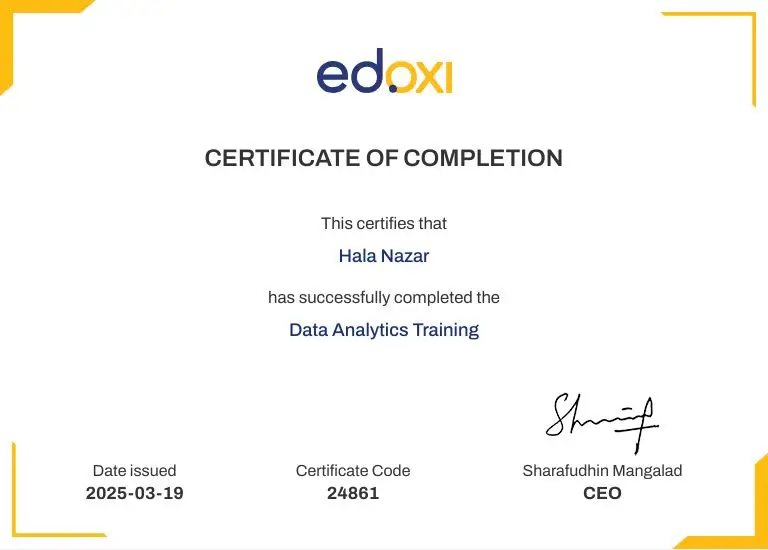
Do You Want to be a Certified Professional in Network Automation?

Join Edoxi’s Network Automation Course

Why Choose Edoxi for the Online Python Network Automation Course?

Edoxi’s Python Network Automation course equips IT professionals and aspiring automation engineers with practical skills to build and manage programmable network infrastructures. Here’s why you should choose us:

Expert Network Automation Trainers

Our instructors are certified professionals with hands-on experience in Python-based network scripting and multi-vendor automation frameworks.

Beginner-Friendly Learning Environment

Our structured curriculum covers Python fundamentals through advanced automation tools, enabling even non-programmers to confidently master network programmability.

Practical, Hands-On Learning

You gain real-world experience by building automation scripts, validating configurations, and managing multi-device operations through guided GNS3 lab exercises.

Industry-Relevant Tools and Frameworks

You work extensively with modern automation technologies such as Paramiko, Netmiko, NAPALM, AsyncIO, and Ansible used in enterprise network environments.

Trusted Provider of Corporate Training

We deliver customised network automation training programmes to telecom, IT, and enterprise organisations across the UAE, aligned with real operational needs.

Global Perspective with Regional Expertise

Edoxi operates in Dubai, Doha, and London, combining international best practices with regional industry requirements to ensure consistent and job-ready skills development.

students-image

Edoxi is Recommended by 95% of our Students

Meet Our Mentor

Our mentors are leaders and experts in their fields. They can challenge and guide you on your road to success!

mentor-image

Afreen M

Afreen, with four years of dedicated teaching experience, has successfully trained over 100 students in programming languages like Python, SQL, and Java. She combines her technical expertise with a passion for education, tailoring her instruction to suit the unique needs of young learners. Her interests in reading and working on coding projects help her design engaging and practical learning experiences for her students.

Afreen’s teaching philosophy emphasizes hands-on learning, guiding children through projects like game development and calculator applications. Her balanced approach helps students build confidence in technology while mastering essential programming skills. By staying actively engaged with personal coding projects, she ensures her teaching remains current, practical, and effective, creating an encouraging environment where children can explore and understand coding concepts with ease.

Locations Where Edoxi Offers Python Network Automation Course

Here are the major international locations where Edoxi offers Python Network Automation Course

FAQ

What are the prerequisites for joining Edoxi’s Online Python Network Automation Training Course?

The Python Network Automation Training Course requires basic knowledge of networking concepts such as routing, switching, and device configuration. Prior programming experience is not mandatory.

Do I need Python programming experience to join Edoxi’s Online Python Network Automation course?

No prior Python knowledge is required for the Python Network Automation course. The Python Network Automation training starts with core programming fundamentals and gradually advances to network automation use cases.

What tools and software platforms are required for Edoxi’s Online Python Network Automation training?

The Python Network Automation training uses Python 3, PyCharm IDE, GNS3 network simulator, and VirtualBox. These tools support hands-on labs required for completing the Python Network Automation Training Course.

Are real network devices used during Edoxi’s Online Python Network Automation Training Course?
The Python Network Automation Training Course uses the GNS3 simulator with Cisco IOS, Arista vEOS, and Juniper vSRX platforms. This setup provides real-world practice without physical hardware.
Is Ansible automation included in your Python Network Automation course curriculum?

Yes, our Python Network Automation course includes Ansible automation using modules such as ios_command and ios_config. Learners build playbooks for multi-vendor network automation and ad-hoc execution.

Does your Python Network Automation training cover asynchronous programming?

Our Python Network Automation training includes AsyncIO concepts such as async/await patterns and asyncssh implementation. Participants build high-performance automation solutions for concurrent device management.

Are multi-vendor environments covered in Edoxi’s Online Python Network Automation Training Course?

Yes, Edoxi’s Online Python Network Automation Training Course covers Cisco, Arista, Juniper, and Linux platforms using NAPALM and vendor-neutral scripting techniques.

Can I apply the skills learned from Edoxi’s Online Python Network Automation course in my current job?

Absolutely. The Python Network Automation course focuses on production-ready scripts for configuration backups, deployment, compliance checks, and monitoring that can be applied immediately.

How is Edoxi’s Online Python Network Automation certification awarded?

Upon successful completion of the Python Network Automation Training Course, participants receive an Edoxi Python Network Automation certification validating their automation and programmability skills.

Can corporate teams customise Edoxi’s Online Python Network Automation training content?

Yes, Python Network Automation training for corporate teams can be customised based on specific network environments, preferred tools, and organisational infrastructure requirements.

What salary growth can I expect after completing Edoxi’s Online Python Network Automation certification?

Professionals with Python Network Automation certification typically qualify for higher-paying roles such as Network Automation Engineer and DevOps Engineer. Automation skills significantly improve salary potential compared to traditional networking roles.

How does your Python Network Automation Training Course support long-term career growth?
Our Python Network Automation Training Course prepares professionals for advanced roles in DevOps, SRE, and infrastructure automation. It bridges traditional networking with modern software-driven career paths.