Request a Callback

+971 43801666
 Sep 08, 2026
|
Key Takeaways
|
Every Dubai company needs employee AI training before 2027 because the emirate's own leadership has set that deadline.
In May 2026, Dubai's Crown Prince, Sheikh Hamdan bin Mohammed bin Rashid Al Maktoum, directs the entire private sector to complete its transition to agentic AI within two years.
Twenty-two government departments already operate under dedicated Chief AI Officers, and workplace AI adoption across the UAE stands at 70.1%, nearly four times the global average.
For Dubai businesses, this is not a distant trend to watch from the sidelines. It is a live deadline with direct consequences for productivity, compliance and talent retention.
This guide explains exactly why AI training matters now, which teams need it first, and how any Dubai organisation builds a practical training roadmap ready for 2027 and the years beyond. If you have doubts about what Artificial Intelligence (AI) is, here is the complete guide.
| Table of Contents |
|
1. Why Does Every Dubai Company Need AI Training Before 2027?
2. How Fast Is AI Adoption Growing Across Dubai and the UAE? 3. Which Departments Need AI Training First? 4. How Much Productivity Can AI Training Deliver? 5. What Happens to Dubai Companies That Delay AI Training? 6. Does AI Training Replace Employees or Make Them More Valuable? 7. How Does a Dubai Company Build an AI Training Roadmap for 2027? 8. Frequently Asked Questions |
Dubai's government sets the pace for private industry, and its own AI mandates leave businesses with a defined, short runway to prepare their people.
In May 2026, Sheikh Hamdan directs Dubai's entire private sector to adopt agentic AI within two years, tasking the Dubai Chamber of Commerce with running specialised training tracks, incubators and investment vehicles to support the shift.
Eleven days earlier, Sheikh Mohammed bin Rashid Al Maktoum sets a target for 50% of federal government services to run through autonomous AI agents by 2028.
The federal cabinet already trains 80,000 employees on AI and runs live agents across procurement, tax auditing, customer happiness and technical support.
The government is not asking Dubai companies to catch up eventually. It is actively building the standard that private businesses now need to match.
The table below shows you the milestones Dubai and the UAE Government plans to achieve by 2031.
Dubai and UAE AI milestones.
| Year |
Milestone on the Road to 2027 and Beyond
|
| 2027 |
Deadline for Dubai's private sector to complete its transition to agentic AI, under the Crown Prince's directive
|
| 2028 |
Target for 50% of UAE federal government services to be delivered through autonomous AI agents
|
| 2028 |
Dubai AI Campus target of over 3,000 new high-value technology jobs
|
| 2030 |
AI's forecast contribution of 13.6% to 14% of UAE GDP
|
| 2031 |
Milestone year for the 'We the UAE 2031' vision, embedding AI across every level of government
|
UAE workplace AI adoption already outpaces almost every country worldwide, so Dubai businesses that fall behind struggle to compete for both talent and clients.
The Microsoft AI Economy Institute's Q1 2026 AI Diffusion Report puts UAE workplace AI adoption at 70.1%, compared with a global average of just 17.8%. That figure climbs steadily, from 59.4% to 64%, before crossing the 70% mark within a single year.
The Stanford AI Index 2026 confirms the pattern, recording UAE generative AI adoption at 54% and more than 80% of employees using AI regularly at work.
UAE organisations also lead on structured AI leadership: 33% appoint a Chief AI Officer, against 26% internationally, and those organisations report up to 36% higher return on their AI investment.
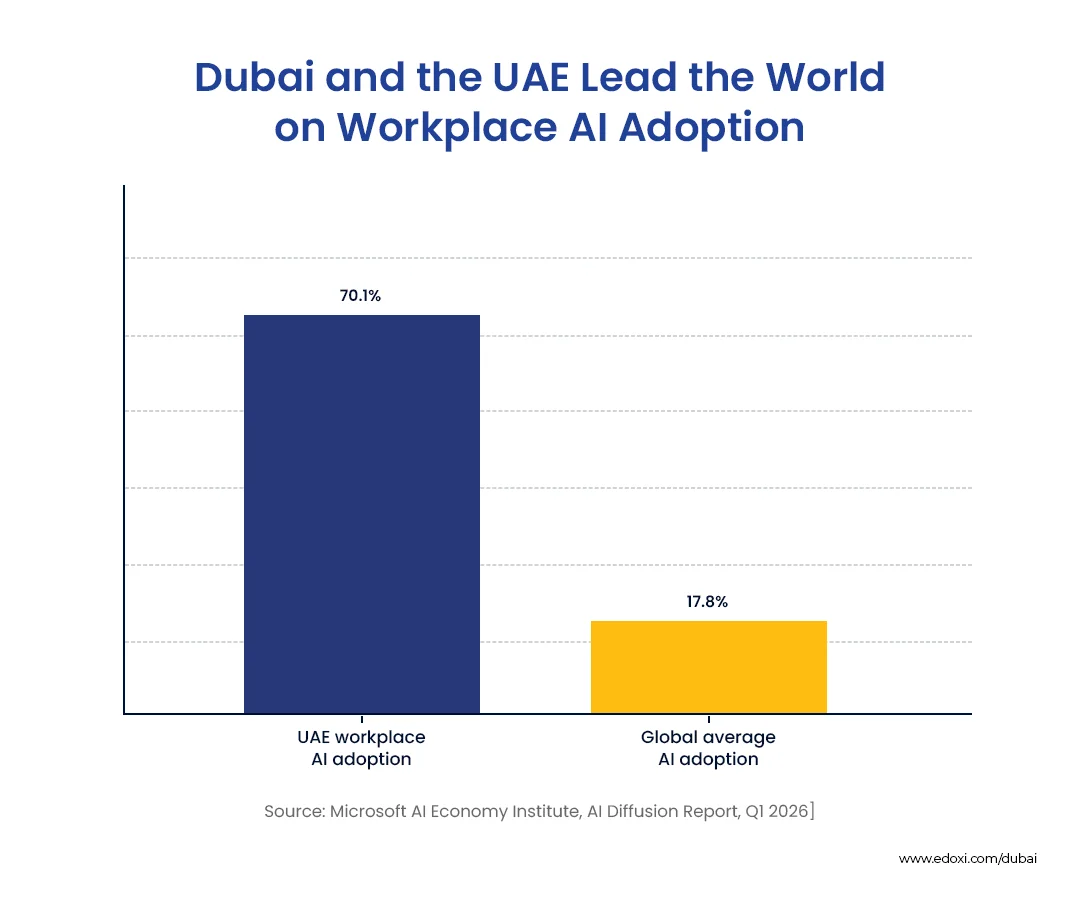
UAE workplace AI adoption versus the global average, Q1 2026.
For any Dubai company, this gap is the clearest signal available. Untrained teams now compete directly against a national workforce already several steps ahead. Here, you may better understand the advantages and disadvantages of AI and what Artificial Intelligence means in Business.
Every department gains from AI training, though marketing, finance, IT, customer service and HR see the fastest, most measurable returns.
AI already reshapes daily tasks across most business functions in Dubai. Retail and e-commerce teams report 4.8% annual productivity growth from AI-powered personalisation and forecasting. Healthcare providers save an estimated $1.2 billion a year through AI-driven diagnostics and administration. Financial auditors identify up to AED 1,000,000 in potential fraudulent claims per audit cycle using AI-assisted review.
None of these gains happens without trained people directing, checking and refining the technology behind them.
Department-wise AI adoption and the skills each team needs to build.
| Department | Where AI Already Helps |
Core Skill Employees Need
|
| Marketing & Sales | Personalised campaigns, predictive analytics |
Prompt engineering, campaign judgement
|
| Finance & Accounting | Fraud detection, automated reporting |
AI output verification, risk oversight
|
| IT & Operations | Workflow automation, agent deployment |
Agent governance, systems oversight
|
| Customer Service | Chat handling, query triage |
Escalation judgement, empathetic resolution
|
| HR & Learning | Screening, onboarding automation |
Data-driven decisions, people judgement
|
| Leadership & Strategy | AI governance, resource planning |
Vision-setting, ethical oversight
|
Firms that pair AI tools with trained, AI-literate staff report productivity gains many times higher than firms that adopt tools alone.
PwC's Global AI Jobs Barometer finds that the average AI-exposed company achieves 33.5% productivity growth relative to a 2018 baseline.
A top tier of "superstar" companies, those using AI for genuine business reinvention rather than simple cost-cutting, reach 163% growth instead, nearly five times the average. These superstar firms also grow headcount at double the rate of the least AI-exposed organisations, and they share the gains widely, with average wage growth of 68% for their staff.
Dubai's own logistics sector is projected to generate an AI-driven economic impact of $4.5 billion by 2030, a reminder of how far productivity gains extend once training turns tools into genuine business capability.
Productivity growth among superstar firms versus the average AI-exposed firm.
The gap between these two outcomes rarely comes down to which software a company buys. It comes down to whether its people know how to use that software well.
Companies without AI-trained staff lose ground on productivity, compliance and client trust as competitors move faster.
Business outcomes with and without structured AI training.
| Business Area | Without AI Training |
With Structured AI Training
|
| Productivity | Falls behind superstar peers, gaining up to 163% |
Positioned to capture superstar-level growth
|
| Regulatory readiness | Struggles to meet Dubai's 2027 agentic AI deadline |
Prepared ahead of the deadline, with documented processes
|
| Talent retention | Loses AI-literate staff to employers offering upskilling |
Attracts and retains talent drawn by AI wage premiums of up to 62%
|
| Client experience | Slower service, higher error rates |
Faster, more accurate service backed by human oversight
|
These are not distant risks. With hiring for AI specialists growing eight times faster than the general job market, Dubai companies that delay training find themselves competing for the same small pool of ready-made talent as everyone else, at a steep premium. Here are the 10 jobs most at risk of being replaced by AI and the 5 industries that will be most affected by AI.
AI training does not replace Dubai's workforce. It raises the value of the judgement, empathy and creativity that only people provide.
Global research groups this human value under the EPOCH framework: empathy, presence, opinion and judgement, creativity, and leadership. New tasks added to AI-exposed roles are 2.5 times more likely to depend on these human-intensive abilities. Edoxi have addressed this concern in Will Artificial Intelligence Take Over Human Jobs by 2030?
Microsoft's Work Trend Index finds that 49% of AI use already supports cognitive work such as analysis and problem-solving, while 50% of advanced users name quality control of AI output as their most valuable new skill.
Around 86% of advanced AI users say they treat AI output as a starting point, staying personally responsible for the thinking behind every decision. Training builds exactly this capability: the confidence to direct AI, question its output, and apply the judgement that Dubai clients and colleagues can trust. If you doubt Why Upskill In The Age of Artificial Intelligence? Here is a solution on how to utilise AI to increase employee productivity.
A practical roadmap moves through six clear steps, from auditing current AI use to embedding certified, role-specific skills across every team.
Costs vary by provider, course length and delivery format, with instructor-led and blended options typically priced by group size and course depth. Edoxi's corporate training team provides tailored quotes based on department needs.
Look for a provider offering instructor-led corporate programmes, practical prompt engineering content and a track record with local and international companies, rather than generic online courses alone.
Employees increasingly favour employers who invest in their AI skills, given rising wage premiums for AI-literate staff. Structured upskilling programmes help Dubai companies retain talent that might otherwise move to AI-ready competitors.
Yes. Most corporate AI certification programmes in Dubai are designed for business users rather than developers, focusing on prompt writing, output evaluation and safe daily use rather than coding.
Agentic AI refers to systems capable of carrying out tasks with a degree of autonomy, rather than simply answering questions. Dubai's private sector mandate specifically targets this shift, making agentic AI oversight a core training priority for 2027.