Request a Callback

+971 4380 1666
 Sep 02, 2026

|
Key Takeaways
|
Prompt engineering basics take one to two weeks to learn through consistent, focused practice. Practical, job-ready proficiency follows in one to three months. Full mastery, including multi-step workflows and AI automation, takes three to six months, and sometimes longer for complex, enterprise-level use. Your background, weekly study time, and access to real projects shape this timeline more than any single course length.
Tools such as ChatGPT, Claude, Google Gemini, and Microsoft Copilot reward the same underlying skill: clear, structured instructions. A beginner who practises daily often overtakes a casual learner within weeks. Guided, hands-on training in prompt engineering shortens this journey further, whichever city you learn from, be it Dubai, London, Doha, Manama, Kuwait City, or anywhere online.
This guide breaks the learning journey into realistic stages, with roadmaps for students, developers, marketers, and business professionals across every major region.
| Table of Contents |
|
1. How Long Does It Actually Take to Learn Prompt Engineering?
2. What Factors Decide How Fast You Learn Prompt Engineering? 3. What Does a Realistic 30-60-90 Day Roadmap Look Like? 4. How Does Learning Speed Differ by Background? 5. Self-Learning vs Instructor-Led Training: Which Is Faster? 6. What Does a Weekly Study Plan Look Like? 7. How Do You Know You Are Ready for a Prompt Engineering Job? 8. Why Is Dubai Emerging as a Global Hub for Prompt Engineering Training? 8. Frequently Asked Questions |
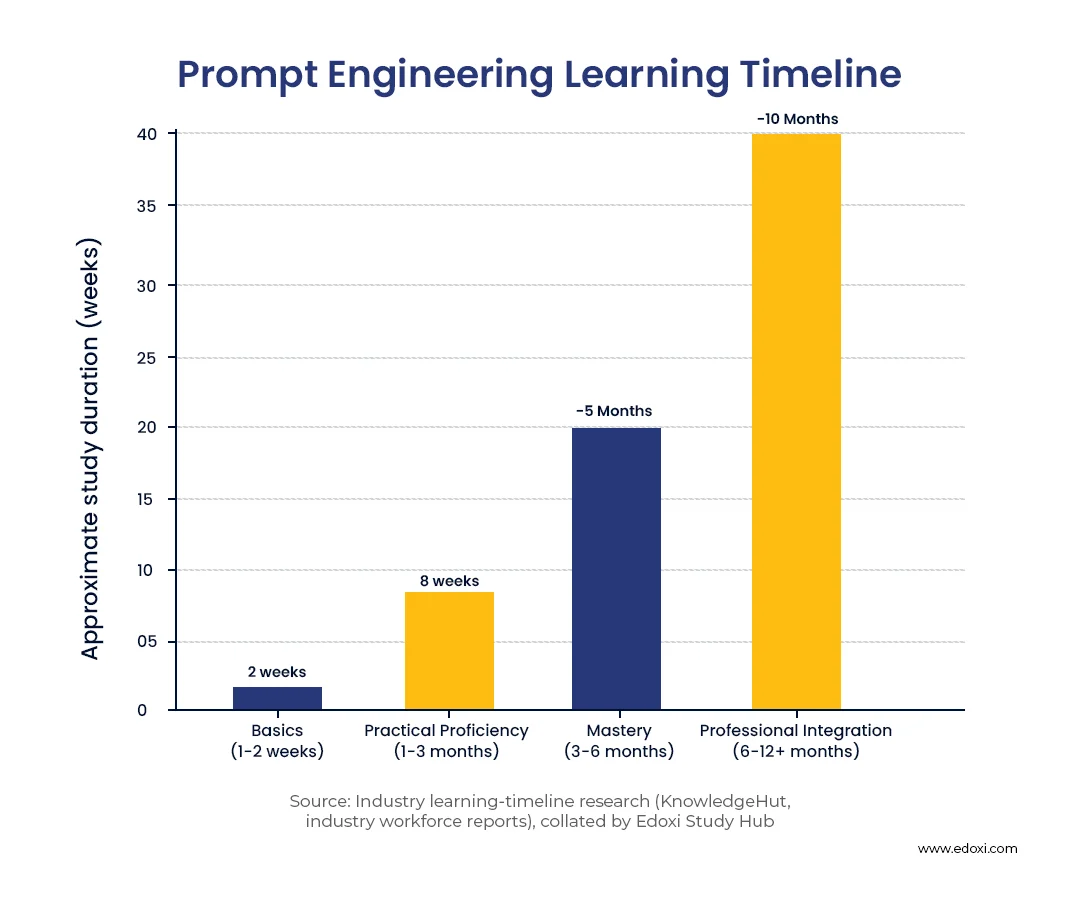
Prompt engineering takes one to two weeks for basics, one to three months for practical proficiency, and three to six months for mastery. Professionals aiming for advanced, enterprise-level integration usually need six to twelve months of continued practice.
The table below sets out what each stage actually involves.
| Stage | Duration |
What You Can Do
|
| Basics | 1–2 weeks |
Write clear prompts; use zero-shot and role prompting confidently.
|
| Practical proficiency | 1–3 months |
Apply chain-of-thought prompting; structure outputs for real tasks.
|
| Mastery | 3–6 months |
Design multi-step prompts; evaluate and refine AI output critically.
|
| Professional/Advanced | 6–12 months+ |
Build AI-powered workflows; integrate APIs; lead adoption at work.
|
Four factors decide your prompt engineering learning speed: your starting experience, your weekly consistency, your access to real projects, and the quality of feedback you receive.
Our Artificial Intelligence Training Course pairs learners with expert instructors for exactly this reason, giving structured feedback from day one.
A realistic prompt engineering roadmap covers fundamentals in the first thirty days, applied practice in the next thirty, and workflow-building in the final thirty. This 30-60-90-day structure suits most working professionals studying part-time.
| Phase | Focus | Outcome |
| Days 1–30 | Prompt structure, zero-shot and few-shot prompting, 30 minutes daily |
Comfort writing clear, single-step prompts
|
| Days 31–60 | Chain-of-thought prompting, context engineering, 3–5 real projects |
Reliable outputs on work-relevant tasks
|
| Days 61–90 | Multi-step workflows across ChatGPT, Claude, Gemini and Copilot |
A documented, job-ready portfolio
|
Software developers often reach proficiency in three to six weeks, since prompting builds on skills they already hold. Students and career changers typically need two to four months, as they build wider AI literacy alongside prompting skill. Marketers and business professionals usually need four to ten weeks, with practice focused on role-specific use cases.
| Background | Typical Timeline | Why |
| Students / fresh graduates | 2–4 months |
Building foundational AI literacy alongside prompting skill
|
| Software developers | 3–6 weeks |
Existing logic and API skills accelerate advanced prompting
|
| Marketers / content teams | 4–8 weeks |
Focus stays on tone, brand voice and content workflows
|
| Business leaders / managers | 6–10 weeks |
Emphasis on strategic use cases over technical depth
|
Whatever your background, the pattern stays consistent: regular, applied practice closes the gap between beginner and job-ready far faster than passive reading or video-only courses.
Instructor-led training gets most learners job-ready in six to ten weeks. Self-directed learning takes four to eight months, and results vary widely without structured feedback.
| Factor | Self-Learning |
Instructor-Led Training
|
| Typical timeline | 4–8 months | 6–10 weeks |
| Feedback quality | Limited or none |
Expert, real-time feedback
|
| Consistency of outcome | Highly variable |
Structured and predictable
|
| Practical project work | Self-sourced |
Guided, work-relevant projects
|
A realistic weekly study plan needs three to five hours a week, split across short daily sessions and one longer practice block.
| Day | Focus | Time |
| Monday | Learn one new prompting technique | 30 minutes |
| Tuesday | Apply it to a real work task | 30 minutes |
| Wednesday | Compare outputs across two AI tools | 30 minutes |
| Thursday | Refine and re-test weak prompts | 30 minutes |
| Friday | Document results in a prompt library | 30 minutes |
| Weekend | One longer project or mini case study | 60–90 minutes |
You are ready for entry-level prompt engineering work once you write reliable prompts, evaluate AI output critically, and hold a small portfolio of documented projects.
You may also refer to this: Top 10 Artificial Intelligence Skills to learn in 2026
Dubai and the wider UAE are emerging as a global hub because of rapid corporate AI adoption and strong national investment in AI-ready talent. Generative AI course enrolments across the UAE have surged sharply, and a significant share of the workforce is actively upskilling on recognised platforms.
This momentum extends well beyond Dubai. Professionals in Doha, Kuwait City, Manama, and London study prompt engineering alongside learners across India and other global markets, often through the same flexible, online-friendly formats. Employers across the region increasingly treat AI literacy as a baseline hiring requirement rather than a bonus skill. For those looking to embark on a career in AI, consider exploring this guide on how to navigate AI courses and transition into an AI engineering role.
Regional AI upskilling momentum, led by the UAE workforce.
For learners based in Dubai, Qatar, Kuwait, Bahrain, London, or studying online, a structured Prompt Engineering Course provides the same guided roadmap covered in this guide, adapted to local career markets.
For those in Kuwait, check out why Prompt Engineering skills are in high demand in Kuwait.
Prompt engineering is not hard for beginners, since it relies on clear communication rather than coding. Most learners write workable prompts within their first week of practice. Difficulty rises only when tasks involve multi-step workflows or API integration.
Coding skills are not required for beginner or intermediate prompt engineering work. Basic Python or JSON knowledge helps with advanced automation and API-based projects. Most entry-level and marketing-focused roles need no programming background at all.
Thirty to sixty minutes of daily practice builds solid prompt engineering skill within a month. Consistency matters more than long, occasional sessions. Short, focused practice on real tasks accelerates learning noticeably.