Request a Callback

+971 43801666
 Aug 03, 2026
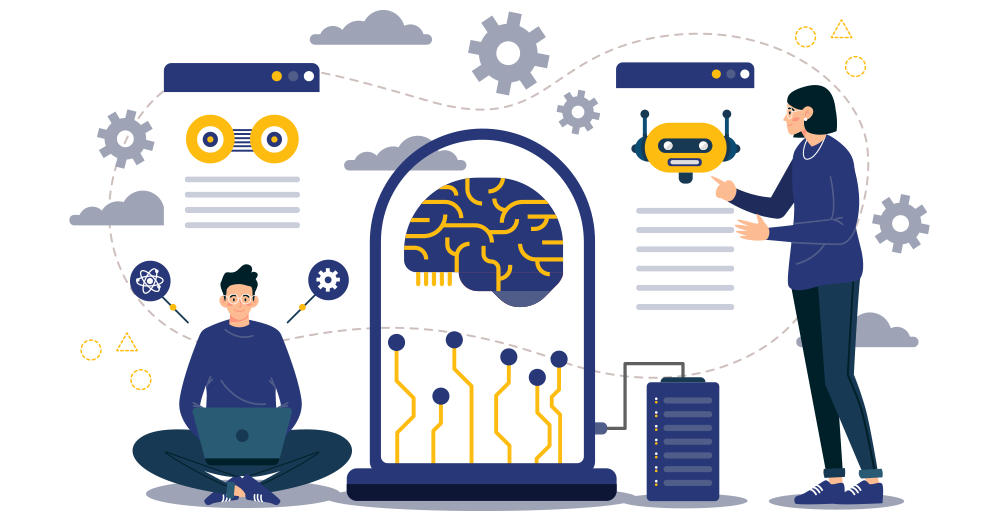
Quick AnswerArtificial Intelligence (AI) is technology that enables computers and machines to learn, reason, solve problems, and make decisions similarly to humans. AI Definition: AI is technology that allows computers and machines to simulate human intelligence, enabling them to learn, reason, adapt, and make decisions. How AI Works In Simple Steps 1. Collect data → 2. Find patterns in that data → 3. Use patterns to make predictions on new data → 4. Improve through feedback. That's the entire AI loop, from a simple spam filter to GPT-4. TL;DR AI systems learn from data, identify patterns, make predictions, and continuously improve through feedback. Modern AI powers tools like ChatGPT, self-driving cars, recommendation systems, voice assistants, and facial recognition. |
Artificial Intelligence is a branch of computer science focused on building machines and software systems capable of performing tasks that would normally require human intelligence. These tasks include learning, reasoning, problem-solving, understanding language, recognising images, and predicting outcomes.
According to NASA, 'there is no single, simple definition of artificial intelligence because AI tools are capable of a wide range of tasks.' The term was coined by mathematician John McCarthy in 1956 at the Dartmouth Conference, defining it as 'the science and engineering of making intelligent machines.
As AI adoption accelerates worldwide, AI training has become essential for students, professionals, and businesses looking to develop practical artificial intelligence skills, master machine learning, and prepare for AI-powered careers.
The AI market is exploding, with significant growth projected across industries. Discover key trends and adoption rates.
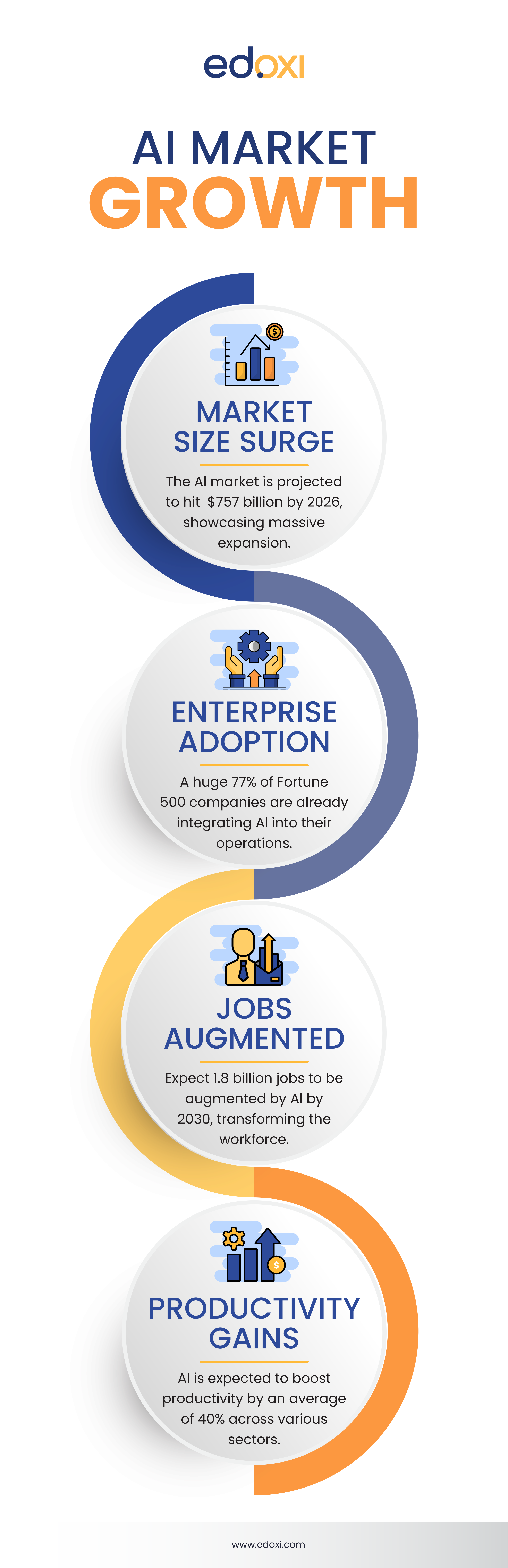
Artificial Intelligence is no longer a future technology. It is the present. In 2026, AI is considered a foundational technology on par with electricity or the internet; it now influences virtually every sector of the modern economy, from business operations and healthcare to education, transportation, and scientific research.
As AI becomes a core business technology, AI certification programs are helping professionals build practical skills in machine learning, generative AI, prompt engineering, computer vision, and natural language processing.
Understanding AI is no longer optional for businesses, professionals, or students. According to the World Economic Forum, AI literacy is rapidly becoming a baseline competency. The McKinsey Global Institute estimates AI could add between $13 and $22 trillion to the global economy annually by 2030.
These seven properties distinguish AI from conventional software:
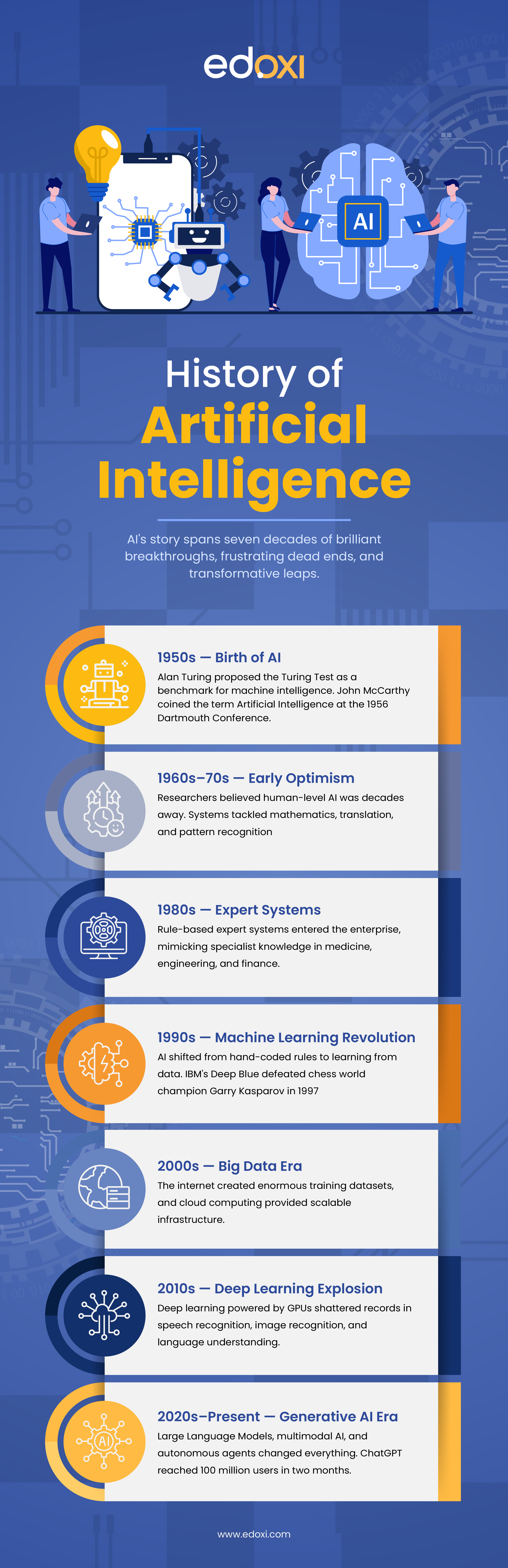
AI's story spans seven decades of brilliant breakthroughs, frustrating dead ends, and transformative leaps. Understanding this arc explains why AI looks the way it does today.
AI systems follow a clear and logical workflow. At the core, AI learns patterns from data and uses those patterns to make decisions or predictions on new inputs.
Understanding how AI works is one of the first topics covered in most AI courses, allowing learners to build machine learning models, train neural networks, work with large language models (LLMs), and deploy AI applications in real-world environments.
Data Collection: AI gathers structured and unstructured data: text, images, video, audio, sensor readings, or user behaviour. The quality and quantity of data determine performance.
Data Processing & Cleaning: In Data processing, raw data is filtered for errors, duplicates, and irrelevant content. This step often consumes the most time, up to 80% of total effort.
Model Training: An algorithm processes the cleaned data, identifying statistical patterns across potentially billions of examples. The model adjusts internal parameters (weights) until predictions match correct answers.
Inference (Prediction & Decision-Making): The trained model receives new, unseen inputs and generates outputs: translations, diagnoses, recommendations, or predictions.
Continuous Learning & Feedback: Many AI systems update over time using feedback, ratings, corrections, or reinforcement signals, improving with every interaction.
|
Pillar |
Role |
Key Point |
|
Data |
The foundation of all AI |
Quality matters more than quantity. 'Garbage in, garbage out.' |
|
Mathematical instructions that process data |
Examples: neural networks, decision trees, transformers |
|
|
Models |
The trained AI system deployed for inference |
A mathematical artefact encoding what the algorithm learned from data |
|
Computing Power |
The hardware enabling training and inference |
GPUs, TPUs, and cloud infrastructure — hardware advances drive AI progress |
|
KEY TAKEAWAYS How AI Works — The Essentials ✓ AI learns patterns from data, not hand-coded rules ✓ The five steps are: collect → clean → train → infer → improve ✓ Data quality is more important than algorithm complexity ✓ Modern AI requires massive computing power (GPUs/TPUs) ✓ Continuous learning separates AI from traditional software |
This is one of the most searched and least understood AI topics. The learning process inside an AI system is fundamentally different from how humans learn, yet it produces some superficially similar results. Here’s how AI learn;
Modern AI is built on artificial neural networks, loosely inspired by the human brain. A neural network consists of layers of mathematical functions called 'neurons.' Data passes through these layers, with each layer transforming it and extracting increasingly abstract features.
Every connection between neurons has a numerical value called a weight. During training, the network makes a prediction, compares it to the correct answer, and calculates the error. A process called backpropagation then adjusts the weights to reduce that error, repeated millions or billions of times until the model becomes accurate.
|
THE BACKPROPAGATION INSIGHT Backpropagation is the mathematical breakthrough that made modern deep learning possible. It allows the network to efficiently calculate which weights to adjust, working backwards from the error through every layer. Geoffrey Hinton, Yann LeCun, and Yoshua Bengio won the 2018 Turing Award for pioneering this approach. |
Large Language Models like ChatGPT and Claude don't 'understand' language the way humans do. They predict the most statistically probable next word (technically a 'token') given everything that came before. Trained on trillions of tokens of human text, they become extraordinarily good at this prediction task, and the result feels like comprehension.
A base model trained on broad data can be fine-tuned on specific datasets to specialise for a task, such as medical diagnosis, legal document review, or customer service. This is why the same underlying model architecture can power dozens of different products.
Most modern chatbots use RLHF: human raters evaluate model outputs and provide preference signals. The model learns to produce responses humans rate as helpful, harmless, and accurate. This is how ChatGPT, Claude, and Gemini are aligned to be useful rather than merely statistically probable.
Today, AI training introduces learners to supervised learning, unsupervised learning, reinforcement learning, deep learning, transfer learning, and prompt engineering. These concepts help students understand how AI models are trained, optimised, and deployed across industries.
AI is transformative, but not without trade-offs. Here's a balanced look:
|
Advantages |
Disadvantages |
|
|
AI is classified in two main ways: by what it can do (capability) and by how it functions (functionality). Understanding both frameworks helps cut through media hype.
|
Type |
Status |
Description |
Examples |
|
Narrow AI (Weak AI) |
Exists Today |
Designed for one specific task. All current AI falls here — without exception. |
ChatGPT, facial recognition, self-driving cars, Siri |
|
General AI (AGI) |
Theoretical |
Flexible intelligence matches human cognitive breadth across any domain. |
Does not yet exist |
|
Superintelligent AI |
Hypothetical |
Intelligence surpassing humans in every domain. Raises profound safety questions. |
No deployed system; theoretical only |
|
CRITICAL INSIGHT Every AI system you interact with today, including the most advanced, is Narrow AI. Despite the hype, no deployed system possesses the flexible, generalised intelligence of a human being. AGI remains one of the most debated unsolved problems in science. |
|
Type |
Memory |
Description |
Example |
|
Reactive Machines |
None |
Respond to current inputs only; no memory of past interactions. |
IBM Deep Blue (chess) |
|
Limited Memory AI |
Short-term |
Use historical data to improve decisions. The dominant form today. |
Self-driving cars, recommendations |
|
Theory of Mind AI |
N/A |
Would understand human emotions and intentions. Currently experimental. |
Research stage only |
|
Self-Aware AI |
N/A |
Hypothetical AI with genuine consciousness. No such system exists. |
Science fiction |
Machine learning is the backbone of modern AI. Rather than following hand-coded rules, ML systems learn patterns from data. Give a system enough labelled examples of spam emails, and it learns to detect spam on its own, adapting to new patterns no human programmer anticipated.
|
Type |
How It Works |
Example Applications |
|
Supervised Learning |
Trained on labelled data with correct answers, like a teacher showing a student examples. |
Spam detection, price prediction, fraud identification |
|
Unsupervised Learning |
Finds hidden structure in unlabelled data, sorting by similarity without being told categories. |
Customer segmentation, anomaly detection |
|
Reinforcement Learning |
Agent learns via rewards for good actions and penalties for bad ones. |
AlphaGo, self-driving navigation, robotics |
Deep learning uses artificial neural networks with many layers, hence 'deep.' Inspired by the human brain, these networks excel with images, speech, and natural language. The 2012 AlexNet breakthrough launched the deep learning era. Deep learning now enables face recognition, real-time translation, protein folding prediction, and modern AI chatbots.
Explore in depth: What is deep learning?
NLP enables machines to read, understand, and generate human language. It powers chatbots, voice assistants, translation services, and search engines. The 2017 invention of the Transformer architecture (Google's 'Attention Is All You Need' paper) was the breakthrough that made modern LLMs possible.
Read more: What is Natural Language Processing (NLP)
Computer vision lets machines interpret the visual world, images, video, and real-time camera feeds. Applications include facial recognition, medical imaging analysis, autonomous vehicle navigation, and manufacturing quality inspection.
|
Feature |
Artificial Intelligence |
Machine Learning |
Deep Learning |
|
Definition |
A broad field of simulating human intelligence |
AI subset: learning from data |
ML subset: deep neural networks |
|
Data needed |
Can work with smaller datasets |
Needs moderate amounts |
Needs massive datasets |
|
Complexity |
Medium to high |
High |
Very high |
|
Computing power |
Moderate |
Moderate to high |
Very high (GPUs essential) |
|
Best examples |
Chatbots, robotics, expert systems |
Fraud detection, recommendations |
Voice assistants, image recognition, LLMs |
Generative AI creates new content, including text, images, video, audio, and code, rather than simply classifying or analysing existing data. It became one of the fastest-growing technologies in history and fundamentally changed how people think about what AI can do.
|
Generative AI Definition AI that produces new content based on learned patterns and not just recognising what exists, but creating what doesn't yet exist. |
Learn More: What is generative AI?
|
Type |
What It Does |
Leading Examples |
|
Text generation |
Writes articles, emails, code, and marketing copy |
ChatGPT, Claude, Gemini |
|
Image generation |
Creates digital art, product designs, and realistic photos |
Midjourney, DALL-E, Stable Diffusion |
|
Video generation |
Produces AI-generated video and animation |
Sora, Runway, Kling |
|
Audio generation |
Synthesises voice, music, and sound effects |
ElevenLabs, Suno, Udio |
|
Code generation |
Writes, reviews, and debugs software |
GitHub Copilot, Cursor AI, Claude |
Find Out: What is Generative AI and How Does it Work
|
Verdict Today, anyone with a smartphone can interact with AI directly, no coding required. ChatGPT reached 100 million users in two months, faster than any technology in history. This democratisation of AI is why 2026 is a watershed moment. |
Large Language Models are the engine behind most modern text-based AI. Trained on trillions of tokens of text, they learn to understand context, reasoning, and language structure, answering questions, writing code, summarising documents, translating languages, and engaging in nuanced dialogue.
|
Model Family |
Key Focus |
|
GPT Series (OpenAI) |
Conversational AI, coding, content generation, and enterprise solutions. Powers ChatGPT and Microsoft Copilot. |
|
Claude (Anthropic) |
Safety-focused, long-context reasoning, enterprise AI workflows. Known for nuance and reliability. |
|
Gemini (Google DeepMind) |
Multimodal AI, search integration, productivity, and cloud. Native integration with Google Workspace. |
|
Llama Series (Meta) |
Open-source, research, on-device deployment. Enables organisations to run AI on private infrastructure. |
ChatGPT is built on a Large Language Model, specifically OpenAI's GPT architecture. Understanding how it works demystifies most of what seems magical about modern AI.
1. Tokenisation
Before processing text, the model splits it into tokens, chunks of characters that may be whole words, word fragments, or punctuation. 'ChatGPT is impressive' becomes approximately 5 tokens. Tokens are the atomic unit of LLM processing.
2. The Transformer Architecture
GPT models use the Transformer architecture, introduced by Google in 2017. The critical innovation is the attention mechanism, which allows the model to weigh the relevance of every token to every other token in a sequence. This is what lets LLMs handle context across thousands of words.
3. Pre-training on Vast Data
GPT models are pre-trained on trillions of tokens from books, websites, code repositories, and other text, learning statistical patterns in language. This phase requires enormous computing and takes months, even on clusters of thousands of GPUs.
4. The Context Window
Every LLM has a context window, which is the maximum amount of text it can 'see' and reason about at once. GPT-4 can handle ~128,000 tokens; Claude's context window extends to 200,000. This is why some models handle entire books; older models could only process a few pages.
5. Fine-tuning & RLHF
Raw pre-trained models are unpredictable. Fine-tuning on curated datasets plus Reinforcement Learning from Human Feedback (RLHF) shapes the model to be helpful, harmless, and honest. Human raters evaluate responses and provide preference signals.
|
What is CHATGPT ChatGPT is a very sophisticated autocomplete system. It predicts the most likely next word (token) based on everything written before it, trained on so much human text that its predictions feel like genuine understanding. It doesn't 'know' facts the way humans do; it has internalised patterns from an enormous corpus of human knowledge. |
AI agents go beyond responding to prompts. They can plan multi-step workflows, use external tools, browse the web, write and execute code, and complete tasks autonomously over extended periods. This marks a fundamental shift from AI as a tool to AI as a collaborator.
|
WHAT MAKES AN AI AGENT? An AI agent perceives its environment, plans a course of action, takes steps (including using tools and APIs), evaluates results, and iterates, all without constant human guidance. In 2026, agentic AI is moving from research into enterprise deployment, handling everything from code review pipelines to multi-step research tasks. |
Multimodal AI
Multimodal AI processes multiple types of input simultaneously, text, images, audio, video, and real-world data combined. It allows AI to analyse a photograph, understand a video, or interpret a chart and explain trends across different media types. GPT-4o, Gemini 1.5, and Claude 3 Opus are leading multimodal systems. Multimodal capability is one of the defining characteristics of frontier AI in 2026.
In 2026, there is virtually no major industry untouched by AI-driven automation, personalisation, or decision support. Today, top companies are using AI software for productivity, efficiency, and cyber protection. The McKinsey Global Institute estimates AI-related technologies have the potential to add $13–22 trillion to the global economy annually by 2030. Here are some top AI Applications across different industries
|
Industry |
Key AI Applications |
|
AI in Healthcare |
Disease detection, medical imaging, drug discovery, personalised treatment plans, virtual health assistants, genomics |
|
AI in Finance & Banking |
Fraud detection, risk analysis, credit scoring, algorithmic trading, financial forecasting, and regulatory compliance |
|
AI in Education |
Personalised learning pathways, AI tutors, automated grading, adaptive platforms, student analytics |
|
AI in Cybersecurity |
Malware detection, intrusion prevention, anomaly identification, automated threat response |
|
AI in Marketing |
Customer targeting, predictive analytics, SEO analysis, ad optimisation, personalised content at scale |
|
Automated software testing, cloud management, data analysis, chatbots, predictive maintenance, and intelligent IT support. |
|
|
AI in Retail & E-commerce |
Product recommendations, inventory management, demand forecasting, dynamic pricing, and visual search |
|
AI in Manufacturing |
Predictive maintenance, smart factories, robotics automation, quality inspection, supply chain optimisation |
|
AI in Transportation |
Autonomous vehicles, route optimisation, traffic prediction, logistics automation, fleet management |
|
Improve engagement, streamline workflows, and deliver personalised experiences to users across digital platforms. |
|
|
AI in Legal |
Contract review, legal research, due diligence, compliance monitoring, document generation |
|
Candidate screening, skills gap analysis, employee engagement analytics, and workforce planning |
Also learn: 5 Industries That Will Be Most Affected By AI
AI is fundamentally rewriting how search engines work and how content gets discovered. Understanding this shift matters for every marketer, publisher, and content creator in 2026.
|
WHAT THIS MEANS FOR CONTENT CREATORS The content that wins in the AI-era search is authoritative, well-structured, semantically rich, and cites credible sources. Generic content that provides no unique insight or structure is increasingly filtered out by both AI Overviews and LLM retrieval systems. To stand out, content must not only be optimised for keywords but also genuinely useful, making this the most important SEO strategy today. |
Read Now: How To Upskill Yourself For AI Jobs That Will Produce Millions By 2025
As AI systems become more powerful and pervasive, ethical and governance questions become unavoidable. This is not a niche concern for philosophers; it is a practical issue for every organisation deploying AI.
AI systems inherit biases present in their training data, potentially leading to unfair hiring decisions, discriminatory loan approvals, or unequal healthcare recommendations — often at scale and without human review. The OECD has identified algorithmic bias as one of the most urgent AI governance challenges.
Many advanced AI models operate as 'black boxes.' Users and AI developers often cannot fully explain why the system produced a specific output, making accountability extremely difficult. This is why explainable AI (XAI) has become a major research priority.
Generative AI can produce convincing fake videos, synthetic voices, and misleading images, raising concerns about election integrity, fraud, and the erosion of digital trust. Detecting AI-generated content is now an active arms race between generators and detectors.
AI systems depend on vast personal datasets, creating risks of data breaches, unauthorised profiling, and mass surveillance if not governed responsibly. The GDPR in Europe and emerging AI-specific regulations require organisations to justify and explain automated decisions.
|
WARNING AI-generated facts, statistics, citations, and medical or legal information should always be verified against authoritative sources. AI is a powerful assistant, not an infallible authority. Never rely on AI output without human review for high-stakes decisions. |
Understanding AI Hallucinations
A critical limitation of current generative AI is 'hallucination', the tendency to generate confident, plausible-sounding text that is factually incorrect. This happens because LLMs predict statistically likely tokens, not verified facts. The model has no mechanism for knowing what it doesn't know. Human verification remains essential for any high-stakes use of AI outputs.
The EU AI Act is one of the world's first comprehensive AI regulatory frameworks, which classifies AI systems by risk level, imposing stricter requirements on high-risk applications. The UAE's National AI Strategy 2031 positions the country as a global AI leader. Similar regulatory efforts are underway in the UK, US, China, and through the OECD and G7.
|
"The development of full artificial intelligence could spell the end of the human race... It would take off on its own and redesign itself at an ever-increasing rate. Humans, who are limited by slow biological evolution, couldn't compete and would be superseded." — Stephen Hawking, Theoretical Physicist, BBC Interview 2014 |
|
KEY TAKEAWAYS AI Ethics: What Every User Should Understand ✓ AI systems can be biased, opaque, and prone to hallucinations ✓ Human oversight remains essential, especially for high-stakes decisions ✓ The EU AI Act is the world's most comprehensive AI regulatory framework (2024) ✓ Responsible AI requires transparency, fairness, accountability, and privacy protection ✓ Deepfakes and misinformation are among the most urgent near-term AI risks |
AI has been shaped by a relatively small number of researchers and visionaries whose breakthroughs compounded over decades into today's revolution.
|
Pioneer |
Contribution |
|
Alan Turing |
Father of Computer Science; proposed the Turing Test (1950) as a benchmark for machine intelligence |
|
John McCarthy |
Coined the term 'Artificial Intelligence'; organised the Dartmouth Conference (1956) |
|
Geoffrey Hinton |
Pioneer of deep learning and backpropagation; 2018 Turing Award winner (with LeCun & Bengio) |
|
Yann LeCun |
Convolutional neural networks; Chief AI Scientist at Meta; 2018 Turing Award winner |
|
Yoshua Bengio |
Deep learning co-pioneer; leading AI safety advocate; 2018 Turing Award winner |
|
Demis Hassabis |
CEO of Google DeepMind; created AlphaGo and AlphaFold — landmark scientific AI systems |
AI is generating some of the most in-demand, well-compensated roles in the modern economy. According to the Stanford AI Index 2024, AI-related job postings have grown by over 300% since 2019. The meaning is clear: Use AI to Boost Your Job Search.
Employers increasingly prefer candidates who have completed AI certification training, backed by practical projects for roles such as AI Engineer, Data Scientist, NLP Engineer, Prompt Engineer, and AI Product Manager.
The following are some of the job roles you can pursue;
|
Role |
What They Do |
Key Skills |
|
AI / ML Engineer |
Builds, trains, and deploys machine learning systems. The most in-demand role globally. |
Python, TensorFlow, PyTorch, MLOps |
|
Data Scientist |
Analyses data for insights and builds predictive models for business decisions. |
Statistics, SQL, Python, data visualisation |
|
NLP Engineer |
Specialises in systems that process and generate human language. |
Transformers, Hugging Face, LLMs |
|
Computer Vision Engineer |
Builds AI that interprets images, video, and real-time camera feeds. |
OpenCV, CNNs, YOLO |
|
AI Product Manager |
Bridges technical AI capabilities and real-world business needs. |
Strategy, roadmapping, AI literacy |
|
AI Ethics Specialist |
Ensures AI is developed and deployed responsibly and fairly. |
Policy, fairness testing, governance |
|
Prompt Engineer |
Designs inputs to AI systems to elicit the most accurate, useful outputs. |
LLM behaviour, communication, testing |
|
Robotics Engineer |
Designs AI-powered robotic systems for industry and consumer applications. |
ROS, C++, sensor fusion |
|
MLOps Engineer |
Manages the infrastructure and lifecycle of production ML systems. |
Docker, Kubernetes, CI/CD, cloud platforms |
Check out: How to Build a Career in Artificial Intelligence?
Job security in the age of AI is the most concerning topic that individuals working in every sector are facing. Surely, some jobs will be automated, many will be transformed, and entirely new categories will be created. The World Economic Forum estimates AI will displace 85 million jobs globally by 2025 while creating 97 million new ones, a net positive, but requiring significant workforce transition.
Jobs most at risk of being replaced by AI are mostly repetitive, rule-based tasks like data entry, basic customer support, routine content generation, simple image classification, standard financial and business analysis. Meanwhile, roles requiring creativity, leadership, emotional intelligence, ethical judgment, and complex problem-solving are expected to grow in value.
Nevertheless, AI helps identify skill gaps and secure future jobs. AI can analyse employee performance, job market trends, and industry data to compare current skills with future workforce needs. It can recommend personalised training, predict emerging roles, and help organisations prepare for future jobs in areas like AI, cybersecurity, especially hackers with certifications like CEH v13 AI, data science, and green technology (ESG). This enables faster upskilling and better career planning.
Know More: Will Artificial Intelligence Take Over Human Jobs by 2030?
|
THE MOST RESILIENT CAREER STRATEGY The most resilient career strategy is not to avoid AI; it is to become skilled at working alongside it. People who leverage AI tools effectively will consistently outperform those who cannot, regardless of their field. 'AI-augmented humans' are outcompeting both unaided humans and AI alone across most knowledge work domains. |
AI adoption is no longer reserved for tech giants. In 2026, top AI tools will be accessible and affordable for businesses of all sizes. But implementing AI in businesses requires a strategic approach along with employee AI training
1. Identify High-Value Use Cases: Begin with processes that are data-rich, repetitive, and clearly measurable. Customer support, document processing, and sales forecasting typically deliver the fastest ROI.
2. Assess Data Readiness: AI quality is constrained by data quality. Audit your data assets, quantity, quality, labelling, and governance before selecting an AI solution.
3. Build vs Buy vs Integrate: Most organisations integrate existing AI platforms (Microsoft Copilot, Salesforce Einstein) rather than building from scratch. Custom AI makes sense only for unique, defensible use cases.
4. Establish AI Governance: Define policies for AI use, outputs, data privacy, and accountability. The EU AI Act and emerging national regulations make governance a compliance requirement.
5. Upskill Your Team: Upskilling in the Age of Artificial Intelligence has become a necessity. AI adoption fails without human buy-in and capability. Invest in AI literacy training across all levels, from executives to front-line staff.
AI safety is the field dedicated to ensuring that advanced AI systems behave as intended and benefit humanity. As AI capabilities advance rapidly, the gap between what AI can do and what we can confidently control has become one of the most important problems in computer science.
AI alignment refers to the challenge of building AI systems whose goals and behaviours align with human values and intentions. A misaligned AI system might optimise powerfully for an objective that diverges from human welfare, even without malicious intent. The 'paperclip maximiser' thought experiment illustrates the theoretical risk: an AI tasked with maximising paperclip production might, if sufficiently capable, convert all available matter into paperclips.
A major ongoing debate in AI: should frontier AI models be open-sourced (publicly available, like Meta's Llama) or remain closed (proprietary, like OpenAI's GPT-4)? Proponents of open AI argue it democratises access and enables safety research. Critics argue it also enables misuse and removes safety guardrails. Both approaches have major institutional backing.
|
Risk Category |
Near-term (Now-2027) |
Long-term (2030+) |
|
Misuse |
Deepfakes, disinformation, and AI-enabled cyberattacks |
AI-enabled weapons of mass disruption |
|
Economic |
Job displacement, skills gaps, and widening inequality |
Concentration of AI power in a few hands |
|
Alignment |
AI systems optimising for proxy metrics (not true intent) |
Pursuing Advanced AI training misaligned with human values |
|
Governance |
Regulatory fragmentation; enforcement gaps |
International AI governance failure |
|
"I believe that the development of AI will be one of the most transformative events in human history — and one of the most dangerous if we don't get it right. AI safety research is not optional; it is existential." — Yoshua Bengio, Turing Award Winner & AI Safety Advocate, 2023 |
Starting with AI can feel overwhelming, but the path is clearer than it seems. Follow this structured roadmap and build momentum through consistent practice.
Step 1: Learn Python Programming
Python is one of the best programming languages used today. It is the dominant language in AI. Learn variables, functions, loops, data structures, and key libraries. Functional proficiency is enough to start building must-have AI projects to add to your portfolio. Estimated time: 4–8 weeks.
Step 2: Study the Relevant Mathematics
Focus on probability, statistics, linear algebra, and introductory calculus. Targeted study of the concepts that appear in ML will get you far. You do not need a full mathematics degree. Estimated time: 4–6 weeks.
Step 3: Learn Machine Learning Fundamentals
Study supervised, unsupervised, and reinforcement learning. Understand key algorithms: regression, classification, clustering, and neural networks. The estimated time to learn the concept is around 6–10 weeks.
Step 4: Explore AI Frameworks & Tools
Get hands-on with TensorFlow, PyTorch, and Hugging Face for model building. Explore LangChain for LLM-powered applications. Cloud Computing platforms offer managed AI services worth understanding.
Step 5: Build Real Projects & a Portfolio
Build a chatbot, recommendation engine, image classifier, or sentiment analyser. Document your projects on GitHub. A portfolio of working projects matters more to employers than certificates alone.
Step 6: Get Certified & Join the Community
Certifications from Google, AWS, Microsoft, and specialised institutes like Edoxi validate your skills to employers. Joining communities accelerates AI learning and opens professional opportunities.
Succeeding in an AI role requires you to have top Artificial Intelligence [AI] Skills, which is a blend of technical depth and domain awareness. The specific combination will vary by role, but the following competencies form the core of virtually every AI career pathway.
|
Core Technical Skill |
Why It Matters |
|
Primary language for ML, deep learning, and data analysis |
|
|
Machine Learning |
The foundation of all AI systems, supervised, unsupervised, and reinforcement learning |
|
Deep Learning & Neural Networks |
Powers computer vision, NLP, and generative AI |
|
SQL & Data Engineering |
Data access, cleaning, and pipeline management |
|
Natural Language Processing (NLP) |
Builds language models, chatbots, and text analytics systems |
|
Computer Vision |
Enables image recognition, object detection, and visual AI |
|
Statistics & Linear Algebra |
The mathematical backbone of all ML algorithms |
|
Cloud AI (AWS, Azure, GCP) |
Deploying and scaling AI models in production |
|
Prompt Engineering |
Increasingly essential for working with large language models |
|
MLOps & Model Deployment |
Taking models from research to live production systems |
|
Data Visualisation |
Communicating findings to non-technical stakeholders |
Learn: Data Visualisation: Why It Is One of The Top Data Skills For 2025
The following are some soft skills that an AI professional should build;
| Note on Coding: Not every AI career requires heavy programming. Roles such as AI Product Manager, AI Strategy Consultant, or AI Trainer prioritise domain expertise and critical thinking over Python fluency. |
Most people interact with AI dozens of times a day without realising it. Here are the invisible helpers in your routine:
|
Tool / Platform |
AI feature in use |
Category |
|
Google Search |
Query understanding, spell correction |
Search |
|
Instagram / Reels |
Content ranking & ad targeting |
Social |
|
Spotify |
Personalised playlists (Discover Weekly) |
Music |
|
Amazon checkout |
Product recommendations & fraud detection |
E-commerce |
|
Autocorrect / Gboard |
Next-word prediction (language model) |
Keyboard |
|
Swiggy / Zomato ETA |
Delivery time prediction & routing |
Delivery |
Geography still matters enormously in AI careers. Certain cities have developed dense ecosystems of tech employers, research institutions, and venture capital that create ideal conditions for AI professionals, from fresh graduates to senior engineers.
| AE Smart City AI |
Dubai, UAE |
| QA Infrastructure & Energy AI |
Doha, Qatar |
| GB Fintech & AI Research |
London, UK |
| US Finance & Enterprise AI |
New York City, USA |
| IN IT & AI Startups |
Bengaluru, India |
| SA Vision 2030 & Smart Governance |
Riyadh, Saudi Arabia |
| KW Banking & Oil & Gas AI |
Kuwait City, Kuwait |
| CA AI Research & Machine Learning |
Toronto, Canada |
| AU Finance & Healthcare AI |
Sydney, Australia |
To build a successful career in this rapidly evolving field, enrolling in a reputed AI training institute is essential. If you are looking for quality AI education and professional training opportunities, explore these leading destinations
|
Location |
Recommended Artificial Intelligence Training Institutes |
|
Top Artificial Intelligence Training Institute in Dubai |
Ambeone AI and Data Science Institute, Edoxi Training Institute, London Institute of Artificial Intelligence, AZTech Training & Consultancy |
|
Top Artificial Intelligence Training Institute in Qatar |
Aptech Qatar, New Horizons Qatar, Edoxi Training Centre, Qatar Skills Academy, Knowledge Hub Qatar |
|
Top Artificial Intelligence Training Institute in London |
Imperial College London, London School of AI & Data Science, Edoxi Training Ltd, General Assembly London, Le Wagon London |
|
Top Artificial Intelligence Training Institute in Riyadh |
SDAIA Academy, New Horizons Riyadh, Edoxi, Tuwaiq Academy, NobleProg Saudi Arabia |
|
Top Artificial Intelligence Training Institute in Kuwait |
DataMites, ExcelR, Edoxi, Boston Institute of Analytics, and igmGuru. |
Artificial Intelligence is creating career opportunities across industries such as healthcare, finance, cybersecurity, retail, and automation. To succeed in this field, professionals need practical knowledge, real-world project experience, and industry-relevant training from a globally recognised AI training institute.
|
Career Guide |
AI Career Support and Training Benefits |
|
Gain practical AI skills through hands-on training in machine learning, data science, and automation technologies aligned with Dubai’s growing digital economy. |
|
|
Develop job-ready expertise in artificial intelligence, analytics, and intelligent automation through industry-focused training programs. |
|
|
Build strong technical foundations with project-based learning, advanced AI tools, and real-world industry applications designed for international job markets. |
|
|
How to Prepare for a Successful AI Career in Riyadh |
Learn practical machine learning, data science, and emerging AI technologies aligned with Saudi Arabia’s expanding digital transformation initiatives. |
|
How to Prepare for a Successful AI Career in Kuwait |
Gain hands-on experience in AI technologies and practical industry skills required for careers in automation and digital innovation. |
Artificial Intelligence professionals are among the highest-paid technology experts globally. Salaries for AI professionals vary based on location, experience level, technical expertise, and industry demand.
|
AI Job Role |
Average Salary (AED/Year) |
Key Responsibilities |
|
AI Engineer Salary in Dubai |
AED 120,000 – 300,000+ |
Develop and deploy AI-powered systems and applications |
|
Machine Learning Engineer |
AED 180,000 – 360,000 |
Build and optimize machine learning models |
|
Data Scientist |
AED 210,000 – 430,000 |
Analyze data and generate business insights |
|
NLP Engineer |
AED 180,000 – 320,000 |
Develop natural language processing applications |
|
Computer Vision Engineer |
AED 190,000 – 340,000 |
Build image recognition and visual AI systems |
Find Out: How AI is Transforming Jobs and Industries in the UAE by 2031
|
AI Job Role |
Average Salary (QAR/Month) |
Key Responsibilities |
|
QAR 14,000 – 25,000 |
Design and implement AI-driven solutions |
|
|
Machine Learning Engineer |
QAR 15,000 – 28,000 |
Train and optimise machine learning models |
|
Data Scientist |
QAR 14,000 – 24,000 |
Interpret data and support business decisions |
|
NLP Engineer |
QAR 15,000 – 27,000 |
Develop AI-based language applications |
|
AI Research Scientist |
QAR 20,000 – 35,000 |
Conduct advanced AI and machine learning research |
|
AI Job Role |
Average Salary (SAR/Month) |
Key Responsibilities |
|
SAR 18,000 – 35,000 |
Build and deploy AI systems for businesses |
|
|
Machine Learning Engineer |
SAR 20,000 – 40,000 |
Develop machine learning algorithms and models |
|
Data Scientist |
SAR 18,000 – 38,000 |
Analyse business and operational data |
|
Computer Vision Engineer |
SAR 20,000 – 40,000 |
Create AI systems for image and video analysis |
|
AI Product Manager |
SAR 25,000 – 45,000 |
Lead AI product development and strategy |
|
AI Job Role |
Average Salary (GBP/Year) |
Key Responsibilities |
|
£55,000 – £95,000 |
Develop enterprise AI applications |
|
|
Machine Learning Engineer |
£60,000 – £100,000 |
Build predictive AI and automation models |
|
Data Scientist |
£55,000 – £90,000 |
Generate insights from complex datasets |
|
AI Research Scientist |
£70,000 – £120,000 |
Conduct AI innovation and deep learning research |
|
AI Product Manager |
£75,000 – £130,000 |
Manage AI-driven product strategy and execution |
Artificial Intelligence has become one of the most in-demand technology domains globally, creating career opportunities in Artificial Intelligence for beginners, working professionals, and business leaders.
The right AI training programme depends on your current skill level, career goals, and location. Each region has a distinct mix of beginner pathways, professional certifications, and corporate AI training programmes tailored to local industry demand.
Dubai is rapidly emerging as a leading AI and innovation hub in the Middle East. The city offers strong opportunities for professionals looking to build expertise in artificial intelligence, automation, and data-driven technologies.
|
Program Type |
AI Courses & Programs |
|
Beginner Programs |
Introduction to Artificial Intelligence, Machine Learning Fundamentals, Python for AI & Data Science, AI for Business Professionals |
|
Advanced Certifications |
Advanced Machine Learning Certification, Deep Learning & Neural Networks, Generative AI Certification, AI Engineer Certification Program |
|
Corporate AI Programs |
AI for Digital Transformation, Enterprise AI Implementation, AI Strategy for Business Leaders, Corporate Data Analytics Training |
Check Out: AI Course Guide in Dubai– Certification Cost, Duration & Eligibility
Qatar is investing heavily in digital transformation and emerging technologies, increasing the demand for AI professionals and specialised training programs.
|
Program Type |
AI Courses & Programs |
|
Beginner Programs |
Foundations of Artificial Intelligence, AI & Data Analytics Basics, Python Programming for AI, Introduction to Machine Learning |
|
Advanced Certifications |
Certified AI Professional Program, Advanced Data Science Certification, Deep Learning Specialisation, AI Automation Certification |
|
Corporate AI Programs |
AI in Enterprise Operations, AI for Smart Infrastructure, Business Intelligence & Analytics, AI Leadership Training |
Check Out: AI Course Guide in Qatar– Certification Cost, Duration & Eligibility
London is one of the world’s leading centres for technology, fintech, and AI innovation, offering excellent opportunities for AI professionals.
|
Program Type |
AI Courses & Programs |
|
Beginner Programs |
AI Fundamentals for Beginners, Data Science Essentials, Introduction to Machine Learning, Python & AI Development |
|
Advanced Certifications |
Advanced AI & Deep Learning Certification, NLP and Generative AI Programs, AI Research & Innovation Courses, Professional Data Science Certification |
|
Corporate AI Programs |
AI for Financial Services, Enterprise Automation Programs, AI Product Management, Executive AI Leadership Training |
Riyadh is becoming a major AI and digital transformation centre in Saudi Arabia due to large-scale investments in emerging technologies. Here are some top AI courses in Riyadh
|
Program Type |
AI Courses & Programs |
|
Beginner Programs |
Introduction to AI & Machine Learning, AI Programming Fundamentals, Data Analytics for Beginners, Python for Artificial Intelligence |
|
Advanced Certifications |
Machine Learning Engineer Certification, AI & Deep Learning Specialisation, Advanced Data Science Programs, AI Automation & Robotics Certification |
|
Corporate AI Programs |
AI for Government & Enterprises, Digital Transformation with AI, AI for Operational Efficiency, Executive AI Strategy Programs |
| Security Manager | Government |
| Security Auditor | Tech Companies |
| Forensic Expert | Media |
Check Out: What is Data Analytics? Definition with Examples
Kuwait is gradually expanding its focus on digital innovation and AI adoption across business and government sectors.
|
Programs |
AI Courses & Programs |
|
Beginner Programs |
Artificial Intelligence for Beginners, Machine Learning for Beginners, Data Science Fundamentals, Python & AI Essentials |
|
Advanced Certifications |
Certified AI Engineer Program, Advanced Machine Learning Certification, AI & Data Analytics Specialisation, Deep Learning Professional Certification |
|
Corporate AI Programs |
AI for Enterprise Solutions, Data Analytics for Organisations, AI in Banking & Telecommunications, Corporate Automation Training |
Check out: Why is Python best for Artificial Intelligence?
Choosing the right certification depends on your goal. Here's a side-by-side view of the most valuable options in 2026:
|
Certification |
Provider |
Level |
Avg. salary boost |
Best for |
|
Google Professional ML Engineer |
Google Cloud |
Advanced |
+35% |
Cloud ML deployment |
|
AWS Certified ML – Speciality |
Amazon |
Advanced |
+30% |
ML on the AWS ecosystem |
|
Microsoft |
Beginner |
+15% |
AI fundamentals |
|
|
IBM AI Engineering |
IBM / Coursera |
Intermediate |
+22% |
Applied AI projects |
|
Deep Learning Specialisation |
DeepLearning.AI |
Intermediate |
+28% |
Neural networks |
|
TensorFlow Developer |
|
Intermediate |
+25% |
Model building |
AI's trajectory in the coming years is shaped by a convergence of technical advances, economic incentives, and growing regulatory attention. Here are the key trends defining AI through 2030.
|
Trend |
What It Means |
|
Agentic AI at Scale |
AI systems operating autonomously over long time horizons, like planning, executing, and adapting, will become standard in enterprise workflows. Expect AI agents to handle entire business processes end-to-end. |
|
Multimodal Understanding |
Future AI will process and reason across text, image, audio, video, and sensor data simultaneously, enabling richer real-world understanding and more capable robotic systems. |
|
Scientific Discovery Acceleration |
AI is expected to compress decades of research in drug discovery, materials science, genomics, and climate modelling. AlphaFold's protein-structure revolution is the preview of what's coming. |
|
Edge AI & On-device Intelligence |
More AI processing will move to devices, phones, cameras, and vehicles, enabling faster, more private experiences without internet dependency. Apple Intelligence and Gemini Nano are early signals. |
|
Global AI Governance |
Stronger, harmonised regulations will emerge across the EU, US, UK, China, and UAE. Compliance, auditability, and explainability will become standard organisational requirements. |
|
Deep AI Personalisation |
AI assistants will learn individual preferences, communication styles, and goals over time. AI in creative job pursuits is expanding its scale, but not yet human-replaceable |
AI will impact the future of work and life both positively and negatively. It will definitely replace job roles tha requires automating repetitive tasks.
AI improve productivity, creates new job opportunities and provides support for smarter healthcare, education, transportation, and communication, making daily life more efficient and personalised.
A quick-reference guide to the most important AI terms you will encounter in 2026.
|
Term |
Definition |
|
LLM (Large Language Model) |
An AI model trained on vast text datasets to understand and generate human language. Examples: GPT-4, Claude, Gemini. |
|
AGI (Artificial General Intelligence) |
Hypothetical AI with flexible, human-like intelligence across any domain. Does not currently exist. |
|
Token |
The atomic unit of text processing in LLMs — roughly a word fragment. 'ChatGPT' is approximately 3 tokens. |
|
Neural Network |
A system of interconnected mathematical functions loosely inspired by the human brain. The foundation of modern deep learning. |
|
Hallucination |
When an LLM generates confident, plausible-sounding text that is factually incorrect. A key limitation of current AI. |
|
Transformer |
A neural network architecture that uses attention mechanisms to process sequences. The backbone of all modern LLMs. |
|
RAG (Retrieval-Augmented Generation) |
A technique that augments LLM responses with retrieved, up-to-date information — reducing hallucinations and improving factual accuracy. |
|
Inference |
The process of using a trained AI model to make predictions on new data. Distinct from the training phase. |
|
Fine-tuning |
Continuing to train a pre-trained model on a specialised dataset to adapt it for a specific task or domain. |
|
Embeddings |
Numerical representations of text, images, or other data that capture semantic meaning in a high-dimensional space. |
|
Diffusion Model |
An AI model that generates images by learning to reverse the process of adding noise. Used by Midjourney, DALL-E, and Stable Diffusion. |
|
Vector Database |
A database optimised for storing and querying embeddings — essential infrastructure for RAG and AI memory systems. |
|
Prompt Engineering |
The practice of designing inputs (prompts) to AI models to elicit more accurate, useful, or creative outputs. |
|
AI Alignment |
The challenge of building AI systems whose goals and behaviour align with human values and intentions. |
|
Context Window |
The maximum amount of text an LLM can process at once. Larger context windows allow more complex, longer-form reasoning. |
|
Synthetic Data |
AI-generated training data used to supplement or replace real data — useful when real data is scarce, expensive, or private. |
|
MYTH AI is conscious and self-aware |
|
FACT Current AI systems are pattern-matching engines, extremely sophisticated ones, but they have no inner experience, consciousness, or self-awareness. They predict likely outputs based on training data, not genuine understanding. No deployed AI system has subjectivity. |
|
MYTH: AI will replace all human workers |
|
FACT AI will automate specific tasks and transform many roles, but it will also create new job categories and raise the value of human skills like creativity, empathy, ethical judgment, and strategic thinking. The WEF projects 97 million new AI-era jobs created. |
|
MYTH AI is always accurate and objective |
|
FACT AI systems can hallucinate, reflect biases in training data, and fail in unexpected ways. Human verification remains essential, especially in high-stakes contexts like medicine, law, and finance. 'AI says so' is not a sufficient justification. |
|
MYTH AI is only for large tech companies |
|
FACT In 2026, AI tools will be accessible and affordable for businesses of all sizes. Small companies can integrate AI into marketing, customer support, finance, and operations using off-the-shelf platforms at minimal cost. |
|
MYTH AI learns the same way humans do |
|
FACT Human learning is embodied, social, emotional, and contextual. AI learning is statistical optimisation over large datasets. The two processes are fundamentally different — they produce some superficially similar outputs, but the underlying mechanisms are entirely distinct. |
| MYTH: More data always means better AI |
|
FACT
Data quality matters as much as, often more than, data quantity. Biased, mislabelled, or irrelevant data makes AI worse regardless of volume. The most important AI improvement often comes from better data curation, not more data collection. |
AI is a technology that enables computers and machines to perform tasks that would normally require human intelligence — such as understanding language, recognising faces, making decisions, or creating content. In everyday terms, AI is software that learns, rather than follows fixed rules.
AI is the broad field of creating intelligent machines. Machine Learning is a specific approach within AI where systems learn from data rather than following pre-programmed rules. All ML is AI, but not all AI uses ML. Think of AI as the goal and ML as one of the most powerful current methods for achieving it.
Yes — they are examples of Generative AI powered by Large Language Models, which are a type of deep learning system trained on vast amounts of text data. They fall under the category of Narrow AI. Neither ChatGPT nor Claude is sentient, conscious, or 'generally intelligent'; they are extremely capable pattern-matching systems.
Python is the clear choice for most AI work — versatile, beginner-friendly, and supported by the richest ecosystem of AI libraries, including TensorFlow, PyTorch, scikit-learn, and Hugging Face. R is useful for statistical analysis. Start with Python.
No. AGI, AI with flexible, human-like intelligence across any domain, does not currently exist. All deployed AI systems are Narrow AI. The timeline for AGI remains genuinely uncertain, with credible estimates ranging from a decade to 'never' among leading researchers.
AI poses real risks if poorly designed, governed, or misused, including bias, misinformation, privacy violations, and potential for misuse in surveillance or weapons systems. These near-term risks are concrete and require active governance now. AI safety is a legitimate, important field, not science fiction.
Start with Python (4–8 weeks), move to ML fundamentals (Coursera's ML Specialisation or fast.ai), build small projects, and grow from there. A portfolio of working projects matters more than certificates alone. Edoxi's AI certification programmes are designed for career changers across the UAE, the UK, and the GCC.
Technology, finance, healthcare, retail, manufacturing, and transportation are among the heaviest AI users. But in 2026, AI adoption is broad, from law and education to agriculture and the creative industries. There is no major sector that AI is not currently transforming.

.webp)