




Edoxi Training Institute offers a 40-hour hands-on Network Automation with Python and Ansible course designed to meet the needs of today’s fast-evolving network environments. Available online, in the classroom, and in corporate training formats, the course is ideal for working professionals and teams looking for flexible learning options. It is well-suited for network engineers, system administrators, DevOps professionals, and Cisco-certified experts, even if they have no prior experience in Python.
This course helps learners eliminate repetitive and time-consuming network tasks by using Python scripting and Ansible automation. It supports the industry shift toward software-defined networking (SDN) and DevOps practices, enabling professionals to manage networks faster, smarter, and with greater consistency.
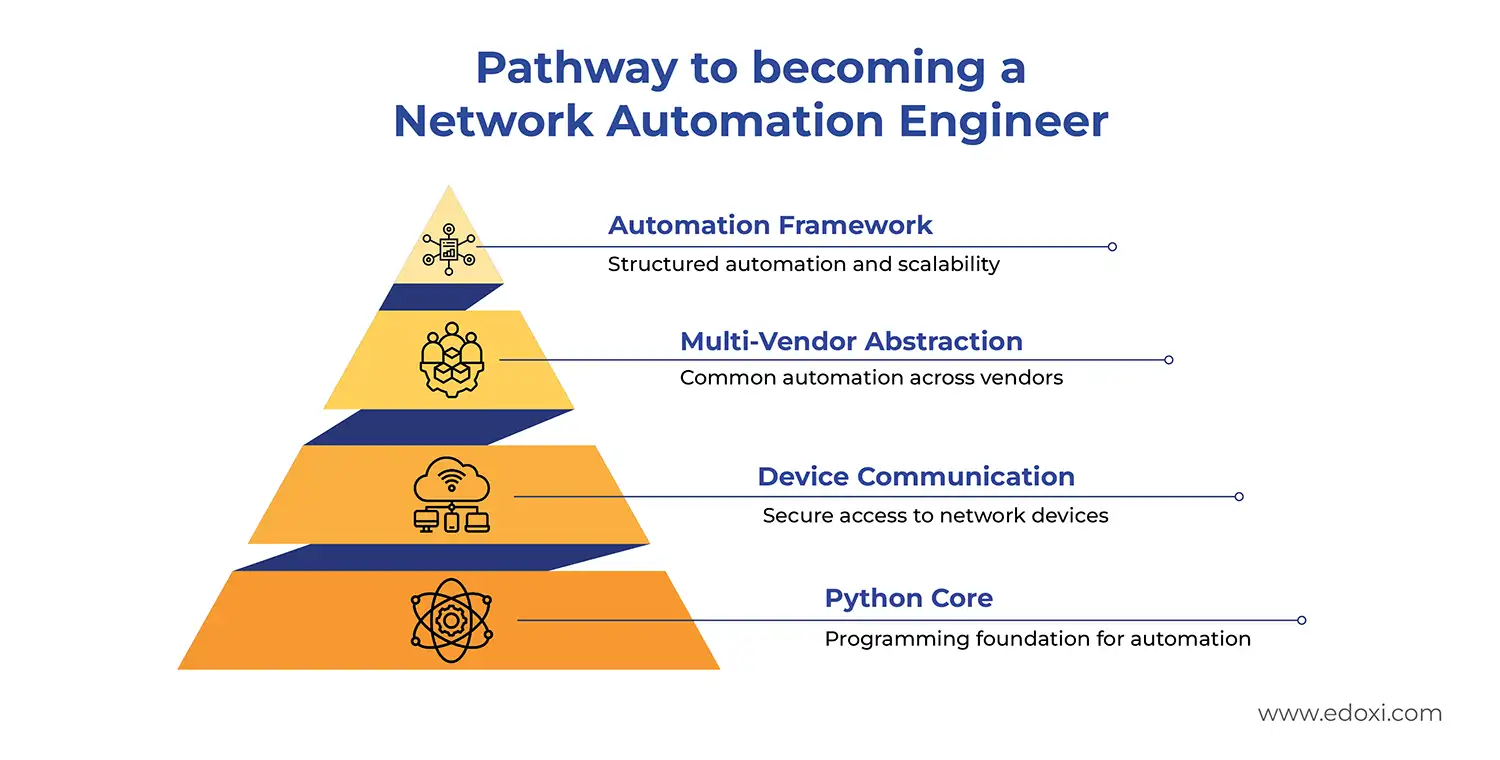
Learners gain real-world experience through interactive GNS3 labs using Cisco IOS and Arista vEOS, allowing them to practice in environments that closely resemble live enterprise networks.The training covers what learners actively search for in a network automation course, including SSH automation with Paramiko, configuration deployment using Netmiko, asynchronous automation with Python AsyncIO, and REST API integration for network management.
Practical exercises focus on OSPF automation, multi-device configuration backups, and vendor-agnostic scripting techniques, with Cisco-specific examples to ensure broad industry relevance. By the end of the course, learners confidently reduce manual workloads, minimise configuration errors, and improve overall network reliability.
Enrol now in our Network Automation classes and become industry-ready for modern network automation and DevOps roles.
Practice automation scripts on simulated Cisco, Arista, and Juniper devices in realistic network topologies.
Receive production-ready Python scripts, YAML playbooks, and network templates for immediate workplace implementation.
Execute real-time configuration changes on network equipment using SSH, Telnet, and serial connection methods.
Build concurrent automation applications using AsyncIO, asyncssh, and aiofiles for high-performance network operations.
Create infrastructure-as-code solutions using Ansible modules specifically designed for Cisco and multi-vendor environments.
Develop reusable Python classes based on Paramiko and telnetlib to simplify network automation development.
Automate repetitive configuration tasks efficiently.
Streamline device management through Python scripting.
Integrate network automation into CI/CD pipelines.
Upgrade skills for programmable infrastructure management.
Transition from manual networking to automation roles.
Upskill staff for software-defined network operations.
This network automation course provides extensive GNS3 lab environments featuring Cisco IOS and Arista vEOS platforms for realistic device simulation. Classroom activities include SSH and Telnet automation exercises, script development sessions, and live debugging workshops using PyCharm and VSCode editors. Participants engage with Paramiko library implementations, Netmiko batch configurations, and PySerial console automation throughout hands-on modules.
Automate router configuration backups using Netmiko and multithreading with error handling and logging.
Deploy OSPF configurations via Jinja2 templates and verify routing stability across multiple devices.
Use AsyncSSH and AsyncIO to collect interface data concurrently from numerous network devices.
Run NAPALM scripts to validate configuration compliance across Cisco, Arista, and Juniper environments.
Create Ansible playbooks for automated interface updates, ensuring consistent, idempotent configurations.
Automate base device setup through PySerial console scripts for quick and error-free provisioning.
Network Automation with Python and Ansible course establishes strong career foundations in network programmability within Dubai's technology sector. These roles offer substantial growth potential as organisations increasingly adopt software-defined networking, infrastructure-as-code methodologies, and automated configuration management systems.

Get expert assistance in getting you Network Automation Course customised!
Here’s a four-step guide to becoming a certified Network Automation professional.

Join Edoxi’s Network Automation Course
The following are some of the reasons why you should choose Edoxi for Network Automation in Dubai;
Learn from certified professionals experienced in Python-based network scripting and multi-vendor automation frameworks.
The course covers Python fundamentals to advanced automation tools, enabling even non-programmers to master network programmability.
Build automation scripts, validate configurations, and perform multi-device operations through real GNS3 lab exercises.
Gain practical experience with Paramiko, Netmiko, NAPALM, AsyncIO, and Ansible for modern network environments.
Trusted by telecom, IT, and enterprise clients across the UAE for team upskilling in network automation practices.
Edoxi has training centers in Dubai, Qatar, and London, providing standardised training across the Middle East and beyond for consistent skills development.

Our mentors are leaders and experts in their fields. They can challenge and guide you on your road to success!

Afreen M
Afreen, with four years of dedicated teaching experience, has successfully trained over 100 students in programming languages like Python, SQL, and Java. She combines her technical expertise with a passion for education, tailoring her instruction to suit the unique needs of young learners. Her interests in reading and working on coding projects help her design engaging and practical learning experiences for her students.
Afreen’s teaching philosophy emphasizes hands-on learning, guiding children through projects like game development and calculator applications. Her balanced approach helps students build confidence in technology while mastering essential programming skills. By staying actively engaged with personal coding projects, she ensures her teaching remains current, practical, and effective, creating an encouraging environment where children can explore and understand coding concepts with ease.
Absolutely, the course emphasises production-ready automation scripts and real-world scenarios. Participants develop backup systems, configuration deployment tools, and monitoring scripts applicable to existing network environments.
The curriculum aligns with Cisco networking concepts while teaching automation using Python. CCNA, CCNP, and CCIE holders enhance their credentials by adding programmability skills to traditional networking expertise.
The course bridges traditional networking with modern DevOps practices through infrastructure-as-code concepts, version control integration, and automation framework development. Participants learn to integrate network automation into continuous deployment pipelines.
Yes, the course explicitly covers Arista, Juniper, and Linux automation using the NAPALM library and vendor-neutral scripting approaches. Most examples adapt to heterogeneous network environments with minimal modifications.


