Request a Callback

+971 43801666
 Aug 05, 2026
AI integration is the norm in the workflow of any organisation. Relying on AI can bring some perks to the table, like enhanced productivity, reduced costs, personalisation, and more. It also has drawbacks, including security risks, ethical concerns, job displacements, etc.
To maximise the value of AI while minimising its risks, organisations invest not only in AI technologies but also in comprehensive AI training for their workforce. Nevertheless, an organisation that makes use of AI systems should clearly understand the advantages and disadvantages of AI. Only the right awareness could lead to the smart utilisation and management of AI.
This blog guides you through the pros and cons of artificial intelligence in detail with real-life examples.
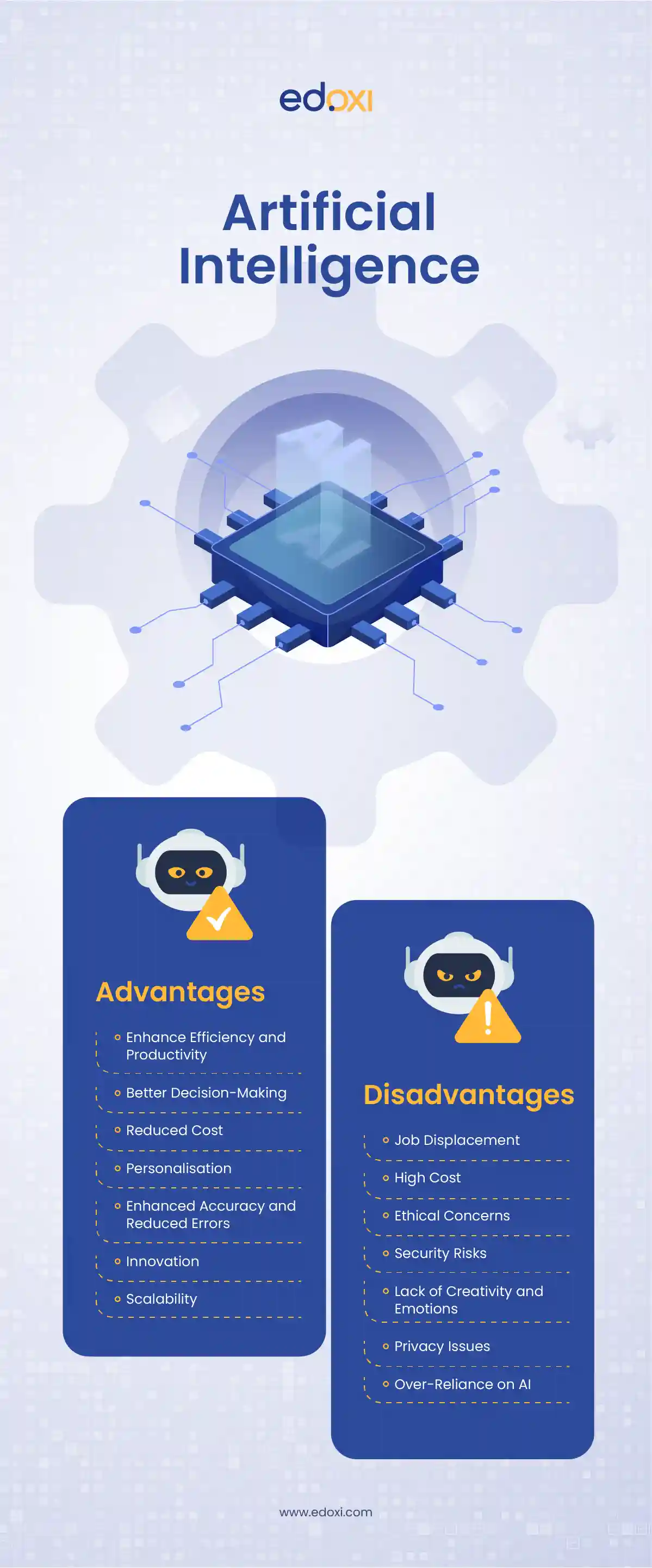
Learn more about the advantages and disadvantages of artificial intelligence below.
Read More: What Is Artificial Intelligence
Artificial intelligence has numerous crucial advantages that support operational success in various domains. Given below is the list of pros of an AI system.
Enhance Efficiency and Productivity
Better Decision-Making
Reduced Cost
Personalisation
Enhanced Accuracy and Reduced Errors
Innovation
Scalability
Let us explore these advantages in detail.
Integrating AI in the workflow is highly beneficial in improving efficiency and productivity. AI can perform tasks faster than humans. AI can easily perform repetitive and mechanical tasks with speed and accuracy. With expert guidance and proper monitoring, AI can also provide the best outcomes. AI integration can help in faster operations and improved overall productivity.
An excellent example of this is the chatbot assistance on websites for enquiries. When we open a website, a chatbot appears to assist potential customers with their queries. This can reduce manual effort, and customers also receive real-time updates via chatbots.
With many AI Courses available in the market today, make sure you choose the right program to upskill your team and experience higher productivity, faster task completion, and improved operational efficiency while maintaining human oversight where needed.
Check out How To Utilize AI To Increase Employee Productivity.
AI enhances the proactive and informed decision-making process. AI can quickly and efficiently analyse large data sets and identify patterns and trends easily. This way, AI integration can support the decision-making process in various domains.
For example, in banking, the bank can analyse the data of a customer and get information on the expenses and credit history. This analysis helps the bank in deciding whether to approve a loan or a credit card for the customer.
The AI automation incorporated in your workflow requires an initial investment but helps to minimise your operational costs. Budget optimisation can be achieved with AI integration by minimising manual labour, reducing mistakes, and ensuring efficient resource usage.
Any company can incorporate an AI system to find any errors in their products or services at an early stage. This early detection of errors with the help of AI can help reduce the cost and usage of resources.
AI integration can help improve personalisation by analysing user behaviour and preferences, and this further helps to enhance the customer experience. With many customisable AI Courses available, choosing the right training can guarantee improved customer engagement and satisfaction, and increased sales.
Your go-to apps, like Netflix, Spotify or Amazon Prime, are the best example of personalisation. These apps suggest movies, web series, songs, or podcasts according to your interests and preferences, which are identified with historical patterns. This enhances your customer experience and satisfaction, and you start purchasing from them again.
AI usually works according to algorithms and data, which can reduce human errors. In a financial domain or an accounting system, AI integration helps in the automatic checking of invoices and financial records. AI can also identify any calculation errors or duplicate entries that are difficult for humans to identify.
AI integration can bring along innovation, creative solutions, research opportunities, and product developments.
AI is the core factor that drives the development of robotics, including self-driving cars and advanced household appliances. AI also plays a crucial role in the medical
research domain.
Checkout,AI in Media Industry: How AI is Transforming the Media Industry? And AI in Creative Jobs: How Can Artificial Intelligence Be Used in Creative Jobs?
AI can easily handle the workload without compromising the quality of performance. The scalability that AI provides can help organisations to increase their operations scale without worrying about expanding human resources and infrastructure.
The filtering system in Email that is powered by AI blocks spam emails for innumerable customers simultaneously in real time.
Taking professional artificial intelligence training can help you advance in your career by enjoying its advantages.
Artificial Intelligence benefits us in a lot of ways; however, it has several disadvantages and risk factors. Below is the list of cons of AI.
Job Displacement
High Cost
Ethical Concerns
Security Risks
Lack of Creativity and Emotions
Privacy Issues
Over-Reliance on AI
Let us explore the disadvantages of AI in detail.
AI can replace many job roles that include repetitive and mundane tasks. This creates challenges for many. The “Future of Jobs Report, 2025, by the World Economic Forum states that “40% of employers expect to reduce their workforce where AI can automate tasks.
Despite this, many job roles are being introduced in the technology field because of the advancement of AI. To help employees adapt to this changing landscape, organisations are heavily investing in AI training and upskilling initiatives.
Here you may check The 10 Jobs Most at Risk of Being Replaced by AI and 5 Industries That Will Be Most Affected by AI
Some traditional jobs are getting advanced with the arrival of technology and AI. Updating and exposure to advanced technology, along with constant AI reskilling and upskilling, are crucial for people to survive in their jobs.
Are you concerned about “ Will Artificial Intelligence Take Over Human Jobs by 2030?” Check out Job Security in the Age of AI- Here Are 13 Ways You Can Protect Your Job
AI helps in minimising long-term costs; however, the initial investment in terms of infrastructure and skilled professionals to maintain AI is costly. Small to medium enterprises may find it financially difficult to develop, implement, and maintain AI.
The continuous updation is also crucial for AI systems, which is also of high cost. The return on investment improves when businesses complement AI implementation with corporate AI training. This ensures employees can effectively utilise AI tools and minimise costly implementation errors.
AI systems should be used carefully, as they may sometimes lead to some ethical concerns. They often show biases in algorithms, privacy issues, and a lack of transparency, which often causes poor decision-making and excludes some significant details.
Improving AI literacy across the workforce helps employees recognise algorithmic bias, transparency issues, and ethical risks before deploying AI solutions.
AI systems can be attacked by cyber threats, as they are part of the critical infrastructure of an organisation. Compromised AI system models and manipulated data can lead to high security risks, such as financial loss and failure of systems.
Regular AI workplace training enables employees to identify cyber threats, protect sensitive data, and follow secure AI usage practices.
The AI systems lack the creativity, understanding, emotions, and empathy of a human. Artificial intelligence may fail in understanding or handling customers with empathy, pitching sales through emotions, or helping users with creative ideas. Human judgment and intelligence are crucial in such contexts.
AI implementation often causes privacy issues. AI systems mainly rely on data in their functioning, and this data may be personal or sensitive. Privacy violations may occur when this data is misused or managed improperly.
Anonymisation, pseudonymization, encryption, and differential privacy are some of the effective privacy methods used in AI for protecting our data. It is required to have user consent to reduce the privacy risks of AI systems.
Professionals responsible for handling sensitive data can benefit from an AI certification course that covers AI governance, privacy regulations, and compliance requirements.
The over-reliance on AI is a creativity killer in humans. Depending on AI too much causes the gradual and significant decline of human creativity and critical thinking capability. The complete dependency on AI causes disruptions in the workflow of the organisation when the AI system fails.
Read more about How AI Will Impact The Future Of Work And Life and Why Upskill In The Age of Artificial Intelligence?The ever-evolving artificial intelligence has advantages and disadvantages equally. We should be careful about how we use AI to make it beneficial for us, rather than focusing on what we could benefit from AI. Smart usage is always crucial when it comes to AI. AI could never be a danger when we use it wisely.
The right knowledge about the pros and cons of AI is the foundation for using AI better. I hope this blog has guided you with some useful insights on this topic. So it is your turn to use it appropriately.
Read More: How AI is Transforming Jobs and Industries in the UAE by 2031
AI systems are designed to strictly follow the programmed rules and to analyse the historical data and patterns. This is how the AI perform tasks with minimised errors.
No, AI cannot completely replace all human jobs, because AI cannot function properly without expert human monitoring. This actually opens doors to new jobs and opportunities. Yet some routine jobs with repetitive tasks can be replaced by AI.
The initial implementation and maintenance of AI needs advanced hardware, software, skilled professionals, and regular updates. So, to implement and maintain AI, you need to invest a huge amount initially.
AI helps to make proactive decisions based on analysing data and algorithms. But human intelligence, judgement, and ethics are crucial in this decision-making process, especially in complex situations.
AI can be reliable for long-term use only when it is properly monitored by human experts. Overly depending on AI and using it without human supervision may cause biases, errors, and system failures.
No, AI lack genuine creativity, because it is a system that works based on programmed rules, and analysing historical data and patterns.