Request a Callback

+44 7497 303637
 Aug 10, 2026
|
KEY TAKEAWAYS
|
The UAE is building an AI economy. In 2017, the UAE became the first country in the world to appoint a dedicated Minister of State for Artificial Intelligence. That was the opening move in one of the most ambitious national AI strategies ever written.
The UAE National Strategy for Artificial Intelligence 2031 sets a clear destination: position the UAE as a global AI leader by 2031, generating up to AED 335 billion in additional economic output and transforming how industries operate and how people work across every emirate.
For professionals, students, and business leaders in the UAE, the central question is: " How AI is Transforming Jobs and Industries and how fast and how prepared they are when it does?” This is exactly what this blog covers!
The UAE AI Strategy is a core pillar of the UAE Centennial 2071, the government’s long-horizon plan to make the UAE the best country in the world by the time it turns 100.
“We want the UAE to become the world’s most prepared country for Artificial Intelligence.”
— HH Sheikh Mohammed bin Rashid Al Maktoum, UAE Vice President and Prime Minister
Artificial Intelligence Training enables machines to learn, reason, solve problems, and perform tasks that typically require human cognition. AI’s role in that plan is economic as much as technological:
The strategy does not aim for leadership across every technology. Instead, it focuses investment where the UAE already has world-class assets, its infrastructure, and its diverse population of over 200 nationalities. It track record of rapid, government-led transformation.
Read Now: Top AI Software For Productivity And Efficiency
The UAE National Strategy for Artificial Intelligence 2031 identifies five priority sectors where the UAE has a genuine competitive advantage and a realistic path to global leadership.
As artificial intelligence in the UAE continues to evolve, organisations across these industries are adopting AI technology, machine learning, and AI solutions to improve efficiency, innovation, and decision-making. This growing demand is also increasing the need for AI training courses in the UAE.
The UAE is the fifth-largest oil exporter in the world, and its energy sector already runs on modelling software and predictive algorithms. AI deepens that capability and extends it into the renewable energy transition underway across the country.
Projected AI economic impact: AED 91 billion
Dubai Airport handles 60 million passengers annually. Abu Dhabi Airport handles 26 million. Jebel Ali Port, the largest marine terminal in the Middle East, provides market access to over 2 billion people. This infrastructure is not just an economic asset. It is a live testbed for AI systems.
Projected AI economic impact: AED 19 billion
Tourism is one of the UAE’s highest-value AI opportunities, with a projected impact of AED 136 billion. The vision is deeply personalised visitor experiences, AI-driven itinerary planning before arrival, automated multilingual concierge services during the stay, and predictive demand management for hotels and attractions.
The UAE’s healthcare AI strategy is focused and specific. Its 200+ nationality population creates a uniquely diverse dataset for genomic and clinical research. The Dubai Health Authority’s Dubai Genomics program aims to bring population-scale whole-genome sequencing to the emirate. The AI Office has already funded a working pilot: an AI algorithm that detects Tuberculosis through X-ray analysis, launched at the UN World Data Forum.
With projected global cybercrime costs of USD 6 trillion annually and the UAE’s growing position as a regional technology hub, cybersecurity is a strategic national imperative. The strategy recognises AI as both the primary threat vector and the primary defence.
The UAE public sector has been building digital services for 16+ years. AI applications already run across government, including smart traffic sensors, dynamically adjusted transport timetables, facial recognition to monitor driver fatigue, and chatbots for public customer service. The UAE AI and Blockchain Council oversees the continued acceleration of AI across all emirates.
Read: 5 Industries That Will Be Most Affected By AI
|
Sector |
Projected AI Output Increase (AED Billion) |
|
Finance, Professional & Other Services |
103 |
|
Mining |
86 |
|
Construction |
39 |
|
Retail Trade |
39 |
|
Logistics |
33 |
|
Manufacturing |
19 |
|
ICT |
18 |
|
Government & Social Services |
14 |
|
Utilities |
13 |
|
Hospitality |
5 |
|
Agriculture |
3 |
|
TOTAL |
335 |
(Source: UAE National Strategy for Artificial Intelligence 2031, based on UAE FCSA National Accounts data)
Get a complete understanding of AI: What is Artificial Intelligence?
Research commissioned for the World Government Summit found that:
The highest-risk roles involve routine, repeatable tasks: data entry, administrative processing, basic customer service management, and predictable manufacturing operations.
The lowest-risk roles require human judgment, creativity, and empathy: healthcare practitioners, educators, designers, and strategic leaders.
Read: The Impact of Artificial Intelligence on HR Roles
The strategy does not frame this as humans versus machines. Its explicit position is that AI augments human capability rather than simply replacing it. The UAE’s approach, funding proofs-of-concept, training government employees to work with AI systems, and building AI literacy across the workforce, reflects a transition model, not a displacement model.
Check out: National Program for Artificial Intelligence Launches Fifth Edition of UAE AI Summer Camp
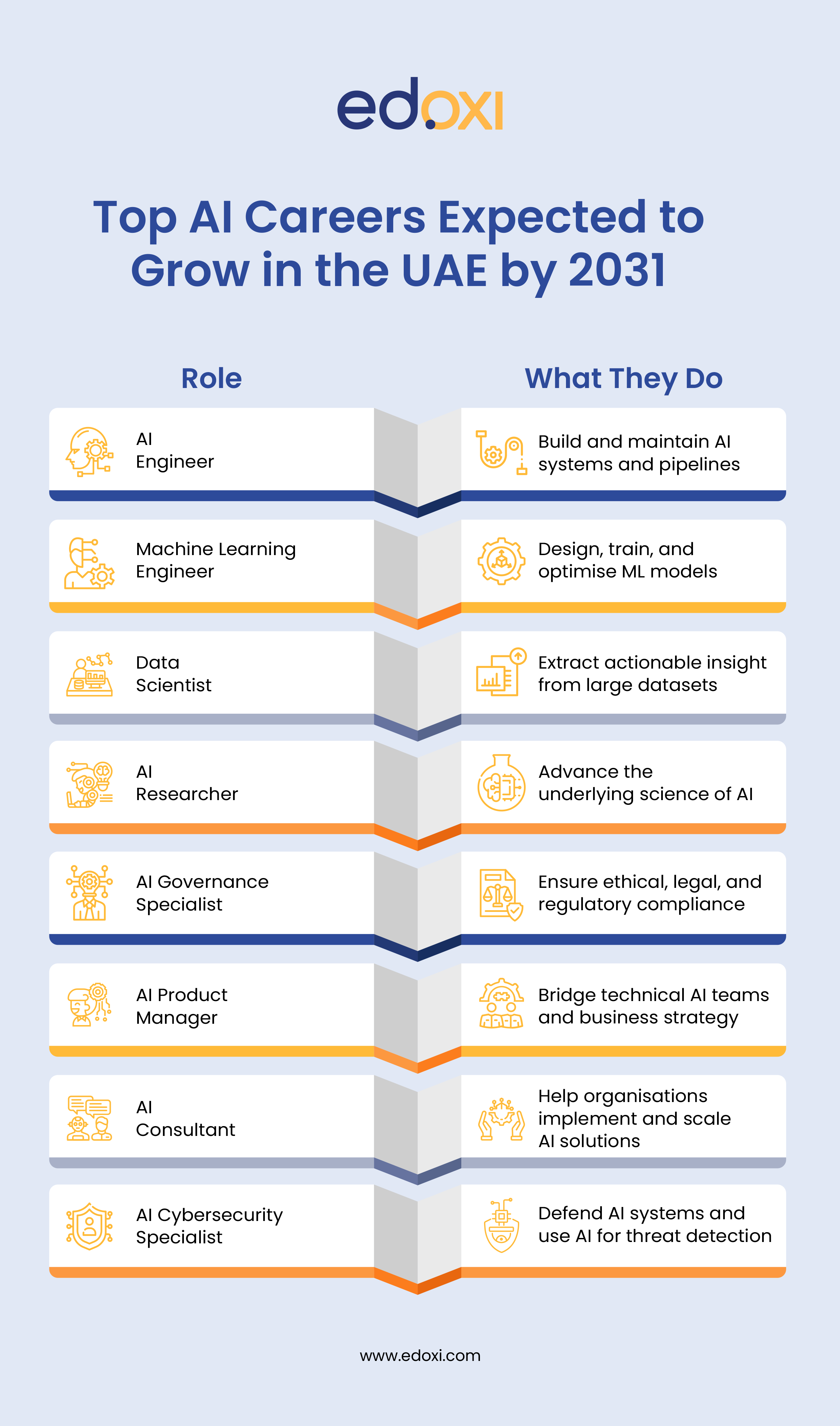
The UAE’s AI transformation will generate significant demand for roles that either did not exist a decade ago or are growing faster than any other category.
Read now: How AI Is Helping To Identify Skills Gaps And Future Jobs?
Free AI courses are already running for UAE residents. The UAE AI Summer Camp trained over 5,000 residents in AI fundamentals with hands-on experience.
The UAE has a structural advantage: 22% of university graduates study AI-relevant STEM disciplines, higher than in the United States (16%) and Australia (18%). The government’s target is to AI upskill one-third of STEM graduates per year, approximately 2,000 students annually, through specialist AI courses and postgraduate pathways.
With 70% of Emiratis in public sector roles, AI literacy in government is non-negotiable. The AI Office has committed to training 100% of senior leadership, at Director-General, Ministerial, and Senior-Ministerial levels, with each participant completing a capstone project directly tied to their current government role.
For working professionals with existing digital or analytical skills, the strategy funds secondments, specialist training programs, and international study tours, targeting the UAE’s strong cohort of professionals in operations, IT, and engineering who are closest to AI-readiness.
For the 60% of the workforce with lower digital skills, the strategy commits to career advice tools, apprenticeship programs, and retraining services to support workers whose roles are most exposed to automation.
Read: How AI Will Impact The Future Of Work And Life
Here’s what the AI Transformation means for Professionals in the UAE;
Students: The UAE is actively building an AI-ready workforce through STEM education, scholarships, and AI learning initiatives. Students who develop skills in AI, coding, and data early will have access to some of the fastest-growing career opportunities in the region.
IT & Tech Professionals: AI adoption is creating a direct pathway for IT professionals to move into high-demand roles such as AI engineering, automation, machine learning, and AI consulting. Professionals with existing technical foundations can transition faster than most industries.
Business Professionals: As companies integrate AI into daily operations, professionals who understand AI tools, strategy, and workflow transformation will become critical to business growth. AI literacy is rapidly becoming a leadership advantage across industries.
Engineers: From smart infrastructure to predictive maintenance, AI is reshaping engineering across construction, logistics, manufacturing, and energy. Engineers who combine domain expertise with automation and data skills will be highly sought after.
Government Employees: With the UAE accelerating AI adoption across public services, AI literacy is becoming essential within government roles. Professionals who adapt to AI-driven systems and digital operations will be better positioned for long-term career growth.
Check Out: How to Build a Career in Artificial Intelligence?
The UAE National Strategy for Artificial Intelligence 2031 is a government roadmap to make the UAE a global AI leader by 2031. It outlines eight strategic objectives, five priority industries, and a comprehensive plan for building AI talent, data infrastructure, research capability, and governance frameworks.
The strategy projects a potential AED 335 billion increase in economic output, a 26% uplift, when automation is applied across UAE industries. PwC separately estimated AI will contribute AED 353 billion to GDP by 2030, equivalent to 13.6% of GDP.
The five priority sectors are energy and resources, logistics and transport, tourism and hospitality, healthcare, and cybersecurity. Finance and professional services represent the largest single economic AI opportunity at AED 103 billion.
Around 43% of existing work activities in the UAE have the potential to be automated. Approximately 300,000 jobs in the administrative and government sector may be impacted, with around 125,000 of these held by UAE nationals.
The strategy points to data analytics, machine learning, business intelligence, computational thinking, AI governance, and sector-specific AI knowledge as the most valuable skills for an AI-driven UAE economy.
The UAE is running free public AI courses, targeting upskilling of 2,000 STEM graduates per year, training 100% of senior government leadership in AI, funding professional secondments and specialist programs, and providing career transition support for workers at risk of automation.