Request a Callback

+971 4380 1666
 Sep 03, 2026
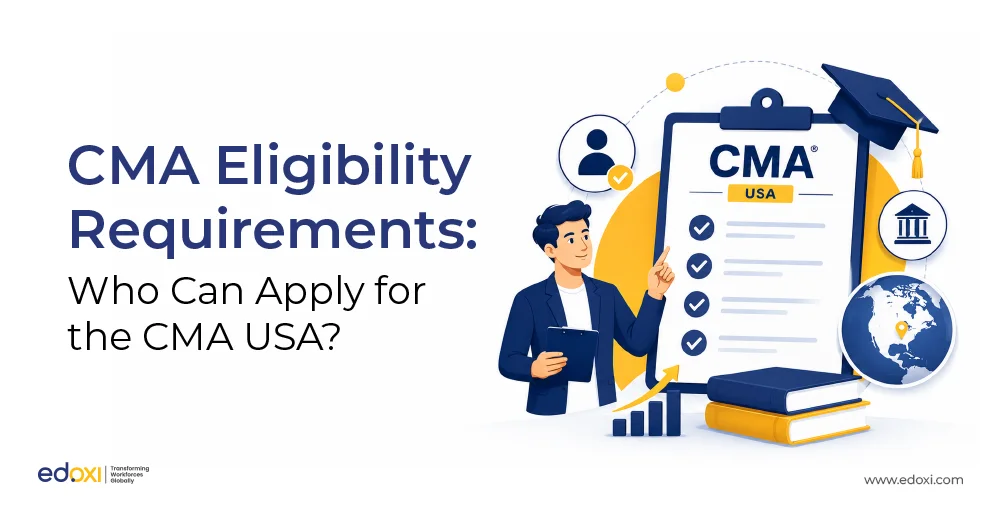
To qualify for the CMA USA, you must meet the education and experience requirements set by the Institute of Management Accountants (IMA). You need a bachelor's degree from an accredited institution, or an accepted professional certification. You also need two years of relevant experience in management accounting or financial management. An accounting, finance, or commerce degree is not required to begin the CMA journey. You can even sit for the CMA exams before you finish your work experience, provided you meet all certification requirements within the set timelines.
CMA USA is a globally recognized professional credential for accounting and finance professionals who want to develop expertise in management accounting, financial management, analysis, and strategic decision-making. Understanding the eligibility requirements before enrolling can help candidates plan their education, work experience, IMA membership, and examination pathway effectively.
This guide explains who can apply for the CMA USA, the required academic and professional qualifications, and what candidates need to complete to earn the CMA designation. According to the latest IMA requirements, certification involves active IMA membership, meeting the education and experience criteria, passing both CMA exam parts, and complying with IMA’s ethical standards.
This blog explains each CMA USA eligibility requirement in detail. It covers education, professional experience, IMA membership, exam rules, and certification timelines. By the end, you will know exactly what you need before you enrol.
Quick Note: CMA USA is not the same qualification as CMA India. CMA USA is issued by the IMA in the United States. CMA India is a separate, India-only credential awarded by the Institute of Cost Accountants of India (ICMAI), with its own foundation-to-final exam structure.
For a broader look at how the CMA credential supports finance professionals, explore this guide to CMA for Finance Professionals
Here are the five eligibility requirements you need to satisfy for the CMA USA:
Let's look at each of these requirements in detail.
Before exploring the individual eligibility criteria, it may also help to understand the role of IMA and the management accounting pathway through this IMA Management Accounting and Education Guide
The degree requirement is simpler than most people assume. You need a bachelor's degree from an accredited college or university. It does not have to be in accounting, finance, or commerce. IMA does not restrict the field of study, and that is usually where the confusion starts. Here is what else you should know:
To complete your CMA qualification, you should have two continuous years of experience in management accounting or financial management. You do not need to finish it before you start the exams. It can be completed before, during, or after the exam, as long as you stay within seven years of passing. A few points are worth noting:
IMA membership is mandatory, and it must stay active throughout your certification journey. Only active members can register for the CMA exam and earn the credential. Here are a few points to keep in mind:
The CMA exam has two parts. You can sit for them in either order once you have enrolled and are an active IMA member. Part 1 covers financial planning, performance, and analytics. Part 2 covers strategic financial management. For most candidates, this is what it looks like in practice:
You have three years from the date you enrol to pass both CMA exam parts. You then have seven years from the date you pass the exam to complete your education and experience requirements. Plan your timeline around these points:
The table below gives a quick overview of the main requirements to earn the CMA USA designation.
| Requirement | What It Involves |
|---|---|
| Education | Bachelor's degree from an accredited institution, in any field, or an accepted professional certification |
| Experience | Two continuous years in management accounting or financial management, within seven years of passing the exam |
| Membership | Active IMA membership, required from enrolment through certification |
| Exam | Part 1 and Part 2, in either order, both passed within three years of enrolling |
| Ethics | Adherence to IMA's Statement of Ethical Professional Practice |
Yes. Fresh graduates and final-year students can both apply for the CMA USA, because the experience requirement can be completed after you pass your exams.
For candidates considering the qualification as a career investment, you can also explore the benefits of CMA certification in Dubai
Here is what that means for most students:
Eligibility is rarely the real barrier to becoming a CMA. Hesitation is. You already understand what the degree, experience, and exam requirements involve. None of them are out of reach for a motivated candidate. The longer you wait to enrol, the longer it takes for your three-year exam window and seven-year experience window to even begin. Enrol in a CMA programme now. Sit for Part 1 while the material is fresh, and let the two-year experience requirement build itself into your next job.
Once you understand the eligibility requirements, the next step is to understand the examination structure. See this comparison of CMA Part 1 vs CMA Part 2 to understand what each exam covers.
If you’re ready to explore the learning pathway, course structure, and preparation options, see the CMA USA Course in Dubai for further details.