Request a Callback

+971 43801666
 Sep 07, 2026
|
Quick Answer: Which Training Delivery Mode Works Best? For most Dubai-based companies, blended (hybrid) corporate training works best and is the strongest choice among other options. It combines the flexibility of online corporate training with the engagement and relationship-building benefits of classroom learning, making it an ideal fit for today's GCC workplace culture. That said:
|
If you're planning a training programme for your team in Dubai, you've probably asked yourself this question: should we go onsite, online, or blended? There's no single right answer for every company.
The best corporate training delivery mode depends on your team size, budget, industry, and how spread out your people are across Dubai, Abu Dhabi, and the wider UAE.
Corporate learning also supports the UAE's broader Vision 2031 goals of building a knowledge-based economy and developing globally competitive talent.
This guide combines regional workforce trends, UAE market reports, learning and development research, and corporate training delivery practices commonly used by organisations across Dubai and the GCC.
Table of Contents |
|
1. Which Corporate Training Delivery Mode is Best for Dubai Teams?
1.1 What Does the Latest Data Say About Corporate Training Delivery Modes? 2. How Do You Choose the Right Corporate Training Delivery Mode? 2.1 Corporate Training Delivery Mode Decision Matrix for Dubai Businesses 2.2 What is the Best Corporate Training Delivery Mode for Different Company Sizes? 2.3 Which Training Delivery Mode Works Best for Each Industry? 3. Is Onsite Corporate Training Still Worth It in 2026? 3.1 Is Online Corporate Training Actually Effective for UAE Teams? 4. Why Blended Learning is Becoming the Default Choice for Corporate Workforce Training in the UAE? 4.1 A Simple Decision Checklist for HR and L&D Teams in Dubai 5. Why Is Choosing the Right Training Delivery Mode Important for Dubai Businesses? 5.1 Conclusion: There's No One "Best" Mode, Only the Best Fit 6. FAQs: What is the best corporate training delivery mode for Dubai teams? |
The three major corporate training delivery models best suited for Dubai teams include the following:
The comparison table for these corporate training delivery modes is given below:
The Three Main Corporate Training Delivery Modes, Compared
| Delivery Mode | Best For | Typical Cost (per person/day) | Strengths | Watch-outs |
| Onsite / Classroom Corporate Training in Dubai | Single-location teams, hands-on or safety-critical skills, leadership offsites | AED 1,500–8,000+ | Strongest engagement, easy team bonding, no tech issues |
Higher venue/logistics cost, harder to scale across Emirates
|
| Online Corporate Training | Remote/distributed teams, high-volume compliance training, cost-conscious rollouts | 20–30% cheaper than onsite | Scales fast, flexible timing, easy to repeat for new hires |
Lower engagement if not well-facilitated, needs strong LMS
|
| Hybrid / Blended Corporate Training | Multinational teams, companies with offices across UAE/GCC, leadership + skills combos | Mid-range, varies by mix | Best of both worlds, supports different learning styles |
Needs careful instructional design, not just "half and half"
|
Cost estimates reflect current Dubai market ranges reported by regional training providers.
|
What Is Corporate Training Delivery Mode? Corporate training delivery mode is the method used to deliver workplace learning to employees. The three main delivery modes are onsite (classroom), online (virtual), and blended (hybrid) training. The right choice depends on your business goals, workforce size, budget, and the type of skills being taught. |
Modern workplace learning increasingly combines digital learning with instructor-led experiences.
If you're still mapping out the basics, read this blog on what corporate training is and how it works before choosing a delivery mode.
Recent reports give a clear direction about corporate training delivery modes for 2026 in Dubai:
This tells us something important: Dubai companies are not choosing one format and sticking to it forever. They're mixing formats by department, seniority level, and skill type.
To choose the right corporate training delivery mode, ask these three questions before you book any professional training from a Dubai provider:
1. Where is your team physically located?
If everyone works from one Dubai office, onsite corporate training Dubai delivery gets you the fastest engagement.
If your team spans Dubai, Abu Dhabi, Dubai Internet City, Dubai Silicon Oasis, JAFZA, DIFC, Sharjah, Ras Al Khaimah, Ajman, Fujairah, and Riyadh, hybrid corporate training keeps everyone aligned without flying people around.
2. What's being taught?
Soft skills, leadership, and culture-building content generally land better face-to-face. Technical certifications, compliance modules, and tool-based training (like AI or software skills) translate well to online corporate training Dubai formats.
3. What's your budget per employee?
Online corporate training Dubai courses typically run 20–30% cheaper than in-person equivalents, per multiple regional training providers. If you're training a large workforce at once, that difference adds up quickly.
If your organisation requires recognised professional development, check whether the training provider offers KHDA-approved courses where applicable.
|
Why Does the Training Delivery Method Affect Learning Outcomes? The way training is delivered directly impacts employee engagement, knowledge retention, participation, and return on investment (ROI). For example, classroom training is often more effective for leadership and hands-on skills, while online learning improves flexibility and scalability. Blended learning combines both approaches, helping organisations achieve better learning outcomes and long-term business results. |
Use this quick decision matrix to match your training objectives, workforce structure, and learning needs with the most effective corporate training delivery mode.
Corporate Training Delivery Mode Recommendations by Business Need
| If your goal is... |
Best Delivery Mode
|
| Leadership Development | Onsite |
| Compliance Training | Online |
| Software Training | Online / Hybrid |
| Sales Training | Onsite |
| AI Training | Hybrid |
| Large Workforce | Online |
| Team Building | Onsite |
| Multi-country Teams | Hybrid |
Choosing the right delivery mode is only half the equation; to understand the actual skill impact, read this blog on how corporate training programs improve employee skills.
Depending on the company size, the best corporate training delivery mode can be suggested as given below:
The training delivery modes that work best for each industry are given in the table below:
Best Corporate Training Delivery Modes by Industry
| Industry | Best Mode |
| Oil & Gas | Onsite |
| Healthcare | Blended |
| Banking | Hybrid |
| Government | Classroom |
| IT | Online |
| Retail | Hybrid |
| Aviation | Classroom |
| Hospitality | Hybrid |
Yes, for the right use cases. Face-to-face sessions remain the go-to choice for leadership development, negotiation skills, and any workplace learning Dubai programme where relationship-building is the actual goal.
In a region where in-person trust still shapes business relationships, a well-run classroom session builds rapport that a screen can't fully replace.
That said, onsite-only training struggles to scale. If your corporate training courses Dubai plan involves onboarding hundreds of new hires a year, pure classroom delivery becomes expensive and hard to repeat consistently.
Generally, yes, when it's designed properly. A majority of L&D teams, roughly 57%, are already using AI tools actively in learning content creation, with another 30% piloting the approach.
This means online and self-paced modules are getting smarter, more personalised, and less generic than the pre-recorded video courses of a few years ago.
The catch: online-only training tends to underperform when there's no live facilitator, no accountability check-in, and no connection to real job tasks. That's exactly why most Dubai corporate training providers' shortlists in 2026 default to a blended approach rather than pure e-learning.
According to the Dubai Chamber, businesses across the emirate continue to increase investment in workforce learning as organisations prioritise productivity and employee retention.
Blended learning isn't just "online plus classroom" done well; it's a structured mix where each format does what it's best at:
Global data backs this design. Managers who moved from classroom-only to blended formats retained roughly five times more content, according to internal L&D benchmarking cited by industry researchers.
For Dubai teams juggling shift patterns, multiple office locations, and tight project timelines, that retention boost is hard to ignore.
"We realised that many of the original concepts of e-learning (replacing instructor-led training) were incorrect: what we really needed to do was create a 'new' learning experience on the web, one which included both formal (structured) programs as well as a wide variety of informal (unstructured) forms of content."
- Josh Bersin, Global Industry Analyst and Founder of Bersin by Deloitte, The Blended Learning Book author
|
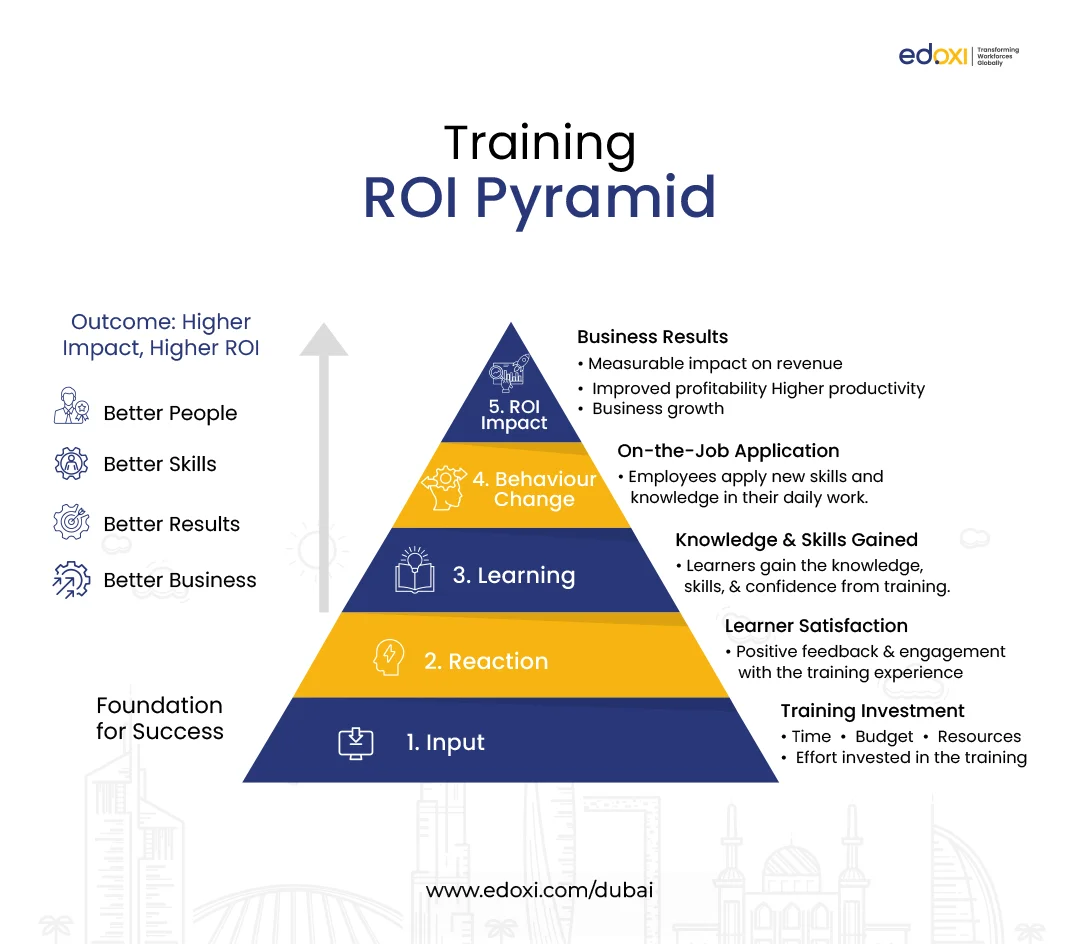
Which Delivery Mode Delivers the Highest ROI? For most Dubai businesses, blended (hybrid) corporate training delivers the highest ROI by balancing cost, flexibility, and engagement. Online training is the most cost-effective for large teams, while onsite training is ideal for leadership, hands-on skills, and team building. The best ROI comes from choosing the delivery mode that aligns with your business goals and workforce needs. "Blended learning is about fundamentally rethinking and redesigning the instructional model with the specific focus on optimising learning." - Dr Charles R. Graham, Professor, Brigham Young University and leading researcher in blended learning |
Before signing off on a corporate training institute in Dubai or building an in-house programme, run through this checklist:
Dubai's workforce isn't like a typical city's workforce. Over 200 nationalities work across Dubai's offices, and most professionals are expats juggling different working styles, time zones for regional offices, and cultural expectations around hierarchy and communication.
That mix changes how a corporate training institute in Dubai needs to design and deliver a programme.
On top of that, corporate training spend in Dubai has been climbing fast. The Dubai Chamber of Commerce reported a 23% year-on-year rise in corporate training and development spending in Dubai, with comparable growth seen across Abu Dhabi, Riyadh, and Doha.
Companies aren't cutting training budgets; they're rethinking how training gets delivered.
The honest answer to what is the best corporate training delivery mode for Dubai teams is simple: it depends on your team's needs, not the latest trend.
Blended corporate training programmes offer the best balance of cost, flexibility, and engagement for most companies across Dubai and the wider UAE.
However, there is no one-size-fits-all solution. A distributed sales team, a single-site factory workforce, and a leadership cohort will each benefit from a different delivery approach.
When choosing a corporate training provider in Dubai, look for one that offers onsite, online, and hybrid training options rather than a single delivery format.
That flexibility, not the format itself, helps protect your training investment and ensures your learning strategy can adapt as your workforce and business continue to grow.