Request a Callback

+44 7497 303637
 Aug 10, 2026
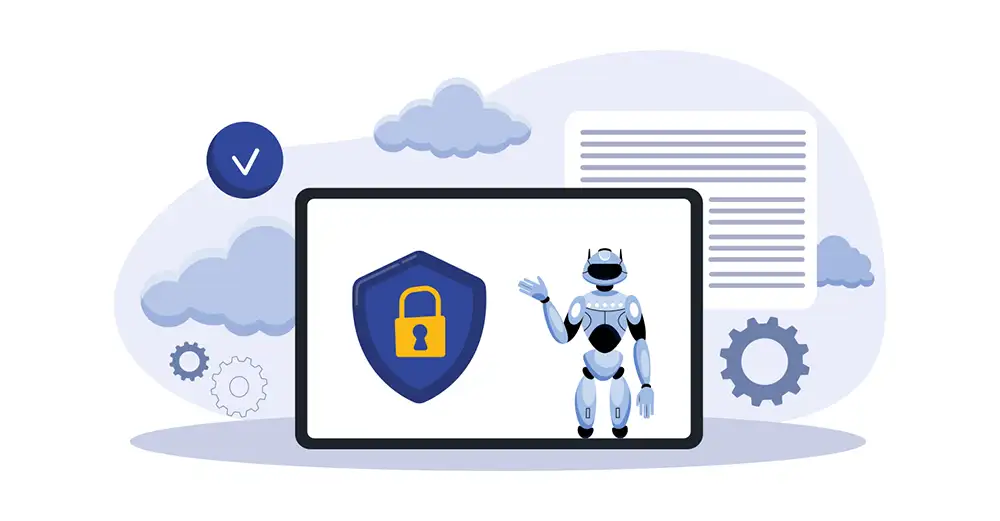
The cybersecurity domain has also implemented AI practices in its workflow to enhance performance and efficiency. Detecting anomalies and vulnerabilities quickly and accurately can be done with AI integration. According to Zipdo, “52% of organisations report large reductions in false positives after adding AI‑driven tools,” and “AI systems can detect malware and threats more accurately and faster than many traditional rule‑based defences.” Integration of artificial intelligence has truly been a game-changer in cybersecurity.
You must learn more about the advantages, functions, and applications of AI in cybersecurity to understand the crucial role it plays. This blog imparts insights into the impact of AI integration in cybersecurity
AI has a critical role in cybersecurity, and artificial intelligence has been integrated into various cybersecurity operations to enhance performance quality. Effective AI Training is essential to keep these systems accurate and adaptive against evolving threats. Review the list below to explore the key functions of AI in cybersecurity.
Threat Detection
Automation
Incident Response
Vulnerability Management
Behavioural Analysis
Let us have a detailed examination of the above-listed functions of AI in cybersecurity.
Threat detection is the primary function of AI integration in cybersecurity. AI consume data, including network traffic, logs, and user activity and creates an outline of normal behaviour. This understanding of the normal behaviour of a system makes it easy to detect any deviating patterns from that behaviour.
Integrating AI can efficiently ensure the real-time detection of phishing, flagging potential malware, and insider threats. AI uses several techniques, such as anomaly detection and predictive modelling, to identify anonymous threats. These capabilities can be enhanced through appropriate AI training, allowing AI models to recognise suspicious patterns more accurately.
Automation is a major function of AI, which helps automate repetitive tasks. The automation by AI helps to reduce errors and quickly complete complex tasks. AI helps the cybersecurity domain to resolve time-consuming tasks with higher efficiency and speed.
Automation helps in reducing errors and speeding threat detection and response, which is crucial in cybersecurity. AI automation also enhances the informed decision-making process in the cybersecurity field.
Incident response by AI integration in cybersecurity boosts the efficiency of various tasks. AI helps to automatically isolate compromised systems to avoid the spread. It also helps in blocking threatening or suspicious IP addresses, users, or accounts in real-time.
AI can generate intelligent response recommendations by analysing the history of attack patterns and attack severity. The AI-powered functions of cybersecurity help to reduce the manual efforts of analysts in processes like containment and remediation.
Vulnerability management using AI improves the real-time efficiency of cybersecurity tasks. AI can detect weaknesses that exist in systems, networks, and applications. By using threat intelligence and analysing behavioural patterns and historical attack data, AI can identify vulnerabilities quickly and efficiently.
AI also has the ability to perform risk-based prioritisation, helping cybersecurity teams prioritise high-impact vulnerabilities. The integration of AI in cybersecurity reduces the chances of cyber attacks and helps address critical security gaps effectively.
Professionals can develop these skills through predictive analytics training programs offered by top AI training institutes, where they learn how AI models analyse historical vulnerability and threat data to support better security decisions.
Behavioural analysis is one of the best features brought by AI integration in cybersecurity. AI can brilliantly analyse the behaviour of normal users, devices, and applications. Some anomalies, such as unusual login patterns, abnormal file access, or unexpected data transfers that can happen in cyber attacks, can be easily identified by AI.
Insider threats and compromised accounts may not be detected by traditional systems, but these can easily trigger AI and can be detected easily. Through behaviour analysis and changing behaviour, the AI-integrated security models can continuously evolve to update their efficiency to resolve new cyber threats. Are you looking to get your career started in AI in Cybersecurity?
Check out: How Edoxi Prepares You for a Successful AI Career in Qatar
The benefits offered by AI integration in cybersecurity are listed below.
Speed & Accuracy
Simplified Reporting
Actionable Insights
Scalability
AI can analyse large security data sets quickly and precisely. Rather than a manual process or traditional system, AI detects threats and addresses them in real-time.
To improve the security team's efficiency in processes like making real-time proactive decisions. This is done by creating simple dashboards and reports by automatically compiling logs, alerts, and incident data.
To make an efficient decision, meaningful insights are remarkable. The AI helps in identifying historical patterns, predicting potential risks, and critical vulnerabilities to make these actionable insights.
AI has scalability that can aid the expansion of organisations by adapting easily to expanding networks, cloud environments, and large data workloads.
Check out How To Utilise AI To Increase Employee Productivity.Let us see the key applications of AI in cybersecurity that we are making use of, and that advantage us in our daily lives, listed below.
AI integration has been a game-changer in cybersecurity, just like any other domain. The role of AI is crucial in cybersecurity for enhanced speed, efficiency, and scalability of cybersecurity functions. If you are someone who is genuinely interested in learning the possibilities of AI, I hope this blog has imparted some valuable insights for you.
Consider taking an artificial intelligence course if you are genuinely enthusiastic about AI and want to explore its possibilities in a cybersecurity career.The following are some examples of AI in cybersecurity.
Malware detection
Email spam and phishing filtering
Fraud detection in banking
Behavioural analytics
Automated incident response tools
AI can help in tracking cloud traffic, identifying anomalies, securing access, and detecting misconfigurations that attackers can exploit.
AI can analyse email patterns, detect suspicious links or attachments, and block phishing attempts before they reach the users.