Request a Callback

+971 43801666
 Aug 17, 2026
|
If you only read one paragraph, read this: Learn Data Science first. It teaches you the Python, statistics and data-handling skills that every AI system is built on, so the jump into machine learning and AI afterwards feels natural rather than overwhelming. The only real exception is if you're already confident with programming and maths and want to head straight for AI-specific tools such as TensorFlow or PyTorch. In Dubai and across the wider UAE, this isn't just a theory. Most "AI Engineer" job adverts still expect the same data-handling fundamentals you'd learn on day one of a data science course. Build that base first, and the rest of the ladder gets a lot easier to climb. |
Let’s deep dive into this confusing subject and dig out the answer. Here’s what this blog covers:
Table of Contents |
|
1. Why This Question Matters More in the UAE Than Almost Anywhere Else
2. What Is Data Science, Really? 3. What Is Artificial Intelligence, Really? 4. Data Science vs AI: The Key Differences 5. Career Demand and Salaries in Dubai and the UAE (2026) 6. Which Should You Learn First? A Simple Decision Framework 7. The Learning Path: From Data Fundamentals to AI 8. A Real Learner's Journey: Marketing Analyst to AI Engineer 9. Why the UAE AI Strategy 2031 Changes the Calculation 10. The Final Recommendation 11. Frequently Asked Questions |
The UAE isn't dabbling in AI. It's betting its economic future on it. Under the National Strategy for Artificial Intelligence 2031, the government is targeting roughly AED 335 billion in additional economic value from AI, and Dubai's own AI Universal Blueprint aims to lift productivity across government and business by up to 50%.
Meanwhile, independent research shows AI talent in the UAE grew by around 121% between 2019 and 2025, and ServiceNow projects more than one million new AI-driven jobs in the country by 2030.
That's the opportunity.
The confusion is that most beginners don't actually know whether "AI" and "Data Science" are the same thing, competing things, or two steps on the same ladder. Here's the answer, in plain English, with the numbers to back it up.
Data Science is the discipline of turning raw, messy data into decisions. A data scientist collects information, cleans it up, looks for patterns using statistics, and builds simple predictive models, then explains what it all means to people who aren't technical. Think dashboards, forecasts, customer segments, and the charts your finance or marketing team relies on every quarter. Learn
Four things sit at the heart of the job:
Learn more about what data science is.
Artificial Intelligence is the broader science of building systems that reason, learn and act in ways that mimic human intelligence. Machine Learning sits inside AI as the engine that lets software improve from experience rather than following rigid, hand-written rules.
In 2026, the field is shifting again from "assistive" tools that simply help you finish a task faster, to "agentic" systems that plan and execute multi-step work with far less hand-holding. Gartner expects agentic capability in around a third of enterprise software by 2028.
So the honest picture is a hierarchy, not a rivalry: AI is the umbrella, Machine Learning is the engine, and Data Science is the fuel supply that keeps the engine running well. Here is a comprehensive guide on what artificial intelligence is.
Here's the side-by-side comparison on Data Science and AI that most people are searching for: the core distinctions that actually affect which course, job title, or learning path suits you.
Data Science vs AI - Comparison
| Dimension | Data Science | Artificial Intelligence |
| Core goal | Extract insight from data to guide human decisions |
Build systems that reason, learn and act with minimal human input
|
| Typical output | Reports, dashboards, forecasts, predictive models |
Intelligent applications, chatbots, and autonomous agents
|
| Core tools | Python, SQL, Power BI, Tableau, statistics |
Python, TensorFlow, PyTorch, neural networks, NLP
|
| Learning curve | Gentler; it builds on maths and analytical thinking |
Steeper — needs a data foundation plus deep learning theory
|
| Typical job titles | Data Analyst, Data Scientist, BI Analyst |
AI Engineer, ML Engineer, AI Researcher
|
| Where it's used | Every data-driven decision, from retail to banking |
Automation, robotics, generative tools, autonomous agents
|
Here is aComplete Guide to the data science career path for you to explore.
This is usually the real question behind "which should I learn first": which one pays better and gets hired faster? The honest answer is that both are in serious demand, but they sit at different points on the salary ladder, and AI roles generally reward experience more steeply.
Salary is one of the biggest factors when choosing between Data Science and Artificial Intelligence. While both career paths offer strong earning potential, AI and Machine Learning roles generally provide higher long-term salaries, especially for professionals with experience in Generative AI, LLMs, and MLOps. The comparison below highlights the average monthly salary ranges across the UAE job market.
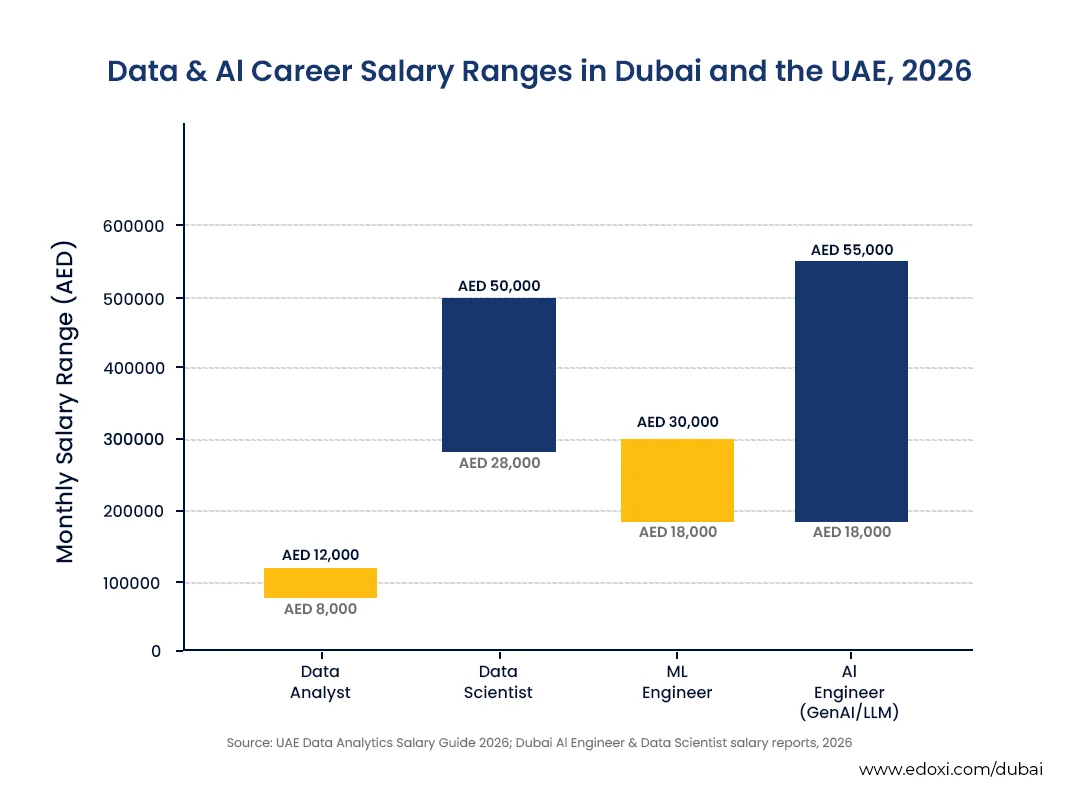
Data Science and AI Job Roles and Salaries by Experience in the UAE
| Role | Entry-Level (Monthly AED) |
Experienced / Senior (Monthly AED)
|
| Data Analyst | 8,000 – 12,000 | 20,000+ |
| Data Scientist | 15,000 – 20,000 |
28,000 – 50,000 (70,000+ for leads)
|
| Machine Learning Engineer | 18,000 – 25,000 | 30,000 – 55,000 |
| AI Engineer (GenAI / LLM specialism) | 18,000 – 25,000 | 22,000 – 55,000+ |
A few figures worth knowing if you're weighing this up seriously:
The pattern is clear: Data Science roles offer a faster, gentler route into a paid data career, while AI and ML specialisations offer a higher ceiling once you've built the foundation to reach them. Check out these highest-paying Data Science Jobs.
Rather than a generic "it depends," run through these four questions honestly. Your answers will point you in the right direction.
Do you enjoy exploring information or building things that act on their own? If you like digging through numbers and telling a story, start with Data Science. If you're energised by building something that performs a task independently, lean toward AI.
What's your starting background? Coming from finance, business, or basic Excel work favours Data Science first. Coming from software development or strong maths favours a faster route into Machine Learning and AI.
How quickly do you need to be job-ready? Data Science and Data Analytics skills tend to open entry-level roles within three to four months of focused study. AI specialisms typically need that data foundation plus extra time in deep learning.
What industry are you aiming for? BFSI, marketing, retail and government analytics roles in the UAE lean heavily on data science skills. Robotics, autonomous systems and generative AI product roles lean more on AI-specific training.
If most of your answers point one way, that's your starting point. If they're split evenly, default to Data Science. It's the safer, more transferable foundation either way.
This is the roadmap that consistently works, whether you're starting from zero or upskilling from an analyst role:
Data fundamentals (4–6 weeks): Python basics, SQL, and how to clean and structure real-world data.
Statistics and visualisation (3–4 weeks): understanding trends, correlation versus causation, and building dashboards in Power BI or Tableau.
Machine Learning (6–8 weeks): regression, classification, clustering, and your first predictive models using Scikit-learn.
Deep Learning and AI (8–10 weeks): neural networks, natural language processing, and frameworks such as TensorFlow and PyTorch.
Followed in order, most learners reach a solid, portfolio-ready AI skill set within six to nine months of consistent, part-time study, which is roughly how Edoxi's own Data Science Course in Dubai, Machine Learning Course and Deep Learning Course are sequenced, so learners can move from one to the next without repeating fundamentals. You can also choose to advance your career with these eight top data science certifications.
Consider a typical path we see repeated across Dubai's job market. A marketing executive at a Dubai Internet City firm starts by learning Python and Power BI to build better campaign dashboards, with practical, immediate value for her employer. Within a few months, she's comfortable with statistics and predictive modelling, and starts forecasting customer churn instead of just reporting it after the fact.
From there, curiosity (and a pay rise) pulls her toward Machine Learning, then Natural Language Processing, so she can build a customer-service chatbot for her company's UAE audience. Eighteen months in, her job title has shifted from Marketing Analyst to AI/ML Engineer, and her salary has moved with it. It's a common route, and it only works in that order because each stage depends on the one before it.
Government direction matters here more than in most countries. The UAE was the first in the world to appoint a Minister of State for Artificial Intelligence, and the National AI Strategy 2031 is now actively shaping curricula, visas and hiring budgets across Dubai and Abu Dhabi.
For learners, the practical takeaway is this: because the UAE government is actively subsidising the pipeline from data skills to AI skills, starting with Data Science is not a detour from an AI career here; it's the officially recommended on-ramp.
If you're weighing Data Science against Artificial Intelligence, stop thinking of it as a choice between two careers and start thinking of it as one career with two stages. Learn Data Science first to build the habits, tools and thinking that make AI genuinely learnable. Then move into Machine Learning and AI once that foundation is solid. In a market as fast-moving and well-funded as Dubai and the UAE's, that order isn't just the safer choice; it's usually the faster one too.