Leave your message to get our quick response
edoxi automated message icon

Data Science Course

Professional data science course banner showing a man analyzing data dashboards, charts, and analytics reports on a digital interface while working on a laptop.
Edoxi offers a 75-hour online Data Science training build skills needed to analyse data and make data-driven decisions. The course covers machine learning techniques, data visualisation, statistical analysis, and predictive modelling. Get hands-on training in database design with MySQL, interactive dashboard creation in Power BI, and exploratory data analysis techniques. Enrol now and prepare for data analytics and junior data science roles across multiple industries.
Course Duration
75 Hours
Corporate Days
5 Days
Learners Enrolled
50+
Modules
6
star-rating-icon1
star-rating-icon2
star-rating-icon3
Course Rating
4.9
star-rating-4.9
Mode of Delivery
Online
Certification by

What Do You Learn from Edoxi's Data Science Training

Python Programming for Data Analysis
Learn foundational Python syntax, data structures, and essential programming concepts.
Data Manipulation with Pandas and NumPy
Learn to clean, transform, and analyse structured datasets efficiently.
SQL Database Management and Querying
Master skills to design databases, write queries, and manage data using MySQL.
Interactive Business Intelligence Dashboards
Develop expertise to create compelling visualisations and reports using Power BI tools.
Statistical Analysis for Data Science
Learn hypothesis testing, probability distributions, and regression techniques for analysis.
Machine Learning Fundamentals and Predictive Modelling
Learn supervised and unsupervised algorithms to build foundational predictive models.

About Our Online Data Science Course

Edoxi's 75-hour Online Data Science training equips professionals and graduates with job-ready analytical skills. Designed for career switchers and professionals from non-technical backgrounds, this course provides a strong foundation in Python, SQL, Power BI, and introductory machine learning. The program reflects real-world workflows used across enterprises worldwide.

Participants engage in dedicated lab exercises that apply Python libraries like Pandas and Matplotlib to practical scenarios. Hands-on sessions cover database design with MySQL, interactive dashboard creation in Power BI, and exploratory data analysis techniques. These activities build competency in data cleaning, manipulation, visualisation, and foundational predictive modelling.

The course prepares learners for entry-level roles in data analytics and trainee data science positions. Skills acquired translate directly to business environments in operations, finance, HR, sales, supply chain, and project management. Participants develop the ability to interpret results and communicate insights clearly to stakeholders.

To know more information about the Data Science Course fee, syllabus or schedule an online/Classroom and Corporate Training, contact our team at Edoxi.

Key Features of Edoxi's Data Science Training

Python Programming Exercises with Real Datasets

Practice data manipulation using Pandas and NumPy libraries on authentic business data.

Live Demonstrations of Data Workflows

Observe end-to-end data analysis processes from acquisition to insight generation.

MySQL Database Implementation Projects

Design schema, establish relationships, and execute SQL operations in practical scenarios.

Power BI Dashboard Development

Build interactive reports connecting multiple data sources with calculated measures.

Customised Projects Based on Your Industry

Work on sector-specific case studies tailored to finance, healthcare, retail, or logistics domains.

Doubt Clearance and Personalised Guidance

Receive individual attention in small batches with dedicated trainer support.

Who Can Join Our Online Data Science Course?

Graduates from Any Discipline

Recent graduates seeking to start careers in data analytics without prior technical experience.

Non-Technical Professionals Transitioning to Data Roles

Individuals from finance, HR, sales, marketing, supply chain, or project management backgrounds.

Business Analysts and Reporting Specialists

Professionals looking to expand into analytics and junior data science positions.

Corporate Teams Requiring Data Upskilling

Organizations aiming to develop data-driven decision-making capabilities across departments.

Data Science Course Module

Module 1: Python Fundamentals
  • Chapter 1.1: Introduction to Python Programming

    • Lesson 1.1.1: Python applications and development environment setup
    • Lesson 1.1.2: Basic syntax and data types
    • Lesson 1.1.3: Variables and operators
  • Chapter 1.2: Control Flow and Functions

    • Lesson 1.2.1: Conditional statements and looping structures
    • Lesson 1.2.2: Functions, modules, and code organisation
    • Lesson 1.2.3: File operations and exception handling
Module 2: Python Advanced Concepts
  • Chapter 2.1: Object-Oriented Programming

    • Lesson 2.1.1: Classes, objects, and inheritance
    • Lesson 2.1.2: Working with Python libraries
  • Chapter 2.2: Data Manipulation with Pandas

    • Lesson 2.2.1: DataFrame operations and CSV/Excel data reading
    • Lesson 2.2.2: Data cleaning, filtering, and handling missing values
    • Lesson 2.2.3: Group by, concat, and merge operations
  • Chapter 2.3: Data Visualisation

    • Lesson 2.3.1: Matplotlib fundamentals for plotting
    • Lesson 2.3.2: Seaborn for statistical visualisations
    • Lesson 2.3.3: Interactive charts with Plotly
Module 3: MySQL Database Management
  • Chapter 3.1: Relational Database Fundamentals

    • Lesson 3.1.1: Introduction to MySQL and server installation
    • Lesson 3.1.2: Statement fundamentals and data types
    • Lesson 3.1.3: Creating databases, tables, constraints, and indexes
  • Chapter 3.2: SQL Querying and Advanced Operations

    • Lesson 3.2.1: SELECT, INSERT, UPDATE, DELETE operations
    • Lesson 3.2.2: Joins, subqueries, and aggregations
    • Lesson 3.2.3: CTE, window functions, and stored procedures
Module 4: Power BI
  • Chapter 4.1: Power BI Essentials

    • Lesson 4.1.1: Introduction to Power BI features
    • Lesson 4.1.2: Importing and connecting data sources
    • Lesson 4.1.3: Data transformation with Power Query
  • Chapter 4.2: Reporting and Visualisation

    • Lesson 4.2.1: Data modelling and establishing relationships
    • Lesson 4.2.2: Creating calculated columns and measures
    • Lesson 4.2.3: Designing interactive dashboards and publishing reports
Module 5: Statistics for Data Science
  • Chapter 5.1: Statistical Foundations

    • Lesson 5.1.1: Descriptive statistics and measures of central tendency
    • Lesson 5.1.2: Probability distributions (discrete and continuous)
    • Lesson 5.1.3: Hypothesis testing and statistical significance
  • Chapter 5.2: Advanced Statistical Techniques

    • Lesson 5.2.1: Correlation and regression analysis
    • Lesson 5.2.2: Introduction to ANOVA
Module 6: Data Science
  • Chapter 6.1: Data Science Workflow

    • Lesson 6.1.1: Understanding the data science lifecycle
    • Lesson 6.1.2: Data acquisition and cleaning techniques
    • Lesson 6.1.3: Exploratory Data Analysis (EDA)
  • Chapter 6.2: Machine Learning Fundamentals

    • Lesson 6.2.1: Supervised and unsupervised learning algorithms
    • Lesson 6.2.2: Model evaluation and performance metrics
    • Lesson 6.2.3: Introduction to NLP and deep learning concepts

Download Data Science Course Brochure

Real World Projects and Practical Sessions in the Data Science Course

This Data Science course provides hands-on lab sessions featuring Python programming tasks, MySQL database implementations, and Power BI dashboard development. Live demonstrations, case studies, and doubt clearance sessions ensure participants gain practical experience with Pandas, NumPy, Matplotlib, Seaborn, SQL queries, and Power Query transformations.

Projects

  • Python Project: Data Analysis and Visualisation

    Work on real-world datasets using Pandas and Matplotlib libraries. Perform data manipulation, statistical analysis, and create insightful visualisations to communicate findings effectively across business contexts.

  • MySQL Project: Database Management System

    Design and implement comprehensive database schemas using MySQL. Create tables, establish relationships, write SQL queries for insertion, retrieval, updates, and deletions. Build sample applications interacting with databases.

  • Power BI Project: Interactive Dashboard

    Create interactive dashboards incorporating charts, graphs, and maps to present key insights. Connect multiple data sources, perform transformations, and create calculated measures to enhance analytical capabilities.

  • Data Science Project: Predictive Modelling

    Build predictive models using machine learning algorithms. Perform data preprocessing, train-test splits, model training, hyperparameter tuning, and performance evaluation. Present results with appropriate visualisations for stakeholder communication.

Data Science Course Outcomes and Career Opportunities

Pursuing the Data Science course provides multiple career entry points into analytical and data-driven roles across industries, including finance, healthcare, logistics, retail, and technology sectors. Here are some outcomes that you can expect after completing the Data Science Course;

Course Outcome Image
Understand the fundamentals of Data Science and data-driven decision-making.
Collect, clean, and preprocess structured and unstructured data.
Apply statistical analysis to interpret data and identify patterns.
Use programming languages such as Python or R for data analysis.
Create data visualisations and dashboards to communicate insights.
Build and evaluate machine learning models for predictive analysis.

Job Roles After Completing the Data Science Training

  • Junior Data Analyst
  • Business Intelligence (BI) Analyst
  • Reporting Analyst
  • Data Analytics Executive
  • Data Analyst
  • Data Scientist
  • Business Intelligence (BI) Analyst
  • Machine Learning Engineer
  • Data Engineer
  • AI Engineer
  • Business Analyst
  • Analytics Consultant
  • Statistical Analyst
  • Data Visualisation Specialist

Data Science Training Options

Live Online Training

  • 75-Hour Online Data Science Course

  • Interactive virtual sessions

  • Screen sharing for demonstrations

  • Cloud access to tools/datasets

  • Recorded sessions for revision

  • Learn at your own pace and convenience

Corporate Training

  • 5-Day Customised Data Science Training

  • Curriculum as per your requirements

  • Flexible venue: Hotel/Client premises/Edoxi

  • Flexible format: Classroom/Online/Hybrid

  • Food and refreshments provided

  • Fly-a-trainer option

  • Team-based business-aligned projects

  • Pre and Post-Assessments

Do You Want a Customised Training for Data Science?

Get expert assistance in getting your Data Science Course Customised!

How to Get a Data Science Certification?

Here’s a four-step guide to becoming a Data Science professional.
Do You Want to be a Certified Professional in Data Science

Join Edoxi’s Data Science Course

Why Choose Edoxi for Data Science Training?

Edoxi is a leading Data Science Training Institute, offering the best professional training courses worldwide. The following are some of the reasons why you should choose Edoxi’s Data Science Training;

Hands-On, Project-Based Learning

Gain expertise in real-world data science through practical projects that reinforce core concepts and build problem-solving skills.

Industry-Ready Portfolio Development

Create a portfolio featuring four major projects using leading tools such as Python, MySQL, Power BI, and machine learning algorithms.

Structured, Progressive Curriculum

Learn Python fundamentals and advance step-by-step into database management, business intelligence, statistics, and machine learning techniques.

Career-Focused Skill Building

Gain the technical expertise and business acumen required to thrive in the fast-growing, data-driven industries.

End-to-End Learning Support

Benefit from comprehensive guidance, including access to up-to-date tools, doubt clearance sessions, and career mentorship.

Gain a Data Science Certification

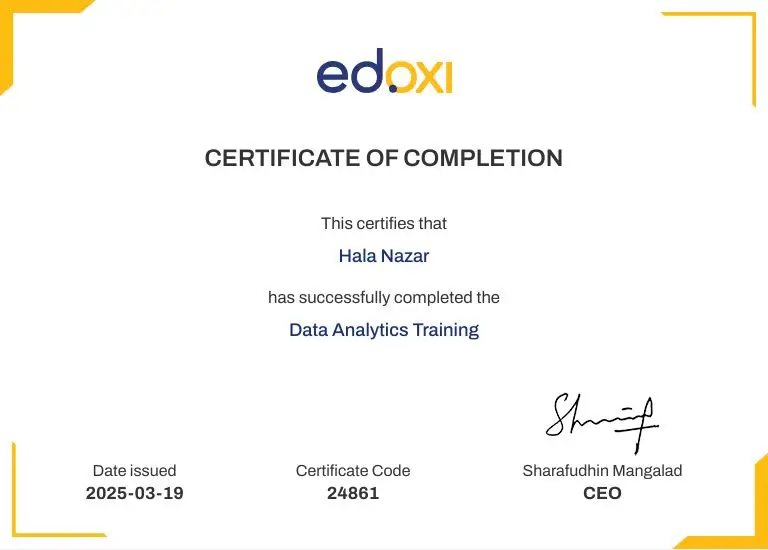
Upon successful completion of the course, you will receive a course completion certificate from Edoxi. This validates your skills to potential employers.

students-image

Edoxi is Recommended by 95% of our Students

Meet Our Mentor

Our mentors are leaders and experts in their fields. They can challenge and guide you on your road to success!

mentor-image

Nahid S

Nahid S. is an experienced educator with 8+ years of expertise in academia, training, and software development. Skilled in curriculum design, interactive training, and mentorship, she has equipped learners with hands-on skills in data analytics, data science, cloud computing, and software engineering. Nahid is an AWS Academy Accredited Educator, AWS Certified Solutions Architect – Associate, Microsoft Certified: Azure Fundamentals, and Google Certified Educator (Level 1). She brings a strong technical foundation and industry credibility to the classroom, blending theoretical knowledge with practical applications.

Nahid has delivered engaging lectures and practical sessions across core and elective subjects, including Cloud Computing, Python, Machine Learning, and Data Science. Nahid has designed and implemented industry-relevant training programs that boost employability. With a strong focus on student development, she has provided mentorship in projects, internships, and career planning while organising workshops, seminars, and guest lectures to bridge the gap between academia and industry.

Locations Where Edoxi Offers Data Science Course

Here is the list of other major locations where Edoxi offers Data Science Course

FAQ

What is a Data Science course?

A Data Science course teaches how to collect, analyze, and interpret large datasets using tools such as Python, SQL, machine learning, and data visualization to support data-driven decision-making.

What programming experience do I need to join this Data Science course?

No prior programming experience is required. The Data Science course begins with Python fundamentals and gradually builds your skills through guided exercises and practical projects.

Which industries can I work in after completing this Data Science training?

Data science and analytics skills are used across many industries, including finance, healthcare, retail, logistics, supply chain, operations, HR, sales, marketing, and project management. Organisations in these sectors rely on data-driven insights to support decision-making.

Does this Data Science course include a Power BI certification?

The course provides comprehensive training in Power BI tools and techniques; however does not provide Power BI Certification. If you want a certification, then you can join the Power BI Training Course.

Is corporate or team Data Science training available?

Yes, the Data Science training can be customised for corporate teams. The course structure, schedule, and delivery format can be adapted to meet organisational learning objectives and workforce development needs.

What job roles can I pursue after completing this Data Science course?

Typical entry-level roles include Junior Data Analyst, Business Intelligence Analyst, Reporting Analyst, Data Analytics Associate, and Junior Database Analyst.

How is the online Data Science training delivered?

Online sessions are conducted live and are designed to replicate an interactive classroom environment. Training includes demonstrations, screen sharing, virtual labs, and real-time interaction with instructors.

How long does it take to complete a Data Science course?

The duration varies depending on the training format and depth of the curriculum. Most professional training programs take 75-hours, while intensive bootcamps may be completed in a few weeks.

Is Data Science a good career option?
Yes. Data science is considered one of the fastest-growing career fields globally. Organisations across industries rely on data professionals to extract insights and support strategic decisions.
What skills will I learn in a Data Science course?

You will typically learn Python programming, SQL, statistics, data visualisation, machine learning basics, data cleaning, exploratory data analysis (EDA), and predictive modelling.

Can beginners learn Data Science?

Yes. Many data science programs are designed for beginners and start with foundational concepts such as Python programming, statistics, and data analysis before moving into advanced topics.

What tools are commonly used in Data Science?

Common tools include Python, R, SQL, Power BI, Tableau, Pandas, NumPy, Scikit-learn, Jupyter Notebook, and Excel.

What is the difference between Data Science and Data Analytics?

Data Science focuses mainly on analysing historical data and generating reports, while data science involves advanced techniques such as machine learning, predictive modelling, and algorithm development.

Do I need a mathematics background to study Data Science?

A basic understanding of mathematics and statistics is helpful, but most courses teach the required statistical and analytical concepts as part of the curriculum.

Is coding required for Data Science?
Yes, coding is an important part of data science. Most data science professionals use Python or R for data analysis, automation, and building machine learning models.
Is Data Science difficult to learn?

Data science can be challenging because it combines programming, statistics, and analytical thinking. However, with structured training and consistent practice, beginners can successfully learn the required skills.

What is the average salary for a Data Scientist?

Salaries for data science professionals vary depending on experience, location, and industry. Entry-level data scientists in the United States earn around $83,000 per year on average, while mid-level professionals can earn $110,000–$160,000 annually.

Can I learn Data Science online?

Yes. Many institutions offer live online training, self-paced courses, and hybrid learning formats that allow students to learn data science remotely.