Request a Callback

+971 43801666
 Jun 30, 2026
You become a Certified Anti-Money Laundering Specialist by earning 40 ACAMS eligibility credits through education, work experience and training, holding an active ACAMS membership, purchasing a CAMS certification package, and passing a 120-question proctored exam within a 180-day testing window.
That's the short version. The long version, the one that actually determines whether you pass on your first attempt or end up paying a retake fee, is what the rest of this guide covers.
CAMS isn't a "nice to have" anymore. With regulators worldwide handing out heavier sanctions-related fines and the UAE bracing for its FATF mutual evaluation in mid-2026, compliance teams across banks, fintechs and DNFBPs are actively hunting for people who already hold the credential.
If you're weighing whether the time and cost are worth it, here's everything you need to plan the move properly.
The Certified Anti-Money Laundering Specialist (CAMS) designation, issued by the Association of Certified Anti-Money Laundering Specialists (ACAMS), is the recognised global gold standard for anti-money laundering (AML) and financial crime compliance professionals.
ACAMS now counts more than 140,000 certified professionals and over 115,000 active members spread across upwards of 200 jurisdictions and territories, numbers that have grown sharply as enforcement activity has intensified.
That enforcement backdrop matters more than most candidates realise. Global regulators have handed down well over a billion dollars in AML-related penalties in single half-year periods in recent years, with digital asset firms, neobanks and traditional lenders all caught out.
France alone became one of the largest enforcers globally after a single penalty exceeding 900 million dollars was issued to a major bank for AML failings. None of this is abstract for hiring managers; every fine translates into budget for compliance headcount, and ACAMS is usually the first credential listed in the job description.
Read our blog to discover proven strategies and expert tips on how to pass the ACAMS exam successfully.
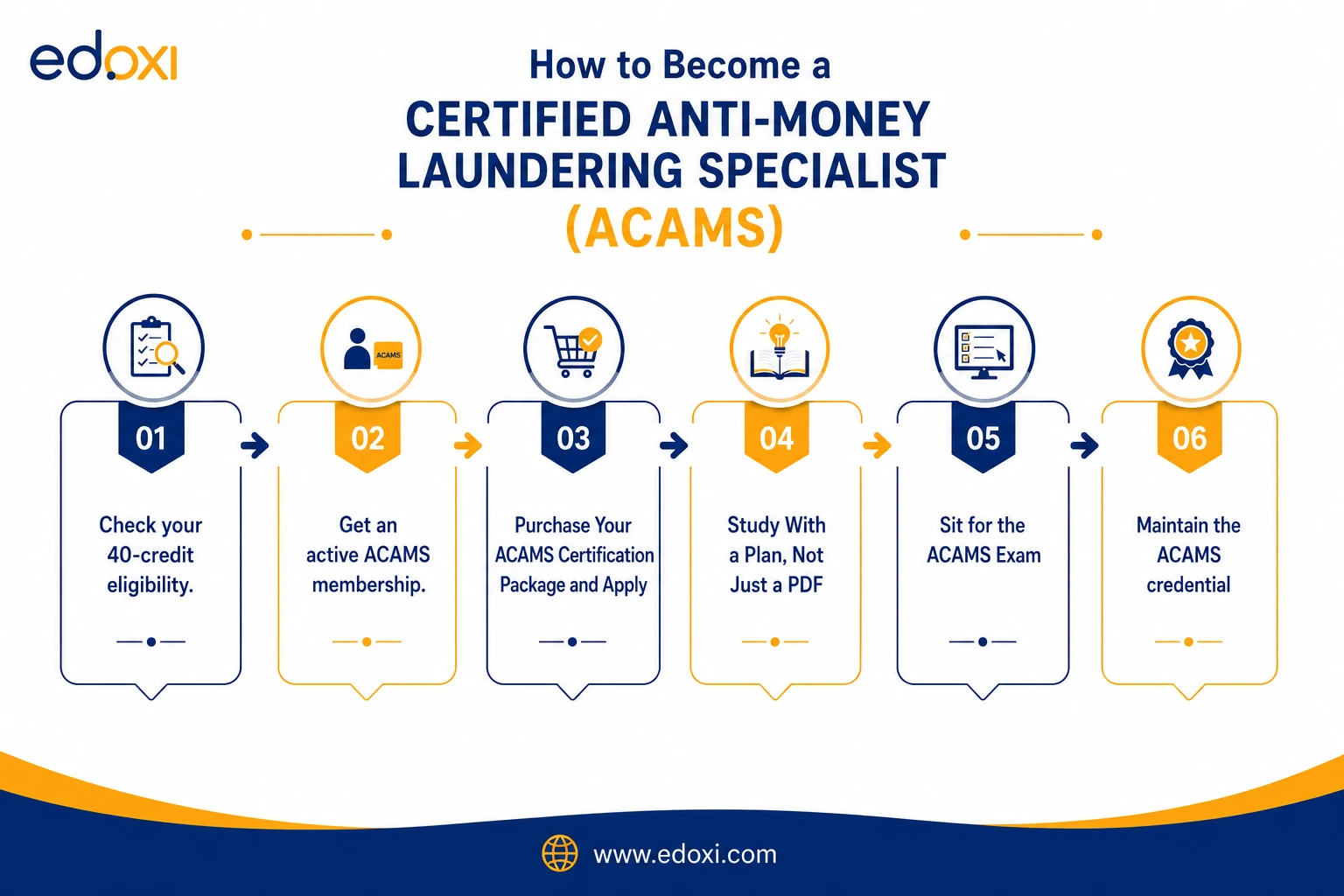
Here are the steps to become a certified anti-money laundering specialist (CAMS)
Check your 40-credit eligibility.
Get an active ACAMS membership.
Purchase Your CAMS Certification Package and Apply
Study With a Plan, Not Just a PDF
Sit for the ACAMS Exam
Maintain the ACAMS credential
ACAMS won't let you sit the exam until you've banked 40 credits across three categories: academic qualifications, professional work experience, and AFC-related training. Here's how the points typically stack up.
Credits Sources for CAMS Examination
|
Credit Source |
Credits Awarded |
|
Associate degree |
10 |
|
Bachelor's degree |
20 |
|
Master's degree |
30 |
|
Juris Doctor (JD) or PhD |
40 |
|
Each year of relevant professional experience |
10 |
|
A recognised professional certification (e.g., CPA, CFE) |
10 |
|
ACAMS training courses / Virtual Classroom hours |
Variable, per course |
A fresh graduate with only a bachelor's degree sits at 20 credits and needs another 20, typically through two years of relevant experience or ACAMS-approved training, before they're eligible to apply.
A master's degree holder with zero experience is 10 credits short and usually closes the gap with the Virtual Classroom Series. Run your own numbers before you spend anything; ACAMS offers a free online eligibility calculator for exactly this reason.
Explore our blog to learn about the career path of a certified anti-money laundering expert and the opportunities available worldwide.
You cannot purchase a certification package or apply for the exam without it. As of 2026, standard private-sector membership runs USD 295 per year, while public-sector, government, regulator and NGO professionals qualify for a reduced USD 195 annual rate.
Membership also unlocks webinars, ACAMS Today publication access, and chapter events, useful for networking, but the real point here is that it's a non-negotiable gateway, not an optional add-on.
Once eligible, you buy the Standard CAMS Package, which bundles your Authorisation to Test, the digital study guide, flashcards and practice questions.
ACAMS reviews your submitted credits and references (you'll need three professional references) before approving your application.
You then have a defined window, typically four to six months depending on the package, to schedule and sit the exam.
Read our blog to understand how long the ACAMS certification remains valid and what is required to maintain it.
Most successful candidates report roughly three months of preparation at around two hours a day, with heavy focus on the Bank Secrecy Act, FATF recommendations, customer due diligence frameworks, and red-flag case studies rather than rote memorisation.
ACAMS itself describes the exam as scenario-driven; it tests judgment under realistic compliance situations, not definitions.
Explore our blog for a detailed breakdown of the ACAMS exam format & pattern, including question types and scoring.
Read our blog to discover the key benefits of ACAMS certification and how it can boost your compliance and financial crime career.
The important step in the way to become a certified anti-money laundering specialist (ACAMS) is to sit for the CAMS examination and pass it.
CAMS Examination Details
|
Exam Detail |
Specification |
|
Format |
120 multiple-choice questions |
|
Duration |
3.5 hours |
|
Passing score |
75 out of 120 |
|
Delivery |
Proctored, in-person or remote |
|
Retake window if you fail |
30 days |
|
Retake fee |
USD 350 (members) |
There's no officially published pass rate, but anecdotal industry estimates put first-attempt success at roughly 6 in 10 candidates, a reminder that the credit eligibility bar doesn't automatically translate into exam readiness.
Read our step-by-step guide on how to register for the ACAMS exam and start your certification journey with confidence.
CAMS isn't a one-and-done credential. Recertification is required every three years, and you'll need to demonstrate ongoing continuing professional education in anti-financial crime to keep the designation active.
What It Actually Costs
|
Cost Component |
Private Sector (USD) |
Public Sector (USD) |
|
Annual ACAMS membership |
295 |
195 |
|
Standard CAMS Package (incl. first exam attempt) |
2,095 |
1,595 |
|
Package with Virtual Classroom |
2,495 |
2,095 |
|
Retake fee (if needed) |
350 |
350 |
|
Approximate total, first attempt |
~2,390 |
~1,790 |
Budget for the higher end if you're paying privately rather than through an employer-sponsored training plan, and factor in that membership renews annually, regardless of where you are in the certification cycle.
The complete pathway to becoming a certified anti-money laundering specialist (ACAMS) is summarised in the infographics below:
With the increasing complexity of financial crimes and growing stringent regulations around the world, there is an increasing need for experts with a reputation for AML knowledge.
The ACAMS certification is becoming increasingly recognised as a global standard, assisting professionals in showcasing their anti-money laundering knowledge as well as securing better job prospects for themselves.
Example UAE
After its successful delisting from the FATF grey list as a result of major reforms made at the start of 2024, the UAE is gearing up to undergo its first mutual evaluation under the fifth cycle of FATF.
The regulatory authorities, comprising the Central Bank of the UAE, the FIU, the DFSA, the FSRA of the Abu Dhabi Global Market, and other institutions, have taken it upon themselves to step up their enforcement activities, suggesting that the reforms undertaken last year proved to be genuine.
The Central Bank has levied a penalty on financial institutions in the UAE amounting to more than AED 350 million, and the latest federal law, Decree-Law No. 10 of 2025, has introduced stricter requirements to virtual assets services providers and DNFBPs such as dealers in precious metals and real estate agents.
Regulatory developments taking place in the UAE are creating employment needs for individuals directly in banks, fintechs, money exchange companies, and real estate businesses in Dubai and Abu Dhabi, with CAMS certification always coming first.
Average Monthly Salary of Anti-money laundering specialists globally
|
Country/Region |
Average Monthly Salary (USD) |
Approximate Monthly Salary (Local Currency) |
|
United States |
$8,500 - $10,500 |
USD 8,500 - 10,500 |
|
United Kingdom |
$5,800 - $7,500 |
GBP 4,300 - 5,500 |
|
United Arab Emirates |
$4,900 - $7,600 |
AED 18,000 - 28,000 |
|
Singapore |
$5,200 - $7,400 |
SGD 7,000 - 10,000 |
|
Canada |
$5,500 - $7,300 |
CAD 7,500 - 10,000 |
|
Australia |
$6,000 – $8,500 |
AUD 9,000 - 13,000 |
|
India |
$1,200 - $3,000 |
INR 1,00,000 - 2,50,000 |
|
Saudi Arabia |
$4,000 - $6,700 |
SAR 15,000 - 25,000 |
|
Germany |
$5,400 - $7,600 |
EUR 4,700 - 6,600 |
|
South Africa |
$2,200 - $4,000 |
ZAR 40,000 - 72,000 |
Salaries vary widely by employer type. Banks, fintech, and crypto firms generally pay at the top of these ranges, given the regulatory exposure involved, while smaller DNFBPs sit lower.
CAMS doesn't guarantee a specific salary bump on its own, but it consistently shows up as a shortlisting requirement, and most professionals report it speeds up interview conversion even where it doesn't single-handedly move compensation.
Yes. ACAMS membership (USD 295 private sector / USD 195 public sector annually) is a mandatory prerequisite purchased separately from the certification package that contains your exam attempt.
Three years, after which recertification through continuing AFC education is required to keep the designation active.