Request a Callback

+971 43801666
 Aug 19, 2026

|
Key Takeaways
|
Dubai's job market is changing faster than most HR teams can keep up with. New hiring is strong, AI adoption is accelerating across government and private sectors, and employees are expected to pick up new skills almost every year.
In this corporate environment, guessing what learning and development strategy your team needs is an expensive mistake. A Training Needs Analysis gives you a data-backed answer instead of a guess.
This guide walks through what a Training Needs Analysis actually is, why it matters for companies in Dubai and the wider UAE right now, and exactly how to run one step by step.
Table of Contents |
|
1. What is a Training Needs Analysis?
1.1 What are the Four Building Blocks of an Effective Training Needs Analysis? 2. Step-by-Step Guide: How to Conduct a Training Needs Analysis 2.1 Define business objectives first 2.2 Identify required skills for each role 2.3 Assess current employee skills and performance 2.4 Identify and prioritise skill gaps 2.5 Choose the right training method 2.6 Implement, measure, and review 3. What Are the Benefits of a Training Needs Analysis for Businesses in Dubai? 3.1 Who Should Be Involved in a Training Needs Analysis? 3.2 Common Mistakes to Avoid in a Training Needs Analysis 4. Why Training Needs Analysis Matters for Dubai Companies in 2026 5. FAQs: What is a Training Needs Analysis? |
A Training Needs Analysis (TNA) is a systematic process organisations use to identify the gap between employees' current skills and the skills required to meet business objectives.
It looks at where performance is falling short, why it's falling short, and whether training is actually the right fix.
Put simply: a TNA answers three questions.
A Training Needs Analysis is not the same as a training request form or an annual survey asking staff what courses they'd like. Customised corporate training solutions in Dubai are a deeper diagnostic exercise that connects learning directly to business performance, rather than treating training as a box-ticking exercise.
|
Training Needs Analysis: Definition A Training Needs Analysis (TNA) identifies the gap between employees' current skills and the skills required to achieve business goals, helping organisations invest in targeted, measurable training. |
The major four building blocks of an effective Training Needs Analysis are:
Organisational Analysis
Task Analysis
Person Analysis
Gap Analysis
Each stage builds on the last. Skipping organisational analysis, for example, is one of the most common reasons training programmes fail; teams end up trained on skills that don't actually support what the business is trying to achieve.
|
Expert Insight "Most organisations we work with in Dubai don't have a training problem; they have a diagnosis problem," says Julie Archer, Chief Consultant Corporate Trainer at Edoxi Training Institute, Dubai. She also quotes that "once a business genuinely understands where the gap sits, whether that's technical, leadership, or digital, the actual training becomes far easier to design and far more effective to deliver." |
The key steps to conduct a Training Needs Analysis are listed below:
Define business objectives first
Identify required skills for each role
Assess current employee skills and performance
Identify and prioritise skill gaps
Choose the right training method
Implement, measure, and review
Before assessing any individual or team, get clear on what the organisation is trying to achieve over the next 12 to 24 months.
Is the business scaling into a new market? Automating a process? Preparing for a digital transformation initiative?
Every downstream step depends on this being clear and includes:
Break down each role into the specific competencies needed to perform it well today and, where possible, in the near future.
This is where many Dubai companies now factor in AI fluency, data literacy, and adaptability alongside traditional technical and leadership skills.
Gather data on what employees can currently do using more than one method to avoid blind spots. Reliable inputs include:
Compare the required skills (Step 2) against actual performance (Step 3). Not every gap deserves equal attention; prioritise based on business impact, urgency, and how many employees are affected.
|
What Are Training Needs Analysis Tools? Training Needs Analysis (TNA) tools are methods and software used to identify employee skill gaps, assess training requirements, and align learning programs with business goals. Common TNA tools include employee surveys, interviews, performance reviews, skills assessments, competency matrices, observation, focus groups, and Learning Management Systems (LMS) with analytics |
Match the gap to the right learning format.
A leadership gap might need coaching or a structured programme; a technical skill gap might need instructor-led or certification-based training; a broad awareness gap (like AI literacy) might suit shorter, scalable formats.
Roll out training, then track whether it actually closes the identified gap, not just attendance numbers. Revisit the analysis regularly, since business needs and skills requirements shift quickly, especially in fast-moving sectors like tech, construction, and finance.
Want to build a high-performing team? Discover how corporate training programs help to improve employee skills and drive real business growth.
Common Training Needs Analysis (TNA) Methods
| Method | Best For | Limitation |
| Employee surveys | Gathering broad input quickly across large teams |
Relies on self-reported accuracy
|
| One-on-one interviews | Deeper insight into specific role challenges |
Time-intensive for large organisations
|
| Performance appraisal review | Linking gaps to documented performance data |
May miss emerging skills not yet assessed
|
| Skills assessments/tests | Objective measurement of current competency |
Needs to be updated as skills requirements change
|
| Focus groups | Capturing team-level or department-wide patterns |
Can be influenced by dominant voices in the room
|
| Direct observation | Seeing real on-the-job performance |
Resource-heavy; not scalable across large teams
|
|
A Practical Example Consider a mid-sized construction firm in Dubai preparing to bid on projects that require BIM-based project delivery. An organisational analysis shows the business needs stronger digital design capability to stay competitive. A task analysis identifies that project engineers need proficiency in tools like Revit. A person analysis reveals that only a small portion of the current team is certified. The resulting gap analysis prioritises structured, certification-based Revit training for that group, a far more targeted (and cost-effective) approach than a generic company-wide training rollout. |
The benefits of a Training Needs Analysis for Dubai organisations are:
The list of stakeholders involved in the training needs analysis is given below:
| Stakeholder |
Role in the Process
|
| HR/L&D Managers |
Lead the analysis, coordinate data collection, select training partners
|
| Department Heads |
Provide role-specific context and validate identified gaps
|
| Senior Leadership |
Align findings with business strategy and approve training budgets
|
| Employees |
Provide self-assessment data and feedback on skills confidence
|
| Corporate Training Providers |
Design and deliver targeted training based on findings
|
The common mistakes to avoid in a Training Needs Analysis in Dubai are:
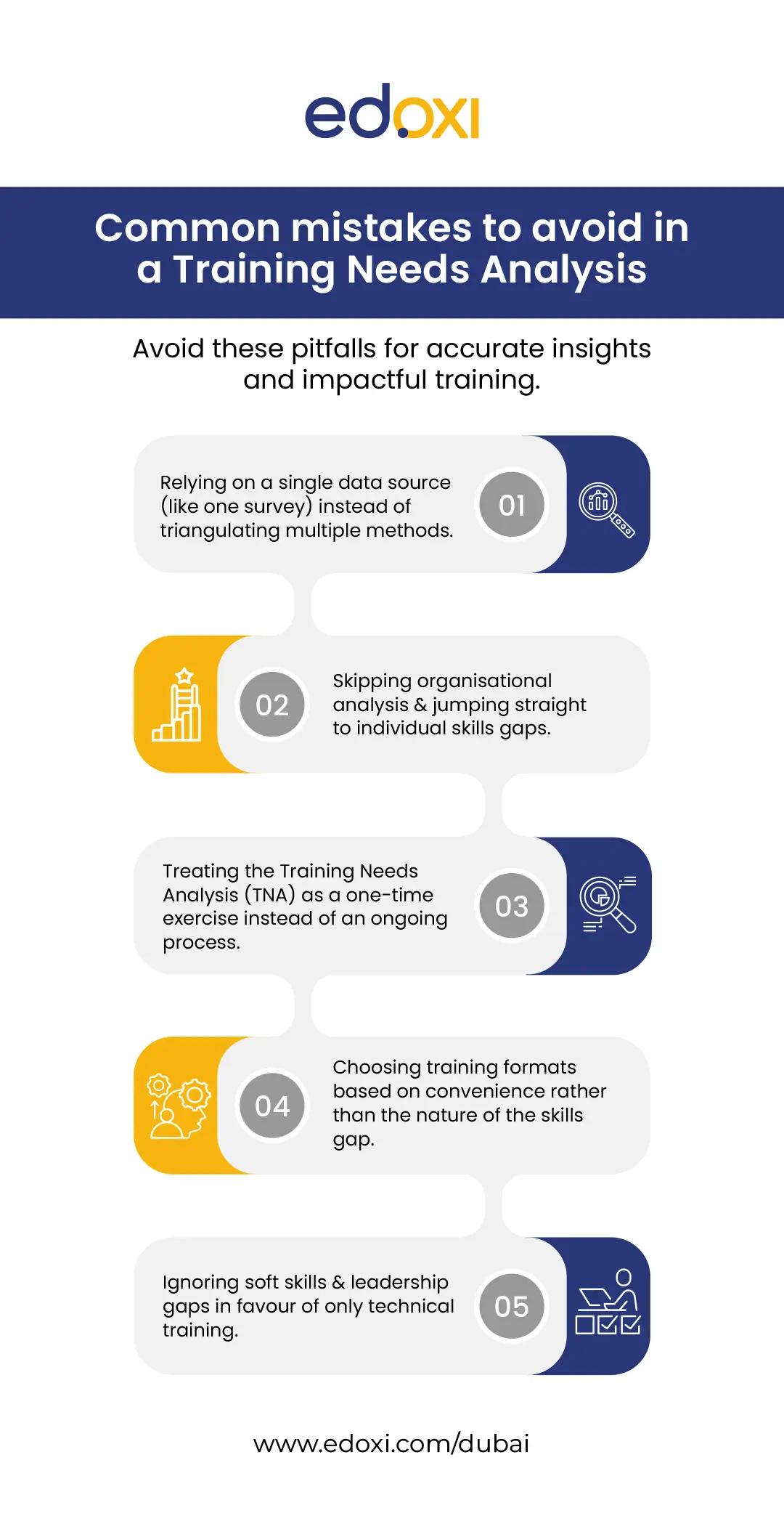
The Training Needs Analysis matters for Dubai companies in 2026 due to the following reasons: