Request a Callback

+971 43801666
 Aug 31, 2026
|
Key Takeaways
|
Dubai companies prepare Emirati talent for workplace success by combining structured onboarding, mentoring, leadership development and future-skills training. It is done not by treating Emiratisation as a hiring quota to tick off once a year.
With the private sector required to reach a 10% skilled Emirati workforce share by the end of 2026 under MOHRE's mandate, and the Ministry reporting that 95% of companies met their targets in the first half of the year, the real challenge for HR and business leaders has shifted. It's no longer only about hiring Emiratis. It's about helping them succeed, lead and stay.
This is exactly where ‘We the UAE 2031’ and the Dubai Economic Agenda (D33) come in. Both treat Emirati talent as the engine of Dubai's next decade, not a compliance line item.
Below, we break down how forward-thinking Dubai companies are turning that national vision into a practical people strategy — one onboarding session, mentorship pairing and leadership programme at a time.
Preparing Emirati talent has become a business priority for companies in Dubai. Emiratisation is no longer just about hiring UAE nationals. Companies must now help Emirati employees grow, perform well, and build long-term careers.
Several important developments have made workplace readiness more important than ever:
The UAE's long-term vision also highlights the importance of developing Emirati talent. We the UAE 2031 aims to build a stronger, knowledge-based economy with an AED 3 trillion GDP. At the same time, Dubai's D33 Agenda plans to bring 65,000 young Emiratis into the labour market.
These national goals show that hiring Emirati talent is only the first step. Companies must also invest in training, leadership development, and workplace skills to help Emirati employees succeed and support Dubai's future growth. Check out What are Leadership Roles with examples and their functions.
|
Table of Contents
|
|
1. Why Is Preparing Emirati Talent a Strategic Priority for Dubai Companies Right Now?
2. What Does ‘Workplace Success’ Actually Look Like for Emirati Employees? 3. How Should Dubai Companies Structure Onboarding for Emirati New Hires? 4. What Role Does Mentoring Play in Emirati Career Development? 5. Why Does Leadership Development Matter for Emirati Talent Retention? 6. How Is AI Reshaping the Skills Dubai Companies Must Build in Emirati Employees? 7. What Are the Biggest Workplace Readiness Challenges — and Their Solutions? 8. How Does Corporate Training Support Emiratisation Compliance and Business Growth? 9. How Can Dubai Companies Measure Success in Emirati Talent Development? 10. Frequently Asked Questions 11. More Questions Dubai Employers Are Asking About Emirati Talent Development" |
Workplace success for Emirati employees means genuine role responsibility, visible career progression and skills that keep pace with AI-driven change, not simply holding a job title on paper.
Companies that get this right tend to focus training investment on five recurring skill areas:
| Skill Area | Why It Matters in Dubai |
How Companies Build It
|
| Business communication | Global clients and multicultural teams need fluent, standard business English |
Structured business-English and communication modules
|
| Digital & AI fluency | AI-exposed junior roles are now far more likely to need strategic input |
AI tool training and practical prompt-literacy workshops
|
| Emotional intelligence | Essential for collaboration across nationalities and departments |
Coaching and soft-skills workshops
|
| Critical thinking | Entry-level roles increasingly carry senior-style judgement calls |
Case-based learning and job rotations
|
| Change management | Rapid digital transformation across every sector |
Structured change-readiness training
|
Effective onboarding for Emirati new hires blends a structured orientation, an assigned mentor and a 90-day skills roadmap, not a single induction day and a laptop handover. Here are the Seven Effective Leadership Training Activities for Employees.
The strongest programmes treat onboarding as the first stage of a longer development journey, not a standalone event. A typical, well-structured path looks like this:
Emirati New Hires Onbording Skills Development Stages
| Development Stage | Focus Area | Typical Duration |
| Onboarding | Company culture, systems and role clarity |
First 30–90 days
|
| Skill-building | Technical training and recognised certifications | 3–12 months |
| Mentorship & coaching | Paired with a senior leader or experienced mentor | 6–24 months |
| Leadership readiness | Stretch projects and cross-department exposure | 12–24 months |
| Advanced leadership | Succession planning and strategic ownership | 2+ years |
Genuine integration also protects companies against “fake Emiratisation” risk. MOHRE's AI-powered monitoring cross-checks payroll data through the Wage Protection System specifically to catch roles that exist on paper only.
Mentoring works because it pairs an Emirati employee with someone who can translate company strategy and unwritten workplace norms into practical, day-to-day guidance, something no induction manual can replace.
Al Ansari Financial Services, a Dubai-headquartered financial services provider, reached 1,000 Emirati employees across its business in 2026. Group Chief HR Officer Georgette Yousef points to the company's dedicated Learning Academy, built specifically for UAE National development, as central to that outcome.
Dubai Holding runs a similar model through its Leaders of Tomorrow Graduate Programme: a structured 12-month journey combining functional placements with senior leadership mentorship across its real estate, hospitality, media and investment businesses.
The pattern is consistent: mentorship isn't a nice-to-have add-on. It's the mechanism that turns a hiring number into a genuinely engaged employee.
Leadership development helps companies retain talented Emirati employees. Many Emirati graduates compare career growth in the private sector with opportunities in government jobs. Government roles often offer faster career progression and greater job security.
When private companies provide clear leadership opportunities, Emirati employees are more likely to stay, grow, and build long-term careers.
A structured leadership development programme usually includes four stages:
Leadership Development Programme Stages
Edoxi supports this pathway directly through its Leadership Training Dubai programmes and its Train The Trainer Course, which prepares internal mentors and supervisors to coach Emirati talent effectively. For more detail on activity design, see our guide on effective leadership training activities.
AI is reshaping Emirati talent development by pushing strategic thinking, judgement and AI fluency into entry-level roles years earlier than before — meaning workplace-readiness training can no longer wait until mid-career.
PwC's 2026 Global AI Jobs Barometer shows the UAE's share of job postings requiring AI skills has more than tripled, from 1.0% in 2021 to 3.2% in 2025, lifting the country into the global top 15 for AI-related hiring. Employees with AI skills are also commanding significant wage premiums. This is up to 92% higher pay in financial services, and around 50% in technology, media and telecoms.
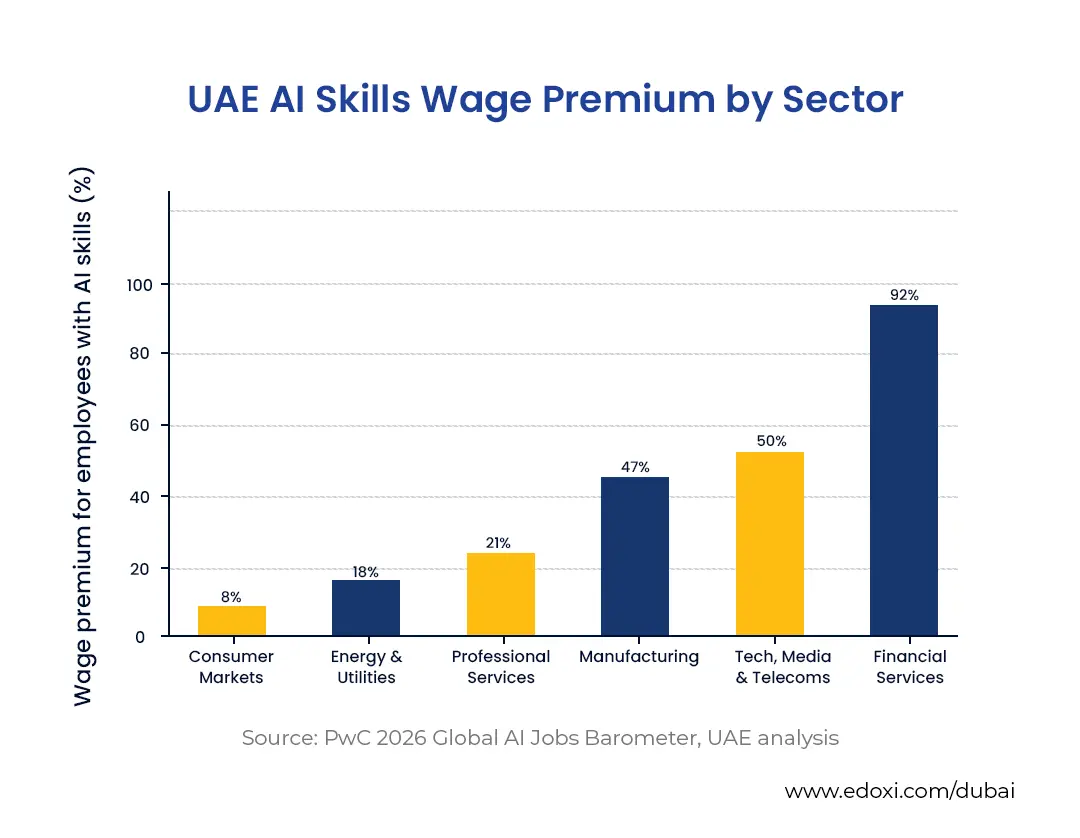
The same report finds that AI-exposed junior roles are now far more likely to require traditionally senior skills, such as leadership and strategic thinking, than roles with limited AI exposure. For Dubai companies, that means Emirati graduate programmes need to introduce AI literacy and decision-making practice from day one, not as a year-three upskilling module.
The biggest workplace readiness challenges for Emirati talent are a persistent STEM and English-language skills gap, high early-career turnover and the ongoing risk of “check-box” Emiratisation. Each of these has a practical, well-tested solution. Find out ways to improve Emiratis Spoken English Language Skills.
The table below gives you an idea of the major workplace challenges that an Emirati Talent face and its solutions.
Emirati Workplace Challenges and Their Practical Solutions
| Career Stage | Typical Programme Type |
Intended Outcome
|
| Graduate | Rotational graduate programme |
Business-wide exposure across departments
|
| Early career | Train-the-trainer and supervisory skills |
First-line leadership readiness
|
| Mid-career | Leadership training and executive coaching |
Department-head readiness
|
| Senior | Succession planning tracks |
C-suite and board-level pipeline
|
| Security Auditor | Tech Companies |
You also learn how Corporate Training Programs help to improve Employee Skills?
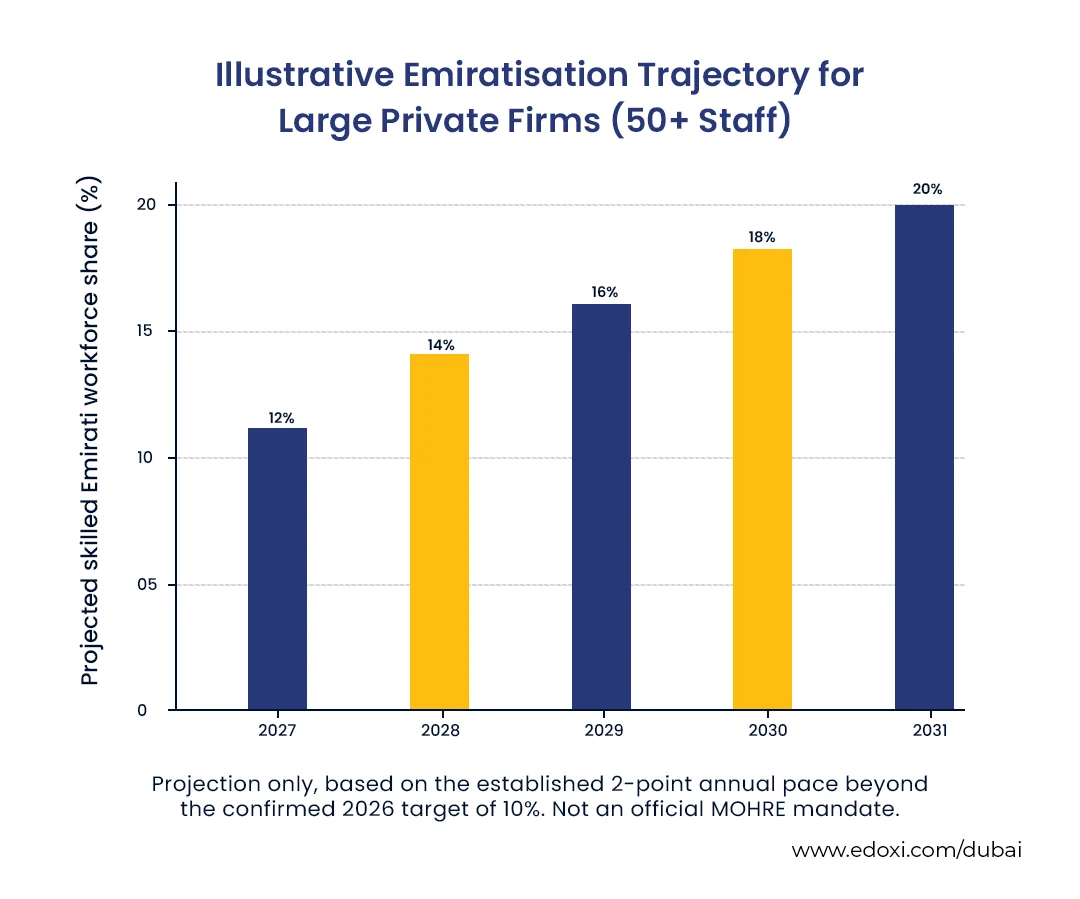
Corporate training supports Emiratisation compliance by turning newly hired Emiratis into genuinely productive, promotable employees. This is exactly what MOHRE's monitoring systems are designed to verify, and exactly what protects a company from financial contributions.
Emiritisation Compliance Mandates
| Company Size | Current Requirement |
Penalty for Shortfall
|
| 50+ employees | 10% skilled Emirati workforce share (by end of 2026) |
AED 9,000 per month, per unfilled role
|
| 20–49 employees (14 designated sectors) | Minimum of 2 Emirati employees (by end of 2025) |
Approx. AED 108,000 annual contribution
|
Companies measure success in Emirati talent development by tracking retention rate, internal promotion rate, representation in the leadership pipeline and engagement survey scores, not headcount alone.
Costs vary by programme depth and cohort size; most Dubai providers offer tiered corporate packages covering leadership, communication and AI-skills modules, often scoped around Nafis-supported salary budgets.
The most effective strategies combine mandatory-target compliance with genuine mentorship, structured leadership pathways and measurable retention tracking, rather than one-off training days.
Improving retention relies on pension portability, transparent promotion timelines, meaningful project ownership and consistent mentorship, the factors most cited in the private-sector “retention riddle.”
Yes. Nafis funds practical training and salary support, while sector-specific initiatives support Emirati graduates moving into education, finance, technology and other priority sectors.