Tausifali Saiyed Aug 17, 2026

Top 8 Careers in Artificial Intelligence: Roles, Skills & Salary

Quick answer:The eight most in-demand technical AI careers in 2026 are AI Engineer, Machine Learning Engineer, Deep Learning Engineer, NLP Engineer, Computer Vision Engineer, AI Research Scientist, Robotics Engineer, and MLOps Engineer. These roles currently dominate job postings, with AI Engineer frequently ranking as the single fastest-growing title and typical U.S. base salaries ranging from roughly $120k–$220k+ (higher at senior levels and top firms).

The artificial intelligence career path has grown far beyond a single job title. Depending on your interests- building software, training models, researching new algorithms, or keeping systems running in production there's a distinct AI career path suited to you.PwC’s 2026 AI Jobs Barometer shows roles requiring AI skills growing nearly eight times faster than the overall job market. These AI Job roles also command an average wage premium of around 62%. Companies most exposed to AI also report 40% higher productivity growth and faster headcount and wage increases.

This guide breaks down the eight core technical AI roles, the skills they require, and indicative salary ranges, along with a quick comparison to help you figure out which path fits you best.

Which AI Career Path Is Right for You?

AI career path depends on your background, AI certifications you possess, interests (building systems vs. strategy vs. research), technical comfort, risk tolerance, and preferred work style. Here’s a practical breakdown of high-demand paths;

If you enjoy... Consider
Building software and integrating AI into products AI Engineer
Working with algorithms and predictive models
Machine Learning Engineer
Neural networks and large-scale model architectures
Deep Learning Engineer
Language, chatbots, and LLMs NLP Engineer
Images and video
Computer Vision Engineer
Research and experimentation
AI Research Scientist
Hardware and autonomous systems
Robotics Engineer
Infrastructure and deployment
MLOps Engineer

Guide:What is Artificial Intelligence?

1. AI Engineer

An AI engineer designs, builds, and deploys intelligent systems that automate tasks or add AI-driven functionality to products and applications.

Key responsibilities:

  • Integrating machine learning and automation into existing products
  • Developing and maintaining AI pipelines
  • Selecting and tuning appropriate algorithms
  • Optimising model performance for production use
  • Collaborating with cross-functional teams to ship AI-driven features

Educational Background:

Bachelor's degree in computer science or a related field, often paired with hands-on project experience or a bootcamp/ AI Training certification.

Average AI Engineer Salary range:

$110,000–$160,000/year

2. Machine Learning Engineer

A machine learning engineer builds predictive models using statistics and algorithms, then turns them into systems that run reliably at scale.

Key responsibilities:

  • Data preprocessing, feature engineering, model training, validation, and deployment
  • Working with algorithms such as regression, decision trees, and reinforcement learning
  • Applying clustering techniques to prediction, classification, and optimisation problems
  • Collaborating with data scientists to convert experimental models into production-ready solutions

Educational Background:

Bachelor's degree plus strong software engineering fundamentals; many roles are accessible without a master's degree. You can also start with Machine Learning Training from a reputed AI Training Institute.

Average Machine Learning Engineer Salary Range:

$120,000–$180,000/year

Related reading:Types of Machine Learning: Which One Should You Learn First?

3. Deep Learning Engineer

A deep learning engineer focuses on neural networks and advanced AI architectures, typically working with large datasets and GPU infrastructure.

Key responsibilities:

  • Building models for image recognition, speech processing, autonomous driving, and natural language understanding
  • Implementing architectures such as CNNs, RNNs, LSTMs, and increasingly, transformer-based models that underpin most modern large language and multimodal systems
  • Designing complex learning systems using frameworks like TensorFlow and PyTorch.

Educational Background:

Bachelor's or master's degree in computer science, mathematics, or a related quantitative field. Individuals from other backgrounds can start building their knowledge with a Generative AI Course.

Average Deep Learning Engineer Salary Range:

$130,000–$190,000/year

4. NLP Engineer

An NLP (natural language processing) engineer builds systems that let machines understand, interpret, and generate human language.

Key responsibilities:

  • Applying techniques such as tokenisation, language modelling, named-entity recognition, and transformer-based architectures
  • Working with large language models (LLMs), embeddings, and retrieval-augmented generation (RAG) to build modern language applications
  • Building chatbots, voice assistants, translation tools, sentiment analysis systems, and summarisation tools

Educational Background:

Bachelor's or master's degree with coursework or experience in linguistics, machine learning, and deep learning.

Average NLP Engineer Salary Range:

$120,000–$175,000/year

Related reading:Best Languages for Machine Learning

5. Computer Vision Engineer

A computer vision engineer builds systems that let machines interpret visual information from images and video, a skill set in high demand across healthcare imaging, autonomous vehicles, surveillance, and robotics.

Key responsibilities:

  • Object detection, facial recognition, motion tracking, image segmentation, and 3D vision
  • Designing and training algorithms for visual-intelligence tasks
  • Working with deep learning architectures (such as CNNs), camera systems, and specialised computer vision libraries

Educational Background:

Bachelor's or master's degree; strong math and Python programming fundamentals literacy is essential.

Computer Vision Engineer Salary Range:

$125,000–$180,000/year

6. AI Research Scientist

AI research scientists work on advancing the field itself, typically in academic institutions, corporate R&D labs, or dedicated AI research organisations pursuing experimental, longer-term projects.

Key responsibilities:

  • Researching topics such as generative AI, reinforcement learning, neural architecture search, and multimodal learning
  • Developing new algorithms, models, and computational methods
  • Publishing research papers and building prototypes to validate new ideas

Educational Background:

A Master's degree is common; research-heavy roles at top labs often prefer or require a PhD, though requirements vary by employer.

Average AI Research Scientist Salary Range:

$140,000–$220,000+/year

7. Robotics Engineer

An AI-driven robotics engineer builds intelligent robotic systems capable of autonomous navigation, manipulation, and decision-making, with demand spanning manufacturing automation, drones, medical robotics, and service robots.

Key responsibilities:

  • Integrating AI with robotics for object handling, obstacle avoidance, environmental mapping, and human-robot interaction
  • Working across robotics control systems, embedded AI, computer vision, and motion planning

Educational Background:

Bachelor's or master's degree in robotics, mechatronics, electrical engineering, or computer science.

Average Robotics Engineer salary range:

$95,000–$140,000/year

8. MLOps Engineer

An MLOps engineer manages machine learning models across their full lifecycle, connecting the gap between data science and DevOps to keep models deployed, monitored, and reliable.

Key responsibilities:

  • Organising the workflow of ML models from development to production
  • Using CI/CD pipelines, containerization, orchestration, model versioning, and real-time monitoring
  • Ensuring AI systems remain scalable, secure, and consistently improved

Educational Background:

Bachelor's degree plus experience in DevOps, cloud platforms, or software engineering.

Average MLOps Engineer salary range:

$115,000–$165,000/year

A note on salary figures: These ranges are indicative estimates intended to give a general sense of earning potential. Actual compensation varies significantly by location, company size, experience level, and specialisation, and figures shift over time. Always check current, role-specific sources like national labour statistics agencies or salary-benchmarking platforms before making career decisions.

Skills Required for an AI Career

Not every AI professional needs to master all ten of these areas, and most build a set of Top AI skills, then specialise.

Core skills for most AI careers:

  • Programming: Python is the dominant language, with R Programming, Java, and C++ used in specific contexts. Frameworks like TensorFlow, PyTorch, and Scikit-learn are standard tools.
  • Mathematics and statistics: Linear algebra, calculus, probability, and statistics underpin optimisation, model training, and algorithm design.
  • Machine learning fundamentals: Supervised and unsupervised learning, regression, classification, clustering, decision trees, SVMs, and model evaluation.
  • Data handling and engineering: Data preprocessing, cleaning, SQL/NoSQL databases, and ETL pipelines.
  • Problem-solving and analytical thinking: Breaking down real-world problems, choosing the right algorithm, and interpreting results meaningfully.

Specialised skills, depending on your path:

  • Deep learning and neural networks: CNNs, RNNs, and transformers, using frameworks like TensorFlow, PyTorch, and Keras.
  • Natural language processing: Text processing, large language models, embeddings, tokenisation, and sentiment analysis. NLP skills are increasingly valuable across AI applications, particularly in conversational AI, search, and enterprise automation.
  • Computer vision: Image processing, object detection (e.g., YOLO, Faster R-CNN), image segmentation, and libraries like OpenCV. This is a specialised skill set rather than a universal requirement, most valuable for image- and video-based AI systems.
  • Cloud and MLOps: Familiarity with platforms such as AWS, Azure, and Google Cloud, plus CI/CD for ML, model versioning, and deployment tools like Docker and Kubernetes.
  • Big data technologies: Tools such as Apache Hadoop, Apache Spark, and Apache Kafka for processing large-scale or streaming datasets.

Generative AI and LLM skills

The following AI skills are increasingly relevant across nearly every AI role

  • Prompt design and evaluation
  • Embeddings and vector databases
  • Retrieval-augmented generation (RAG)
  • Fine-tuning pre-trained models
  • Building and evaluating AI agents
  • Integrating with model APIs and managing inference costs

Check Out:How To Upskill Yourself For AI Jobs That Will Produce Millions By 2027

Other AI-Adjacent Careers to Consider

This guide focuses on technical AI development roles, but AI has created demand in adjacent careers too, including:

  • Data Scientist: extracting insights and building models from data, with more emphasis on analysis than production deployment
  • Data Engineer: building the data infrastructure AI systems depend on
  • AI Product Manager: defining and guiding AI-powered products
  • AI Solutions Architect: designing AI system architecture for organisations
  • AI Consultant: advising businesses on AI strategy and implementation
  • AI Security/Governance Specialist: managing risk, compliance, and responsible AI use

Which AI Roles Are More Accessible to Beginners?

AI roles vary considerably in how much prior experience they expect. Rather than labelling entire roles as "beginner-friendly", since even junior AI Engineer and ML Engineer positions typically expect solid programming and math foundations, it's more accurate to think in terms of entry barriers:

Lower barrier to entry: AI/ML analyst roles, junior data-analyst positions with an AI focus, AI application-support roles

Moderate barrier: Junior data scientist, junior AI engineer, junior ML engineer (with demonstrated projects or coursework)

Higher specialisation: Deep learning engineer, computer vision engineer, NLP/LLM engineer, MLOps engineer

Advanced/research-heavy: AI research scientist, research engineer

If you're just starting, building a portfolio of real projects is often what determines whether a "junior" role is actually within reach.

Conclusion

A career in AI can offer strong earning potential and the opportunity to work on some of the most rapidly evolving technology in the world, but the field isn't a single path. If you enjoy building software, AI Engineering or ML Engineering may suit you. If you're drawn to language technologies, NLP is worth exploring. If research and experimentation excite you, consider AI Research. And if you prefer working on deployment and infrastructure, MLOps offers a strong, in-demand direction.

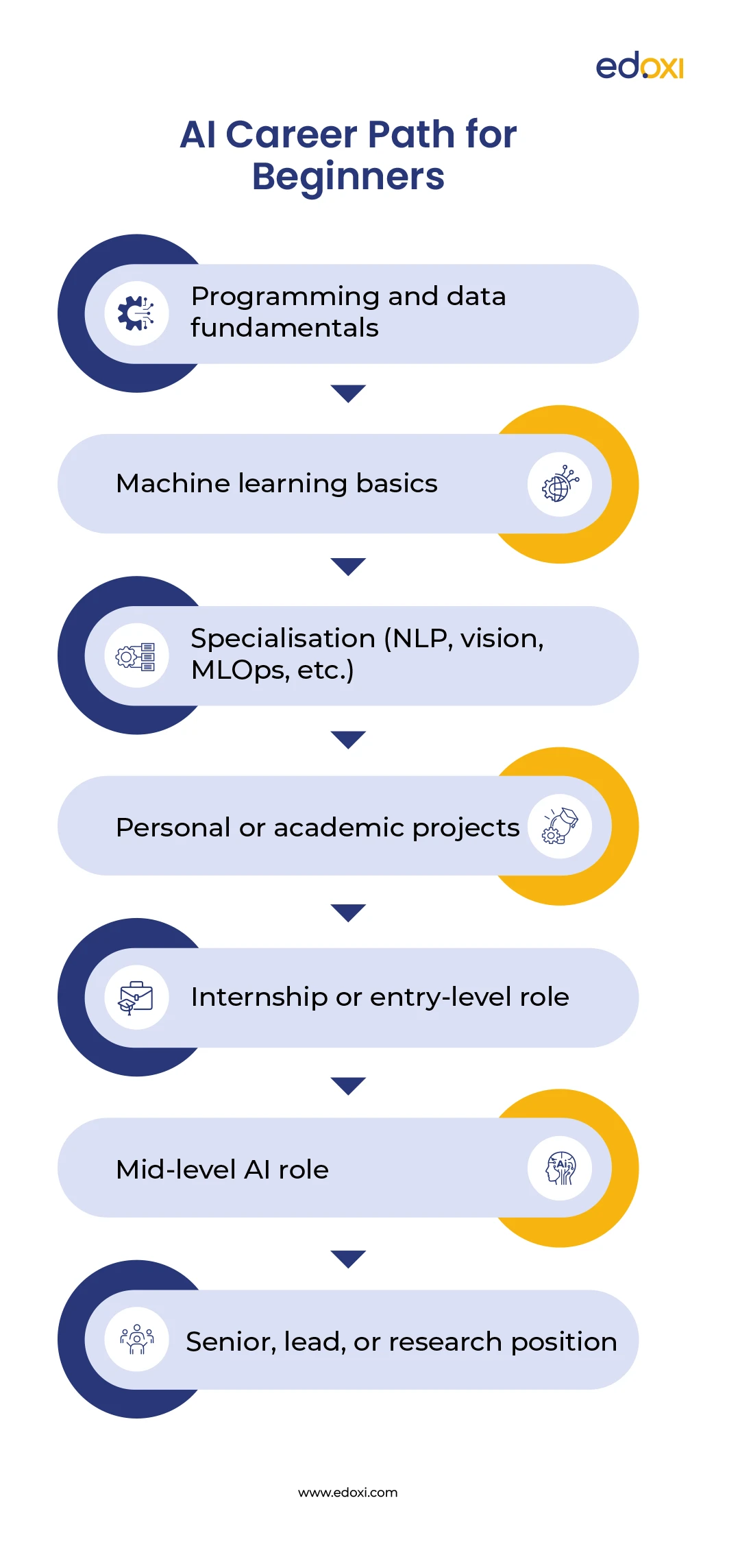
Whichever path fits, the foundation is the same: solid programming and math skills, hands-on project experience, and a willingness to keep learning as the field evolves. Structured training can help you build that foundation faster

Build Your AI Career with Edoxi

Master AI Skills. Unlock Career Opportunities with Edoxi.

Locations Where Edoxi Offers Artificial Intelligence Courses

Here is the list of other major locations where Edoxi offers Artificial Intelligence Course

Artificial Intelligence Course in Dubai|Artificial Intelligence Course in Qatar


FAQs

What qualifications do I need to begin a career in AI?

A background in computer science, mathematics, engineering, or a related field is ideal, along with programming and machine learning fundamentals. Many roles are open to career changers with strong self-taught or bootcamp-based skills.

Can I start an AI career without a master's degree?

Yes. Many roles, including AI Engineer, ML Engineer, and Data Scientist, are accessible with a bachelor's degree and demonstrated skills. Research-heavy positions, particularly those involving novel algorithm development, more often prefer or require a master's degree or PhD, though this varies by employer.

What skills are most important for AI jobs?

Programming (especially Python), statistics and mathematics, machine learning fundamentals, and problem-solving form the core. From there, most professionals specialise in an area like NLP, computer vision, deep learning, or MLOps.

How long does it take to become an AI engineer?

This varies widely based on your starting point, but many people build job-ready skills within 6–18 months through structured courses combined with hands-on projects, on top of any existing programming background.

What is the typical salary range for AI professionals?

AN entry-level AI roles typically start in the $60,000–$90,000 range, mid-level roles fall around $90,000–$150,000, and senior or research-focused roles can reach $150,000–$220,000+. These figures vary substantially by country, company, and specialisation.

Is AI a good career choice going into the future?

The AI industry continues to grow and diversify, with new specialised roles emerging regularly. While specific tools and in-demand skills will keep evolving, the underlying demand for AI expertise remains strong.

Which programming language is best for an AI career?

Python is the most widely used language in AI development due to its libraries and frameworks (TensorFlow, PyTorch, Scikit-learn). R, Java, and C++ are used in more specific contexts, such as statistical analysis or performance-critical systems.

How can I gain practical experience in AI?

Personal projects, Kaggle competitions, internships, academic research, and open-source contributions are all effective ways to build a portfolio that demonstrates real skills to employers.

AI Trainer

Tausifali Saiyed is a Senior AI and Technology Professional with over 12 years of experience spanning Artificial Intelligence, Machine Learning, Deep Learning, Python application development, full-stack software engineering, and technology training. His broader expertise includes Java, PHP, MERN, mobile and web development, databases, and software engineering. Tausifali holds an MSC in Computer Science from the University of Greenwich, London, and a Bachelor of Engineering in Computer Engineering from Sardar Patel University, Vallabh Vidyanagar, India.

Tausifali has trained 500+ professionals and delivered corporate and academic training for organisations including Tech Mahindra, State Bank of India (SBI), and the Computer Society of India. He combines strong conceptual knowledge with hands-on experience, helping professionals apply AI and software engineering to real-world solutions. He leverages this expertise to deliver AI training, develop applications, drive AI transformation, and lead technology initiatives.

Tags
Technology
Education