Request a Callback

+971 4380 1666
 Aug 18, 2026
SAP means Systems, Applications and Products in Data Processing. In business, SAP is the world's most widely used enterprise resource planning (ERP) system. It connects finance, sales, supply chain, and HR inside one shared database, so every department works from the same live data instead of separate spreadsheets.
SAP is also the name of the German company behind the software. So when someone says a business "runs on SAP," they mean it manages its core operations from a single system rather than dozens of disconnected tools.SAP's footprint is genuinely global. It sits behind tax and revenue platforms in the UK, retail and energy giants in the United States, banks and telecoms across Africa, major retailers and utilities in Australia, and national oil companies and government services across the UAE and wider Gulf.
This guide covers the SAP meaning in business, how SAP works, its main modules, and where it's used, with real deployments from the UAE, UK, USA, Africa and Australia, plus the SAP career paths worth knowing.SAP in Busienss refers to Systems, Applications, and Products in Data Processing, a major enterprise software ecosystem used to manage and integrate business operations. In simple terms, SAP helps organizations bring different departments and business processes together in a connected system rather than managing information through separate applications.
Businesses can use SAP for areas such as finance and accounting, procurement, sales, inventory, supply chain, human resources, production, and reporting. By connecting these functions, SAP can provide a consistent view of business data, support process automation, improve operational visibility, and help organizations make data-informed decisions.
At the center of many SAP business environments is SAP ERP (Enterprise Resource Planning). SAP offers different solutions and modules depending on an organization's size, industry, and operational requirements. Understanding what SAP means, how it works, and where it is used can help beginners, business professionals, and aspiring SAP consultants understand why SAP skills are valuable in modern enterprise environments.
| Numbers | Table of Contents |
|---|---|
| 1 | What Is SAP in Business? |
| 2 | What Does SAP Stand For? |
| 3 | How Does SAP Work Inside a Business? |
| 4 | What Are the Main SAP Modules and What Do They Do? |
| 5 | What Is the Difference Between SAP ECC, S/4HANA and SAP Cloud ERP? |
| 6 | Where Is SAP Used? Which Industries Rely on It Most? |
| 7 | How Widely Is SAP Used Around the World? |
| 8 | What Are the Benefits of Using SAP for a Business? |
| 9 | What Career Opportunities Does SAP Offer? |
| 10 | Frequently Asked Questions About SAP in Business |
| 11 | Most Common Questions People Ask About SAP |
| 12 | Key Takeaways |
The role of SAP and ERP systems in the UAE is closely connected with the country's wider move toward digital business transformation. Organizations across sectors are increasingly looking for ways to integrate finance, procurement, supply chain, human resources, sales, operations, and business data instead of managing each function through disconnected systems. SAP, as a major enterprise technology provider, offers ERP solutions designed to bring these business processes together within an integrated environment.
The UAE's broader digital-economy strategy provides an important context for this transformation. The UAE Digital Economy Strategy aims to increase the digital economy's contribution to national GDP from 9.7% in 2022 to 19.4% within 10 years. The strategy includes more than 30 initiatives and programmes covering six sectors and five new areas of growth.
For businesses in Dubai, the country's digital-first direction is particularly relevant. Dubai's Digital Strategy focuses on areas including the digital economy, data, digital talent, digital infrastructure, cybersecurity, and digital competitiveness. According to the Dubai Government, the digitisation rate of government services reached 99.5% in 2023, while the paperless-government objective reached 100% and digital transactions accounted for 87% of total government service transactions. The strategy also reported more than 120 government smartphone applications and aims to equip more than 50,000 professionals with advanced digital qualifications.
The growth of the broader ERP market provides additional context for understanding the business demand for integrated enterprise software in the UAE. Grand View Research estimates that the UAE enterprise resource planning market generated US$264.6 million in revenue in 2023 and is projected to reach US$725.2 million by 2030, representing a 15.5% CAGR from 2024 to 2030. The research identifies cloud as the fastest-growing deployment segment during the forecast period.
It is important to note that these figures represent the overall UAE ERP market and not SAP's individual market share. They therefore provide broader evidence of ERP-market development rather than a measurement of SAP adoption specifically.
The relationship between ERP and emerging technologies is also becoming increasingly important in the UAE. In May 2026, SAP reported findings from SAP-commissioned YouGov research involving chief IT decision-makers in the UAE. The research found that 85% of surveyed UAE organizations rely on ERP systems to support AI, while 53% said their ERP system already serves as the primary platform enabling AI-driven processes and decisions. Another 32% said their ERP supports AI across several core business functions.
These findings help explain why modern ERP platforms are increasingly viewed as more than traditional back-office systems. When business data, workflows, and operational processes are connected, organizations can create a stronger foundation for automation, analytics, AI-assisted decision-making, and more integrated business operations.
SAP in Qatar means using SAP enterprise software and ERP solutions to manage and integrate business processes while supporting Qatar-specific requirements where applicable. SAP can be used for finance, procurement, sales, supply chain, inventory, HR, reporting, and other enterprise functions. Qatar-specific SAP functionality includes financial and regulatory-related features, while the country's broader Digital Agenda 2030 and Qatar National Vision 2030 provide a wider context for digital transformation and economic diversification
Enterprise Resource Planning (ERP) has become an important part of modern business technology because it allows organizations to bring different functions and business data together within a connected system. In Qatar, ERP solutions can help businesses link areas such as finance, procurement, operations, inventory, and other core processes, giving management a more integrated view of business activities. Tasmu Digital Valley describes ERP as software that uses a centralized database to connect business data and processes with operational and financial activities.
The growing interest in ERP also reflects Qatar's broader shift toward digital business operations. According to Tasmu Digital Valley, the estimated Qatar ERP market size is US$58.6 million, with an expected annual growth rate of 7%. The market is projected to reach approximately US$77.7 million in 2026. These figures indicate the increasing relevance of integrated enterprise systems as organizations in Qatar continue to adopt digital technologies to improve efficiency, data management, and business decision-making.(Source: Tasmu Digital Valley, Qatar ERP Market)
Quick Answer: SAP is an ERP system that links a business's core functions, including finance, sales, procurement, HR, and production, inside one connected platform. Employees across departments read and update the same records in real time, rather than emailing spreadsheets between teams.
SAP was founded in Germany in 1972 and now serves organisations in more than 180 countries. Roughly 425,000 businesses run on SAP worldwide, including 87% of the Fortune 500 and 99 of the world's top 100 companies by revenue (Span Global Services, 2026).
For a business, "SAP" carries three meanings at once: the company, the ERP software, and the standardised way of working the software encourages. A finance manager who says "it is all on SAP" means stock levels, invoices, payroll and orders all live inside one shared system.
SAP stands for Systems, Applications and Products in Data Processing. The name traces back to the German phrase Systemanalyse und Programmentwicklung, roughly "system analysis and program development," used by the five former IBM employees who founded the company in 1972.
SAP released its first product, SAP R/1, in 1973, to centralise financial accounting. SAP R/2 followed in the 1980s with multi-currency support, and SAP R/3 arrived in 1992 as a client-server system that made SAP a global standard for large businesses. Today's flagship product, SAP S/4HANA, runs on an in-memory database built for real-time analytics and artificial intelligence.
SAP works by storing all business data in one central database, so every department reads and writes to the same live records instead of keeping separate files.
A sales order raised in the Sales module instantly checks stock in the Materials Management module, without anyone re-typing the numbers.
Think of SAP as a shared company memory. Finance, warehouse, and HR teams all draw from the same data, rather than passing paper between desks. This single source of truth is what makes SAP dashboards trustworthy, updated as transactions happen.
SAP is built from modules, and each one manages a specific business function. Most businesses only need a handful of modules relevant to how they operate, not the full suite.
| Module | Full Name | What It Manages |
|---|---|---|
| FICO | Financial Accounting & Controlling | General ledger, cost centres, reporting |
| MM | Materials Management | Procurement, vendors, stock control |
| SD | Sales & Distribution | Orders, pricing, deliveries, billing |
| HCM | Human Capital Management | Payroll, recruitment, workforce records |
| PP | Production Planning | Manufacturing schedules, bills of material |
| PS | Project Systems | Budgets, timelines, resource planning |
| EAM | Enterprise Asset Management | Maintenance, asset lifecycle tracking |
| BTP | Business Technology Platform | Cloud apps, integration, analytics |
Finance professionals usually begin with SAP FICO, while procurement specialists start with SAP MM. Matching the right module to a career goal matters more than trying to learn every module at once.
Interested in developing practical SAP skills? Explore Edoxi's SAP training programmes.
SAP ECC is the older, on-premise ERP system. SAP S/4HANA (SAP MM) is SAP's modern, in-memory ERP platform, built for real-time reporting and AI. SAP Cloud ERP, delivered through RISE or GROW with SAP, is the subscription-based, cloud-hosted version of S/4HANA, updated continuously without a business managing its own servers.
SAP has confirmed that mainstream maintenance for ECC ends on 31 December 2027, after which unsupported systems stop receiving security patches and compliance updates (Seidor, 2026). Businesses still on ECC are expected to plan their move to S/4HANA well before that date.
| Feature | SAP ECC | SAP S/4HANA | SAP Cloud ERP (RISE/GROW) |
|---|---|---|---|
| Database | Traditional (Oracle, SQL, DB2) | SAP HANA, in-memory | SAP HANA, cloud-hosted |
| Support Timeline | Mainstream support ends 2027 | Supported through 2040 | Continuously updated |
| Deployment | On-premise | On-premise or private cloud | Public or private cloud |
| Best Suited For | Legacy, stable operations | Large enterprises modernising | Growing businesses wanting agility |
SAP is used across nearly every industry that needs to connect finance, supply chain and people data in one place. Manufacturing, retail, banking, healthcare, logistics, energy and government are among the sectors that lean on it most heavily, in every region where it operates.
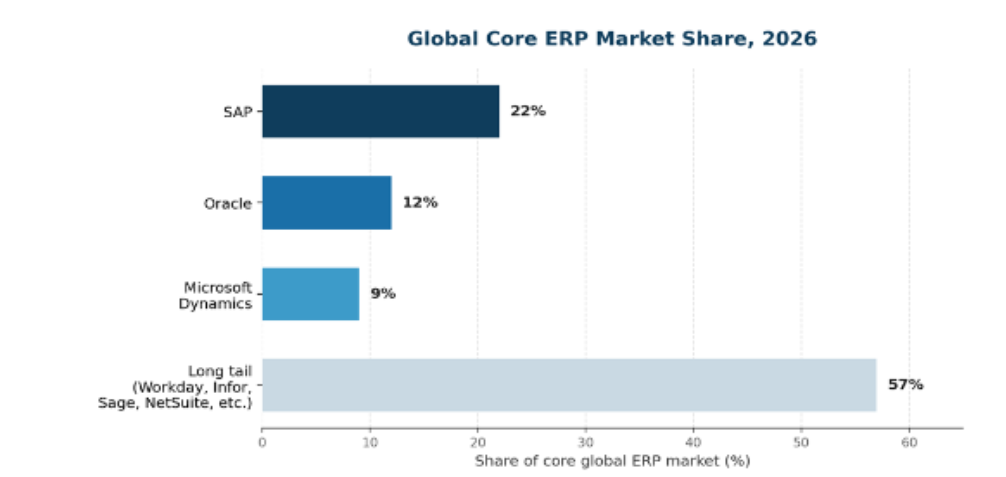
This fragmentation matters for buyers: SAP's strength is complexity at scale, which is exactly why it clusters in capital-intensive, highly regulated industries (energy, government, banking, manufacturing) wherever a business operates in the world.
SAP's presence looks different in every market, shaped by local regulation, industry mix and digital transformation agendas. Five regions illustrate the range: the UAE, the UK, the USA, Africa and Australia.
The UAE is the largest SAP market in the Middle East, with over 1,000 active installations, driven by the UAE Vision 2031 agenda and the looming 2027 ECC end-of-maintenance deadline. SAP runs behind some of the region's largest public and private organisations:
SAP UAE's Managing Director, Marwan Zeineddine, has said the company “infuses AI across our enterprise cloud portfolio” to help customers apply AI-driven insights from finance through to HR and supply chains (The National, 2024).
The UK is SAP's second-largest European market, with over 8,000 organisations running its solutions. Brexit-driven compliance needs and the 2027 ECC deadline are accelerating migration to S/4HANA Cloud.
The US is SAP's single largest national market. 6sense's 2026 tracking counts roughly 9,251 active SAP ERP customers in the United States — about 47.66% of all SAP ERP users worldwide (6sense, 2026).
South Africa is the continent's largest SAP market, with over 1,500 SAP installations, historically holding up to 60–65% of the large-enterprise ERP market share (ERP Research, 2026). SAP has also flagged strong growth momentum in Nigeria, Kenya, Côte d'Ivoire and Ethiopia.
SAP's ANZ customer base is well-funded for transformation but faces a shallower talent pool and a narrower partner ecosystem than Europe or North America, which shapes how organisations plan their move to S/4HANA ahead of 2027 (SAPinsider, 2026).
Sovereign cloud is a recurring theme in this market: SAP has been expanding Australian-hosted cloud capabilities for finance, HR, procurement and supply chain, reflecting local data-residency expectations.
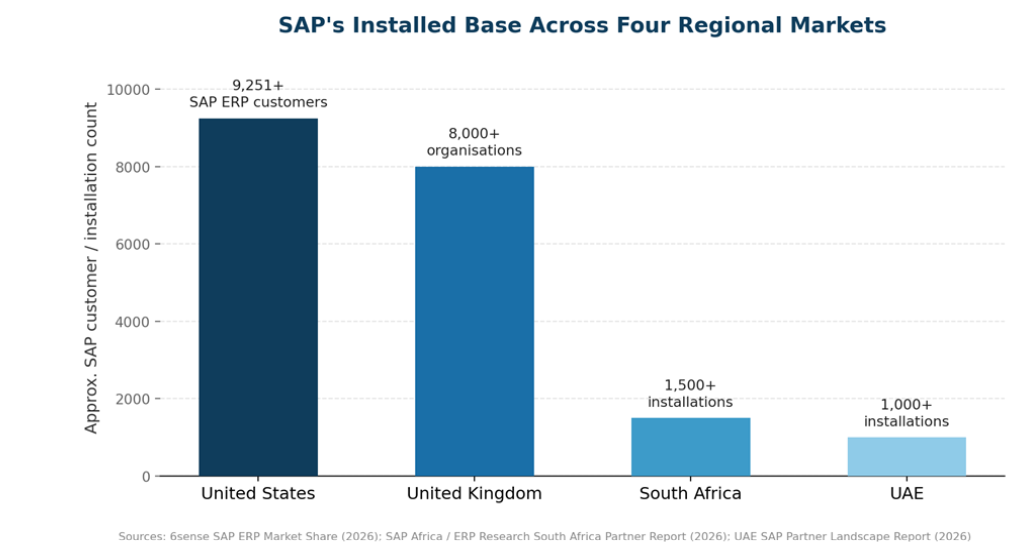
Approx. SAP customer / installation count
10000 - 9,251+ SAP ERP customers
8000 - 8,000+ organisations
9000+ - United States
8000 - United Kingdom UK
1,500+ installations - South Africa
1,000+ installations- UAE
Sources: 6sense SAP ERP Market Share (2026); SAP Africa / ERP Research South Africa Partner Report (2026); UAE SAP Partner Landscape Report (2026)
The following table outlines where SAP is used in real-world deployments across the world.
| Organisation | Country / Region | Industry | SAP Solution |
|---|---|---|---|
| ADNOC | UAE | Oil, Gas & Chemicals | S/4HANA, HCM |
| Emirates Global Aluminium | UAE | Manufacturing | S/4HANA Private Cloud |
| HM Revenue & Customs | UK | Government / Tax | RISE with SAP (S/4HANA Cloud) |
| Bristol & Weston NHS Consortium | UK | Healthcare | SAP Ariba |
| Amazon | USA | Retail / eCommerce | Core financial systems |
| Walmart | USA | Retail | SAP HANA |
| ExxonMobil | USA | Energy | Asset management |
| Alphabet (Google) | USA | Technology | S/4HANA, RISE with SAP |
| BMW | Germany | Automotive | S/4HANA Cloud,FICO |
| MultiChoice | South Africa | Media | S/4HANA |
| Endeavour Group | Australia | Retail | S/4HANA |
| Officeworks | Australia | Retail | S/4HANA |
| JR East | Japan | Transportation | S/4HANA |
Source: Enterprise Software Deployment and Vendor Evaluation Analysis, compiled 2026.
The modules and career paths below apply whether you're working with SAP in Dubai, London, New York or Johannesburg. Explore Edoxi's SAP courses in dubai
SAP gives a business one connected view of its operations, so leaders make decisions from current data rather than end-of-month reports. The benefits below explain why organisations across such different regulatory environments continue to invest in it.
SAP is not the right fit for every business. Very small teams with simple processes may find a lighter tool more practical, and the benefits above depend on how well a business configures and maintains its SAP environment.
SAP offers career paths across finance, supply chain, HR, technical development and consulting, in every market where the software runs. The right module to learn usually follows a person's existing job role, rather than starting from scratch.
| Career Path | Typical SAP Module | Where to Start |
|---|---|---|
| Finance analyst or accountant | SAP FICO | SAP FICO Training |
| Procurement or supply chain specialist | SAP MM | SAP MM Training |
| HR or payroll executive | SAP HCM | SAP HR Training |
| Production planner | SAP PP | SAP PP Training |
| Project coordinator | SAP PS | SAP PS Course |
| Maintenance or asset engineer | SAP EAM | SAP EAM Training |
| Cloud or technical consultant | SAP BTP | SAP BTP Course |
| ERP end user, small business | SAP Business One | SAP Business One Training |
SAP training builds practical, job-ready skills, but it differs from SAP certification and from hands-on project experience. Employers value all three together, so treat training as the first step, not a guaranteed route to a specific salary or job offer.
Edoxi has more than a decade of experience delivering professional training across the world. Learners join classroom sessions in Dubai, Doha, London or live online from anywhere in the world.
Take the next step toward an SAP-focused career. Explore Edoxi's SAP training programmes
SAP in Qatar refers to the use of SAP enterprise resource planning (ERP) solutions to connect and manage business functions such as finance, procurement, sales, inventory, human resources, supply chain, and reporting. SAP provides Qatar-specific functionality designed to address local legal and business requirements, including financial accounting, withholding tax, supplier certificates, bank reconciliation, asset accounting, and reporting (reference source: sap help portal)
Qatar's Digital Agenda 2030 is built around six strategic pillars: digital infrastructure, digital government, digital technologies, digital innovation, digital economy, and digital society. The initiative aims to accelerate digital adoption and use technology to support economic growth
For organizations operating in Qatar, SAP can serve as an integrated business platform that brings financial and operational information together. This is particularly relevant as Qatar continues to promote digital transformation, private-sector development, innovation, and a knowledge-based economy through Qatar National Vision 2030 and the Digital Agenda 2030 (reference:qatar govt official commercial portal)
SAP is relevant to Qatar-based organizations because many businesses operate across multiple departments, projects, suppliers, customers, and financial processes. An integrated ERP environment can help connect these activities rather than keeping information in isolated systems.
Businesses can use SAP to:
According to Qatar's Ministry of Communications and Information Technology, the Digital Agenda 2030 is expected to generate QR 40 billion and create 26,000 jobs by 2030. The ICT sector is also expected to contribute up to 3.5% of non-oil GDP by 2030
This wider digital transformation creates a relevant environment for enterprise technologies such as ERP systems, which help organizations digitize financial, operational, and administrative processes.
| Indicator | Qatar's Target/Reported Figure |
|---|---|
| Digital Agenda 2030 expected economic impact | QR 40 billion |
| Expected jobs from Digital Agenda 2030 | 26,000 by 2030 |
| Expected ICT contribution to non-oil GDP | Up to 3.5% by 2030 |
| Government services targeted for end-to-end digitization | 90% |
| Target annual non-hydrocarbon GDP growth | 4% |
(The figures above come from Qatar's government communications and digital-transformation programmes and provide broader context for understanding the country's technology-driven business environment)
Explore Edoxi's SAP Courses in Qatar and choose the module that fits your career goals.
SAP is increasingly relevant to organizations in Qatar that are modernizing their enterprise operations and moving toward more integrated digital systems. Rather than treating ERP as a standalone finance or accounting tool, organizations can use SAP to connect finance, procurement, supply chain, employees, customers, suppliers, and other core business functions within a unified technology environment.
A notable example is Ooredoo Group, which announced in 2022 that it had selected SAP to support the digital transformation and consolidation of its ERP landscape across most of its operating companies. The initiative was designed to create more integrated processes covering areas such as employees, customers, suppliers, products, finance, and IT. This illustrates how a large organization can use SAP to standardize and connect business operations across multiple entities.
Another Qatar-based example is Qatari Investors Group (QIG). In 2024, the company announced an agreement with SAP to adopt RISE with SAP and SAP S/4HANA Cloud, with its cloud ERP environment hosted in Qatar. The initiative focused on moving important business processes from traditional on-premises ERP systems to a cloud-based environment while supporting the organization's wider digital transformation objectives.
From a business and career perspective, these examples show why SAP knowledge can be relevant in Qatar's enterprise environment. They also demonstrate that SAP implementations are not limited to a single department; depending on the organization's requirements, SAP can support finance, procurement, operations, supply chain, human resources, customer processes, and enterprise reporting.(Sources: SAP News Centre; Ooredoo Group and Qatari Investors Group announcements)
.webp)