Leave your message to get our quick response
edoxi automated message icon

R Programming Training Course

A professional programmer writing R code on a desktop computer in a modern office at night.
​Edoxi’s 40-hour online R Programming training equips you with essential skills in data wrangling, visualisation, and statistical analysis.​ Master R fundamentals, Tidyverse packages (dplyr, tidyr, ggplot2), and machine learning model development through hands-on projects and real-world datasets. This R Programming course enables you to transform data into actionable business intelligence. Enrol now to enhance your analytical capabilities and drive data-driven decisions.
Course Duration
40 Hours
Corporate Days
5 Days
Learners Enrolled
50+
Modules
10
star-rating-icon1
star-rating-icon2
star-rating-icon3
Course Rating
4.9
star-rating-4.9
Mode of Delivery
Online
Certification by

What Do You Learn from Edoxi's R Programming Training

Data Structures and Manipulation in R
Learn R fundamentals and learn to organise, manipulate, and transform data efficiently using core R data structures and tidyverse packages.
Professional Data Visualisation
Create compelling visualisations using ggplot2 with customised themes, colours, and layouts to effectively communicate insights from complex datasets.
Statistical Analysis and Hypothesis Testing
Apply descriptive statistics, probability distributions, and hypothesis testing techniques to make data-driven decisions with confidence.
Machine Learning Model Development
Build predictive models using regression, classification techniques, and evaluate model performance using industry-standard metrics.
Real-world Data Cleaning Techniques
Handle missing values, outliers, and inconsistencies in datasets using tidyr, dplyr, and other specialised packages for effective preprocessing.
Data Manipulation with R
Transform, aggregate, and restructure complex datasets using specialised functions and the tidyverse ecosystem for efficient data processing.

About Our Online R Programming Course

​Edoxi's 40-hour online R Programming course equips you with essential skills in data wrangling, visualisation, and statistical analysis.​ This R Programming training is designed to help individuals and corporate teams leverage data for business insights, focusing on practical applications across various sectors.

The R Programming for Data Analytics training includes extensive sessions where you work with real-world datasets. From setting up R and RStudio to building predictive models and creating sophisticated visualisations, you gain hands-on experience applicable to workplace challenges. Our curriculum combines statistical foundations with modern R programming techniques using the Tidyverse ecosystem.

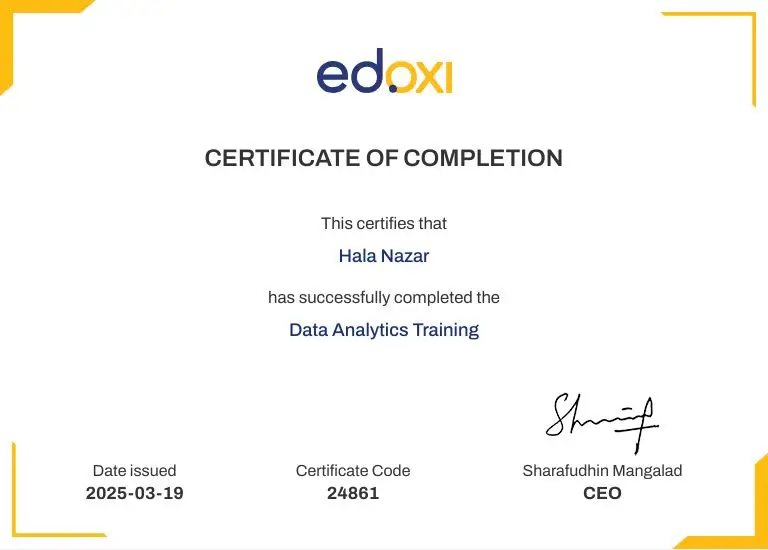
Corporate teams particularly benefit from customisable training approaches, with specialised modules designed to address industry-specific data challenges. This ensures you can directly apply their newly acquired skills within their organisational context, transforming data into actionable intelligence and enhancing decision-making capabilities. Upon completing our R Programming course, you will receive Edoxi’s R Programming Course Completion Certificate. This credential validates your expertise in using R for data analysis, visualisation, and statistical modelling. 

Enrol now to advance your analytical capabilities and drive data-driven success in your organisation.

Key Features of Edoxi's R Programming Training

Hands-on RStudio Environment

Practice in the industry-standard RStudio interface with immediate feedback on coding techniques and analysis approaches.

Tidyverse Package Ecosystem

Learn the powerful collection of R packages designed for data science, including dplyr, tidyr, and ggplot2 for efficient data workflows.

Interactive Coding Sessions

Engage in live coding with instructors to develop practical skills in data manipulation, visualisation, and modelling techniques.

Capstone Analytics Project

Apply all learned concepts in a comprehensive project using real-world datasets from finance, healthcare, or marketing domains.

Statistical Methods Application

Implement hypothesis testing, regression analysis, and other statistical techniques to extract meaningful insights from business data.

Real-World Analytics Activities

Apply learned concepts to analyse data, create visualisations, and deliver actionable recommendations.

Who Can Join Edoxi’s Online R Programming Course

Data and Business Analysts

Professionals working with data who want to enhance their analytical capabilities using R's powerful statistical and visualisation tools.

Finance, Marketing and Operations Professionals

Industry practitioners seeking to apply data-driven approaches to financial modelling, market research, or operational efficiency analysis.

Research and Academic Personnel

Researchers and academics who need to perform statistical analysis and create professional visualisations for their work.

IT Professionals Transitioning to Data Science

Technical professionals looking to expand their skill set into data science and analytics using R programming.

Corporate Teams

Departments seeking to build internal analytical capabilities across team members with consistent methodologies and tools.

Beginners in Data Analytics

Individuals with basic computer literacy who want to start their journey in data analysis with R's accessible programming environment.

R Programming Course Modules

Module 1: Introduction to R & Setup
  • Chapter 1.1: R Programming Fundamentals

    • Lesson 1.1.1: Why R for Data Analytics
    • Lesson 1.1.2: Installing R & RStudio
  • Chapter 1.2: RStudio Environment

    • Lesson 1.2.1: RStudio Interface (Console, Script, Plots)
    • Lesson 1.2.2: Basic R Commands and Operations
Module 2: Data Structures in R
  • Chapter 2.1: Basic Data Structures

    • Lesson 2.1.1: Vectors and Factors
    • Lesson 2.1.2: Lists and Matrices
  • Chapter 2.2: Working with Data Frames

    • Lesson 2.2.1: Creating and Manipulating Data Frames
    • Lesson 2.2.2: Indexing and Subsetting Techniques
    • Lesson 2.2.3: Type Conversions
Module 3: Importing & Exporting Data
  • Chapter 3.1: Data Import Methods

    • Lesson 3.1.1: Working with CSV Files
    • Lesson 3.1.2: Importing Excel Spreadsheets
    • Lesson 3.1.3: Reading JSON and Other Formats
  • Chapter 3.2: Data Export Techniques

    • Lesson 3.2.1: Writing Data to Files
    • Lesson 3.2.2: Database Connections
Module 4: Data Manipulation with dplyr & tidyr
  • Chapter 4.1: Tidyverse Introduction

    • Lesson 4.1.1: Philosophy of Tidy Data
    • Lesson 4.1.2: Core Tidyverse Packages
  • Chapter 4.2: Data Transformation with dplyr

    • Lesson 4.2.1: Filtering and Selecting Data
    • Lesson 4.2.2: Arranging and Summarising Data
    • Lesson 4.2.3: Grouping Operations
  • Chapter 4.3: Reshaping Data with tidyr

    • Lesson 4.3.1: Long and Wide Format Conversions
    • Lesson 4.3.2: Handling Missing Data
    • Lesson 4.3.3: Combining Datasets
Module 5: Data Visualisation with ggplot2
  • Chapter 5.1: Grammar of Graphics

    • Lesson 5.1.1: ggplot2 Philosophy and Structure
    • Lesson 5.1.2: Layers and Aesthetics
  • Chapter 5.2: Creating Basic Visualisations

    • Lesson 5.2.1: Bar Charts and Histograms
    • Lesson 5.2.2: Scatter Plots and Line Graphs
    • Lesson 5.2.3: Boxplots and Violin Plots
  • Chapter 5.3: Advanced Visualization Techniques

    • Lesson 5.3.1: Customizing Themes and Colors
    • Lesson 5.3.2: Multi-Panel Plots with Facets
    • Lesson 5.3.3: Interactive Visualizations
Module 6: Exploratory Data Analysis (EDA)
  • Chapter 6.1: Descriptive Statistics

    • Lesson 6.1.1: Measures of Central Tendency
    • Lesson 6.1.2: Measures of Dispersion
    • Lesson 6.1.3: Identifying Outliers
  • Chapter 6.2: Relationship Analysis

    • Lesson 6.2.1: Correlation Analysis
    • Lesson 6.2.2: Cross-Tabulations
    • Lesson 6.2.3: Pattern Discovery Techniques
Module 7: Statistical Analysis in R
  • Chapter 7.1: Probability Distributions

    • Lesson 7.1.1: Common Distributions in R
    • Lesson 7.1.2: Random Sampling
  • Chapter 7.2: Hypothesis Testing

    • Lesson 7.2.1: t-Tests and z-Tests
    • Lesson 7.2.2: ANOVA
    • Lesson 7.2.3: Chi-Square Tests
  • Chapter 7.3: Regression Analysis

    • Lesson 7.3.1: Simple Linear Regression
    • Lesson 7.3.2: Multiple Regression Basics
Module 8: Introduction to Machine Learning with R
  • Chapter 8.1: Machine Learning Fundamentals

    • Lesson 8.1.1: Supervised vs. Unsupervised Learning
    • Lesson 8.1.2: Train-Test Splits
  • Chapter 8.2: Classification Models

    • Lesson 8.2.1: Logistic Regression
    • Lesson 8.2.2: Decision Trees
    • Lesson 8.2.3: Random Forests
  • Chapter 8.3: Model Evaluation

    • Lesson 8.3.1: Confusion Matrices
    • Lesson 8.3.2: Accuracy, Precision, Recall
    • Lesson 8.3.3: RMSE and Other Metrics
Module 9: Working with Real-World Data
  • Chapter 9.1: Large Dataset Handling

    • Lesson 9.1.1: Memory Management in R
    • Lesson 9.1.2: Efficient Data Processing
  • Chapter 9.2: Data Cleaning Challenges

    • Lesson 9.2.1: Complex Missing Data Patterns
    • Lesson 9.2.2: Inconsistent Formatting
    • Lesson 9.2.3: End-to-End Workflow Practice
Module 10: Capstone Project & Presentation
  • Chapter 10.1: Project Development

    • Lesson 10.1.1: Problem Definition and Data Selection
    • Lesson 10.1.2: Analysis Implementation
  • Chapter 10.2: Results Presentation

    • Lesson 10.2.1: Creating Compelling Data Stories
    • Lesson 10.2.2: Communicating Insights Effectively

Download R Programming Course Brochure

Real-World Projects and Case Studies in Our R Programming Course

The R Programming course features extensive hands-on projects and case studies using real-world datasets and the RStudio environment.​ You will work on practical data analytics challenges, including:

Projects

  • Comprehensive Data Analytics Capstone

    You can choose a dataset (finance, healthcare, marketing, etc.), perform data cleaning, exploratory data analysis, visualisation, and predictive modelling, then present insights and recommendations based on their findings.

  • R and RStudio Setup

    Set up and configure the R environment and RStudio interface, write simple scripts, and run basic commands to establish a functional analytics workspace.

  • Data Structures Implementation

    Organise and manipulate datasets using R's data structures, including vectors, factors, lists, matrices, and data frames, with exercises.

  • Dataset Loading and Saving

    Practice importing data from various sources (CSV, Excel, JSON) and exporting processed datasets back to different file formats.

  • Data Transformation Workshop

    Clean, transform, and prepare datasets for analysis using tidyverse packages to handle real-world data challenges like missing values and inconsistent formats.

  • Visualisation Development

    Create professional-level plots and dashboards using ggplot2 with customisation options to effectively communicate analytical findings.

R Programming Course Outcome and Career Opportunities

​Our R Programming for Data Analytics course delivers significant corporate benefits, empowering organisations to leverage data more effectively.​ Upon completion, your team will contribute to:

Course Outcome Image
Gain proficiency in the R ecosystem by mastering R fundamentals and core data structures. Learn data manipulation with the Tidyverse packages (dplyr and tidyr) and create professional data visualisations using ggplot2.
Develop robust statistical analysis skills to apply descriptive statistics, probability distributions, and hypothesis testing for confident, data-driven decision-making.
Learn to build and evaluate machine learning models using regression and classification techniques with industry-standard performance metrics.
Master effective data cleaning and preparation methods to handle missing values, outliers, and inconsistencies for reliable analytical outcomes.
Apply all learned concepts in a comprehensive capstone project using real-world datasets to solve practical business problems.
Strengthen analytical problem-solving abilities by performing exploratory data analysis and interpreting insights effectively. Communicate your results through clear, impactful visualisations and well-structured reports.

Career Opportunities After Completing the R Programming Training

  • Data Analyst
  • Data Scientist
  • Statistical Analyst
  • Quantitative Analyst
  • Data Engineer
  • R Developer/Programmer
  • Machine Learning Engineer

R Programming Training Options

Online Training

  • 40-hour online R Programming Training

  • Virtual RStudio Environments

  • Flexible Scheduling for Working Professionals

  • Session Recordings for Review

  • Online Support for Coding Challenges

Corporate Training

  • 5-day R Programming Corporate Training

  • Customised Program Based on Company Data

  • Industry-Specific Case Studies

  • Training delivered at a selected hotel, client premises, or Edoxi

  • Fly-Me-A-Trainer Option

Do You Want a Customised Training for R Programming?

Get expert assistance in getting you R Programming Course customised!

How to Get a R Programming Certification?

Here’s a four-step guide to becoming a certified R Programming professional.
Do You Want to be a Certified Professional in R Programming?

Join Edoxi’s R Programming Course

Why Choose Edoxi for Online R Programming Training?

With many options available, Edoxi proves to be the best choice. The following are the reasons why Edoxi’s R Programming training is the ideal option for you:

Industry-Relevant Analytics Curriculum

Our course covers the complete R ecosystem, including tidyverse, ggplot2, and statistical packages specifically configured for corporate data analytics workflows.

Business-Focused Implementation Approach

We emphasise practical business applications over theory, with instructors who bring extensive experience in applying R analytics to corporate decision-making processes.

Customised Corporate Training Solutions

Our flexible delivery formats ensure training aligned with your organisation's specific data challenges and industry context for maximum relevance.

Enterprise-Grade Analytics Practices

Our curriculum focuses on scalable, reproducible analytics methods used by leading companies for data-driven decision making and reporting.

Comprehensive Data Skills Development

Build your analytics capabilities with our related courses in Python, Power BI, and Advanced Statistical Analysis for continued professional growth.

students-image

Edoxi is Recommended by 95% of our Students

Meet Our Mentor

Our mentors are leaders and experts in their fields. They can challenge and guide you on your road to success!

mentor-image

Athar Ahmed

Athar Ahmed is a skilled technical trainer with more than 15 years of experience in both educational institutions and the software development business. Athar specialises in technology stacks including Advanced Excel, Python, Power BI, SQL, .NET, Java, PHP, Full Stack Web Development, Agile, Data Science, Artificial Intelligence, Data Analytics, and DevOps.

He holds several certifications and licenses that underscore his expertise in the field. These include MCTS (Microsoft Certified Technology Specialist), MCP (Microsoft Certified Professional), and a Certificate in Artificial Intelligence and Machine Learning for Business. He also completed a Certificate Course in Unix, C++, and C# from CMC Academy, among other qualifications.

Athar also holds a Bachelor of Computer Applications (BCA) and a Master of Computer Applications (MCA). Additionally, he earned a Master of Technology (M. Tech) in Machine Learning and Artificial Intelligence, as well as a Doctorate of Philosophy (PhD) in Computer Applications.

Locations Where Edoxi Offers R Programming Course

Here is the list of other major locations where Edoxi offers R Programming Course

FAQ

What prerequisites are needed for this R Programming course?

Basic computer literacy is the only essential requirement. While familiarity with statistics is helpful, the course includes all necessary statistical concepts for complete beginners.

Can I use my company's data for projects during the R Programming course?
Yes, we encourage corporate teams to work with their actual business data (with appropriate confidentiality measures). This makes the R Programming training immediately applicable to your specific challenges.
How can I measure the ROI of this R Programming training for my team?
We help you evaluate ROI through clearly defined pre-training benchmarks and post-training performance metrics. These focus on measuring time efficiency, accuracy improvements, and enhanced analytical capabilities that lead to tangible business impact.
What is the average salary of an R Programming certified professional?

R is a core skill across data roles, with salaries typically ranging from $86,000 to $174,000 per year based on role and experience. Below are the average salaries for common R-related positions:

Job Role Average Salary (USD)
Data Analyst $91,000
Statistician $108,000
Data Scientist $112,000–$151,000
Data Engineer $131,000
Data Architect $174,000
Can the R Programming corporate training be split across multiple weeks?

Yes, we offer flexible scheduling for corporate clients. The 5-day program can be delivered as weekly sessions or split according to your team's availability and workload considerations.