Request a Callback

+971 4380 1666
 Sep 23, 2026
|
Key Takeaways: Artificial Intelligence in Education
|
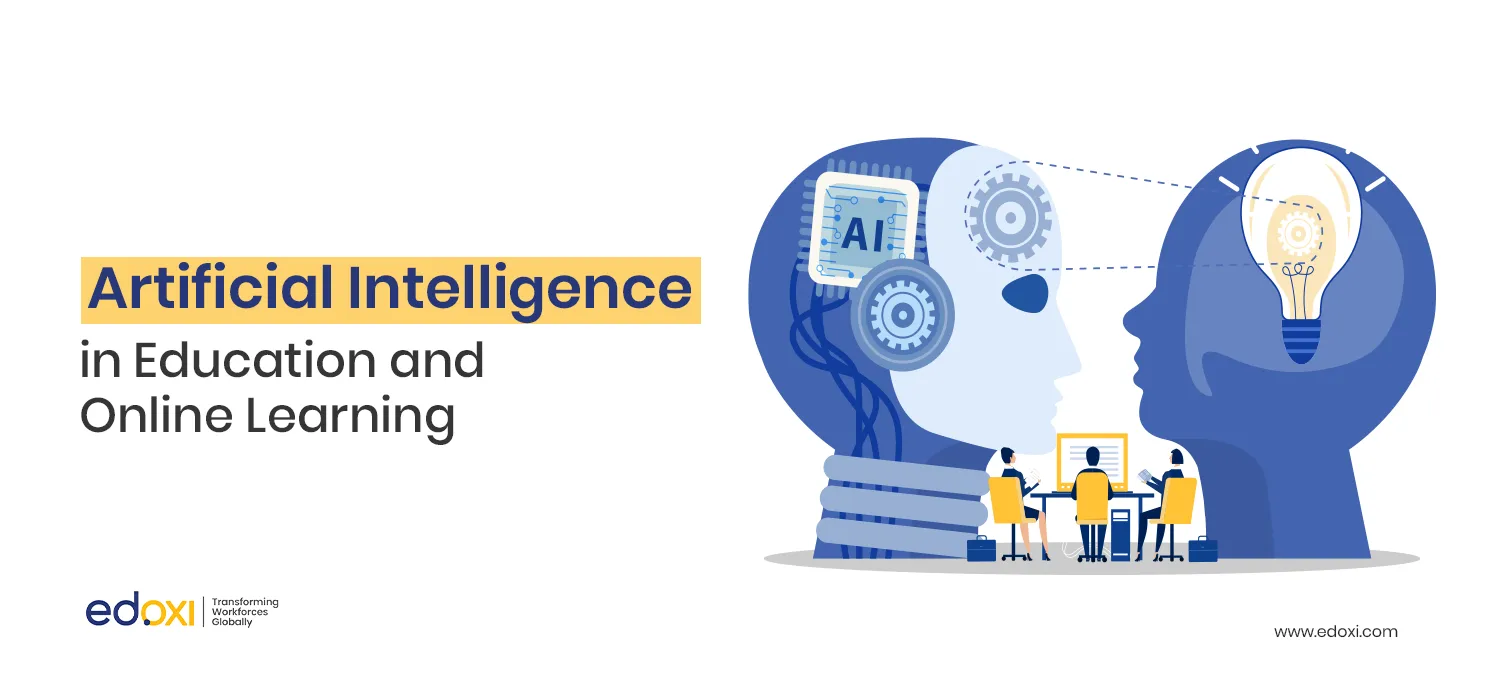
Artificial Intelligence (AI) is changing how people learn, teach, create educational content, and develop professional skills. However, AI is not a substitute for good teaching. Its value depends on how well it is designed, implemented, and governed.
In this blog, we explore how artificial intelligence is transforming edTech and online learning. Also examine the benefits and challenges of AI in education, AI training and upskilling, responsible implementation, and the future of AI-powered learning.
Artificial intelligence in edTech refers to the use of AI technologies to support teaching, learning, assessment, content development, learner engagement, and educational administration. AI technologies used in education can include:
AI-enabled systems can respond to learner data and interactions. This makes it possible to provide more dynamic learning experiences. The OECD describes digital education as an ecosystem involving learning management systems, student information systems, digital assessment, teaching and learning tools, and the people who use them. AI is increasingly becoming part of this ecosystem.
AI is not limited to education; for a broader overview, explore the top 10 Artificial Intelligence applications.
At a basic level, AI systems process data and use models to generate predictions, recommendations, classifications, or content. For example, an online learning platform may analyse assessment results and identify a learner's knowledge gaps. It can then recommend:
The scale of online learning creates a challenge. A teacher can provide highly personalised support to a limited number of learners. An online platform may serve thousands or millions of users.
AI can help provide certain forms of personalised support at a greater scale. The World Bank notes that AI can provide personalised learning, real-time feedback, automated assessments, and virtual tutoring. It also highlights AI's potential to support education in contexts affected by teacher shortages and dropout challenges.
This is one reason AI is becoming an important technology skill beyond education. Professionals who want to understand the wider technology landscape can also explore how to build a career in Artificial Intelligence.
AI is being applied across different stages of the learning process.
AI-personalised learning uses learner information to provide more relevant learning experiences. A system may consider previous assessment results, learning progress, knowledge gaps, course activity, learning pace and responses to practice questions. The objective is to make learning more responsive to individual needs. For example, two learners studying the same mathematics course may receive different practice activities based on their performance.
AI adaptive learning dynamically adjusts elements of a learning experience. A learner who demonstrates strong understanding may progress to more difficult material. A learner who struggles may receive additional explanations or practice. Adaptive learning can be useful in mathematics, language learning, coding, test preparation, and professional education and technical training
However, adaptive technology does not automatically create effective learning. The underlying curriculum, learning objectives, assessment design, and content quality still matter.
AI tutoring systems use AI to provide interactive learning support. An AI tutor can potentially answer learner questions, explain concepts, provide hints, generate practice problems, offer feedback, simulate conversations and support revision. The World Bank identifies virtual tutoring as one of the emerging applications of AI in education.
An AI virtual tutor can make online learning more conversational. Instead of simply reading a lesson, learners can ask follow-up questions. For example: "Can you explain this concept using a real-world example?" The system can generate a response based on the question and available context.
Assessment is another major application of AI in EdTech. AI assessment tools can support automated grading, formative assessment, feedback generation, question generation, knowledge-gap identification and performance analysis
Automation can reduce the time spent on repetitive assessment activities. But not every assessment is suitable for automation. Complex written responses, creative work, nuanced reasoning, and high-stakes decisions may require human evaluation.
AI-driven data analytics uses learner data to identify patterns in engagement and performance. A platform may analyse assessment scores, course completion, time spent on activities, repeated errors, learning progress and engagement patterns. Educators can use these insights to identify learners who may need additional support.
An AI-powered learning platform can bring several AI capabilities together. Depending on the platform, this may include personalised recommendations, adaptive learning, AI tutoring, automated feedback, learning analytics, AI-generated practice and content recommendations. This creates a more responsive learning environment than a simple library of online courses.
Online learning is particularly suited to AI because digital platforms already generate large amounts of learner interaction data.
Online AI education can support learners before, during, and after a lesson. Before learning, AI can recommend relevant content. During learning, it can provide explanations or practice. After learning, it can analyse performance and recommend revision. This creates a continuous feedback loop.
AI-powered online courses can combine traditional instructional content with AI-driven features. Examples include AI tutors, adaptive quizzes, personalised AI learning paths, automated feedback, AI-generated practice activities and conversational assistants. The goal should be to improve learning outcomes rather than simply add AI features.
An AI learning management system (LMS) can use AI to improve course discovery, recommendations, learner support, and analytics. For organisations, this can connect learning data with professional development and skills programmes. The OECD considers learning management systems an important component of broader digital education ecosystems.
AI tools for students can support concept explanations, study planning, practice questions, language learning, coding assistance, summarisation and revision. The most effective use of these tools is not always getting an answer quickly. AI can be more valuable when it helps students understand the reasoning behind an answer.
AI tools for teachers can assist with repetitive preparation tasks. Potential uses include lesson planning, quiz creation, question generation, content adaptation, activity ideas, feedback assistance and resource development. UNESCO's AI Competency Framework for Teachers highlights the need for educators to develop knowledge, skills, and values for responsible AI use in teaching and professional learning.
AI offers several potential benefits when it is aligned with sound instructional practices.
AI can help learners receive content and support that reflects their current level of understanding. This can be especially useful in large online courses where one teacher cannot provide individualised support to every learner.
AI can provide immediate feedback in suitable learning activities. Fast feedback can help learners identify mistakes while the material is still fresh.
AI can reduce some repetitive tasks. This can give educators more time for teaching, mentoring, classroom interaction, individual support and curriculum development. The OECD notes that AI can potentially free teachers' time for teaching, provided the right conditions and safeguards are in place.
AI is also changing professional roles outside education. For example, the impact of Artificial Intelligence on HR roles shows how AI is changing recruitment, workforce management, learning, and development.
AI can support accessibility through technologies such as translation, speech recognition, conversational interfaces, text adaptation and assistive learning features. However, accessibility depends on how the system is designed and deployed.
AI can help institutions identify patterns that are difficult to detect manually. This can support decisions about learner support, course design, content effectiveness, engagement, and student progression.
One major advantage of digital AI systems is scalability. A virtual tutor can potentially support many learners simultaneously. That does not mean AI can replicate every benefit of human teaching. It means certain types of support can be delivered at a greater scale.
Generative AI has created a new category of educational applications. Unlike conventional AI systems that may classify or recommend information, generative AI can produce new text, images, code, explanations, questions, and other content. Generative AI in education can assist with explanations, lesson materials, summaries, practice questions, examples, study resources, course drafts and feedback.
For readers who want to understand the technology itself, What Is Generative AI and How Does It Work? provides a broader introduction.
Prompt engineering involves designing effective instructions for AI systems. For education, useful prompting practices include giving clear context, defining the learner level, specifying the desired format, providing constraints, asking for examples, requesting multiple explanations and evaluating the output. Prompting is useful, but AI literacy goes beyond prompt writing. Learners also need to understand how to evaluate AI-generated information.
AI is not only a technology students use. AI courses are also becoming a subject that students, teachers, and professionals need to understand.
AI training for students should combine technical understanding with responsible use. Students can learn AI fundamentals, AI ethics, data literacy, prompting, critical evaluation, responsible AI use and AI-assisted problem-solving. UNESCO's AI Competency Framework for Students defines 12 competencies across four dimensions: human-centred mindset, ethics of AI, AI techniques and applications, and AI system design.
Teachers need training that goes beyond learning how to operate a chatbot. AI training for teachers can cover AI fundamentals, AI-assisted teaching, AI pedagogy, ethical AI use, assessment, privacy, and professional development
AI training for beginners should focus on foundational understanding before advanced technical concepts. A beginner programme can introduce:
What AI is
How machine learning works
What generative AI is
What large language models are
How to use AI tools
How to evaluate AI outputs
AI ethics and privacy
Practical applications
This approach makes AI education accessible to non-technical learners.
Professionals increasingly need AI skills that relate directly to their roles.
For example:
Professionals interested in technical career paths can also read How to Get Started as an AI Developer.
Corporate AI training helps organisations prepare employees for changing workflows. Training may include:
The need for such training is supported by changing workforce requirements. The World Economic Forum's Future of Jobs Report states that AI and big data are the fastest-growing skills, followed by networks and cybersecurity and technological literacy.
AI upskilling means adding AI capabilities to an existing role. AI reskilling involves developing substantially different capabilities for a changing role. Both are becoming important as AI changes workplace tasks. The World Economic Forum reports that employers expect 39% of workers' existing skill sets to be transformed or become outdated between 2025 and 2030.
For a deeper look at this transition, explore Why Upskill in the Age of Artificial Intelligence? and How to Upskill Yourself for AI Jobs.
Demand for AI certification, AI courses online, and structured online AI training is growing. Learners should evaluate an AI certification based on:
A certificate can demonstrate learning. It does not automatically demonstrate practical AI proficiency.
AI can create significant value, but it also introduces risks.
Educational platforms can process sensitive learner information. This may include student profiles, academic records, assessment results, learning activity and behavioural information. AI privacy in education therefore requires clear data policies.
AI systems can reflect biases in their training data, design, or implementation. In education, this can affect recommendations, automated assessments, content generation, student profiling and predictive systems.
AI ethics in education involves questions about fairness, transparency, accountability, privacy, human agency, inclusion, safety, and academic integrity. AI adoption should therefore be guided by educational values rather than technology alone.
Generative AI has changed how institutions think about assignments and assessment. Students may use AI to generate essays, solve problems, or produce code. This creates challenges for traditional assessment methods. Top training institutions may need to place greater emphasis on process-based assessment, oral evaluation, projects, classroom activities, critical thinking and authentic tasks. The goal should be to assess actual learning rather than simply detect AI use.
AI systems can produce confident but incorrect information. This is particularly important in education because learners may treat an authoritative-sounding answer as factual. Teachers and learners should therefore verify important information using reliable sources.
AI benefits depend on access to devices, Internet connectivity, digital skills, quality educational resources and technical support.
AI can make tasks easier. That is useful until convenience replaces learning. If learners use AI to complete every task without understanding the reasoning, they may reduce opportunities to develop independent problem-solving skills. The right objective is AI-assisted learning, not AI-dependent learning.
AI adoption should start with a clear educational need, not a technology trend. Institutions should:
Identify challenges such as low engagement, slow feedback, teacher workload, or limited tutoring support before choosing an AI solution.
Evaluate tools for educational value, accuracy, accessibility, usability, data practices, cost, and scalability.
Set clear policies for data collection, storage, access, retention, security, and third-party sharing.
Provide practical AI training covering capabilities, limitations, responsible use, privacy, assessment, and classroom integration.
AI can provide recommendations, but humans should remain responsible for high-impact decisions involving assessment, progression, and student support.
Test AI solutions on a small scale and measure learning outcomes, engagement, accuracy, workload, satisfaction, cost, and unintended effects before expanding.
Create clear policies covering approved tools, data protection, academic integrity, transparency, responsibilities, and risk management. The OECD recommends strong governance, digital competencies, infrastructure, and risk management for effective AI use in education.
The future of AI-powered learning will likely involve greater integration across LMS platforms, AI tutors, adaptive learning, assessment, learning analytics, course creation, and corporate training.
AI can create more personalised learning pathways by combining learner progress, skills, assessments, and preferences. However, increased use of learner data also makes privacy and governance essential.
AI is more likely to augment teachers than replace them. It can reduce repetitive tasks while allowing educators to focus more on mentoring, feedback, learning design, critical thinking, and student support. UNESCO highlights AI pedagogy and professional development as important teacher competencies.
AI education will increasingly connect with workforce development. The World Economic Forum's Future of Jobs Report identifies AI and big data as the fastest-growing skills, highlighting the need for AI-ready learners across education and professional training.
The future of AI in education depends on responsible implementation. UNESCO promotes human-centred, ethical, safe, and equitable AI, while the OECD highlights privacy, equity, quality, and digital skills. The goal is not to replace human education with AI but to use AI where it genuinely improves learning.
Related perspectives include The 10 Jobs Most at Risk of Being Replaced by AI and Will Artificial Intelligence Take Over Human Jobs by 2030?.
Artificial intelligence is moving from an emerging EdTech capability to an increasingly important part of the digital education ecosystem. Its applications now extend across personalised learning, adaptive learning, AI tutoring, assessment, learning analytics, online courses, content creation, generative AI, and workforce training.
For students, AI can provide more personalised support and new ways to practise and explore concepts. For teachers, it can assist with planning, content creation, feedback, and selected administrative tasks. For EdTech companies, AI can enable more adaptive and responsive learning platforms. For employers, AI training, AI upskilling, reskilling, and AI literacy are becoming increasingly important as workforce skills change.
But AI is not a solution simply because it is advanced. The strongest education systems will be those that connect AI with sound pedagogy, qualified educators, reliable content, learner privacy, accessibility, and responsible governance.
Here is the list of other major locations where Edoxi offers Artificial Intelligence Course
Artificial Intelligence Course in Dubai|Artificial Intelligence Course in Qatar