Request a Callback

+971 4380 1666
 Sep 29, 2026
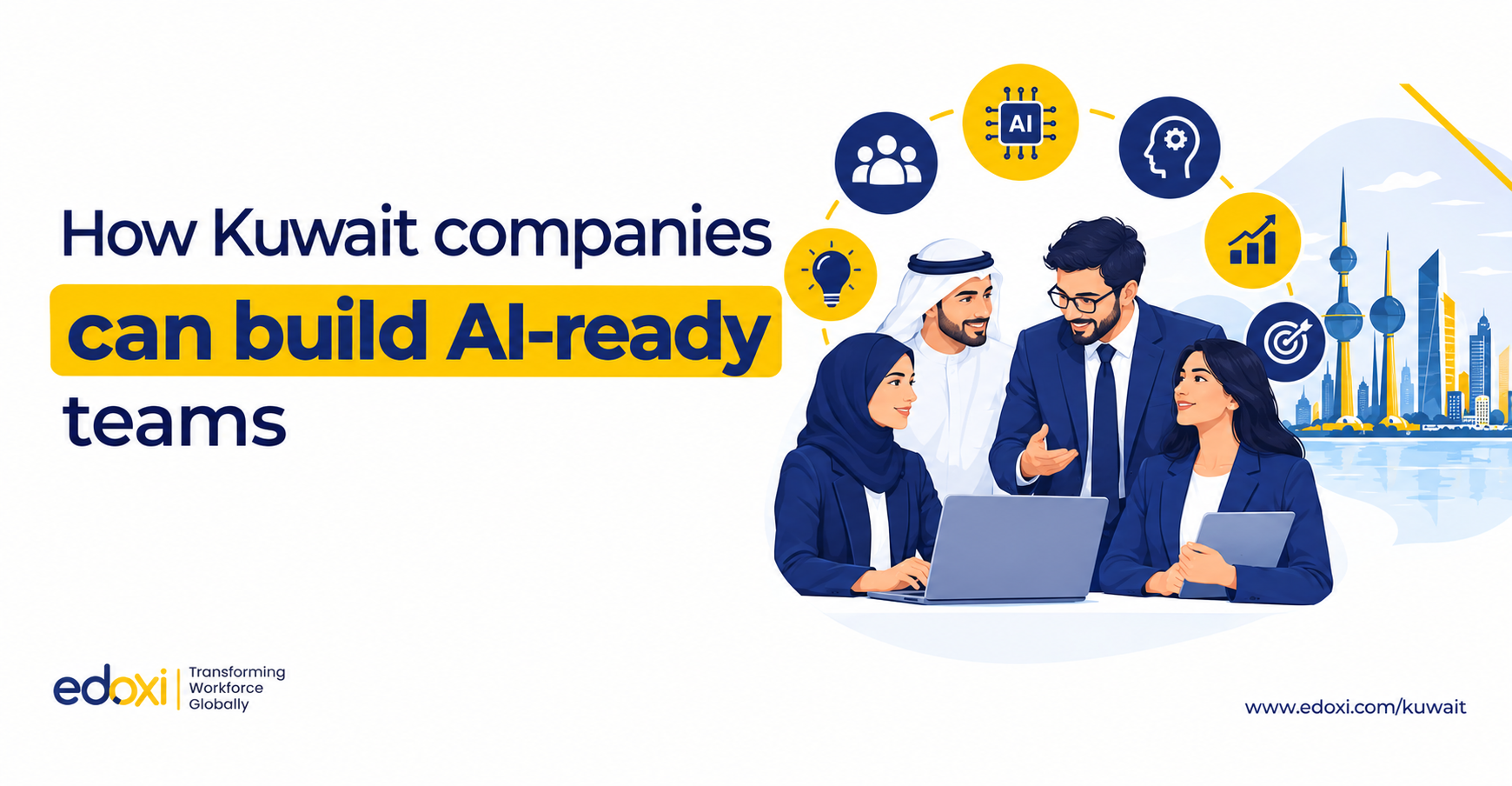
Kuwait companies can build AI-ready teams in Kuwait by mapping skill gaps role by role, training staff on the tools they already use, naming an AI lead in each department, and tracking adoption monthly.
PwC's 2025 Middle East Workforce Hopes and Fears Survey found that 75% of regional employees had used AI at work in the past year, with 82% reporting improved productivity.
Structured training turns that regional momentum into team-wide capability inside a single company.
A finance manager in Kuwait City gets Copilot access on a Monday. By Friday, she has used it twice, both times to fix a typo. Her employer bought a licence. Nobody taught her what the tool was actually for.
That gap between access and ability is the real story behind AI adoption in Kuwait. The country has the policy direction.
Kuwait's draftNational AI Strategy 2025–2028, aligned with Kuwait Vision 2035, outlines proposed priorities for AI across government, energy, finance, and workforce development.
What most companies lack is a plan for the people who have to use the tools.
This blog breaks down what building AI-ready teams in Kuwait actually takes: gap analysis, role-based training, sector examples, and a decision matrix you can apply this quarter.
It's worth understanding the wider context first, since AI is already reshaping the future of work and everyday life, not just isolated tasks inside a single department.
| Nos | Content |
|---|---|
| 1 | What Does an AI-Ready Workforce Need?
|
| 2 | How Can Kuwait Companies Identify AI Skills Gaps?
|
| 3 | How Can Companies Prepare Employees for AI? |
| 4 | How Can Kuwait Companies Upskill Employees for AI? |
| 5 | Why is Corporate Training Important for AI Adoption? |
| 6 | What Does AI Adoption Look Like Across Kuwait's Sectors? |
| 7 | How Kuwait's Government Supports Skills Development |
| 8 | How Do You Build AI-Ready Teams in Kuwait? |
| 9 | Key Takeaways |
| 10 | FAQs: Building AI-Ready Teams in Kuwait |
For practical workforce planning, an AI-ready team can be built around three capabilities:
Skill without governance creates risk. Governance without skill creates a licence nobody opens
Many non-technical roles can begin building AI capability without requiring a computer science degree. Four capabilities cover most jobs:
The World Economic Forum'sFuture of Jobs Report 2025estimates that 39% of workers' core skills will change by 2030, with AI and big data ranking as the fastest-growing skills.
Technical fluency and human judgement now sit side by side, not in competition.
Some employees will want to go further than day-to-day tool use, and for them, a structured look at how tobuild a career in artificial intelligenceis a natural next step.
Companies identify AI skills gaps by auditing what each department actually does, then testing whether current staff can do it with AI support.
A skills audit beats a generic AI course every time, because it points training budget at the roles where it pays off fastest.
AI tools themselves are increasingly part of that diagnosis, and it's worth reading up onhow AI is helping to identify skills gaps and future jobsbefore gaps show up in performance reviews instead of in a planning session.
A practical starting point is to audit functions with high volumes of repetitive text, information, or data work:
These functions offer relatively clear opportunities to test AI-assisted workflows and measure changes in time, output quality, and error rates.
Companies prepare employees for AI by replacing one-off workshops with role-based, hands-on training tied to real tasks.
A single company-wide seminar rarely changes daily behaviour. AI training built around each team's actual workflow does.
| Approach | Traditional AI Training | Role Based AI Upskilling |
|---|---|---|
| Format | One-off seminar, same content for all | Ongoing sessions, tailored per department |
| Content | Generic AI overview | Tools mapped to real daily tasks |
| Typical measurement | Attendance | Usage, task completion, and output quality |
Once training moves past the pilot stage, the practical question becomeshow to utilise AI to increase employee productivityin ways staff actually keep using after the novelty wears off.
Aneesh Raman, LinkedIn's workplace expert (then VP Workplace Expert, now Chief Economic Opportunity Officer), told Fortune in 2024 that most staff don't need to learn to code. The goal is to "communicate with AI in the same way you communicate with humans."
Kuwait companies upskill employees for AI by matching the training model to company size and in-house capacity, not by copying whatever a competitor announced.
A 30-person firm and a 3,000-person bank need different paths to the same goal.
For employees wondering where to start on their own, it helps to knowhow to upskill yourself for AI jobs that will produce millionsof new roles over the coming decade.
| Company Profile | Recommended Path | Illustrative Implementation Timeframe |
|---|---|---|
| SME, limited L&D team | Outsourced AI corporate training, cohort-based | 4–8 weeks |
| Mid-size, growing tech use | Blended: external certification + internal AI champions | 2–3 months |
| Large enterprise, multiple business units | Department-led training with a central AI governance team | Ongoing, phased rollout |
These timeframes are editorial estimates, not an industry benchmark. Training providers such as Edoxi offer corporate AI anddata science trainingthat organisations can use to support this kind of role-based workforce upskilling.
PwC's 29th Global CEO Survey provides additional context on AI and capability building in Kuwait.Khalid AlShatti, Country Senior Partner, Kuwait, PwC Middle East, said that "CEOs in Kuwait are investing, transforming and scaling today," pointing to investment, AI adoption, and capability building among Kuwaiti businesses.
Corporate trainingmatters because buying an AI licence and building the capability to use it are two separate projects, and only the second one produces results.
A 2026 report from theInternational Labour Organisation, produced with the Kuwait Chamber of Commerce and Industry, examined how enterprises in Kuwait's private sector are adopting AI and whether it is translating into measurable productivity gains.
It found that workforce preparedness, skills, data maturity, and governance are the conditions that determine whether AI moves past a pilot stage into results that hold up at scale.
Without that groundwork, tools sit unused or get applied inconsistently across teams. With it, the same licence starts showing up in faster turnaround times, fewer errors, and staff who trust the output enough to act on it.
AI adoption in Kuwait is developing across government, energy, financial services, and other major sectors, supported by national digital transformation priorities and rising investment in AI capabilities.
| Sector | Potential AI Enabled Workflow | Workforce Capability Needed |
|---|---|---|
| Banking | Fraud detection, customer service, document analysis | Review AI flags and validate outputs |
| Telecom | Network analytics and optimisation | Interpret AI recommendations |
| Logistics | Demand forecasting and route planning | Check model assumptions and exceptions |
| Government | Digital services and administrative automation | Use AI responsibly and protect sensitive data |
| Energy | Forecasting and operational analytics | Interpret AI-supported recommendations |
| Healthcare | Predictive analytics and administrative support | Verify outputs against clinical judgement |
| Marketing & Customer Service | Content drafting, chat support, and customer insights | Edit for accuracy, tone, and brand fit |
These are workflows the technology supports, not a claim that every Kuwait company has deployed them at scale.
PwC's 2025 Middle East Workforce Hopes and Fears Survey found that 82% of regional employees said AI had improved their productivity, compared with 77% globally. That gap points to appetite. It does not close on its own.
Kuwait's draft National AI Strategy 2025–2028 names workforce empowerment as one of its core pillars, alongside establishing Kuwait as an AI hub and building sectoral AI use cases.
That pillar calls for AI skill-development programmes and training initiatives, digital literacy campaigns to raise public awareness, and scholarships and innovation hubs to nurture local talent.
On the ground, this work runs partly through thePublic Authority for Applied Education and Training (PAAET), Kuwait's national body for applied and vocational education.
Its Continuing Education Center already runs short courses covering IT certifications, data analysis, and digital marketing, alongside PAAET's broader technical and vocational colleges.
For readers hiring into security-adjacent roles, it's worth trackingcybersecurity job trends in Kuwait Cityalongside broader AI upskilling plans.
For companies building AI-ready teams, that public infrastructure is a resource to plug into, not a substitute for role-based training inside the business.
You build AI-ready teams in Kuwait by pairing tool access with structured, role-specific training, and by treating AI literacy as one factor in relevant hiring and development decisions, not an afterthought.
Microsoft's 2025 Work Trend Indexfound that 47% of leaders list upskilling existing employees as a top workforce strategy for the next 12-18 months, and 51% of managers expect AI training to become a core team responsibility within five years.
The simple 6 steps to build AI-ready teams in Kuwait are illustrated in the infographic below: