Request a Callback

+971 4380 1666
 Nov 09, 2026
Corporate training in Kuwait is moving towards AI, data analytics, cybersecurity, leadership, project management, and digital skills. Companies also favour blended learning and skills-based assessment.
Kuwait Vision 2035, the National AI Strategy, and a visible skills gap are driving this shift.
Imagine a finance team in Kuwait City on a Monday morning. Two years ago, they built the weekly report by hand. Now a tool drafts it in minutes. Nobody lost their job, but the job changed shape.
That story is playing out in many offices. Tools move fast, and skills have to keep up. Corporate training in Kuwait is how companies close that gap.
This guide covers what is changing, which industries need which skills, and how to choose a provider. It uses plain words and real data from PwC, the World Economic Forum (WEF), the US Commercial Service, and the Kuwait Skills programme
Table of Contents
| Nos | Contents |
|---|---|
| 1 | What Is Corporate Training in Kuwait? |
| 2 | What Are the Top Corporate Training Trends in Kuwait? |
| 3 |
a) Why Is AI and Generative AI Training Growing?
b) Why Do Teams Need Data Analytics and Power BI Skills?
c) Is Cybersecurity Awareness Part of Every Training Plan?
d) How Is Leadership Development Changing?
e) Why Is Project Management Still a Top Training Area?
f) What Digital Transformation Skills Do Employees Need?
g) Which Soft Skills Matter Most at Work?
h) What Is the Difference Between Upskilling and Reskilling?
i) Why Are Companies Moving to Blended Learning?
j) What Is Skills-Based Learning and Assessment?
|
| 4 | What Corporate Training Does Each Industry in Kuwait Need? |
| 5 | Why Are Kuwait Companies Investing in Employee Training? |
| 6 | How Can HR and L&D Teams Choose Training Priorities? |
| 7 |
How Do You Choose a Corporate Training Provider in Kuwait?
a) Does the provider understand your industry?
b) Can the training be customised?
c) How are the skills assessed?
d) Is training available onsite, online, or blended?
e) How Is Training ROI Measured?
|
| 8 |
What Is the Future of Corporate Training in Kuwait?
|
| 9 |
Key Takeaways
|
| 10 |
FAQs: Corporate Training Trends in Kuwait
|
Corporate training is structured learning that a company gives its staff to build job skills. It can be a workshop, an online course, or coaching on the job.
Think of it as a company investing in its own people. Topics range from software and safety to leadership and customer service.
Good training links to a business goal, such as faster reporting or fewer errors. If you want the basics first, this guide to corporate trainingexplains the types and benefits.
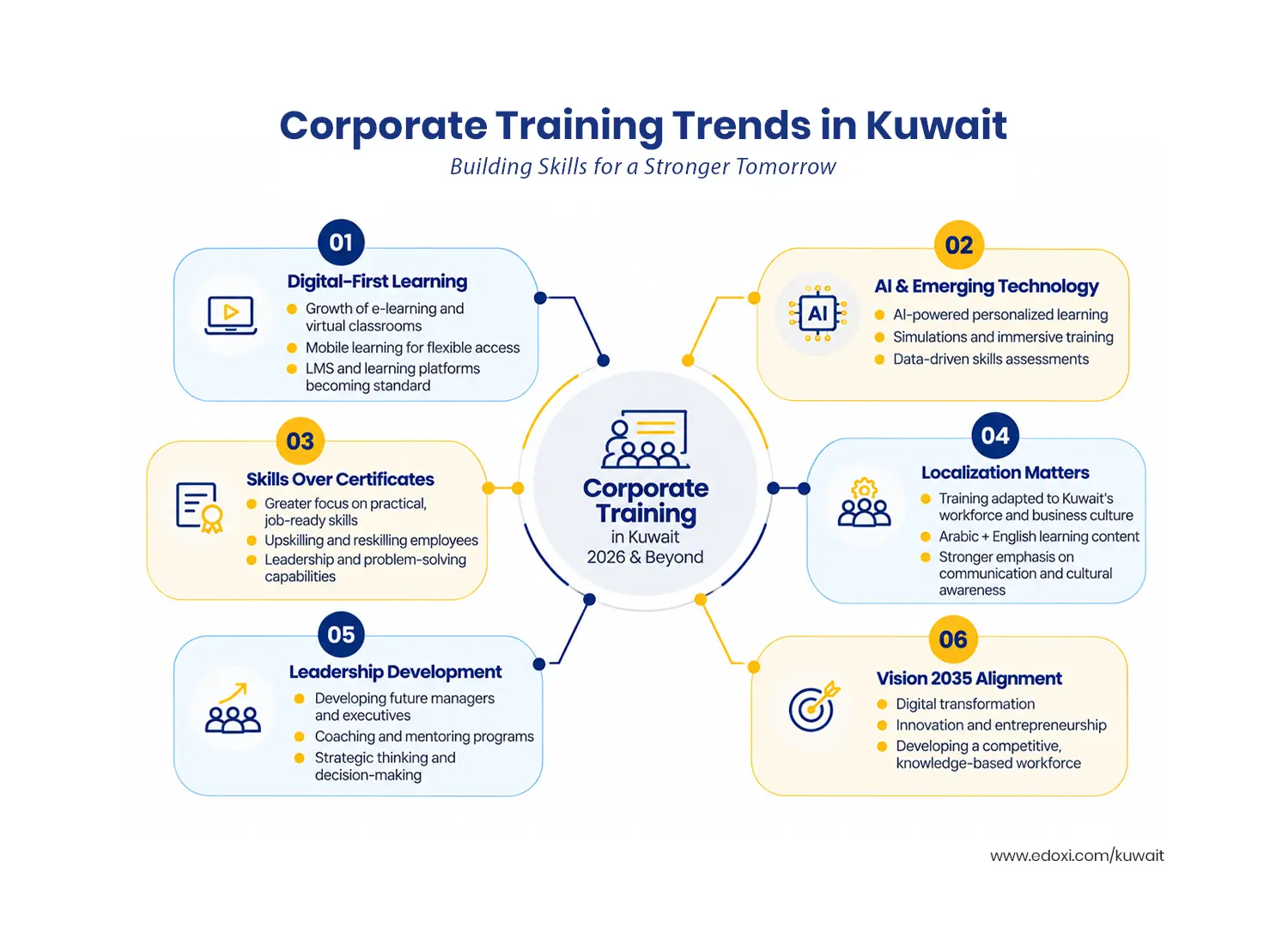
The top corporate training trends in Kuwait are:
AI and Generative AI training
Data analytics and Power BI
Cybersecurity awareness
Leadership development
Project management
Digital transformation skills
Soft skills and communication
Upskilling and reskilling
Blended learning
Skills-based learning and assessment
Here is how each one looks in practice for Corporate Training in Kuwait.
PwC says Kuwait's National AI Strategy (2025–2028) aims to bring AI into the economy and the workforce.
PwC's 2025 Middle East survey found that 75% of regional workers used AI at work in the past year. Some 82% said it improved their productivity. Start with AI basics, prompt writing, and safe handling of company data.
Microsoft's Charles Nahas, Regional General Manager for the Middle East, called the Kuwait Skills initiative "a holistic transformation", not just training.
Managers want decisions backed by numbers, and dashboards make that fast. Each Kuwaiti industry uses data differently.
Training should cover cleaning data, building Power BI dashboards, and asking better questions. Use examples from the learner's own sector, and the skills stick faster.
Yes, cybersecurity awareness is part of every training plan, but the risk is highest in banking, government, telecom, and critical infrastructure.
Kuwait set up the National Cybersecurity Center (NCSC) in 2022.
The Country Commercial Guide says it regulates cybersecurity and works with CAIT on a Zero Trust programme with Microsoft. Banks handle money, telecom networks carry everyone's data, and energy sites run control systems.
Zain Kuwait offers private 5G networks for oil and gas sites, partly because they give extra security.
Every employee needs awareness training: spotting phishing, strong passwords, and early reporting. Finance, IT, and operations teams need role-based training on top.
Leadership training develops coaching, communication, delegation, feedback, decision-making, and change-management skills.
Assigning tasks is the easy part. Leading people through new tools is harder. Kuwait Skills includes 350 leaders in its AI and cloud target, and the World Economic Forum’s 2025 report keeps leadership among the human skills employers value.
Projects drive change, and trained managers finish them with fewer surprises.
New systems, upgrades, and AI rollouts all run as projects. Teams need planning, budgeting, risk, and stakeholder skills. Practice on real company projects works best.
Digital literacy, cloud basics, comfort with data, and confidence with new tools.
Kuwait Vision 2035 aims for a diversified, knowledge-driven economy, according to PwC. Digital change works better when the whole team learns together, not just IT.
The soft skills that matter most at work are communication, critical thinking, teamwork, and adaptability.
Tools handle routine tasks. People handle judgment, trust, and tough conversations. The WEF's 2025 report lists analytical thinking as the top core skill employers want. Short role-play workshops and coaching work well.
Upskilling deepens skills in your current role. Reskilling teaches new skills for a different role.
The WEF Future of Jobs report says employers expect 39% of workers' core skills to change by 2030. It also says 59 out of every 100 workers will need training, and 11 of them may not get it.
Smart programmes show how training can improve employee skills before roles change.
Blended learning mixes classroom and online study, so staff learn without long breaks from work.
Employees watch short lessons online, then practise together in a workshop. It helps to know the main training methods before you choose a mix.
Corporate Training Formats: Benefits and Considerations
| Format | Best for | Watch out for |
|---|---|---|
| Onsite classroom | Team workshops, hands-on practice | Time away from work |
| Online (live or self-paced) | Busy staff, wide teams | Low motivation without support |
| Blended | Most skills programmes | Needs planning from the start |
Training that tests what a person can do, not how many hours they sat in class.
Staff take a skills check first, learn what they lack, then prove it with a practical task. This saves time for people who already know the basics.
The complete idea about the corporate training trends in Kuwait is presented in the infographics below:
Banking needs AI, data, and cyber skills. Oil and gas needs digital and project skills. Telecom needs cloud and security. Government needs AI and digital services. Retail needs customer analytics.
| Industry in Kuwait | Priority Skills | Kuwait Workforce Context |
|---|---|---|
| Banking & Finance | AI,data analytics, cybersecurity, risk management | Kuwait's banks are expanding digital banking and technology-driven services. |
| Oil & Gas | Digital transformation, data analytics,project management | Kuwait Oil Company is investing heavily in digital transformation across its operations. |
| Telecommunications | Cloud computing, cybersecurity, AI | Telecom operators are expanding into cloud, cybersecurity, and AI services for businesses. |
| Government | AI, digital services, data analytics | Kuwait Skills targets 30,000 employees, 4,000 technical experts, and 350 leaders, supporting public-sector digital skills. |
| Retail & E-commerce | Customer analytics, digital tools, communication | Retail businesses can use customer and sales data to improve decision-making, service and digital experiences. |
National goals, fast AI adoption, and a skills gap are the three main reasons.
First, the country has set the direction.
The Kuwait Skills programme, built by the Central Agency for Information Technology (CAIT) with Microsoft, plans to train over 30,000 employees, 4,000 technical experts, and 350 leaders.
It will also help over 100,000 people use Copilot tools. Progress will be reported every quarter.
Minister of State for Communications Affairs Omar Al-Omar said advanced technical skills are "essential for positioning Kuwait as a leader in the digital and knowledge economy".
Second, AI is already in daily work. Third, there is a gap between school and the workplace.
PwC's Kuwait Country Senior Partner, Khalid AlShatti, wrote that employers struggle to find people with both technical knowledge and practical experience.
AlShatti said Kuwait's competitiveness depends on "clear and credible pathways from learning to employment". (PwC Middle East, February 2026)
That is why employee training has moved from a yearly event to a steady habit.
Start with business goals, find the skill gaps, then rank training by impact and urgency.
The HR and L&D teams can choose training priorities by following the steps below:
Pick two or three business goals for the year, such as faster reporting or safer data.
Map the skills each goal needs.
Check the gaps with a short skills test or manager feedback.
Rank by impact and urgency. Fix the biggest risk first.
| Your situation | Training priority | Suggested format |
|---|---|---|
| Staff use AI tools without rules | AI literacy and safe use | Short workshop plus online practice |
| Reports are slow and inconsistent | Data analytics and Power BI | Blended |
| New managers struggle with teams | Leadership and communication | Coaching plus workshops |
| Projects run late | Project management | Onsite with real project work |
| Staff fall for suspicious emails | Cybersecurity awareness | Online with quizzes |
Choose a provider that knows your industry, customises content, assesses skills, offers flexible delivery and measures results. Ask for proof of each one.
Many corporate training companies in Kuwait look alike on a brochure. These five questions help you tell them apart.
Ask for examples from your sector, not generic slides.
A trainer who knows banking rules or oilfield operations will use the right case studies. Ask who designed the content and what experience they have.
Good training providers adapt content to your tools, your data, and your team's level.
A fixed course often wastes time. Ask whether the trainer will use your own reports and workflows. A short needs analysis before the first session is a good sign.
Look for a skills check before and after training, plus a practical task.
Attendance does not prove learning. Ask how learners will show what they can do. Be careful with any provider that promises certification or job outcomes.
The best providers offer all three, so you can match format to the team.
Onsite sessions suit hands-on skills and teams in one office, whether in Kuwait City, Shuwaikh, or Ahmadi. Online sessions suit shift workers or staff at several sites. Check that the provider can switch formats without losing quality.
A highly professional training provider agrees on success measures before training starts.
Ask which metrics they track, such as time saved, error rates, or manager feedback, and when they report back.
Questions to Ask Before Choosing Corporate Training
| Question to ask | Strong answer | Red flag |
|---|---|---|
| Industry fit? | Sector examples, experienced trainers | Generic slides |
| Customisation? | Needs analysis first | One fixed course |
| Assessment? | Pre- and post-checks, practical tasks | Attendance only |
| Delivery? | Onsite, online and blended | One format only |
| ROI? | Metrics agreed up front | No reporting plan |
Use the Kirkpatrick model, which has four levels:
Set the target before training begins. For example, "cut report time from two days to one". Then measure again after 60 to 90 days.
Onboarding is a good place to start, because results show quickly. A solid new employee training plan makes it easy to track how fast new hires become productive.
The future of corporate training in Kuwait is expected to include more AI in learning, more practical assessment, and closer ties between employers and training providers.
AI will help build personal learning paths, so each person studies what they lack. Practical tests will matter more than attendance sheets.
PwC argues that government, education providers and employers must work together to turn ambition into results.
For HR leaders, the message is simple. Skills will keep changing, so learning cannot stop. Companies that plan corporate training solutions in Kuwait around real business goals will be in a stronger position.
Corporate training programs in Kuwait works best when it is steady, practical, and measured.