Nahid S Jul 16, 2026

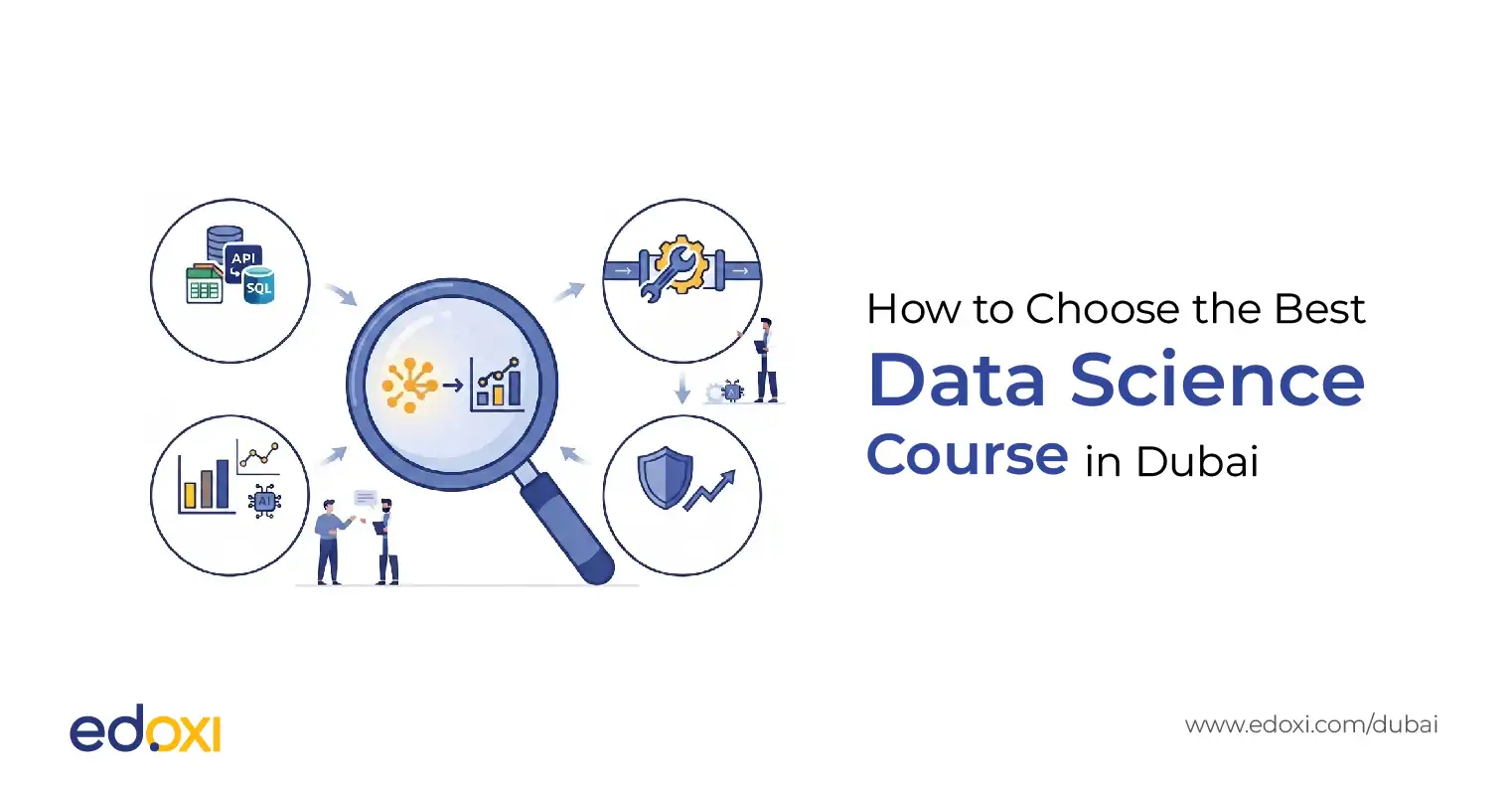
How to Choose the Best Data Science Course in Dubai: A Checklist


Quick Answer: How to Choose the Best Data Science Course in Dubai?

To choose the best data science course in Dubai, evaluate your career goals and current skill level, then compare curriculum depth, hands-on project work, KHDA or international accreditation, instructor experience, placement support, delivery format, and total cost against expected ROI. Shortlist at least three providers, attend a demo class or info session for each, and pick the one that best matches your goals and budget, not just the one with the lowest price.

Dubai's push toward becoming a global AI hub is reshaping its job market. The UAE's National AI Strategy 2031 targets a 20% contribution to non-oil GDP from AI, backed by a commitment to train thousands of local data scientists and machine learning engineers. Government-backed initiatives such as Smart Dubai, the Dubai AI Lab, and Dubai's autonomous transport program are driving steady demand for data talent across finance, healthcare, logistics, aviation, retail, and government.

This demand for skilled data professionals has produced a crowded market of universities and top training institutes in Dubai that provide the best data science course. Picking the wrong one wastes months and thousands of dirhams on an outdated syllabus that won't get you hired. This guide walks through exactly what to check before you enrol, and closes with a shortlist of Dubai's most established providers.

6 Steps to Choose the Best Data Science Course in Dubai

Dubai offers strong options for aspiring data professionals, including university master's programs and professional Data Science training programs. Before choosing a course, it helps to understand what Data Science is. Data Science is an interdisciplinary field that combines statistics, programming, machine learning, and domain expertise to collect, process, analyse, and interpret data, enabling organisations to make informed decisions and solve complex business problems.

Here's a practical, step-by-step checklist and process to choose the best data science course in Dubai. 

  • Step 1: Define Your Goals and Current Skill Level
  • Step 2: Research Data Science Course Content and Curriculum
  • Step 3: Evaluate Accreditation, Reputation, and Outcomes
  • Step 4: Compare Practical Factors of Each Data Science Training
  • Step 5: Shortlist and Validate the Top Data Science Courses in Dubai
  • Step 6: Make the Decision and Enrol in a KHDA-Permitted Data Science Course

Step 1: Define Your Goals and Current Skill Level

Before comparing any data science courses in Dubai, get clear on what you're actually trying to achieve and where you're starting from. This single step narrows a crowded market down to options that actually fit you.

Clarify your objective: Career switch into data analytics/science, upskilling for a promotion, specialisation (Artificial Intelligence/ML, big data, business analytics), or academic depth via a master's degree.

Assess your starting point: Beginners need foundational statistics and Python programming first; experienced professionals should prioritise advanced ML, model deployment, or domain-specific applications (fintech, healthcare, logistics).

Decide on format: Full-time master's (1–2 years), part-time, an intensive bootcamp (weeks to months), or flexible online/hybrid learning.

Set a budget: Professional certifications and bootcamps in Dubai typically run AED 5,000–20,000+; full master's programs run roughly AED 50,000–175,000+ depending on the university.

Tip: Browse current job postings on Bayt, LinkedIn, and Indeed UAE for data analyst/scientist roles in Dubai to see which specific tools and skills employers are actually asking for right now.

Ready to Launch your Data Science Career? 

Get hands-on training with industry experts and an up-to-date curriculum.

Step 2: Research Data Science Course Content and Curriculum

A strong curriculum should cover statistics, programming, data wrangling, visualization, machine learning, deep learning, and a capstone project using real datasets. Beyond "Python and SQL," check whether the syllabus actually teaches the top Data Scientist Skills and tools employers list in job postings:

  • Core languages & analysis: Python, R, SQL
  • Visualisation & BI: Power BI, Tableau, Excel
  • Data science libraries: Pandas, NumPy, Scikit-learn
  • Machine learning & deep learning: TensorFlow, PyTorch
  • Big data: Apache Spark, Hadoop
  • Cloud platforms: AWS, Microsoft Azure, Google Cloud
  • Version control & deployment: Git, Docker

A course that only lists "Python, SQL, ML" in its marketing but can't tell you which specific frameworks and cloud platforms are covered is a red flag in itself, ask for the full module list before enrolling.

Also check for relevance to Dubai's market specifically: does the course reference use cases in finance, logistics, government, aviation, or healthcare, the sectors driving most local hiring or is it a generic global syllabus with Dubai mentioned only in the marketing copy? And make sure it's been updated for 2025–2026 trends like generative AI and LLM applications, not just classical Machine Learning (ML).

Find out: Why Python Is Essential for Data Analysis and Data Science?

Step 3: Evaluate Accreditation, Reputation, and Outcomes

Accreditation signals quality, but "check for KHDA approval" only gets you halfway. Look for:

  • KHDA approval required for the course to be locally recognized in Dubai.
  • University or Ministry of Education accreditation, relevant for degree-level programs.
  • International recognition such as BCS or Euro-Inf for academic programs.
  • Industry-issued certifications bundled into the course: IBM, Microsoft (e.g., Azure Data Scientist Associate), Google (Professional Machine Learning Engineer), and AWS certifications carry real weight with UAE employers and are worth asking about explicitly.

Beyond credentials, verify outcomes directly:

  • Ask for job placement rates and recent alumni employment data.
  • Contact two or three alumni on LinkedIn and ask what they're doing now.
  • Read recent, independent reviews (Google Reviews, Reddit, CourseReport) rather than only testimonials on the provider's own site.
  • Check instructor profiles for real industry experience, not just academic credentials.

Also Read: Data Science vs Machine Learning: What's the Difference?

Step 4: Compare Practical Factors of Each Data Science Training

Once the content and credibility check out, weigh the day-to-day realities, schedule, cost, class size, and flexibility that determine whether you'll actually finish the course.

  • Duration & schedule: Most professional courses run 6–13 months; a full-time MSc typically runs one year.
  • Delivery mode: In-person (better for Dubai networking), fully online, or hybrid.
  • Cost vs. value: Factor in bundled certifications, software/tool access, and materials, not just tuition. Ask about scholarships or employer sponsorship options.
  • Class size & support: Smaller batches generally mean more instructor attention; ask about mentorship and career services specifically.
  • Flexibility: Lifetime access to materials, ability to switch batches, or reschedule sessions.

Step 5: Shortlist and Validate the Top Data Science Courses in Dubai

Narrow your research down to a handful of real contenders, then test them firsthand before committing.

  1. Build a comparison table with 4–6 shortlisted options (see template above).

  2. Attend free webinars, trial classes, or info sessions; most established providers offer these.

  3. For in-person programs, verify facilities: labs, software licenses, cloud access.

  4. Ask direct questions: What's the placement support process? Do students get AWS/Azure access? How often is the curriculum updated?

Step 6: Make the Decision and Enrol in a KHDA-Permitted Data Science Course

With your shortlist validated, make a final, informed trade-off and commit with a concrete plan to put what you learn into practice.

Weigh the trade-off: university master's programs offer deeper theory and globally recognised degrees; professional bootcamps offer faster, more job-focused training. Consider what happens after the course: alumni networks, continued job assistance, refresher content, and enrol with a concrete plan to apply what you learn (personal projects, a public GitHub portfolio, contributing to open datasets).

Career Opportunities After Completing a Data Science Course

A data science qualification in Dubai can lead toward several related roles, each with a different skill emphasis:

  • Data Analyst: Reporting, dashboards, and BI tools (Power BI, Tableau, SQL)
  • Data Scientist: Statistical modelling, machine learning, and experimentation
  • Machine Learning Engineer: Building and deploying ML models in production
  • Business Intelligence Analyst: Translating data into business decisions
  • AI Engineer: Applied AI/GenAI systems and integration
  • Data Engineer: Data pipelines, warehousing, and infrastructure
  • Analytics Consultant: Cross-industry advisory using data

Read Now: A Complete Guide to a Data Science Career Path

What Does a Data Scientist Earn in Dubai?

Salary estimates for data-related roles in Dubai vary substantially by source, seniority, and whether the figure includes bonuses, so treat any single number with caution and cross-check multiple sources before negotiating an offer. As a rough picture from mid-2026 data:

  • Job-board estimates (Indeed), an entry-to-mid-level Data Scientist pay in Dubai in a range of roughly AED 7979 per month for base salary, rising toward AED 25,000–30,000+ per month for senior data scientists at larger employers.

  • Compensation-benchmarking sites that include total pay (base + bonus + equity, aggregated across the UAE) show notably higher figures; total compensation estimates for data scientists nationally have ranged from roughly AED 74,000 to well over AED 350,000 per year, skewed upward by senior hires at large tech and finance employers.

  • AI Engineer roles reportedly range from around AED 18,000/month at mid-level up to AED 55,000/month at senior level at top employers, with generative AI/LLM specialists commanding some of the highest pay in the market.

The wide spread reflects real variation by company size, industry, and specialisation, treat these as directional ranges, not guarantees, and validate against current listings for your specific target role before enrolling in a course based on expected ROI.

Red Flags to Avoid When Choosing a Data Science Course

Walk away from a course if you notice any of these:

  • Syllabus hasn't been updated to reflect generative AI and recent tooling
  • No real, dataset-based projects, only slide-based theory
  • No portfolio or GitHub component built into the course
  • Vague or unverifiable claims about career/placement support
  • Very large batch sizes with no mentorship structure
  • No hands-on Python or SQL practice
  • No AI/ML modules despite being marketed as a "data science" course
  • Instructors with no disclosed industry experience

Quick Checklist Summary

  • Matches my goals, current level, and schedule
  • Curriculum is practical, current, and tool-focused with real projects
  • KHDA/Ministry accredited, with at least one recognized industry certification
  • Good independent reviews, verifiable alumni outcomes, experienced instructors
  • Reasonable cost with clear ROI and included support
  • I attended a demo class or spoke with an alumnus before enrolling

Ready To Start Your Data Science Career?

Compare your shortlisted options carefully and choose a program that combines practical projects, experienced instructors, and real placement support. A well-structured course can help you build job-ready skills for Dubai's growing data-driven industries, start with your goals, shortlist 2–3 providers, and go see a demo class before you commit.

Key Takeaways

  • Define your career goal (analyst, scientist, ML engineer) before comparing courses.
  • Compare curriculum and hands-on projects before comparing price.
  • Confirm KHDA approval plus at least one recognised industry certification (IBM, Microsoft, Google, AWS).
  • Ask specifically about placement support and alumni outcomes; don't take marketing claims at face value.
  • Attend a demo class or speak to an alumnus before paying.

Looking for a KHDA-approved course with expert instructors?

Connect with our admissions team for verified alumni results and career guidance.

Locations Where Edoxi Offers Data Science Certification Course

Here is the list of other major locations where Edoxi offers Data Science Certification Course

Data Science Course in Dubai | Data Science Course in Qatar

FAQs

Which data science course is best in Dubai?

There's no single "best" course; the right choice depends on your goals, budget, and whether you want a university degree or a faster, practice-focused bootcamp. Use the comparison framework above to shortlist 3–6 options and compare them directly.

Is KHDA approval important?

Yes, for local recognition and to ensure the provider is regulated. Pair it with an internationally recognised certification (IBM, Microsoft, Google, AWS) for added credibility with employers.

Can beginners learn data science with no prior background?

Yes, but beginners should look for courses that build foundational statistics and programming skills before jumping into machine learning, rather than assuming prior coding experience.

How long does a data science course take?

Professional courses typically run 6–13 months; full-time master's degrees usually take about one year.

Is Python mandatory?

Effectively yes. Python is the dominant language in data science hiring in Dubai, and any course without substantial hands-on Python practice should be treated as a red flag.

What salary can I expect?

It varies widely by role, seniority, and employer; see the salary section above, and validate current figures against live job postings before making decisions based on expected earnings.

Which certification is most recognised?

KHDA approval matters for local legitimacy; alongside that, certifications from Microsoft, IBM, Google, and AWS carry the most weight with UAE employers, particularly for cloud-based ML roles.

Data Science Trainer

Nahid S. is an experienced educator with 8+ years of expertise in academia, training, and software development. Skilled in curriculum design, interactive training, and mentorship, she has equipped learners with hands-on skills in data analytics, data science, cloud computing, and software engineering. Nahid is an AWS Academy Accredited Educator, AWS Certified Solutions Architect – Associate, Microsoft Certified: Azure Fundamentals, and Google Certified Educator (Level 1). She brings a strong technical foundation and industry credibility to the classroom, blending theoretical knowledge with practical applications.

Nahid has delivered engaging lectures and practical sessions across core and elective subjects, including Cloud Computing, Python, Machine Learning, and Data Science. Nahid has designed and implemented industry-relevant training programs that boost employability. With a strong focus on student development, she has provided mentorship in projects, internships, and career planning while organising workshops, seminars, and guest lectures to bridge the gap between academia and industry.

Tags
Technology
Education