Request a Callback

+971 4380 1666
 Sep 29, 2026
|
Key Takeaways
|
AI is not just a tech trend in Dubai. It is the engine driving the Dubai Economic Agenda, known as D33. This ten-year plan aims to double the size of Dubai's economy by 2033, and to make Dubai one of the world's top three cities for living, working and investing.
AI sits right at the centre of this plan. Digital transformation, powered largely by AI. It is aimed at adding AED 100 billion to Dubai's economy every year. Dubai is already putting this into practice. In 2026, it ranked second in the world for smart-city AI use, and first for actually applying AI at scale, according to the Boston Consulting Group.
This guide breaks down how AI supports the D33 economic agenda, which Dubai sectors are transforming fastest, and what skills you need to build a solid AI career here.
| Table of Contents |
|
1. What Is Dubai's D33 Economic Agenda?
2. Why Is AI Central to Dubai's D33 Agenda? 3. How Is Dubai Performing in Global AI Adoption? 4. Which Sectors in Dubai Are Being Transformed by AI? 5. How Is AI Changing Jobs and Skills Demand in Dubai? 6. What AI Skills and Careers Should You Build for Dubai's Future? 7. How Can You Start an AI Career in Dubai Today? 8. FAQs 9. Quick Answers: More Questions People Ask |
Dubai's D33 Economic Agenda is a ten-year growth plan, launched in January 2023 by His Highness Sheikh Mohammed bin Rashid Al Maktoum. Its main goal is simple to state, but bold in scale: double the size of Dubai's economy by 2033, and place Dubai among the world's top three cities for business, innovation and quality of life.
The agenda includes 100 transformational projects and sets out clear, measurable targets across trade, investment, government spending and consumer demand. By 2033, Dubai wants a cumulative AED 32 trillion in economic activity. That is roughly $8.7 trillion generated over the decade.
The chart below shows how far Dubai's ambitions stretch beyond its already strong track record.
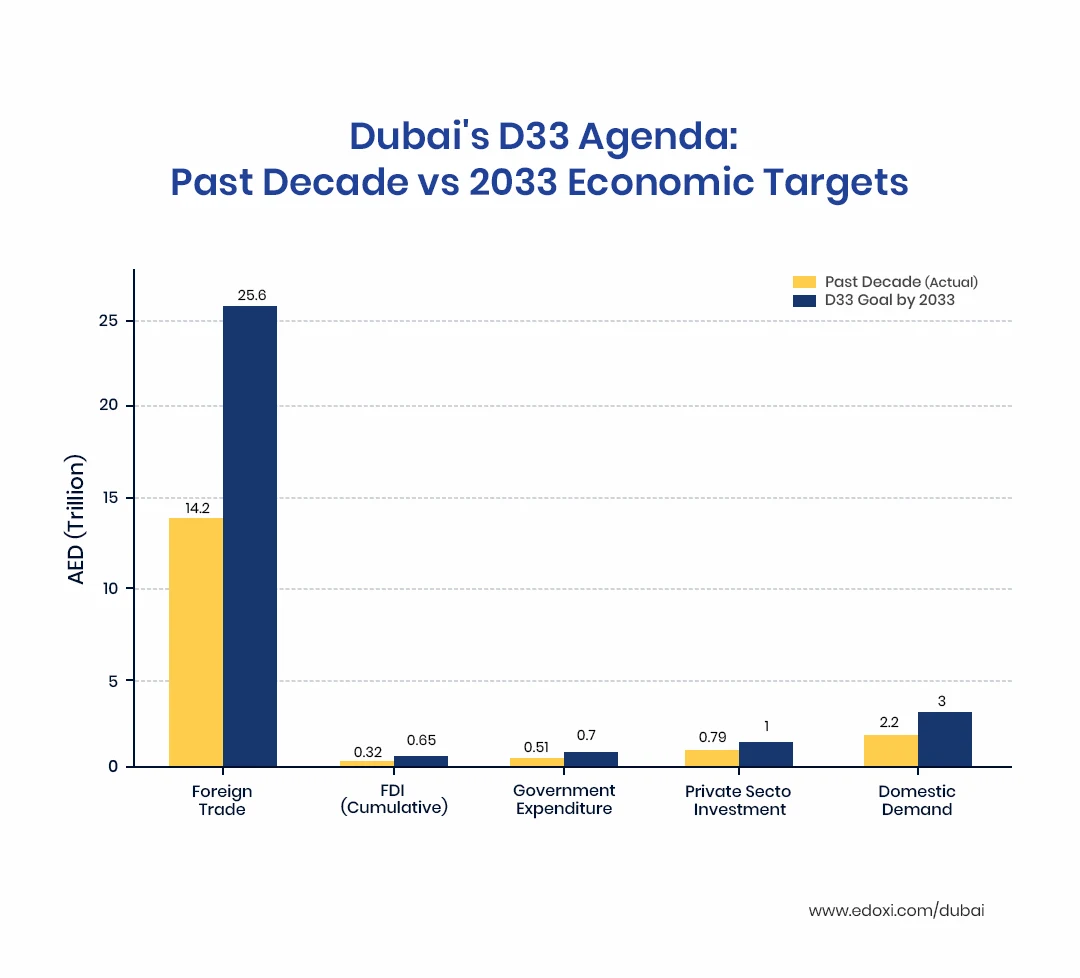
Dubai's D33 Agenda — Past Decade performance vs 2033 targets (AED trillion). Source: Dubai Economic Agenda D33, Government of Dubai.
This is more clearly put into the table below:
Dubai D33 Metric- Past Decade vs 2033 Target
| D33 Metric | Past Decade | 2033 Target |
| Foreign Trade (Goods & Services) | AED 14.2 trillion | AED 25.6 trillion |
| FDI (Cumulative) | AED 320 billion | AED 650 billion |
| Government Expenditure | AED 512 billion | AED 700 billion |
| Private Sector Investment | AED 790 billion | AED 1 trillion |
| Domestic Demand | AED 2.2 trillion | AED 3 trillion |
AI matters to D33 because it is treated as a direct productivity multiplier, not a side project. Dubai expects digital transformation, most of it AI-led. This will contribute AED 100 billion to the economy every year, and lift overall productivity by 50% through smarter, faster ways of working across government and business. See what artificial intelligence means to business.
The Dubai Universal Blueprint for Artificial Intelligence is the annual roadmap that turns this ambition into action. It was launched by His Highness Sheikh Hamdan bin Mohammed bin Rashid Al Maktoum, Crown Prince of Dubai, and it rests on four pillars:
Dubai has already started the first set of projects from its blueprint. The city has appointed 22 Chief AI Officers in government organisations, launched a special AI business license, accelerated land development for new data centers, and introduced AI Week in schools to help develop future talent. While all these are ready, understanding the benefits and drawbacks of AI is important to be better prepared for its use.
Dubai is not just talking about AI. It is one of the world's leading cities for actually using it. In its first-ever Intelligent Cities Index (2026), the Boston Consulting Group ranked Dubai second overall out of 61 global cities, and first in the world specifically for AI adoption and smart-city deployment.
This is backed up at the country level too. The UAE ranked first worldwide for AI adoption among its working-age population, with 70.1% using AI tools such as Copilot or ChatGPT regularly, according to Microsoft's AI Diffusion Report. That kind of everyday, widespread AI use is exactly what gives D33's digital targets real momentum. See how AI will impact the future of work and life.
Sovereign investment is backing this up at scale. The MGX AI Fund has closed $49 billion for global AI infrastructure, and Stargate UAE is building a 5-gigawatt AI compute campus in Abu Dhabi, both reinforcing the UAE's wider AI ecosystem that Dubai's businesses and job seekers can tap into.
AI is moving from pilot projects to everyday operations across Dubai's priority sectors. Here is where the impact is clearest, and what it could mean by 2030.
Sectors in Dubai Transformed by AI
| Sector | AI Application |
Projected Impact by 2030
|
| Financial Services | Fraud detection, credit risk models, virtual assistants (e.g. Emirates NBD's "Eva") |
DIFC AI adoption already above 50%, well ahead of the global average
|
| Healthcare | AI diagnostics linked to the NABIDH data platform |
Faster, more accurate care for over 9.5 million patient records
|
| Transport & Logistics | Autonomous vehicles, smart routing, computer vision |
25% of transport autonomous, transport costs down by 44%
|
| Real Estate | AI buyer-matching, predictive pricing, VR viewings |
Faster, more informed property decisions for residents and investors
|
| Energy & Utilities | AI-based demand forecasting (used by DEWA) |
Energy savings of over 24% through smarter grid management
|
| Government Services | Chief AI Officers, agentic AI systems |
Faster, more efficient public services across every entity
|
AI is creating more jobs in Dubai, not fewer. Job postings requiring AI skills in the UAE doubled between 2021 and 2024, from around 5,000 to 10,000. Around 84% of UAE companies plan to hire dedicated AI specialists within the next 15 months. Yet 43% of IT leaders still say a shortage of skilled staff is their biggest obstacle to using AI properly. See how AI will transform the IT industry and check out these 10 jobs most at risk of being replaced by AI.
Here's the twist. Even in an AI-first economy, human skills still win most job postings in the UAE.
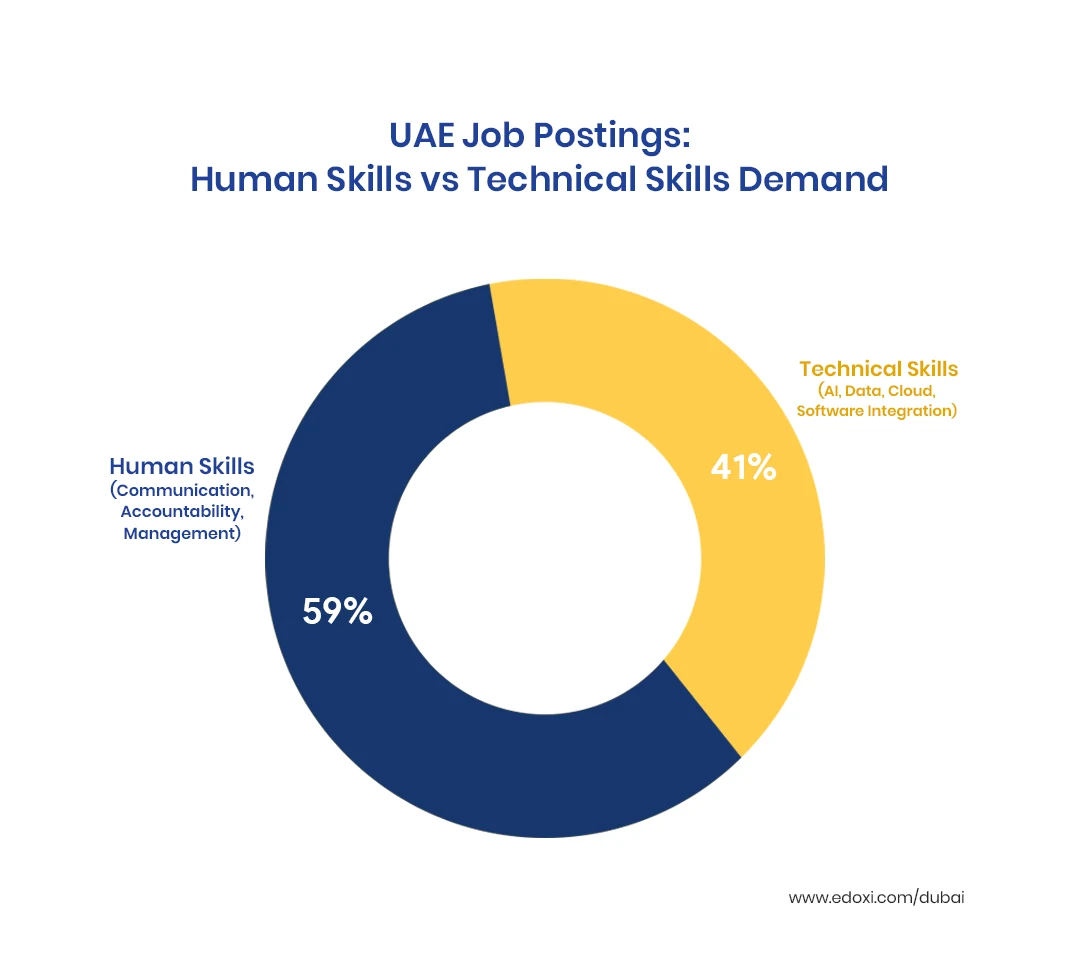
Share of UAE job postings requesting human skills vs technical skills. Source: SkyHive by Cornerstone / Abdulla Al Ghurair Foundation, 2024.
UAE employers are three times more likely to ask for skills like communication, accountability and management than for purely digital ones. AI can process data brilliantly, but it still cannot build trust with a customer or make a judgement call under pressure. That is where people add the value AI can't replace. Will Artificial Intelligence take over human jobs by 2030? And why upskill in the age of Artificial Intelligence?
The strongest AI careers in Dubai combine technical know-how with the human skills employers keep asking for. A balanced skill set gives you the best chance of standing out.
Technical & AI Skills Worth Learning
Human Skills That Still Get You Hired
For young Emiratis, this matters even more. D33 aims to integrate 65,000 young Emiratis into the private sector, and the Massar Al Ghurair platform is already supporting 45,000 learners by connecting them with over 50 employers and 20-plus training providers. Building both technical and human AI skills early gives you a real head start toward these opportunities. Check out how to upskill yourself for AI jobs that will produce millions by 2027.
Starting an AI career in Dubai does not mean becoming a full-time coder overnight. Here's a simple, practical path:
Check out in detail how to build a career in Artificial Intelligence.
Structured, practical training like Edoxi's Artificial Intelligence Certification Courses is built around exactly this approach: real projects, recognised credentials, and skills mapped to what Dubai employers are actually hiring for.
AI is not a side note in Dubai's D33 economic agenda. It is one of the main tools Dubai is using to double its economy, modernise government, and create thousands of new jobs by 2033. Whether you are a student, a working professional, or a business owner, understanding why upskill in the age of Artificial Intelligence and how AI fits into Dubai's economy is now a genuine career advantage. Building the right mix of AI and human skills today puts you ahead for tomorrow's opportunities.
Yes. Dubai ranked second globally and first for AI adoption specifically in BCG's 2026 Intelligent Cities Index, while the UAE ranked first worldwide for AI use among its working population.
It is Dubai's annual roadmap for AI adoption, built on four pillars: strategic application, a regulatory sandbox, government adoption, and creating the best environment for AI talent and companies.
Dubai has appointed 22 Chief AI Officers across its government entities as part of the Universal Blueprint for AI's first batch of transformational projects.
Massar Al Ghurair is a workforce platform supporting around 45,000 young Emirati learners, connecting them with over 50 employers and 20-plus training providers to close AI and digital skills gaps.