Request a Callback

+971 4380 1666
 Oct 09, 2026
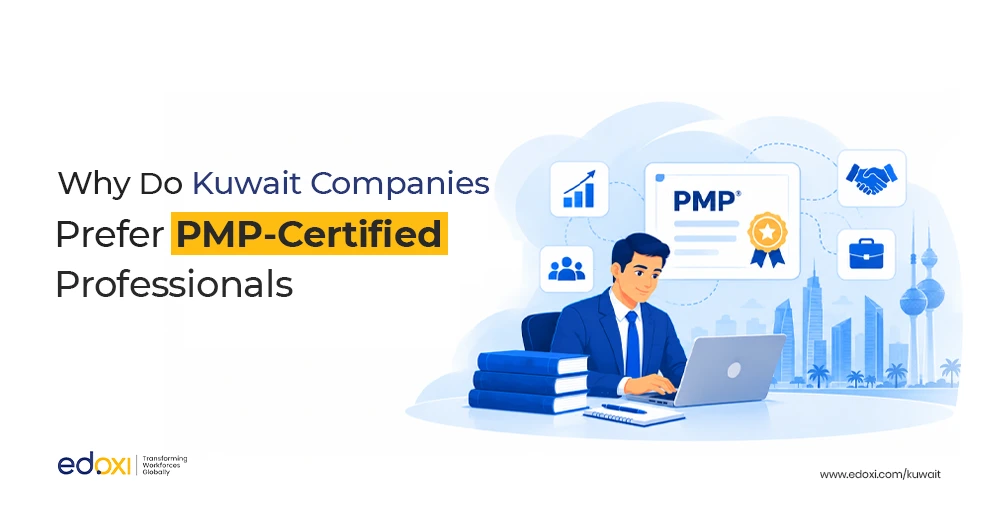
Kuwait companies prefer PMP-certified professionals because the credential shows proven skills in planning, risk control, budgeting, and team leadership.
With billions of dinars going into new projects, employers want managers who follow a trusted global method. A PMP does not guarantee a job. It does make a CV easier to trust.
Imagine two CVs on a hiring manager's desk in Kuwait City. Both people have ten years of site experience. Both are good at their jobs. One CV carries three extra letters: PMP.
That small detail can tip the balance. Not because the other person is weaker. A hiring manager needs a quick, safe choice. PMP-certified professionals in Kuwait come with a shared method and a global exam behind them.
This blog explains why that matters. It also covers the industries, jobs, and skills around the PMP, and whether it is worth your time.
| Nos | Contents |
|---|---|
| 1 | What Is PMP Certification and Who Awards It? |
| 2 | What Makes PMP-Certified Professionals in Kuwait Stand Out to Employers? |
| a) Does PMP Show Structured Project Planning? | |
| b) How Does PMP Help With Risk and Resource Management? | |
| c) Does PMP Lead to Better Project Execution? | |
| d) Why Does Stakeholder Communication Matter? | |
| e) Does PMP Prove Leadership and Team Management Skills? | |
| f) Why Do Consistent Practices Matter? | |
| 3 | Which Industries in Kuwait Need Project Management Professionals? |
| 4 | What Jobs Can PMP Certification Support in Kuwait? |
| 5 | What Skills Should You Combine With PMP? |
| 6 | Is PMP Certification Valuable for a Career in Kuwait? |
| 7 | Choosing the Right PMP Path Based on Your Experience |
| 8 | Key Takeaways |
| 9 | FAQs: Why Do Kuwait Companies Prefer PMP-Certified Professionals? |
PMP stands for Project Management Professional. The Project Management Institute (PMI) awards it to people who prove project experience, complete 35 hours of training, and pass an exam.
Think of it as a driving licence for projects. It shows you can steer a team, a budget, and a deadline.
PMI sets the entry rules. With a four-year degree, you need 36 months of experience leading projects. With a secondary diploma, you need 60 months. Always check pmi.org for the latest rules before you apply.
The exam tests people skills, process skills, and business awareness. It covers predictive, agile, and hybrid ways of working. You can read a simple PMP certification overview before you decide.
Many candidates also join structured PMP exam preparation in Kuwait to cover the 35 hours of project management education.
PMP-certified professionals in Kuwait arrive with a tested toolkit. Employers get managers trained to plan, control risk, report clearly, and lead people, using one method the whole industry recognises.
The timing helps. AGBI reported that Kuwait approved about KD3 billion ($10 billion) in capital spending for 2026-2027, covering 117 new projects and 551 already under construction.
The finance minister, Yacoub Al-Rifai, called the country's financial position "more than reassuring."
Money is ready. Delivery is the hard part. That is where a trained project manager earns their place.
One honest note: no public Kuwait-wide survey measures PMP preference. The evidence comes from project volume, government delivery pressure, and job adverts that list PMP.
For example, a Baker Tilly Kuwait vacancy for a project management officer asks for PMP or an equivalent.
Yes. PMP training teaches scope, schedule, and cost planning before work starts, so a project begins with a clear map.
Kuwait's own government is pushing the same habit. AGBI reported a cabinet-backed plan to tackle project delays that asks ministries to list budgets, KPIs, and obstacles for every project.
The Al-Anba daily said they must show "a commitment to a timetable for the execution of the project."
A PMP holder already works this way. If you want the basics first, read why project management matters.
PMP teaches you to spot risks early, plan a response, and use people, money, and materials wisely.
A risk register is simply a list. It names what could go wrong, how likely it is, and who will act. Simple, but many teams skip it.
Kuwait gives a live example. Gulf Construction reported that the 2026 construction outlook is volatile because of higher costs and supply-chain risks, though state spending tied to Vision 2035 should keep core work moving.
Managers who plan for price swings protect the budget. Build your base with these core project management skills.
PMP can lead to better project execution. PMP holders use tested methods to track progress, fix issues early, and finish within budget. Experience still matters, though.
Look at how Kuwait buys these skills.
MEED reported that the Public Authority for Housing Welfare appointed Egis as project management consultant for Al-Mutlaa City, covering programme management, cost management, and a project management information system.
Big clients pay for structure.
A PMP brings that structure into your own team.
Kuwait projects involve ministries, consultants, contractors, banks, and suppliers. PMP teaches managers to keep each group informed and aligned.
Bad news travels badly when nobody has built trust. A good project manager shares problems early, in plain words, with a clear fix. These PMP skills are as much about talking as planning.
Partly, yes. The exam tests how you lead people, not just how you build schedules.
Questions cover coaching, conflict, team building, and decision-making. Leading a mixed team of engineers, vendors, and officials is daily work in Kuwait. See what project manager roles involve in practice.
PMI standards give every PMP holder the same terms and tools. New hires fit into a team faster.
When two companies work on one project, shared language saves weeks of confusion. The PMP exam syllabus shows how widely these practices apply across industries.
All the major reasons why Kuwait employers value PMP are presented in the infographic below:
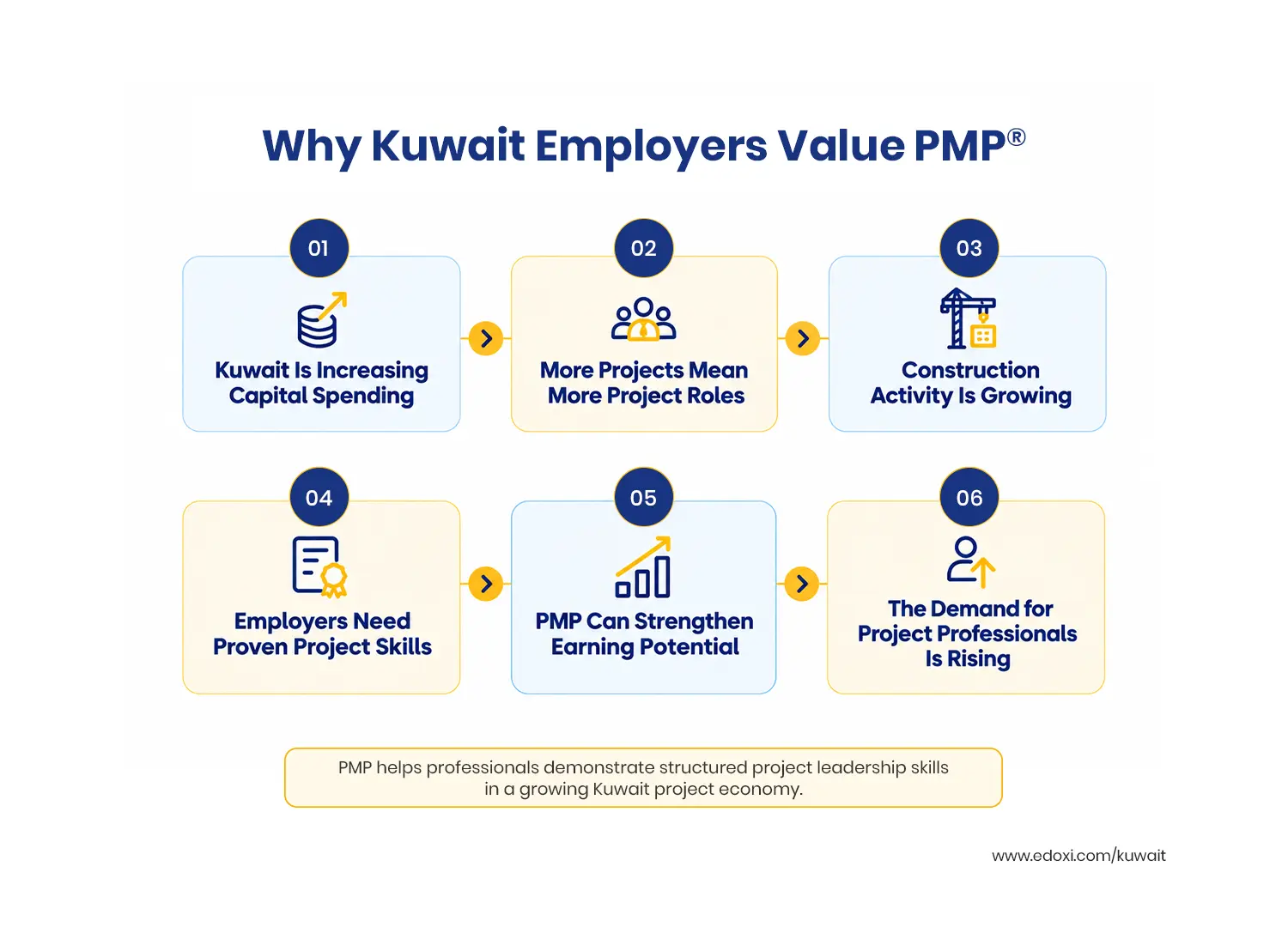
Kuwait Is Increasing Capital Spending
More Projects Mean More Project Roles
Construction Activity Is Growing
Employers Need Proven Project Skills
PMP Can Strengthen Earning Potential
The Demand for Project Professionals Is Rising
PMP helps professionals demonstrate structured project leadership skills in a growing Kuwait project economy.
Oil and gas, construction, power, transport, IT, banking, and government all run large projects. Each needs people who can deliver on time and on budget.
GlobalData expects Kuwait's construction industry to grow by an average of 7.1% a year in 2025-28.
The roads authority's executive director, Ahmad Hasan Mahboub, said it had "hammered out a plan to execute up to 80 ventures."
| Industry | Kuwait example | Why PMP helps |
|---|---|---|
| Construction and housing | Al-Mutlaa City | Cost and schedule control |
| Power and water | Al-Zour North Power Plant, phases two and three | Contractor coordination |
| Transport | Airport terminal, Mubarak Al-Kabeer Port | Interface management |
| Oil and gas | Refining and field projects | Safety, risk, long timelines |
| IT and banking | Digital transformation programmes | Agile and hybrid delivery |
| Government | Vision 2035 programmes | Reporting and governance |
The power plant and port work appears in Kuwait Times coverage of Vision 2035 delivery. Project work is also changing fast, so read how PMP fits the future of project management.
If you work in one of these fields, a PMP certification course in Kuwait can match your sector.
PMP supports project manager, project coordinator, planning engineer, PMO officer, and IT project manager roles. It helps most when you want to move from team member to team leader.
Project Management Roles for PMP-Certified Professionals in Kuwait
| Role | Common sector |
|---|---|
| Project Manager | Construction, oil and gas |
| IT Project Manager | Banking, telecom, technology |
| Planning Engineer | Infrastructure, contracting |
| PMO Officer | Consulting, government bodies |
| Project Coordinator | Almost every industry |
Pay depends on sector, company, and experience. Kuwait salary figures are left out here because no reliable public source covers them. Compare options in this guide to the highest-paying project management jobs.
Pair PMP with a scheduling tool, cost control, Agile basics, contract knowledge, and clear communication. The credential opens the door. Skills keep you in the room.
Some people stack other credentials too. Compare the main project management certifications before you choose
Yes, if you already lead project work and want senior roles. It is less useful if you have no project experience yet.
PMI's global data points to the same.
PMI’s Earning Power survey found PMP holders earned 17% higher median salaries than non-certified peers across 21 countries. That figure is global, not Kuwait-only.
PMI's Talent Gap report also forecasts a shortfall of up to 29.8 million project professionals by 2035.
Pros: global recognition, a shared method, stronger CV signal.
Cons: cost, study time, experience rules, no job guarantee.
Choosing the Right PMP Path Based on Your Experience
| Your situation | Best next step |
|---|---|
| 3+ years leading projects | Apply for PMP |
| Engineer moving into management | Build experience, then PMP |
| Fresh graduate | Start with entry-level credentials |
| IT team lead | PMP plus Agile skills |
Learn why PMP matters for your career, then plan your route.
Many professionals choose PMP certification training in Kuwait for local support and clear structure.
In short, PMP-certified professionals in Kuwait offer employers lower risk and a common language. That is why the credential keeps showing up in job adverts