Request a Callback

+971 4380 1666
 Oct 09, 2026
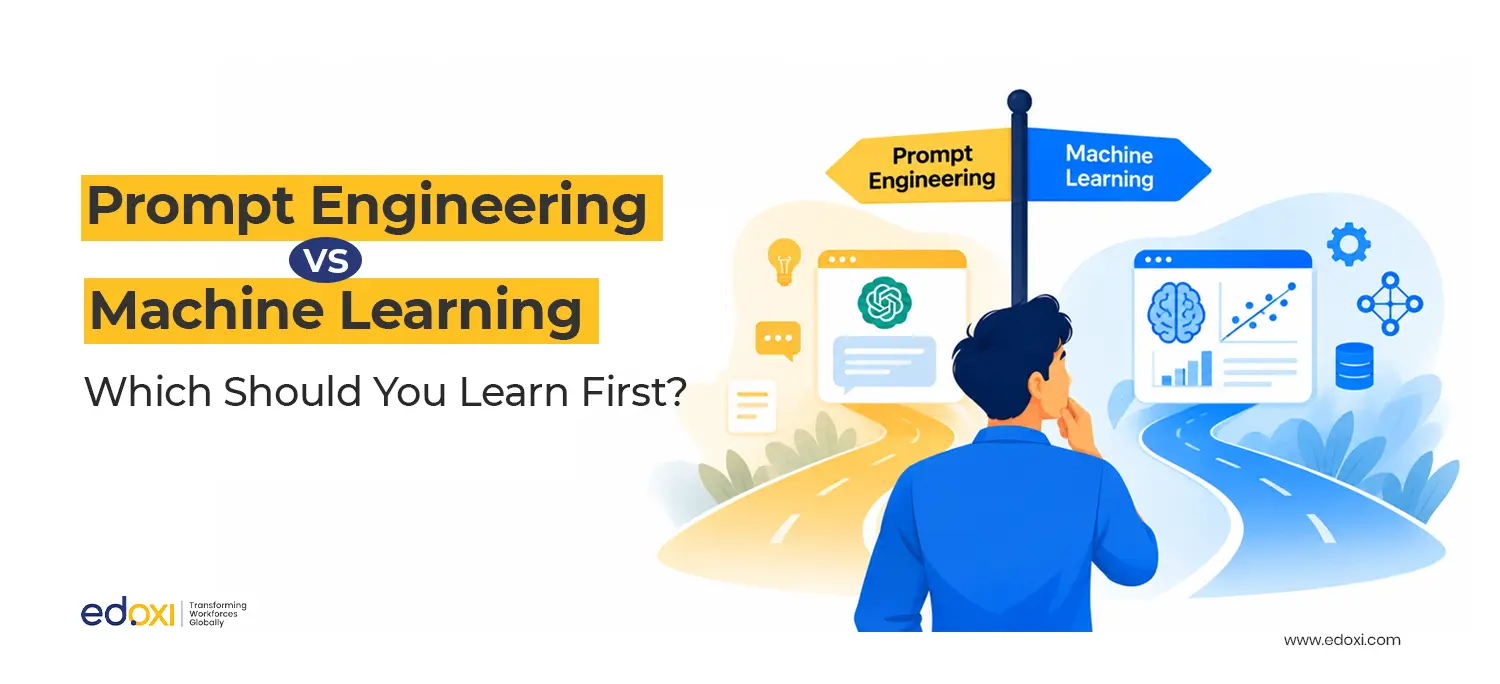
Start with prompt engineering if you want to work with AI tools fast and don't have a coding background. Choose machine learning if you want to build the models behind those tools and are ready to invest in programming and math.
Most AI careers eventually use both, but your starting point should match your current skills, timeline, and career goals.
Key Takeaways
|
A marketing manager in Dubai and a software developer both enrolled in an AI course this year. One left writing sharper prompts for ChatGPT and Claude.
The other left training and testing machine learning models. Neither is "ahead"; they were solving two different problems.
That's the confusion at the heart of the Prompt Engineering vs Machine Learning debate. Both sit under the AI umbrella, both show up constantly in job postings, and both get pitched as "the skill to learn."
But they ask different things of you, lead to different roles, and suit different starting points.
This blog compares the skills, career paths, and market demand behind each option, using current industry and hiring data.
Table of Contents |
| 1. What is the Difference Between Prompt Engineering and Machine Learning? 1.1 Prompt Engineering vs Machine Learning: Skills, Tools and Learning Curve 1.2 Prompt Engineer vs Machine Learning Engineer: How Different Are the Career Paths? 2. What Does the Job Market Say About Salary and Demand? 3. Which Skill Should Beginners Learn First? 3.1 Should Developers and Working Professionals Start With Machine Learning Instead? 3.2 Can You Learn Both? How Prompt Engineering and Machine Learning Complement Each Other 4. What Global AI Hiring Trends Tell Us 5. Key Takeaways 6. FAQs: Prompt Engineering vs Machine Learning |
Prompt Engineering directs an AI model that already exists. Machine Learning builds that model from raw data. That's the one-line answer; here's what it means in practice.
A prompt engineer works with tools like GPT-4, Claude, or Gemini.
Their job is to design the instructions, context, and examples that make these models produce reliable, on-brief output for a specific business use case: a chatbot script, a content workflow, a customer support flow.
|
Prompt Engineering vs Machine Learning: Which Is Better? Neither is universally "better." Prompt Engineering suits people who want fast, practical AI skills without coding. Machine Learning suits those ready to invest in programming and math to build AI systems from scratch. The right choice depends on your background, timeline, and career goals, not on which field sounds more advanced. |
A machine learning engineer works further upstream.
They select algorithms, prepare data, train and test models, and deploy systems for tasks such as fraud detection, forecasting, recommendations, and generative AI.
It's a fair question: prompt engineering vs. programming — what's the difference covers exactly where the two overlap and where they don't.
Prompt Engineering vs Machine Learning: Key Differences
| Aspect | Prompt Engineering | Machine Learning |
| Core task | Designs instructions for existing AI models | Builds and trains AI models from data |
| Coding required | Minimal to none for most roles | Strong programming skills (Python, SQL) |
| Math background | Not essential | Statistics, linear algebra, probability |
| Output | Better AI responses and workflows | New predictive or generative models |
| Typical entry point | Business, content, support, ops roles | Engineering, data science, CS backgrounds |
Prompt Engineering skills centre on language, logic and iteration. Machine Learning skills centre on code, mathematics and data infrastructure. Here's the side-by-side comparison.
Prompt Engineering asks you to understand how an AI model interprets instructions, then refine your wording until the output is consistent.
You'll work with techniques like chain-of-thought prompting, few-shot examples, and system prompts, mostly inside tools like ChatGPT, Claude, Gemini, and prompt-testing platforms such as PromptLayer or Humanloop.
Machine Learning asks you to understand algorithms, model evaluation, and deployment pipelines.
You'll write code in Python, work with libraries like TensorFlow, PyTorch, and scikit-learn, clean and structure datasets, and monitor models once they're live.
Python leads the pack today, but it helps to compare the best languages for machine learning before you commit to a stack.
Prompt Engineering vs Machine Learning: Skills and Tools Compared
| Category | Prompt Engineering | Machine Learning |
| Core skills | Clear writing, logic, iteration, domain knowledge | Python/SQL, statistics, algorithms, model evaluation |
| Common tools | ChatGPT, Claude, Gemini, PromptLayer, Humanloop | Python, TensorFlow, PyTorch, scikit-learn, Jupyter |
| Learning difficulty | Moderate; no coding required to start | Steep; requires programming and math fluency |
| Time to entry-level competency | Weeks to a few months with focused practice | Several months to a year or more |
Neither path is "easy." Prompt Engineering trades a steep technical curve for a steep precision curve: small wording changes can shift output quality dramatically, and getting consistently reliable results across edge cases takes real skill.
Machine Learning trades faster early wins for a longer runway before you can ship production-grade models.
"The scarcity of AI-related skills is becoming a major obstacle to deploying AI effectively."
Justina Nixon-Saintil, Vice President and Chief Impact Officer, IBM (2025)
A Prompt Engineer often works close to the business side of AI adoption, designing workflows, chatbots, and content systems.
A Machine Learning Engineer typically sits inside engineering and data teams building the infrastructure those systems run on. Titles overlap in practice, but the day-to-day work differs sharply.
Prompt Engineers often start in marketing, customer support, content, operations, or product roles and layer AI skills on top of domain expertise.
Machine Learning Engineers usually come from computer science, data science, or software engineering backgrounds and move into applied AI roles from there.
"While AI will transform the future role of software engineers, human expertise and creativity will always be essential to delivering complex, innovative software."
Philip Walsh, Senior Principal Analyst, Gartner (2024)
AI skills are becoming baseline expectations, but human judgement, whether in prompt design or model oversight, still decides whether an AI system actually works.
Since the job title itself is still inconsistent across companies, a recognised prompt engineering certification can help recruiters take your skills seriously on paper.
Both fields show strong hiring demand, but Machine Learning roles tend to carry a compensation premium tied to their steeper technical bar, while Prompt Engineering shows some of the fastest skill-growth rates on record.
Exact pay varies widely by employer, region, seniority, and whether "prompt engineer" is a standalone title or folded into a broader AI engineering role, so treat any single number with caution.
What's better documented is demand.
The World Economic Forum's Future of Jobs Report 2025 names AI and big data as the fastest-growing skill category globally through 2030, with AI and Machine Learning Specialist roles among the fastest-growing job titles worldwide.
LinkedIn's Skills on the Rise 2025 report lists both Large Language Models and Prompt Engineering among its fifteen fastest-growing skills, alongside AI Literacy.
Gartner has separately forecast that 80% of the engineering workforce will need to upskill in generative AI capabilities, including prompt engineering and RAG techniques, through 2027.
The practical takeaway is that don't chase a headline salary figure for either skill.
Chase the role that matches your background, because both fields are hiring, and both are still maturing enough that titles and pay bands vary by company.
"AI adoption and optimisation of its use will of course take time, but at this early stage it appears that the pace of diffusion is getting underway."
- Karin Kimbrough, Chief Economist, LinkedIn (2023)
If you're new to AI and don't code, Prompt Engineering is the more realistic starting point.
It lets you build practical, job-relevant skills in weeks rather than months, without first needing to learn programming.
Use this decision matrix to check where you fit.
Prompt Engineering vs Machine Learning: Which Should You Learn First?
| Your situation | Recommended starting point |
| No coding background, want quick, practical AI skills | Prompt Engineering |
| Comfortable with Python or planning to learn it | Machine Learning |
| Working in marketing, content, support, or operations | Prompt Engineering |
| Working in software engineering or data analysis | Machine Learning |
| Want to add AI skills to an existing non-technical career | Prompt Engineering |
| Want to build AI products or models from scratch | Machine Learning |
If more than one row applies to you, that's normal; it usually means both skills will matter to your career eventually. Start with the one that solves your most immediate problem.
A short, structured prompt engineering course can get you job-ready faster than piecing it together from scattered tutorials.
For a week-by-week breakdown of what that looks like, see how long it takes to learn Prompt Engineering: a realistic timeline.
If you already write code, Machine Learning is usually the stronger first investment, because your existing skills shorten the learning curve considerably.
Once you're ready to go deeper, this walkthrough on how to perform machine learning in Python is a practical next step.
Developers, data analysts, and engineers already have the programming and problem-solving habits that Machine Learning courses build on, so the return on that learning time is higher.
That doesn't rule out Prompt Engineering for technical professionals. Many software teams now expect developers to write effective system prompts and design LLM-based features alongside traditional code.
A backend developer who picks up top in-demand Prompt Engineering skills isn't switching careers; they're extending an existing one.
Working professionals considering an AI career switch face a slightly different calculation. If you have six months and no technical background,
Prompt Engineering gets you job-ready faster. If you have a year or more and want to move into a core engineering role, Machine Learning is worth the longer runway.
A well-structured machine learning course can also fill in the statistics and deployment gaps that self-taught developers often miss.
If you're weighing formal training over self-study, this roundup of the top machine learning training institutes in India is worth a look first.
Yes, and in most AI-focused careers, you eventually will.
Prompt Engineering and Machine Learning aren't competing skills; they sit at different points of the same pipeline.
Someone who understands both can design better prompts because they understand model behaviour, and can build better models because they understand how those models get used in practice.
A practical learning path looks like this:
Start with Prompt Engineering fundamentals: prompt structure, few-shot examples, evaluation basics.
Apply those skills to real workflows in your current job or a portfolio project.
If you want to go deeper, add Python, statistics, and one Machine Learning framework.
Learn how models are trained, evaluated, and deployed, connecting it back to what you already know about prompting.
This sequence works because Prompt Engineering gives you fast, visible wins that build confidence, while Machine Learning gives you the depth to understand why models behave the way they do.
AI hiring isn't a Silicon Valley story anymore; it's a global one, and the Gulf is one of its fastest-moving markets.
LinkedIn's Work Change Report 2025 shows the UAE recording an 80-fold increase in members adding AI skills to their profiles since 2016, the highest growth of any country in the report, ahead of the US and Germany.
That kind of growth signals two things for anyone deciding what to learn first. One, employers across the region are actively hiring for AI-adjacent skills right now, not waiting for a future wave.
Two, early movers who build either Prompt Engineering or Machine Learning skills today are entering a market with comparatively less competition than it will have in a few years, once these skills become as standard as spreadsheet literacy.
Whichever skill you choose first, treat it as the start of a longer AI learning path rather than a one-time course.
The World Economic Forum expects nearly two-fifths of core job skills to shift by 2030; standing still isn't really an option in this field.
Prompt Engineering is generally easier to start because it can be learned without advanced programming or mathematics. Machine Learning requires programming, statistics, data handling, and model-building skills.
Yes. Beginners can learn Prompt Engineering without coding by practising prompt structure, context, examples, constraints, and AI output evaluation using tools such as ChatGPT, Claude, and Gemini.
Start with Prompt Engineering if you are new to AI or have no coding background. Choose Machine Learning first if you already know programming and want to build, train, and deploy AI models.
Yes. Prompt Engineering is a useful AI skill for roles involving content, marketing, automation, customer support, product development, and AI workflows. Dedicated prompt-engineer roles vary by employer.
Python is not strictly mandatory, but it is one of the most widely used programming languages for Machine Learning. Learning Python, along with statistics and data handling, provides a strong foundation for ML.