Request a Callback

+971 43801666
 Oct 27, 2026
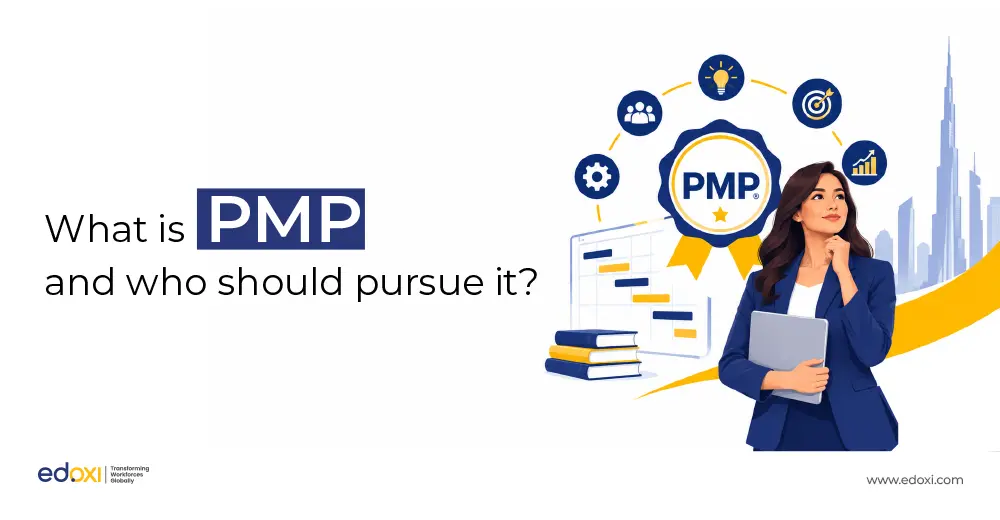
PMP (Project Management Professional) is a globally recognised certification from the Project Management Institute (PMI) that proves you can lead and deliver projects.
It suits professionals who already direct project work, team leads, coordinators, engineers, IT managers, and want formal proof of that skill.
PMP certification requirements include a set number of months leading projects, plus 35 hours of project management education.
A project without a plan is just a wish. That line gets repeated in every PM classroom, and it holds up.
Somebody has to own the plan, the budget, the timeline, and the people. PMP certification is PMI's way of proving that person knows what they're doing.
If you've typed "what is PMP" into Google before landing here, you're probably weighing whether the exam, the study hours, and the fee are worth it for your career.
This blog answers that directly: what PMP certification covers, who it fits, what it costs in time and money, and whether it's the right move if you're building a career in Kuwait or the wider GCC.
| Nos. | Contents |
|---|---|
| 1 | What Is PMP Certification? |
| 2 | Who Should Pursue PMP Certification? |
| 3 |
How to Get PMP Certification in Kuwait: Eligibility, Steps and Requirements
|
| 4 | What Are the PMP Certification Requirements? |
| 5 | What Does the PMP Exam Cover and How Is It Structured? |
| 6 | What Is the PMP Exam Syllabus? |
| 7 | How Much Does PMP Certification Cost? |
| 8 | What Are the Latest PMP Exam Changes in 2026? |
| 9 | What Are the Benefits of PMP Certification? |
| 10 | What Is the Average PMP Salary in Kuwait? |
| 11 | What Career Opportunities Are Available for PMP Holders in Kuwait? |
| 12 | Which Industries Hire PMP-Certified Professionals in Kuwait? |
| 13 | Can You Get PMP Certification Without Project Management Experience? |
| 14 | Is PMP Worth It in Kuwait and the GCC? |
| 15 | Key Takeaways |
| 16 | FAQs: What Is PMP and Who Should Pursue It? |
PMP stands for Project Management Professional. It's a certification issued by PMI, the body that also publishes the PMBOK Guide.
The PMP certification confirms you can plan, execute, and close projects using recognised methods: waterfall, agile, or a mix of both.
The PMP exam tests three domains: People, Process, and Business Environment, with over 180 questions and roughly four hours.
Unlike a degree, PMP isn't theory-only. PMI requires documented hours leading real project work before you can even sit the exam. That's what separates it from entry-level credentials: it certifies experience, not just knowledge.
If you are new to the field, understanding what is project management and why is it important can help you see how project managers contribute to successful business outcomes.
PMP fits people who already lead project work, even without the job title "project manager." PMI defines "leading projects" broadly; it covers anyone who directed scope, budget, timelines, or a team toward a defined outcome.
You're a strong candidate if you're one of the following:
If your job never involves leading a team, setting a budget, or owning a delivery timeline, PMP may be premature. CAPM certification in Kuwait is a better starting point in that case.
PMP candidates can also benefit from understanding the roles and responsibilities of a project manager, from managing scope and schedules to coordinating teams and stakeholders.
The process is the same PMI framework used worldwide, with a few Kuwait-specific practicalities layered on.
Here are the 7 key steps to get PMP certified in Kuwait:
Check your eligibility route: Confirm whether you qualify under the four-year degree path (36 months leading projects) or the secondary diploma path (60 months).
Complete 35 hours of PMI-approved training: Several Kuwait-based and regional training providers run PMI-authorised PMP prep courses, both in-person in Kuwait City and live online; either works for eligibility.
Join PMI (optional): Membership cuts the exam fee and includes the PMBOK Guide, so it usually pays for itself.
Submit your application: Document your project hours accurately; PMI audits a portion of applications, and vague descriptions are the most common reason for delay.
Schedule your exam: Kuwait has Pearson VUE test centres in Kuwait City, or you can sit the exam online through remote proctoring from home or office.
Sit and pass the exam: 180 questions across People, Process, and Business Environment.
Maintain your certification: PMP training in Kuwait requires 60 professional development units (PDUs) every three years to stay active.
PMI offers two main eligibility routes, based on education. Both require the same 35 contact hours of project management education.
| Requirement | Four-Year Degree | Secondary Diploma / Associate Degree |
|---|---|---|
| Months leading projects | 36 months | 60 months |
| Hours leading projects | 4,500 hours | 7,500 hours |
| PM education hours | 35 hours | 35 hours |
| Experience window | Within past 8 years | Within past 8 years |
Once you apply, PMI reviews your experience and education records. Most applications clear in about five business days unless selected for audit.
After approval, you book the exam through Pearson VUE, in person or online.
As of the current 2026 exam version, the PMP exam looks like this:
| Feature | Detail |
|---|---|
| Total questions | 180 |
| Scored questions | 175 (5 unscored pretest questions) |
| Time allowed | 240 minutes |
| Breaks | Two 10-minute breaks |
| Format | Multiple choice, multiple response, matching, hotspot, limited fill-in-the-blank |
| Delivery | Pearson VUE test centres or online proctored |
The PMP exam syllabus is built from three domains, each broken into tasks and enablers (the specific skills PMI expects a project manager to demonstrate):
Exam fees run around $425 for PMI members and $675 for non-members, with a lower retake fee if you don't pass on the first attempt.
PMI membership costs roughly $164 a year and often pays for itself through the reduced exam fee and free access to the PMBOK Guide.
PMI reviews the PMP certification every three to five years to keep it aligned with how project managers actually work.
The latest update took effect globally on 9 July 2026, and it's now the only version of the exam offered.
What changed:
If you're studying now, make sure your prep materials and mock exams are built for the 2026 Exam Content Outline, not the older 2021 version; the domain weighting shift alone changes where study time should go.
The clearest benefit is pay. PMI's 2025 Earning Power Salary Survey found PMP-certified professionals report a 17% higher median salary than non-certified peers across 21 countries surveyed.
In Kuwait, PMP certification is associated with higher earning potential for project professionals.
A Kuwait-specific industry source reports a 40% median salary uplift for PMP-certified professionals compared with non-certified peers, although this figure is not from PMI’s official salary survey.
"Our latest Salary Survey shows the enduring value of PMP certification across the world.”
Pierre Le Manh, PMP, President and CEO of PMI, at PMI's Global Summit 2025.
Beyond salary, PMP signals three things to employers:
There's also a demand story behind the pay premium. PMI's Talent Gap research points to a widening shortfall in qualified project professionals worldwide.
"The global economy will need 25 million new project professionals by 2030."
Mike DePrisco, Chief Operating Officer at PMI.
That shortage is exactly why certified professionals are commanding better offers; supply hasn't caught up with demand.
Before investing in certification, it is worth exploring why is a PMP certification important for your career and how it can support professional growth in project management.
The average PMP salary in Kuwait based on experience level is listed in the table below:
Average PMP salary in Kuwait
| Project Management Role | Early Career | Mid Career | Senior Level |
|---|---|---|---|
| Project Manager | KWD 600–900 | KWD 900–1,500 | KWD 1,500–2,000+ |
| Senior Project Manager | KWD 900–1,200 | KWD 1,200–1,800 | KWD 1,800–2,500+ |
| Program Manager | KWD 1,000–1,400 | KWD 1,400–2,000 | KWD 2,000–3,000+ |
| Project Management Consultant | KWD 800–1,200 | KWD 1,200–1,800 | KWD 1,800–2,500+ |
| PMO Manager | KWD 900–1,300 | KWD 1,300–1,900 | KWD 1,900–2,500+ |
Source: Naukrigulf
Understanding earning potential can also help professionals evaluate the long-term value of a project management career.
See our Project Manager Salary Guide for a detailed breakdown of salaries by experience and role.
The career opportunities available for PMP-certified professionals in Kuwait include the following roles:
Recruiters and multinational contractors including Worley, KBR, Amentum, Wood, and Egis are consistently active in the Kuwait market for these roles, alongside state entities managing New Kuwait 2035 programmes.
The top industries hiring PMP-certified professionals in Kuwait are:
Not directly. PMP course in Kuwait is built around verified experience, so there's no route that skips it entirely. If you're early in your career, two paths work better:
Start with CAPM: It has no leadership-experience requirement, only 23 hours of project management education (or a related degree).
Build qualifying hours first: Lead a workplace project and document your experience. PMI recognises relevant project leadership experience even without a formal PM title.
Most professionals who ask about PMP "without experience" are really closer to eligible than they think, once informal leadership work gets counted properly.
Explore the Top 10 Project Management Certifications for Your Career to compare leading credentials and find options that match your career goals.
| Factor | PMP | CAPM |
|---|---|---|
| Best for | Professionals already leading projects | Early-career or aspiring PMs |
| Experience needed | 36–60 months leading projects | None required |
| Exam length | 180 questions, ~4 hours | 150 questions, ~3 hours |
| Career signal | Senior PM, PMO, programme roles | Entry into project coordination |
| Typical next step | Programme or portfolio management | PMP, once experience is built |
If you're deciding between the two, the honest test is simple: have you already directed a project's scope, budget, or team? If yes, go for PMP. If not yet, CAPM is the faster, cheaper entry point.
Building the can help professionals prepare for both the PMP exam and the practical demands of leading projects.
Kuwait's project economy is expanding fast. The New Kuwait 2035 Vision is driving an estimated $32.6 billion in planned investment, targeting more than 50,000 new jobs across energy, transport, smart cities, and industrial zones.
Megaprojects like the Al Zour North Power Plant expansion and the Al Mutlaa City housing development need certified professionals who can manage cost, schedule, and multi-stakeholder delivery at scale.
Khaled ElMir, Country Managing Director of Egis in Kuwait, has pointed to the country's extensive infrastructure pipeline as a driver of demand for experienced project management consultancy on megaprojects such as Al Mutlaa City.
If you're building a career in infrastructure, energy, construction, or programme delivery in this region, PMP certification in Kuwait is one of the few credentials employers recognise without needing an explanation.