Request a Callback

+971 4380 1666
 Aug 14, 2026
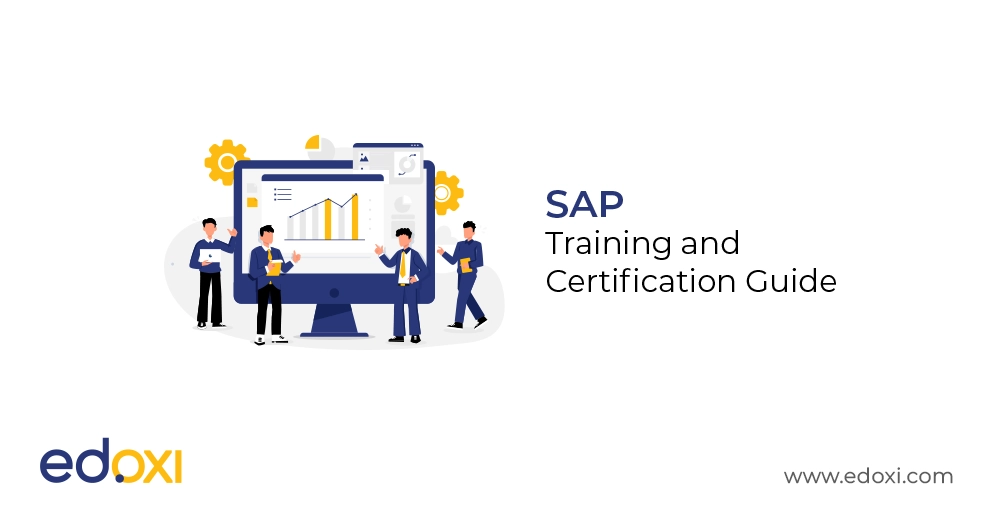
SAP training teaches you how to use SAP software for business processes like finance, sales, or HR. SAP certification is a formal exam which proves that you know a specific SAP module well enough to work on it professionally.
Together, they form a learning path that can lead to roles like SAP consultant, SAP analyst, or SAP project manager.
If you're short on time, that's the one-line answer. Now let's break down how it actually works.
SAP is the software that runs daily operations at most of the large companies. It manages finance, supply chain, HR, and sales in one system. SAP training teaches you how to actually use this system.
SAP certification is different, but the two work together. Training teaches you the skill. Certification proves you have it. You take SAP certification exam, and if you pass, SAP issues you an official credential. Employers value this credential because SAP itself sets and controls the exam.
Most people follow the same path: start with an SAP training course, build hands-on skills, then sit the certification exam once they're ready. Training comes first. Certification comes after.
SAP isn't one single course. It's a family of modules, and each one leads to a different job. Picking the right one is the first real decision in your SAP learning path.
SAP FICO course focuses on Financial Accounting and Controlling. It's built for people who want to work with budgets, ledgers, and financial reporting inside SAP. Finance is one of the most in-demand areas right now, because every company running S/4HANA needs certified finance consultants to manage the transition.
SAP MM training stands for Materials Management. It covers procurement, inventory, and supply chain processes. If you enjoy logistics or supply chain work, this module fits naturally into that career.
SAP SD training is Sales and Distribution. It covers order processing, pricing, billing, and shipping. It's a strong fit for people coming from a sales, retail, or customer-facing background.
SAP SuccessFactors training is built for HR professionals. It covers cloud-based HR tools like recruiting, performance management, and employee data. As more companies move HR to the cloud, this module keeps growing in demand.
SAP Basis training is the technical backbone. It covers system administration, installation, and performance tuning. This one suits IT professionals who like infrastructure and system management more than business processes.
SAP ABAP training teaches SAP's own programming language. It's for developers who want to build custom features inside SAP systems. ABAP skills stay valuable because every SAP implementation needs some level of custom development.
SAP S/4HANA training is the one everyone is talking about right now, and for good reason. The December 2027 ECC end-of-support deadline is forcing more than 60% of SAP customers into S/4HANA migrations they haven't started yet.
This module covers SAP's newer, faster ERP platform, and it's quickly becoming the standard across the industry. If you're choosing just one SAP course to future-proof your career, this is usually it.
A clear SAP learning path usually follows four stages.
Step one is picking your module: Base this on your background. Finance people go FICO. Supply chain people go MM. HR people go SuccessFactors. IT people go Basis or ABAP.
Step two is structured SAP training: You learn the module through guided lessons, practice systems, and real business scenarios. This is where an SAP training institute matters, because the quality of instruction shapes how well you understand the software.
Step three is the SAP certification exam: Once your trainer confirms you're ready, you register for the exam and sit it, usually through Pearson VUE testing centres.
Step four is applying your skills on the job: Certification opens doors, but real SAP skills grow through hands-on project work. Many professionals keep learning after certification, adding a second or third module over time.
Start with your current job and where you want to go. If you're already in finance, don't jump straight into ABAP just because it sounds technical and impressive. Build on what you know.
Next, check if the SAP courses includes hands-on system access. Reading about SAP screens isn't the same as clicking through them yourself. A good SAP certification course gives you a live or simulated system to practise on.
Also check the trainer's background. SAP is a practical skill, not just theory. A trainer who has actually worked on live SAP projects will teach you things a textbook never will.
This is where the SAP career guide part really matters. SAP certification doesn't lock you into one job title. It opens several paths.
An SAP consultant career also travels well. SAP is used across nearly every industry, and every major economy, so your certification holds value whether you work locally or move abroad.
SAP online training works well if you're already employed and need flexible hours. You can study around your job, replay difficult lessons, and set your own pace.
Classroom-based SAP training course formats work better if you learn through direct interaction. You get immediate answers to questions and often build a peer network you can lean on later.
Some SAP training institutes now offer a blend of both: live online sessions with recorded backups. If you're unsure, this hybrid model is usually the safest middle ground.
Before you enrol in an SAP training institute, check these three things:
A good SAP training institute should also be transparent about pass rates and job placement support, even if informally. If they can't talk about outcomes, that's worth noting.
This is the question most people actually want answered. So here's the honest, data-backed answer.
SAP-certified professionals in the United States earn an average salary of $146,422 to $152,511 per year, depending on their SAP module and experience level.
According to the 2025 Pearson VUE Value of IT Certification Report, 32% of SAP-certified professionals received an immediate salary increase after earning their certification.
Nearly one-third of those salary increases exceeded 20%.
The report also found that 82% of certified professionals gained the confidence to pursue new job opportunities that had previously been out of reach. There is also a broader industry-wide reason to pursue SAP certification.
Gartner projects that around 17,000 SAP ECC customers will not have migrated to SAP S/4HANA by the December 2027 deadline. This represents roughly half of the original ECC customer base.
As the deadline approaches, demand for SAP consultants and system integrators is expected to surge. This is because the pool of qualified SAP S/4HANA professionals remains limited.
That is why SAP certification benefits extend beyond a single salary increase.
| Data Point | Figure |
|---|---|
| Average SAP-certified professional salary (US) | $146,422–$152,511/year |
| Salary premium for certified vs non-certified | 20–40% higher |
| Professionals who got a raise after certification | 32% |
| Of those, raises above 20% | Nearly 1 in 3 |
| Companies still to migrate off ECC by 2027 | ~17,000 (Gartner) |
| Typical time to recover certification cost | 3–9 months |
SAP skills are becoming increasingly relevant in Qatar as businesses continue to adopt digital systems to manage finance, procurement, supply chains, human resources, sales, and day-to-day operations. Industries such as energy, construction, banking, logistics, healthcare, and professional services all rely on efficient business processes, creating opportunities for professionals with ERP and SAP knowledge.
For beginners, the right SAP module usually depends on their existing experience. Finance and accounting professionals can consider SAP FICO, while those working in procurement, inventory, or supply chain may find SAP MM more suitable. Sales professionals can explore SAP SD, while IT professionals can build careers around SAP Basis, SAP ABAP, or SAP S/4HANA.
Qatar's strong energy and infrastructure sectors also make SAP knowledge useful for professionals involved in large-scale projects and complex business operations. Companies managing procurement, finance, inventory, project activities, and supply chains need professionals who understand how these functions work together within an ERP environment.
The most suitable SAP skill depends on your career background and target role:
Yes, SAP certification can strengthen your professional profile, particularly when it is combined with practical SAP skills and relevant industry experience. Certification demonstrates knowledge of a specific SAP solution, while hands-on training helps you understand how that solution is used in real business situations.
If you are planning to build an SAP career in Qatar, focus on three areas: choose a module that matches your background, gain practical experience through a structured SAP training course, and prepare for the relevant certification. This combination can give you a stronger foundation for SAP consultant, business analyst, ERP specialist, and other technology-related roles.
For professionals already working in Qatar, SAP courses can also be a way to add ERP expertise to an existing finance, supply-chain, HR, sales, or IT career. The goal should not simply be to collect a certification, but to develop skills that you can apply to real business processes.