Request a Callback

+971 43801666
 Jun 16, 2026
Quick AnswerYes. PMP certification is worth it in Qatar in 2026 due to the strong demand for skilled project managers across construction, energy, IT, and infrastructure sectors. It can lead to higher salaries, better job opportunities, and faster career progression into leadership roles. |
Qatar is not a typical job market. The country is midway through one of the most ambitious national transformation plans in history, Qatar Vision 2030, which is channelling over USD $200 billion into infrastructure, energy transition, smart cities, and healthcare.
Every riyal of that investment needs qualified project professionals to turn blueprints into reality. The Project Management Professional (PMP) certification, issued by the Project Management Institute (PMI), is the global gold standard for exactly that.
But "worth it" is a serious question. PMP preparation costs time, money, and significant effort.
If you are a project professional in Doha, Lusail, or anywhere across Qatar's booming economy, this guide gives you the data-driven answer, straight from PMI's latest global talent report, real salary benchmarks from the GCC market, and on-the-ground context from the PMI Qatar Chapter in Doha.
Table of Contents |
|
1. PMP Certification in Qatar 2025–2026: Is It Really Worth It for Career Growth?
2. Reasons Why PMP Certification Is Still Worth It in Qatar (2026 Guide) 3. What does the data say about PMP salaries in Qatar? 4. How Much Does PMP Certification Cost in Qatar and How Long Does It Take to Complete? 5. Conclusion 6. FAQs: Is PMP Certification Worth It in Qatar in 2026? |
Qatar's economy has outgrown oil dependence faster than most GCC neighbours. West Bay's skyline, the Lusail Smart City development, the Hamad Medical City expansion, and massive renewable energy investments under QatarEnergy are all multi-billion-riyal projects that require structured project governance.
According to industry analysts, the GCC economy as a whole was forecast to grow 4.7% in 2025, with Qatar's labour market tightly linked to this regional momentum.
For project professionals based in Doha or the Al Wakrah and Al Khor corridors, this means a pipeline of complex, long-horizon projects that actively demand PMP-certified leaders, not just experienced managers. Recruiters in Qatar's West Bay and Msheireb Downtown districts regularly filter candidate profiles by PMP status before shortlisting.
Qatar Vision 2030 is a national development framework aimed at transforming the country into a diversified, knowledge-based economy. To achieve this vision, Qatar continues to invest heavily in large-scale infrastructure, transportation, energy, healthcare, education, and smart city projects.
These initiatives require skilled project managers who can plan, execute, and deliver projects efficiently while managing risks, budgets, and stakeholder expectations.
As organisations strive to meet ambitious project goals, PMP-certified professionals are increasingly sought after for their globally recognised project management expertise. The PMP certification validates an individual's ability to lead complex projects, making certified professionals valuable assets in Qatar's evolving project-driven economy.
The industries in Qatar that value PMP the most are the following:
Qatar is the world's largest LNG exporter. QatarEnergy's North Field expansion, the largest LNG project in history, requires hundreds of project managers coordinating engineering, procurement, and construction across Al Khor and Ras Laffan Industrial City. PMP certification is the baseline credential for senior PM roles in this sector.
Lusail City, the 38-km² smart city development north of Doha, is still mid-construction with residential, commercial, and entertainment zones underway. Projects of this scale running parallel workstreams across hundreds of contractors require PMP-trained leaders.
Qatar's National Vision 2030 Technology Pillar is pushing e-governance, smart infrastructure, and AI adoption across public sector agencies. IT project managers with PMP credentials are in strong demand at organisations like Meeza (Qatar's government cloud provider) and Ooredoo, Qatar's leading telecom.
Qatar's healthcare infrastructure investment is creating complex multi-facility projects that need PMP-certified professionals to manage scope, timelines, compliance, and cross-cultural stakeholder groups.
PMP Certification Salary & Demand Insights of Qatar
|
36% Average salary premium for PMP holders in Qatar vs. non-certified peers QAR 380K Annual median salary for PMP-certified professionals in Qatar 30M New project professionals needed globally by 2035 (PMI, 2025) 33% Higher median earnings for PMP holders vs. non-certified peers across 21 countries (PMI) |
The major reasons why PMP certification is still worth it in Qatar are:
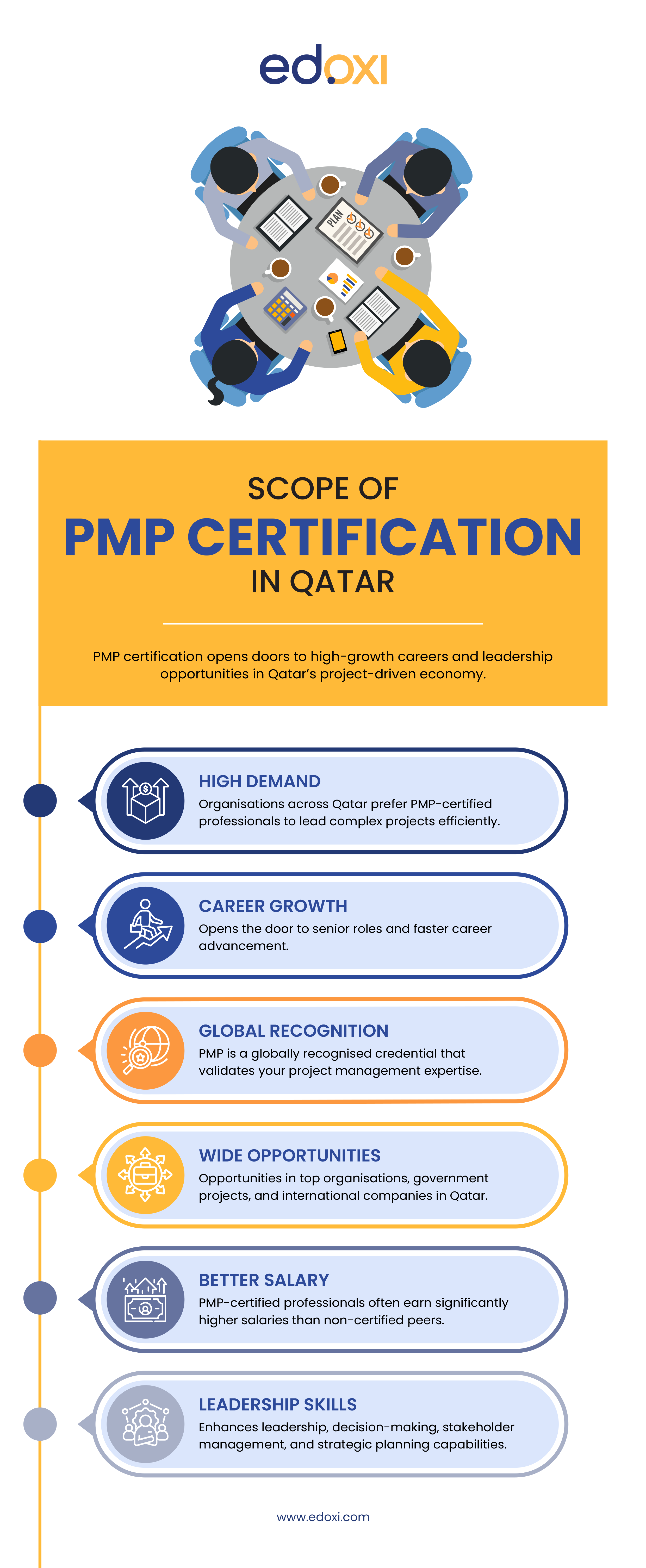
The reasons for the scope of the PMP certification in Qatar are illustrated below:
The current data says that the PMP salaries in Qatar are between QAR 364,000 and 582,000 per year, depending on industry, seniority, and the complexity of projects managed.
The industries at the top of that range are oil and gas and large-scale infrastructure, both of which are Qatar's backbone sectors.
PMI's Earning Power: Project Management Salary Survey consistently shows that PMP holders earn a median salary 33% higher than non-certified counterparts across 21 countries globally.
In the Middle East, Qatar, along with the UAE and Saudi Arabia, offers tax-free salaries. So every raise goes directly to take-home pay with no deductions.
The salary varies with the experience level and the career path you are currently in.
The Career Path of PMP Professionals in Qatar is given below:
Career Path of PMP Professionals in Qatar
|
Career Level |
Common Job Role |
Typical Annual Salary in Qatar (QAR) |
|
Entry Level |
Project Coordinator |
90,000 – 150,000 |
|
Early Career |
Assistant Project Manager |
150,000 – 220,000 |
|
Mid-Level |
Project Manager (PMP Certified) |
220,000 – 380,000 |
|
Senior Level |
Senior Project Manager |
350,000 – 500,000+ |
|
Leadership |
Program Manager |
450,000 – 700,000+ |
|
Executive |
PMO Director / Project Director |
600,000 – 1,000,000+ |
Source: NaukriGulf, GulfTalent
Check out: What is the Salary for PMP Professionals in QatarOne of the biggest benefits of working in Qatar is the opportunity to earn a tax-free salary. Unlike many countries where a significant portion of income is deducted through personal income tax, professionals in Qatar can retain a larger share of their earnings. This allows PMP-certified project managers and other professionals to increase their savings potential while enjoying a high standard of living.
In addition to tax-free income, many employers offer attractive benefits packages that may include housing allowances, transportation, medical insurance, annual air tickets, and performance bonuses.
For expatriate professionals, who make up the majority of Qatar's private-sector workforce, PMP certification provides immediate, portable credibility.
It communicates globally recognised competence to employers at multinational contractors like AECOM, Mott MacDonald, and Parsons, all of which have significant Qatar operations.
For Qatari nationals, the calculus is equally compelling. Qatarization policies across government entities and state-owned enterprises explicitly favour nationals for leadership roles.
A PMP credential strengthens an application for senior PM or program director positions in Qatar's Ministry of Public Works, Ashghal (the Public Works Authority), and the Qatar Investment Authority's portfolio companies.
Other than PMP certification, individuals interested in project management can choose Primavera certification in Qatar as an alternate path.
PMI's May 2025 Global Project Management Talent Gap Report, arguably the most important workforce study in the profession this decade, reveals a stark reality: nearly 30 million new project professionals will be required globally by 2035 to meet rising demand.
The global project management workforce, already around 40 million strong (larger than the global pool of software developers or nurses), is still projected to fall tens of millions short.
Qatar's LNG expansion is generating a long-term need for project leaders. QatarEnergy's North Field expansion aims to bump up LNG production capacity from 77 million tonnes per annum to 126 MTPA by 2027. That'll make it one of the biggest energy projects around and keep project management pros busy for years.
Also, Qatar's infrastructure market is forecasted to hit $41.3 billion by 2030. It's slated to climb from $33.4 billion in 2025, fueled by growth in transport, utilities, digital infrastructure, and Vision 2030 projects. This demands lots of skilled project managers to keep things moving.
There's a catch, though. Experienced construction and project professionals are hard to find. Many organisations must fiercely compete for these talents because of shortages. Obtaining PMP certification really sets project managers apart in this challenging job market.
The global talent shortage keeps the market in favour of certified project professionals. In Qatar, with its constant stream of big projects, demand stays high past 2030. Become a PMP professional in Qatar to seize high-value career opportunities.
The PMP certification cost and completion time in Qatar depend on factors such as the training provider, learning format, PMI membership status, and the candidate's study pace and experience level.
The total cost of obtaining PMP certification in Qatar typically ranges from QAR 3,500 to QAR 8,000, depending on the training provider, study materials, and exam fees.
While the initial investment may seem significant, PMP-certified professionals often benefit from higher salaries, better job opportunities, and faster career progression. For many project managers, the certification delivers a strong return on investment (ROI) through increased earning potential and long-term career growth.
So, the PMP certification stays super valuable in Qatar. It gives PMP aspirants better job chances, pays more, and opens doors to top spots in the nation’s booming project-focused fields.
PMP certification remains worthwhile for professionals in Qatar in 2026. The nation keeps pouring money into energy, infrastructure, tech, and economic diversification. For this reason, firms are always on the lookout for folks who can handle big projects smoothly.
PMP shows off these PMP skills, making it easier for people to catch recruiters' eyes and snag better-paid, leadership-type gigs.
It's not just about money either. PMP packs long-term value by boosting your project management knowledge with global PMP standards.
If you're an engineer, coordinator, team lead, or just eyeing a PM role, getting that PMP can really speed up career growth. It also adds major creds and opens up job options all across Qatar and even in the broader Gulf area.