Request a Callback

+971 43801666
 Mar 03, 2026

The key job roles in top HR Analytics are People Analytics Manager, HR Data Scientist, Workforce Planner, AI & Ethics Specialist (HR), Talent Acquisition Analytics Specialist, and HRIS Manager. These job roles in HR command an average salary of $92,000-$135,000 per year.
With the global hiring trends moving towards strategic and advisory HR and technology-driven AI-based HR practices, you can become a competent and in-demand HR professional to secure successful HR jobs. The key skills that you should emphasise in your development are Data analysis, Data Visualisation and Reporting, AI fluency, strategic thinking, and ethical judgment.
In this article, let's explore the best HR Analytics roles in 2026, the skills that define a professional, salary criteria, and hiring trends.
The top HR analytics roles in 2026 include positions that go beyond reporting. These roles focus on shaping the real workforce and business decisions. Top HR Analytics roles in 2026 are:
People Analytics Lead/Manager
HR Data Scientist/Analyst
Workforce Planner/Strategist
AI & Ethics Specialist (HR)
Employee Experience (EX) Analyst
Talent Acquisition Analytics Specialist
HRIS Manager
Head of People Analytics/Director.
Let’s get into detail about what each of these job roles entails.
A People Analytics Lead/Manager supports data-driven workforce decisions in an organisation. He or she develops analytics strategies, maintains data infrastructure, and provides insights to employee recruitment, retention, and productivity. Core Responsibilities of a People Analytics Lead/Manager include:
People Analytics Lead/Managers are some of the highest-paid HR analytics professionals. The salaries depend on the level of experience and industry. Here is what to expect.
The salaries for People Analytics Lead/Manager vary significantly by experience, from entry-level to senior levels. Let's check the average salaries based on Glassdoor salary insights:
| Experience Level | Average Salary (USD) |
| Entry-Level (0–2 years) | $97,000 – $113,000 |
| Mid-Level (3–5 years) | $114,000 – $150,000 |
| Senior-Level (5+ years) | $150,000 – $200,000+ |
An HR Data Scientist/Analyst evaluates employee information by using data and statistical methodologies to help HR and business leaders make better decisions.
Now, let’s have a look at what the major responsibilities of an HR Data Scientist/Analyst are:
With the right skills and expertise, an HR Data Scientist/Analyst can lead to significant salary hikes in the future.
HR Data Scientists and Analysts earn high salaries due to the rising demand for evidence-based talent management. Let's look at the pay scale for HR data analysts according to experience level.
| Experience Level | Average Salary (USD) |
| Entry-Level (0–2 years) | $85,000 – $133,000 |
| Mid-Level (3–6 years) | $151,000 – $175,000 |
| Senior-Level (7+ years) | $190,000 – $234,000+ |
A Workforce Planner or Strategist helps align HR with business goals. By focusing on smart planning and data-driven decisions, this role improves workforce efficiency, reduces costs, and supports long-term business success. Let’s see what the core responsibilities of a Workforce Planner/Strategist are:
Workforce Planner/Strategist provides attractive salaries due to increased demand in the job market. Let's look at the salary range below.
Here, we have included the global average salary of a Workforce Planner / Strategist based on the experience level. Starting from an average salary of $50,000, a Workforce Planner/Strategist can earn up to $150,000+ in senior-level roles.
| Experience Level | Average Salary (USD) |
| Entry-Level (1–3 years) | $50,000 – $65,000 |
| Mid-Level (4–7 years) | $70,000 – $95,000 |
| Senior-Level (8+ years) | $100,000 – $150,000+ |
An AI Ethics Specialist (HR) is a professional who focuses on identifying, analysing, and addressing ethical issues related to the development and deployment of artificial intelligence (AI) technologies. Let’s find out what the responsibilities of an AI & Ethics Specialist (HR) are.
The responsibilities vary based on an AI & Ethics Specialist (HR) experience and the company one works for. AI and Ethics Specialists (HR) are in high demand and are offered attractive pay. Let’s look at the salary range for this role.
AI and Ethics Specialists (HR) usually earn an annual salary of $135,800. This can vary based on one’s level of experience and is given in the table below:
| Experience Level | Average Salary (USD) |
| Entry-Level (0–2 years) | $80,000 – $110,000 |
| Mid-Level (3–5 years) | $120,000 – $150,000 |
| Senior-Level (5+ years) | $160,000 – $244,000 |
An Employee experience (EX) refers to an employee's complete experience, including all interactions from recruitment to offboarding within an organisation. It includes workplace culture, technology, working conditions, and overall well-being. The primary areas of responsibility are:
Employee Experience (EX) Analysts are in high demand in the job market, with attractive salary opportunities. Here's what to expect.
An average annual salary of an Employee Experience (EX) Analyst is approximately $106,373. See how much one can earn based on the level of experience.
| Experience Level | Average Salary (USD) |
| Entry-Level (0–2 years) | $55,000 – $80,000 |
| Mid-Level (3–5 years) | $70,000 – $110,000 |
| Senior-Level (5+ years) | $100,000 – $160,000+ |
The Talent Acquisition Analytics Specialist is tasked with enhancing the effectiveness and quality of the candidate experience through the use of data created from the hiring process. The key responsibilities of a Talent Acquisition Analytics Specialist are:
Talent acquisition analytics specialists are in high demand and earn competitive pay as companies increasingly rely on data-driven hiring. The salary outlook for this role is provided below.
The average salary of a Talent Acquisition Analytics Specialist is approximately $91,938 per year. This varies based on the experience of a Talent Acquisition Analytics Specialist. See this division of salary based on experience in the table below:
| Experience Level | Average Salary (USD) |
| Entry-Level (0–2 years) | $43,000 – $59,000 |
| Mid-Level (3–5 years) | $75,000 – $90,000+ |
| Senior-Level (5-8+ years) | $94,000 – $155,000+ |
HRIS Manager supports specialised and internal HR systems, services, and applications used in organisations with customised needs. Maintains internal database files and creates customised reports to satisfy company management and employees. The key responsibilities of an HRIS Manager include:
As HR systems become important to businesses, the HRIS Manager offers strong career opportunities and a good salary. Let's look at the salary range below.
The average salary range of an HRIS Manager is between $106,469-$139,800 annually. See the salary variations by experience level, from entry-level to senior-level, in the table below.
| Experience Level | Average Salary (USD) |
| Entry-Level (1–3 years) | $95,000 – $125,000 |
| Mid-Level (3–7 years) | $120,000 – $150,000 |
| Senior-Level (8+ years) | $150,000 – $200,000+ |
A Head of People Analytics/Director is a senior leadership role responsible for transforming employee data into strategic business insights. They act as the connection between technical data science and HR to support the organisation in making evidence-based decisions on hiring, retention, diversity, and productivity. The key responsibilities are:
With the growing importance of people analytics at the leadership level, this role carries great responsibility and high earning potential. Let's look at the salary range below.
The average salary range of a Head of People Analytics/Director is between $247k - $261k annually. See these salary variations in the table below:
| Experience Level | Average Salary (USD) |
| Entry-Level (1–3 years) | $95,000 – $125,000 |
| Mid-Level (3–7 years) | $120,000 – $150,000 |
| Senior-Level (8+ years) | $150,000 – $220,000+ |
To understand what employers expect from modern HR analytics professionals, look into the key skills required in 2026 below:
To succeed in an HR analytics career in 2026, you must build skills beyond standard reporting. Here are the key competencies required to be successful in an HR analytics role:
AI fluency refers to the ability to understand how artificial intelligence works correctly in real-world HR analytical tasks. It involves working with AI technologies, interpreting the outputs, and applying your judgment to inform your decisions. You do not have to develop AI systems, but you should know how to apply AI-enabled solutions for workforce analysis and forecasting.
Emotional intelligence is the ability to learn how to feel yourself and those around you. Emotional intelligence skills can help you make better hires, create trust and growth, and improve employee engagement, performance, and retention.
Statistical analysis includes the utilisation of information in order to establish the trends and patterns in the workforce. The Statistical analysis skill assists you in predicting future requirements, improving the recruitment process, and making business decisions.
The data visualisation and reporting transform employee data into clear insights. The data visualisation and reporting skills include identifying trends, explaining knowledge, and supporting better decisions.
Strategic thinking uses workforce data to support long-term business goals. Having the strategic thinking skill assists you in improving the quality of hiring, engagement of employees, and business performance.
Change management is a skill that helps employees adapt to new work processes and environments. Good communication helps employees overcome resistance and adapt to change.
Having skills in communicating clearly is the ability to describe data concepts in a straightforward language. This helps business leaders and non-technical teams understand information and act on it effectively.
Data responsibility skill involves the careful handling of employee data. Strong ethical judgment helps to protect privacy, build trust, and support unbiased decisions.
To understand the job market, explore the Key Hiring Trends & Demands for HR Analytics in 2026 below.
In 2026, companies are not only focused on salary when hiring HR analytics professionals. They are more interested in people who can understand data, use digital tools, and help businesses make better decisions.
Some important trends include:
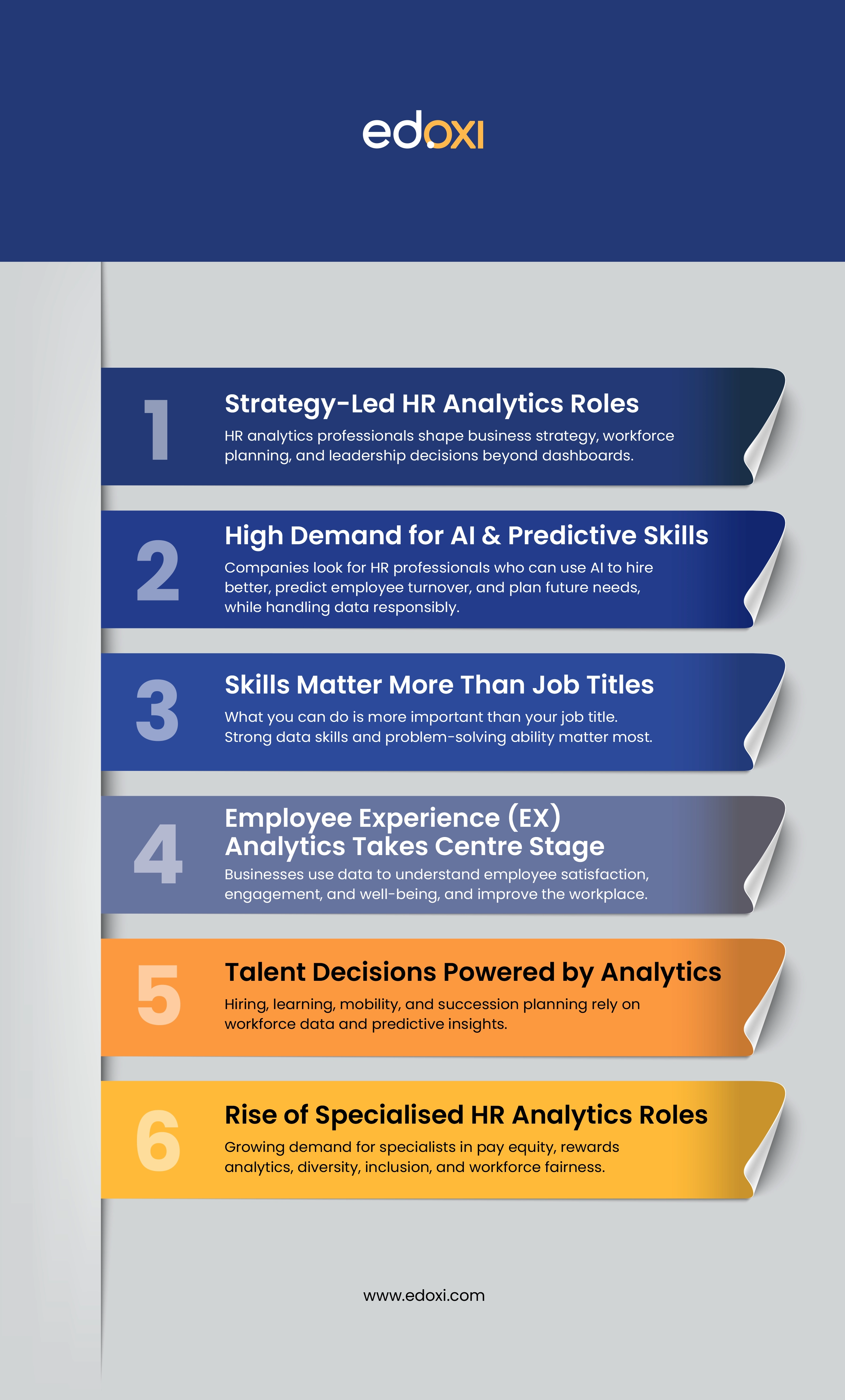
You are no longer required to provide data reporting only. Employers are looking for HR analytics professionals who can use employee data to make business decisions and become more responsive to organisational requirements.
Companies require individuals who can apply AI to HR tasks such as planning and hiring, as well as a deep understanding of data privacy and ethics.
Today, companies care more about your skills than your job title.
It is not enough to say you work in HR. Employers want people who understand data, think logically, and solve problems. If you can analyse information and connect it to business goals, you have strong value, no matter your title.
Companies are now paying more attention to employee experience.
They want to understand how employees feel at different stages, from hiring to daily work life. HR professionals who can collect and study employee data to improve engagement and well-being are in high demand.
Many HR decisions are now based on data instead of guesswork.
Companies use analytics to:
Data helps organisations make smarter and more confident decisions.
As HR becomes more data-focused, new specialized roles are emerging.
Some professionals now focus only on areas like:
HR analytics skills unlock high-growth roles, strategic influence, and future-ready career paths across industries.
Build the skills employers demand. Start your HR Analytics journey today.
An HR career will remain relevant in 2026 if you grow in the right direction. HR is moving from administrative work to people analytics, data-driven, and AI-assisted work. Employers are looking for professionals with data insights and human intuition.
The positive thing is that to remain competitive does not mean discarding HR. By building analytics skills and understanding changing hiring and pay trends, you can move into more strategic roles. Most of the HR professionals choose to upskill through the best HR analytics institute to gain industry-relevant training and stay employable.
In 2026, the most popular HR analytics positions will be People Analytics Lead, HR Data Scientist, Workforce Planner, Employee Experience Analyst, and HRIS Manager. Rather than simply reporting on workforce data, the roles focus on converting this into business decisions.
The most in-demand roles for HR analytics in 2026 is Strategic People Analytics. This is because the role combines data analysis with business strategy, workforce planning, and AI insights.
Yes, HR analytics is one of the fastest-growing careers. This is because organisations are increasingly turning to HR analytics to improve recruitment, retention, and workforce planning, and as a result, the demand for HR analytics professionals continues to grow.
A large number of HR analytics jobs do not require advanced coding skills. Many roles focus on data analysis, dashboards, and insights rather than programming, which requires the use of HR analytics tools and technology.
Yes, many professionals have been able to transition into an HR analytics career out of the traditional HR roles. HR process experience, as well as reporting, analytics tools, and data interpretation skills, provide an effective base.
The data analysis, AI fluency, data visualisation, strategic thinking, communication, and ethical judgement are some of the HR analytics skills that employers seek. It is possible to convert data into decisions, which is more important than technical complexity.
Yes, the future of HR analytics is good with organisations investing in workforce data and AI. The right-skilled professionals can advance to senior positions and leadership positions with time.
HR analytics is more concerned with evidence-based decisions, whereas traditional HR is intimately associated with experience and processes. The employers are becoming more attracted to HR professionals who are able to quantify impact and minimise people-related risks with data.
HRIS systems, dashboards, reporting tools, survey systems, and artificial intelligence-based analytics tools are all common HR analytics jobs. Knowledge of such technologies enhances labour preparation in 2026.
The common beginning of an HR analytics career is the mastery of essential analytics skills, knowledge of HR data, and hands-on experience with reporting tools. Most professionals start by learning to up-skill through organized learning and proceed into analytics-based functions.
HR background is optional. HR analytics positions can be occupied by professionals with an analytic, business, or IT background. This is more helpful if you are aware of workforce data and people-related issues.
When recruiting HR analytics professionals in 2026, the top-paying industries are technology, financial services, healthcare, retail, and large organisations undergoing digital transformation. All organisations that operate with large and/or distributed workforces are investing in HR analytics to enhance hiring, retention, and workforce planning.
The average salary for HR analytics professionals in 2026 is between $92,000 and $135,000 per year, depending on the role and experience level.
Senior leadership roles, such as Head of People Analytics/Director, have the highest paying potential, ranging from $150,000 to more than $200,000 per year based on experience levels mentioned in the salary outlook above.