Request a Callback

+971 4380 1666
 Oct 06, 2026
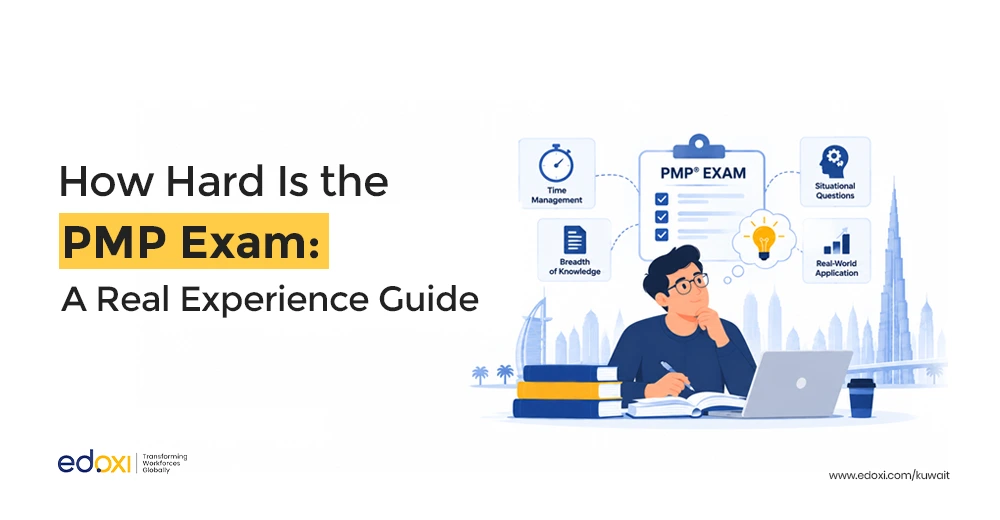
PMP exam is challenging because it tests judgment, not just memory. You get 180 questions in 240 minutes and must pick the best action in realistic project scenarios.
Your experience, your study plan, and your comfort with agile and hybrid work decide how hard it feels.
Imagine that your sponsor wants the launch moved up by two weeks. Your lead developer is unhappy. The budget will not stretch. Four answers sit on your screen, and all four look sensible.
That’s the PMP exam in one scene. It is not a definition quiz. It is a judgement call, made again and again.
So, how hard is the PMP exam? Hard enough to need a plan, but not so hard that a focused person cannot pass.
This guide covers the 2026 format, what makes the questions tricky, and how to prepare. It also looks at why the certificate matters in Kuwait, where large projects keep growing.
If project management is still new to you, start with this short read on what project management is and why it is important.
Table of Contents
| Nos | Contents |
|---|---|
| 1 | Is the PMP Exam Really Difficult? |
| 2 |
How Hard Is the PMP Exam in 2026?
a) What Is the 2026 PMP Exam Format?
|
| 3 |
Why Do Candidates Find the PMP Exam Hard?
a) Does the PMP Exam Test Application or Memory?
b) Why Can Several PMP Answers Look Right?
c) How Much Time Do You Get per Question?
d) Why Do Agile and Hybrid Questions Feel Different?
e) Why Does Business Environment Matter More Now?
|
| 4 |
What Makes It Hard for First-Time Candidates?
a) Is the PMP Exam Harder Without Project Management Experience?
|
| 5 |
What Does the PMP Exam Feel Like?
a) What Should You Do Before the Exam?
b) How Should You Read Questions During the Exam?
c) What Should You Do When You Get Stuck?
d) How Do You Manage the 240 Minutes?
|
| 6 | Which PMP Topics Are Hardest to Understand? |
| 7 | How Long Does It Take to Prepare for the PMP Exam? |
| 8 |
How Do You Prepare for a Difficult PMP Exam?
a) Which Mistakes Should You Avoid?
|
| 9 |
PMP Exam Difficulty: How Do Experience and Preparation Compare?
a) Is the PMP Exam Worth the Preparation Effort?
|
| 10 | Key Takeaways |
| 11 | Frequently Asked Questions |
For many people, yes. The exam asks what you would do, not what a term means. Add a running clock and mixed delivery styles, and it gets tough.
Here is where candidates struggle:
PMI changed the exam in July 2026. The length stayed the same, but the weight of each domain moved a lot.
PMI moved the weights from People 42%, Process 50%, and Business Environment 8% to 33%, 41%, and 26%.
Some of that is a reshuffle. Change and risk topics moved into Business Environment from Process. So the content is not all new. It is just sorted differently. (PMI)
180 questions, 240 minutes, and three domains.
2026 PMP Exam Structure and Key Factors
| Exam Factor | 2026 PMP Exam |
|---|---|
| Questions | 180 |
| Exam time | 240 minutes |
| People | 33% |
| Process | 41% |
| Business Environment | 26% |
| Delivery approaches | Predictive, agile/adaptive and hybrid |
Ten of the 180 questions are pretest items, so 170 count toward your result. Two 10-minute breaks are built in. New case-study and graphic-based question types have also been added.
PMI's outline says about 40% of items reflect predictive approaches. The other 60% cover agile and hybrid (PMI).
This reflects how the project management profession is evolving, as discussed in how PMP certification aligns with the future of project management.
Five things stack up when we discuss why candidates find the PMP exam hard:
Application
Close answers
Time
Agile thinking
Business context
The PMP exam tests the application. Knowing what a risk register is helps, but knowing when to update it and who to tell first wins the mark. You must choose the right action, not repeat a definition.
Because the exam wants the best answer, not just a correct one. Two options may both work in real life. Only one fits the situation and PMI's way of managing projects. Read the last line of the question twice.
About 80 seconds. That is 240 minutes divided by 180 questions. It sounds fine until a long case study eats three minutes. Time is a skill you must practise.
They ask you to think in another way. These ideas are spread across the whole exam, not kept in one section. A question on stakeholders may quietly assume an agile team. You need both mindsets ready.
It grew from 8% to 26%. That is roughly 47 questions instead of about 14. It also covers value delivery, sustainability, and the use of AI in projects.
Kuwait shows why this matters. KPMG in Kuwait's infrastructure report said a pipeline of projects worth an estimated USD 27.6bn was in the bidding stage.
Projects like these run on funding, rules, and public partnerships. Project managers must read that world, not just a Gantt chart.
Hassan F. Choudhry, Chief Financial Officer at Umm Al Hayman for Wastewater Treatment Company, told KPMG in Kuwait that the market's mood toward PPP projects is "welcoming." He added that public and private partnerships can bring real efficiency and economic benefits to the State of Kuwait.
First-timers meet a new style of questions and a big syllabus at the same time.
| Challenge | Why It Can Be Difficult |
|---|---|
| Situational questions | Requires judgement |
| Large syllabus | Many concepts to connect |
| Time pressure | Limited time per question |
| Agile/hybrid | Requires different ways of thinking |
| Business context | Requires strategic understanding |
| Question interpretation | Small details can change the answer |
Words like "first", "best", and "most likely" change the answer. Slow down on those.
It can be. Experience gives you a picture to attach each scenario to. But experience alone is not enough.
People who lead projects already know how a stakeholder argument feels. They know what a slipping schedule does to a team. That helps with judgment questions.
People moving into project management face a different job. They must learn the language and the PMI way of working from scratch. Mock exams help them most.
But years on the job do not replace structured study. Some habits from work, like fixing everything yourself, are the wrong answer on the exam. Candidates from either group should also review the key skills that make a successful PMP.
Kuwait-based contractors say the same about data.
Shi Yifei of AVIC INTL told KPMG in Kuwait that digital tools help contractors collect and study project performance data, which leads to better decisions.
That is the habit the new Business Environment domain rewards.
Project Management Training in Kuwait gives you structure, trainers, and mock tests in one place to make the journey easier.
It feels like a long meeting where every question is a small decision. Here is the journey, based on PMI's published format.
Practise the format, not just the content. Mock tests show gaps your notes hide. Revise weak areas in short sessions. Nerves are normal, so rehearse the day: the route, the ID, the breaks.
Read the last line first, then the scenario. Ask, "What is the question really asking?" Note the role you play. Then compare options against the situation, not against your own workplace habits.
Remove the two weakest answers, choose the best of the rest, flag it, and move on. Do not spend four minutes on one item. A good guess now beats a rushed question later.
Check the clock at set points, not every minute. Split the exam into three blocks of 60 questions. Aim to finish each block in about 80 minutes. Use the two breaks to reset. Do not leave a pile of questions for the end.
There is no single hardest topic. It depends on your background. These are the areas that trip people up most often.
Key PMP Exam Topics and Why They Can Be Challenging
| Topic Area | What Makes It Challenging |
|---|---|
| Situational decision-making | Several answers may seem reasonable |
| Stakeholder management | Requires context and judgement |
| Conflict management | Requires choosing an appropriate response |
| Agile/hybrid delivery | Different principles and practices |
| Risk and issues | Requires distinguishing responses |
| Governance and compliance | Requires understanding business context |
| Value and outcomes | Goes beyond traditional project constraints |
Tool knowledge helps with several of these. See the top project management tools every project manager should master.
It depends on your starting point. PMI does not set a study period. Plan in stages, not in a fixed number of days.
PMP Exam Preparation Stages and Key Focus Areas
| Preparation Stage | Main Focus |
|---|---|
| Foundation | Understand exam domains |
| Learning | Study concepts and approaches |
| Practice | Apply concepts to scenarios |
| Mock exams | Build speed and accuracy |
| Final revision | Review weak areas |
A simple roadmap for beginners:
Read the exam outline once, slowly.
Fix a weekly study slot you can keep.
Learn one domain at a time.
Add practice questions from week one.
Take full mocks near the end.
Spend the last days on weak spots only.
You also need 35 hours of project management training to apply. That is where guided learning helps. A PMP Course in Kuwait can also cover that training requirement, which is the first step toward PMP certification.
PMI is also updating live training eligibility rules from 1 December 2026, so check its site before you book anything.
For a broader look at the field, see why project management is a top career choice.
Use the official outline, learn the reasons behind answers, and practise under a timer.
It is PMI's own list of what the exam tests. It sets out the domains, tasks, and enablers. Build your notes around it. If you want a gentle first read, try an introduction to PMP certification.
Memorised lists break under new wording. Ask "why would a project manager do this?" for every step. That reasoning carries over to new scenarios.
Do a few every day and keep them mixed. Include agile and hybrid cases early, not as a last-week topic. After each one, say out loud why the right answer beats the second-best.
Yes. Your wrong answers are your real syllabus. Keep a short log with the reason for each miss: misread, weak topic, or rushed.
Because stamina is part of the test. Four hours is long. A full-length mock shows where your focus drops and where your pacing slips.
Five common mistakes that you should avoid are:
Both matter. Experience gives context. Preparation gives method.
Factors That Influence PMP Exam Preparation
| Factor | Impact on Preparation |
|---|---|
| Project experience | Helps contextualise scenarios |
| PMP training | Builds structured knowledge |
| Practice questions | Improves application |
| Mock exams | Builds exam stamina |
| Time management | Helps complete 180 questions |
| Revision | Reinforces weak areas |
It depends on your goals. The exam takes time and money, and it suits some career paths more than others.
Points in its favour:
Points to weigh:
Kuwait's Vision 2035 plan leans on major projects, and this is why the PMP certification comes up in hiring talks.
Kapil Kumra of National Bank of Kuwait said banks there support the 2060 carbon-neutral goal and have set sustainable financing policies. That shapes how projects are funded and judged.
You can also learn more about the value of PMP certification by reading why PMP certification is important for your career.
PMP Exam Difficulty: Quick Answer
| Question | Short Answer |
|---|---|
| Is PMP hard? | It can be challenging because it tests application and judgement. |
| Is PMP mostly memorisation? | No, scenario-based application is important. |
| How many questions? | 180 |
| How much time? |
240 minutes |
| What is the largest domain? | Process at 41% |
| Is agile included? | Yes |
| Is hybrid included? | Yes |
| Does experience help? | Practical experience can provide useful context. |
If you prefer structured exam preparation, a PMP course can help you build the required 35 contact hours, understand the current exam content, and practise scenario-based questions before the exam. Look for training that follows the latest PMI requirements and gives you enough practice with predictive, agile, and hybrid approaches.
For candidates who prefer instructor-led preparation, Edoxi Kuwait is a PMI Authorized Training Partner (ATP) offering PMP training aligned with PMI requirements and the current exam format. You can learn more about the PMP course in Kuwait before choosing a training option.