Request a Callback

+971 4380 1666
 Nov 02, 2026

SEO (search engine optimisation) helps your website become discoverable and rank in organic search results. AEO (answer engine optimisation) focuses on presenting clear, useful answers that search and AI systems can surface. GEO (generative engine optimisation) focuses on improving your brand's visibility and citations in AI-generated responses. These approaches overlap: strong technical SEO, reliable content and clear expertise support visibility across traditional search and AI-powered experiences.
|
Table of Contents
|
|
1. What is SEO?
2. What is AEO? 3. What is GEO? 4. AEO vs GEO vs SEO comparison table 5. Why the difference matters now 6. How SEO, AEO and GEO work together 7. Where should you focus? 8. How to measure SEO, AEO and GEO 9. Common myths 10. Skills needed 11. Conclusion 12. Terminology note 13. FAQs |
Search engine optimisation (SEO) is the practice of improving a website so its pages can be found and ranked in search engines such as Google and Bing. Higher rankings bring more organic, unpaid traffic.
For example, when someone searches for “Digital Marketing Course in Dubai” on Google, SEO helps websites such as Edoxi Training Institute improve their chances of appearing in the search results.
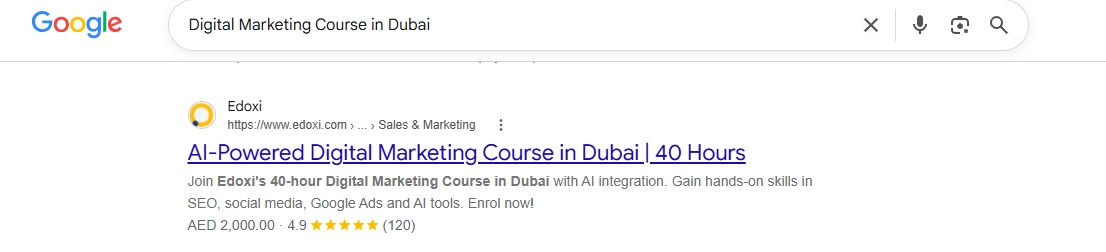
An image displaying a search query in Google for a Digital Marketing Course in Dubai shows Edoxi Training Institute as one of the top results.
SEO covers three main areas:
Success is measured by rankings, impressions, organic clicks and conversions from organic visitors. SEO still matters in the AI era because AI search features build on the same web content, crawling and quality signals.
Read more in What is SEO: A Complete Guide.
Answer engine optimisation (AEO) is the practice of structuring content so it directly answers the questions people ask, in a form that search engines and AI assistants can understand and surface as an answer.
AEO focuses on places where an answer appears with or without a click, such as featured snippets, People Also Ask boxes, Google AI Overviews and voice assistants. For example, when someone asks “Which practical digital marketing training are available in Dubai?”, clear and well-structured course information can help search systems identify relevant answers,
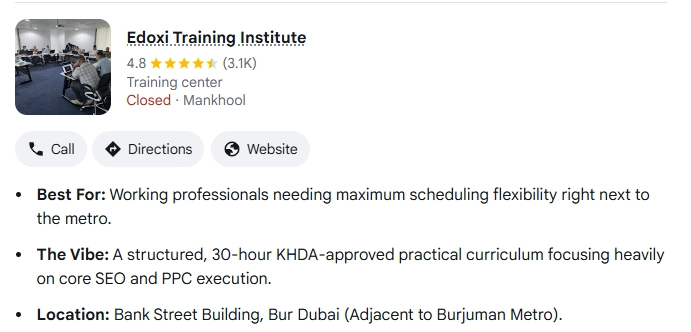
An image displaying a search query in AI mode for a Digital Marketing Course in Dubai shows Edoxi Training Institute as one of the top results.
Useful AEO practices include:
Success in AEO is tracked through featured snippets, People Also Ask appearances and presence in AI Overviews.
Generative engine optimisation (GEO) is the practice of improving the chances that your brand and content are mentioned, recommended and cited in AI-generated answers from tools such as ChatGPT, Gemini, Perplexity, Microsoft Copilot and Google AI Mode.
The difference from AEO is one of emphasis. AEO aims to provide the answer to a specific question. GEO aims to make your brand a credible source that AI systems draw on when they build longer, more conversational answers.
For example, when someone asks “Recommend some digital marketing training institutes in Dubai,” an AI tool may provide a list of options. Popular LLMs mention Edoxi Training Institute because it appears to be a relevant option based on the information available to them.
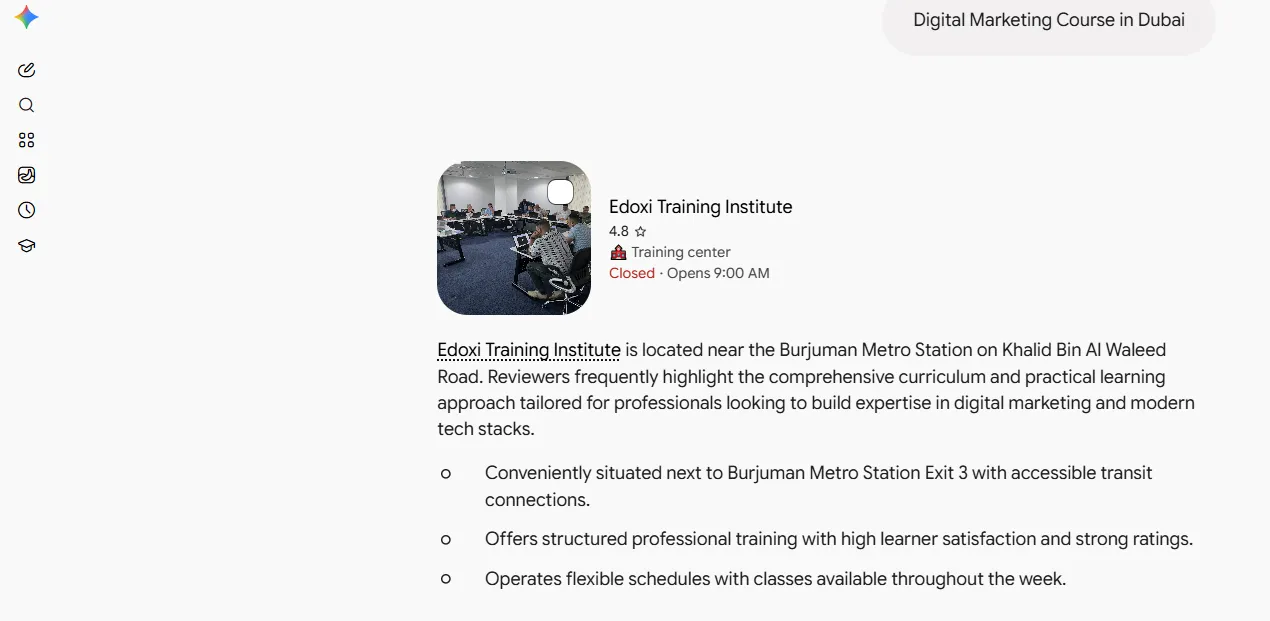
An image showing a Gemini search for a Digital Marketing Course in Dubai lists Edoxi Training Institute as the top result.
Some AI systems expand a question into several related searches, an approach often called query fan-out. Implementations vary by product and query, so comprehensive coverage can help you answer related intents, but it does not guarantee more citations.
Useful GEO practices include:
E-E-A-T is Google’s quality framework for judging content credibility: Experience, Expertise, Authoritativeness, and Trustworthiness. It is not a direct ranking factor, but strong E-E-A-T signals help content rank better indirectly.
Success in GEO is tracked through brand mentions, citations and referral traffic from AI tools.
| Factor | SEO | AEO | GEO |
| Main goal | Rank pages in search results | Be surfaced as a clear answer |
Be mentioned and cited in AI-generated answers
|
| Where results appear | Google and Bing results pages | Featured snippets, People Also Ask, AI Overviews, voice assistants |
ChatGPT, Gemini, Perplexity, Copilot, Google AI Mode
|
| What helps | Relevance, technical health, authority, backlinks | Clear, concise, well-structured answers |
Depth, original evidence, consistent entities, trusted mentions
|
| Content style | Pages built around search intent | Question headings, short answers, lists, tables, FAQs |
Complete topic coverage with specific, dated, citable information
|
| Key technical work | Crawling, indexing, speed, mobile, internal links | Clean HTML, extractable formats, accurate structured data |
Consistent brand data, author information, third-party presence
|
| Main metrics | Rankings, impressions, organic clicks, conversions | Snippet wins, People Also Ask and AI Overview appearances |
Brand mentions, citations and referral traffic from AI tools
|
| Typical tools | Google Search Console, GA4, SEO platforms | Search Console, SERP trackers, manual checks |
Manual prompt testing, AI visibility trackers, GA4 referral reports
|
Search no longer ends with a list of ten blue links. AI summaries, answer boxes and chat assistants now sit alongside traditional results, and people use them to research, compare and decide.
This is changing how people click, although the evidence is still limited to specific studies:
Treat these as useful signals, not universal benchmarks. The practical lesson is that visibility inside AI answers is becoming a separate thing to track, alongside rankings and clicks.
If you are new to the wider field, start with What is Digital Marketing and How Does It Work?, then come back here to see where search fits in.
You do not need three separate content strategies. One well-built page can support all three. Take a page that answers "What is the difference between SEO and GEO?"
Most work that improves AEO and GEO also improves SEO, and strong SEO helps AI systems find your pages in the first place.
A recognised training can also help you build SEO, AEO & GEO skills to impress employers. Read: Is it Worth Getting a Digital Marketing Certification?
The work does not need to happen in a strict order. Get the technical foundations right while you improve answer clarity and AI visibility in parallel. Your starting point depends on your situation:
A page can lose clicks to an AI summary while still gaining visibility inside it, so report these measures separately.
1. GEO replaces SEO.
It does not. AI search features still rely on Google's core systems and established SEO principles.
2. AEO is only about voice search
Voice was an early use case, but AEO now also covers featured snippets and AI Overviews.
3. Schema markup guarantees an AI citation
Google states that no special schema is required for AI Overviews or AI Mode. Structured data is a supporting SEO practice that should accurately match the visible content. It is not a citation tactic.
4. You need separate content for AI
Clear, accurate, well-structured content written for people serves both readers and AI systems.
5. Fewer clicks means SEO no longer works
Clicks are falling on many informational queries, but visibility, trust and brand awareness still matter, and the evidence on citations is correlational.
These skills build on traditional SEO rather than replacing it:
If you want to learn them in a structured way, Edoxi's Digital Marketing Course in Dubai covers SEO in Module 3 and AEO, GEO and Google AI Overviews in Module 8, with AI tools used across the course.
For a closer look at what employers in the UAE look for, see Top In-Demand Digital Marketing Skills in Dubai’s Job Market.
SEO, AEO and GEO are not competing strategies. They are overlapping lenses on the same goal: being found and trusted wherever people search. SEO helps your pages get discovered and ranked, AEO makes your answers clear and easy to surface, and GEO builds the credibility that makes AI systems more likely to mention your brand.
Start with strong technical foundations, structure your best pages around clear answers, and build original evidence and consistent brand information over time. No tactic guarantees AI citations, so measure what you can and keep improving.
Check out How to Become a Digital Marketer in Dubai Without Experience: a starting path if you are changing careers or have no background in marketing.
AEO and GEO are overlapping industry terms, not separate technical systems or standardised disciplines. Google AI Overviews, for example, give direct answers and cite sources, so they sit in both categories. Google's own guidance on generative AI features in Search says there is no special optimisation required for inclusion in AI Overviews or AI Mode, and that its core search systems and established SEO principles still apply.
In this article, the terms are used as strategic lenses defined by their primary objective, not as secret shortcuts around SEO.