Request a Callback

+971 4380 1666
 Nov 02, 2026
In Kuwait, government approvals, summer heat, and supply problems add more pressure. Realistic schedules and early risk checks prevent most of them.
The 10 main causes for construction project delays at a glance
Poor planning and unrealistic schedules
Weak contractor and subcontractor performance
Design errors and scope changes
Material and supply problems
Late payments and cash-flow gaps
Labour shortages and low productivity
Slow permits and approvals
Poor communication and coordination
Equipment failures and weak site management
Extreme weather and site conditions
The crane is booked. The crew is ready. A concrete truck waits at the gate. Then someone asks, "Which drawing revision are we using?" Nobody knows. The truck sits. The meter keeps running.
One hour is small. But sites lose weeks this way, one tiny stop at a time.
These small disruptions often point to larger problems with planning, approvals, procurement, and coordination. Understanding the causes is the first step towards preventing them.
This blog discusses why construction delays happen in Kuwait, their common causes and costs, early warning signs, and practical ways to prevent them.
Table of Contents
| Nos | Contents |
|---|---|
| 1 |
Why Do Construction Projects Face Delays?
a) Why does poor planning cause construction delays?
b) How do contractors and subcontractors cause delays?
c) Why do design errors and scope changes slow a project?
d) How do material shortages affect construction schedules?
e) How do late payments delay construction projects?
f) How do labour shortages affect project timelines?
g) Why do permits and approvals delay construction?
h) How does poor communication cause construction delays?
i) How do equipment failures and weak site management cause delays?
j) How do weather and site conditions delay construction?
|
| 2 | What Are the Main Causes of Construction Delays in Kuwait? |
| 3 |
How do government approvals and regulatory processes affect project timelines?
a) How does Kuwait's summer heat affect construction productivity?
b) Why do payment and procurement problems delay Kuwait construction projects?
c) How do contractor management and subcontractor coordination affect delivery?
d) How do design changes and contract variations increase delays?
|
| 4 | How Do Construction Delays Affect Project Costs and Completion Dates? |
| 5 | How Can Contractors Prevent Construction Project Delays? |
| 6 |
How Can Project Managers Identify Construction Delays Early?
a) Which project KPIs help track construction progress?
b) How do schedule variance and milestone tracking reveal delays?
c) When should a project manager update the construction schedule?
|
| 7 | Key Takeaways |
| 8 | FAQs About Construction Project Delays |
Construction project delays start when plans, people, money, materials, or approvals fall out of step. One late task pushes many others back. Each reason is holistically covered here.
Poor planning cause construction delays plan hides problems until they cost money. Teams guess task times and miss links between jobs.
A properly networked project schedule can identify a critical path: the sequence of activities that determines the earliest completion date.
It is the longest chain of linked tasks, and it sets the finish date. If one task on it slips, the project slips. Planners who take Primavera P6 training for construction project scheduling learn to map those links early.
Late starts, thin crews, and messy handovers between trades slow everything down.
A July 2025 pilot study in Buildings by Aldammak MM, Hamzah NB, et al., surveyed 60 professionals involved in Kuwait government building projects.
It identified poor contractor monitoring, weaknesses in consultant project management teams, and design faults among the key delay factors
Because it was a pilot study, its findings should be treated as preliminary rather than representative of every Kuwait construction project.
Every drawing revision or change order can force rework and re-ordering.
A 2005 survey of 450 private homeowners in Kuwait, in Construction Management and Economics, found that change orders were the top cause of delay.
A late delivery stops every task that needs it. Long-lead items like lifts and switchgear need orders in week one.
Procurement teams should track supplier lead times and confirm delivery dates against the project schedule. Approved alternatives can help reduce disruption when a supplier misses a commitment.
When cash slows, suppliers pause deliveries and crews thin out. Work drags.
Contractors may struggle to pay subcontractors, purchase materials, or maintain planned staffing levels. Clear payment milestones, timely invoice approvals, and regular cash-flow reviews can help prevent these interruptions.
Fewer skilled workers mean slower progress. Low productivity hurts just as much.
Short staffing can also delay dependent tasks and force project managers to rearrange work sequences. Forecast labour needs early, confirm subcontractor availability, and monitor productivity against planned output.
Work waits when sign-offs arrive late. Slow owner decisions rank high in Kuwait research, as shown below.
Missing documents, unresolved technical queries, and late submissions can extend approval timelines further. Maintain an approvals register with submission dates, responsible parties, and follow-up deadlines to identify bottlenecks early.
Crews build from old information when updates arrive late.
Everyone needs one current plan. Knowing the main Primavera job roles shows who owns each update.
A broken crane or blocked gate stops work fast. Deliveries, storage, and access need a daily plan.
Public Works Ministry spokesperson Eng. Ahmad Al-Saleh told KTV: "One of the biggest challenges you face is road closures." (Kuwait Times, 27 December 2025)
Heat, dust, rain, and poor soil cut working time. Kuwait's summer is the clearest case.
Extreme heat can affect worker productivity and restrict outdoor work during specified hours. Project managers should account for seasonal restrictions, assess site conditions early, and build realistic weather allowances into the schedule.
Kuwait research points to owner variation orders, rising material prices, slow approvals, late payments, and weak coordination.
The workload is huge.
Zawya reported in July 2026 an estimated $36bn construction pipeline in Kuwait. Kuwait-based Kamco Invest said GCC contract awards fell 37.2% to $47.4bn in Q3 2026. Late awards squeeze build time.
Key Causes of Construction Delays in Kuwait: Research Findings and Rankings
| Delay causes in Kuwait | Finding |
|---|---|
| Owner variation orders | Ranked 1st of 21 causes |
| Rising material prices | Ranked 2nd |
| Slow approvals and decisions | Ranked 3rd |
| Late owner payments | Ranked 4th |
| Weak contractor monitoring, design faults | Flagged by 60 professionals |
Mordor Intelligence estimates that the market will grow from USD 15.47 billion in 2025 to USD 21.48 billion by 2031, at a projected CAGR of 5.7%.
Its market analysis also identifies skilled-labour shortages and volatile steel and cement costs as industry constraints. These pressures reinforce the need for realistic schedules, early procurement planning, and effective workforce management.
Slow approvals leave crews and equipment idle.
Add approval time to the plan as a real task. A Primavera P6 course in Kuwait shows planners how.
Kuwait prohibits outdoor work between 11 a.m. and 4 p.m. from 1 June to 31 August under Ministerial Decree No. 3 of 2026 (Alwast).
Contractors must plan around this restricted daytime window by adjusting work sequences, shifts and resource allocation. The rule affects scheduling, but the actual impact depends on the site and the work involved.
PAM Director-General Eng. Rabab Al-Eseimy said the decree secures "suitable breaks to ensure sound working conditions."
Late owner payments and rising material prices both ranked in the top four in the 2020 study (Mubarak Al-Alawi, Research Gate). Order long-lead items early and track invoices weekly.
Payment delays can disrupt subcontractor cash flow, slow site activities, and lead to missed delivery commitments. Use procurement schedules, supplier follow-ups, and cash-flow forecasts to identify risks before they affect critical project milestones.
Poor coordination between the main contractor and subcontractors ranked sixth in the 2020 study (Dalia A. Kshaf et al., ScienceDirect). Weak contractor planning ranked seventh.
Kuwait's Decree-Law No. 94 of 2026 introduces a requirement for foreign contractors to subcontract at least 30% of awarded work to eligible local contractors, with 10% of that share reserved for SMEs (AGBI).
Published on 27 September 2026, the amendment is scheduled to take effect three months later. Contractors should check the applicable rules and tender conditions before relying on the new requirement.
Ali Al-Anzi of the Al-Manakh economic center said it "will give a big push to the local contracting market."
A Primavera P6 course for construction project management helps leaders sequence those trades.
Owner variation orders ranked first in the 2020 study. Freeze the design early and price every change first.
Late revisions can trigger drawing updates, rework, additional procurement, and schedule changes across multiple trades. Use a formal change-control process to assess each variation’s cost, time impact, and approval status before authorising the work.
The ways construction delays affect project costs and completion dates are:
Contractors can prevent construction project delays by following these steps:
Track a few numbers weekly and act on the first warning.
Watch percent complete against plan, open design queries, on-time deliveries, and labour productivity.
Tools shape tracking. This Primavera P6 vs Microsoft Project guide helps you choose.
Schedule variance (SV) is earned value minus planned value. A negative SV indicates that less work value has been earned than planned.
Compare progress to the baseline, the approved original plan.
Update weekly, and again after every approved change.
Project managers should compare actual progress with the approved baseline at regular intervals, update forecast completion dates using verified progress data, and document the reasons for any schedule changes.
Changes to scope or sequencing should be assessed for their impact on key milestones before the revised plan is approved.
That is why Primavera P6 training in career growth comes up so often.
Early Warning Signs of Construction Delays and Recommended Actions in Kuwait
| Warning Sign | What It Indicates | Recommended Action |
|---|---|---|
| Total float keeps shrinking | Less room to absorb slippage | Review the critical path and recovery options |
| Deliveries repeatedly miss dates | Procurement or supplier risk | Confirm delivery commitments and identify alternatives |
| Design queries remain unresolved | Drawings or decisions are blocking work | Assign an owner and response deadline to each query |
| Actual progress falls behind baseline | A milestone may be at risk | Forecast completion and agree on a recovery plan |
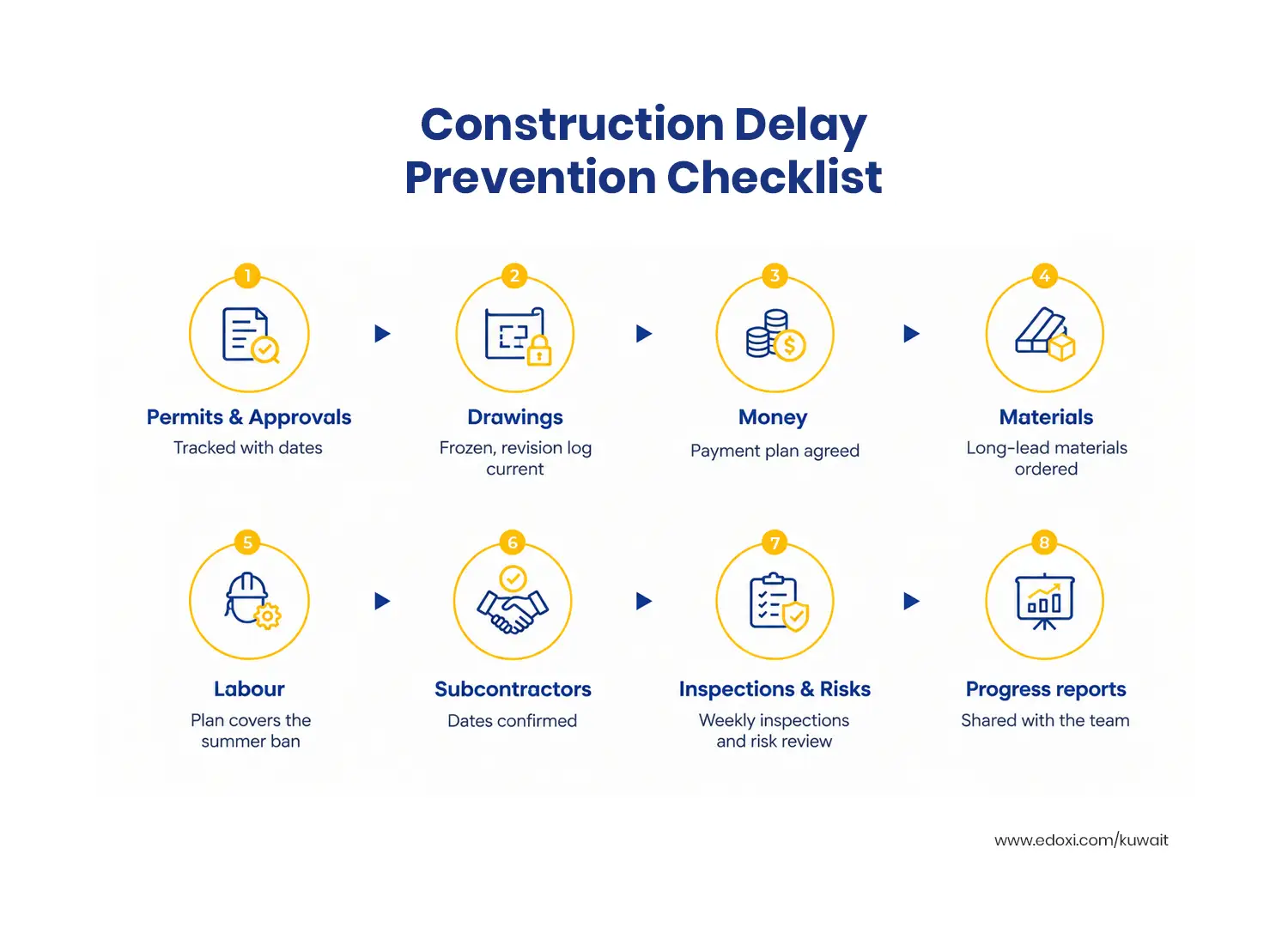
So, why do construction projects face delays? Usually because small gaps go unchecked. Realistic scheduling, quick decisions, and steady monitoring close them. In Kuwait, early planning matters even more.