Leave your message to get our quick response
edoxi automated message icon

C Programming Training Course

A professional C Programming course setup showing a developer writing C code with functions, loops, and debugging output on a computer screen in a modern programming workspace.
Edoxi’s 20-hour online C Programming training builds foundational to advanced coding skills for system-level programming.​ It covers core C concepts, pointers and memory management, data structures, and file handling. Learn using Code Blocks and Turbo C, and work on projects like employee management. Prepare for careers in integrated systems and IoT. Enrol now to validate your skills and lead programming roles in technology companies.
Course Duration
20 Hours
Corporate Days
4 Days
Learners Enrolled
100+
Modules
9
star-rating-icon1
star-rating-icon2
star-rating-icon3
Course Rating
4.9
star-rating-4.9
Mode of Delivery
Online
Certification by

What Do You Learn from the C Programming Training

Core C Programming Fundamentals
Learn variables, data types, and operators to write efficient programs. Build a strong foundation for all C programming concepts.
Control Structures and Functions
Practice loops, conditionals, and functions to create modular programs. Write clean, reusable, and maintainable code structures.
Memory Management with Pointers
Understand pointer operations and memory referencing. Use malloc, calloc, and free for effective dynamic memory handling.
Data Structures Implementation
Work with arrays, strings, structures, and unions for organised data. Apply these concepts to solve real-world programming problems.
File Handling Operations
Learn to read, write, and modify files in C. Manage persistent data using standard I/O functions.
System-Level Programming Skills
Develop coding skills for embedded systems and IoT devices. Apply low-level concepts for firmware and system software development.

About Our Online C Programming Course 

​Edoxi's 20-hour online C Programming course provides foundational skills in system-level programming, essential for careers in embedded systems, IoT, and firmware development.​ This C Programming training emphasises practical coding techniques through hands-on virtual lab sessions and real-world projects. 


Our C Programming curriculum starts by teaching the essential basics, variables, data types, operators, control structures, and functions, so learners build a strong foundation. After mastering these core skills, the course moves into more advanced topics like memory management with pointers, working with important data structures (arrays, strings, and structures), and performing file-handling operations. Learners also develop system-level programming skills for embedded systems and IoT, gaining practical expertise in low-level programming and firmware development.


This C Programming course is suitable for anyone who wants to learn programming and build strong technical skills. Upon completing the course, you will receive Edoxi’s C Programming Course Completion Certificate. This credential highlights your capability to take on in-demand roles such as Embedded Developer, System Software Engineer, and Firmware Developer in leading technology companies worldwide. 

Enrol now to develop your coding skills and gain career opportunities in the tech and software industry.

Key Features of Edoxi's C Programming Training

Hands-On Coding Environment

Practice in fully-equipped programming labs with industry-standard compilers and debugging tools for real-time code implementation.

Comprehensive Learning Materials

Access detailed PDF notes, IDE setup guides, sample codes, and module-wise assessments for continued learning after class.

Interactive Problem-Solving Sessions

Engage in code debugging, pair programming, live quizzes, and whiteboard challenges to strengthen analytical thinking skills.

Project-Based Learning Approach

Develop eight practical projects, including banking systems, matrix operations, and file management applications for hands-on experience.

System-Level Programming Focus

Learn memory management, pointer manipulation, and low-level operations crucial for embedded systems and firmware development.

Modular Curriculum Structure

Progress through carefully sequenced topics from basic syntax to advanced concepts like dynamic memory allocation and file operations.

Who Can Join Our Online C Programming Course?

Computer Science Students

University students aiming to strengthen programming skills through practical C projects.

Aspiring Software Developers

Beginners seeking foundational coding knowledge for entry-level programming positions.

Embedded Systems Enthusiasts

Individuals interested in IoT and hardware-based programming applications.

Career Transitioners

Professionals moving from non-technical fields into programming and system development.

Engineering Graduates

Graduates wanting to enhance job prospects with real-world coding experience.

Competitive Programming Aspirants

Learners focused on improving algorithm design and problem-solving skills in C.

C Programming Course Modules

Module 1: Getting Started with C
  • Chapter 1.1: Introduction to C Programming

    • Lesson 1.1.1: What is C? History, Features, and Applications
    • Lesson 1.1.2: Setting Up the C Environment (IDE, Compiler)
  • Chapter 1.2: Writing Your First Program

    • Lesson 1.2.1: Structure of a C Program
    • Lesson 1.2.2: Writing and Running Your First Program
    • Lesson 1.2.3: Basic Input and Output (printf, scanf)
    • Lesson 1.2.4: Understanding Compilation and Execution
Module 2: Variables, Data Types, and Operators
  • Chapter 2.1: Understanding Variables and Data Types

    • Lesson 2.1.1: Variables and Constants
    • Lesson 2.1.2: Data Types (int, float, char, double, void)
    • Lesson 2.1.3: Type Conversion and Casting
  • Chapter 2.2: Operators in C

    • Lesson 2.2.1: Arithmetic, Relational, Logical, Assignment, Increment/Decrement
    • Lesson 2.2.2: Conditional (Ternary) and Bitwise Operators
    • Lesson 2.2.3: Expression Evaluation & Operator Precedence
Module 3: Control Flow Statements
  • Chapter 3.1: Decision Making

    • Lesson 3.1.1: if, if-else, Nested if
    • Lesson 3.1.2: switch-case Statement
  • Chapter 3.2: Looping Constructs

    • Lesson 3.2.1: for, while, do-while Loops
  • Chapter 3.3: Jump Statements

    • Lesson 3.3.1: break, continue, goto (Intro)
Module 4: Functions and Program Structure
  • Chapter 4.1: Functions in C

    • Lesson 4.1.1: What is a Function?
    • Lesson 4.1.2: Declaring, Defining & Calling Functions
    • Lesson 4.1.3: Function Prototypes
    • Lesson 4.1.4: Call by Value vs Call by Reference
  • Chapter 4.2: Scope and Recursion

    • Lesson 4.2.1: Variable Scope (local, global, static, extern)
    • Lesson 4.2.2: Recursion Examples (Factorial, Fibonacci)
  • Chapter 4.3: Modular Programming

    • Lesson 4.3.1: Modular Programming and Header Files
Module 5: Arrays and Strings
  • Chapter 5.1: Working with Arrays

    • Lesson 5.1.1: 1D Arrays: Declaration, Initialisation, Traversal
    • Lesson 5.1.2: 2D Arrays: Matrix Operations
  • Chapter 5.2: Working with Strings

    • Lesson 5.2.1: Character Arrays and String I/O
    • Lesson 5.2.2: Common String Functions (strlen, strcpy, strcmp, strcat)
    • Lesson 5.2.3: Passing Arrays & Strings to Functions
Module 6: Pointers and Memory Management
  • Chapter 6.1: Introduction to Pointers

    • Lesson 6.1.1: Understanding Pointers and Addresses
    • Lesson 6.1.2: Pointer Arithmetic
    • Lesson 6.1.3: Pointers and Arrays
    • Lesson 6.1.4: Pointers to Pointers
  • Chapter 6.2: Dynamic Memory Management

    • Lesson 6.2.1: malloc, calloc, free, realloc
    • Lesson 6.2.2: Pointer Errors (Dangling, Null)
    • Lesson 6.2.3: Function Pointers (Intro)
Module 7: Structures, Unions, and Enumerations
  • Chapter 7.1: Structures in C

    • Lesson 7.1.1: Defining and Using Structures
    • Lesson 7.1.2: Array of Structures
    • Lesson 7.1.3: Nested Structures
    • Lesson 7.1.4: Passing/Returning Structures
    • Lesson 7.1.5: Pointers to Structures
    • Lesson 7.1.6: typedef Keyword
  • Chapter 7.2: Unions and Enumerations

    • Lesson 7.2.1: Introduction to Unions
    • Lesson 7.2.2: Introduction to Enumerations
Module 8: File Handling in C
  • Chapter 8.1: Basics of File Handling

    • Lesson 8.1.1: File Handling Basics
    • Lesson 8.1.2: Opening, Reading, Writing Files (fopen, fclose, fscanf, fprintf)
  • Chapter 8.2: Advanced File Operations

    • Lesson 8.2.1: Text vs Binary Files
    • Lesson 8.2.2: Random Access (fseek, ftell, rewind)
    • Lesson 8.2.3: Error Handling in File Operations
Module 9: Advanced Topics and C Preprocessor
  • Chapter 9.1: Managing Multi-file Programs

    • Lesson 9.1.1: Multi-file Program Structure
  • Chapter 9.2: The C Preprocessor

    • Lesson 9.2.1: include, define, ifdef, ifndef, undef
  • Chapter 9.3: Memory and Debugging

    • Lesson 9.3.1: Memory Model (Stack, Heap, Static)
    • Lesson 9.3.2: Debugging Techniques and Best Practices

Download C Programming Course Brochure

Real-World Projects in Our Online C Programming Course

​Our online C Programming course blends expert-led sessions with hands-on projects based on real-world programming scenarios.​ Key projects include:

Projects

  • Employee Management System

    Build a complete employee management application using structures to store, manipulate, and display employee records with salary calculation functionality.

  • Dynamic Memory Management Project

    Create dynamic arrays for data storage and management using malloc, calloc, realloc, and free functions to optimise memory usage in resource-constrained environments.

  • File Operations Project

    Develop a student record management system that saves and retrieves data from text files, implementing file creation, reading, writing, and modification operations.

  • Matrix Operations Project

    Build a comprehensive matrix calculator using 2D arrays to perform addition, subtraction, multiplication, and determinant calculations with user input validation.

  • Library Management System

    Develop a complete library system for managing book records using arrays and structures, including functionality for adding, deleting, searching, and displaying books.

C Programming Course Outcome and Career Opportunities

​By completing our C Programming course, you will develop strong foundational skills, master essential programming concepts, and gain practical expertise in system-level application development.​ The key outcomes include:

Course Outcome Image
Build strong foundational skills in C programming, preparing them for careers in embedded systems, IoT development, and system-level programming.
Master essential C programming concepts, variables, data types, operators, control structures, and functions, enabling them to write efficient, structured, and modular code.
Gain in-depth knowledge of memory management using pointers and dynamic allocation functions (malloc, calloc, free, realloc), a critical skill for working in resource-limited environments.
Develop practical expertise in key data structures (arrays, strings, structures, unions) and file-handling operations, enabling them to store, manipulate, and manage persistent data effectively.
Equip learners with system-level programming skills required to build applications for embedded systems, IoT devices, and firmware development.
Create a practical portfolio showcasing real-world C programming applications, significantly boosting their employability in high-demand technology fields.

Job Roles After Completing the C Programming Training

  • Embedded Developer
  • System Software Engineer
  • Firmware Developer
  • Firmware Architect
  • Technical Lead – C/C++
  • Systems Programming Manager

C Programming Training Options

Online Training

  • 20 hours Online C Programming Training

  • Real-Time Code Compilation Demonstrations

  • Virtual IDE Environment Access

  • Flexible Weekday Evening Sessions

  • Weekend Batches for Working Professionals

Corporate Training

  • 4 days Online C Programming Training

  • Customised Curriculum for Team Requirements

  • Training delivered at a selected hotel, client premises, or Edoxi

  • Fly-Me-a-Trainer Option

  • Team-Based Learning Activities

Do You Want a Customised Training for C Programming?

Get expert assistance in getting you C Programming Course customised!

How to Get a C Programming Certification?

Here’s a four-step guide to becoming a certified C Programming professional.
Do You Want to be a Certified Professional in C Programming?

Join Edoxi’s C Programming Course

Why Choose Edoxi for an Online C Programming Course?

Among the many options available, Edoxi is one of the best choices. Here’s why Edoxi’s C Programming training is the perfect fit for your needs:

Specialised Systems Programming Trainers

Our instructors bring extensive experience in embedded systems development and memory optimisation techniques essential for high-performance application roles.

Practical-First Learning Methodology

Our curriculum dedicates over 70% of class time to hands-on coding exercises using industry-standard compilers for building applicable system-level programming skills.

Industry-Relevant Project Portfolio

Students develop five complete practical projects that demonstrate professional programming capabilities to potential employers.

Structured Learning Progression

The methodical curriculum builds programming knowledge from basic syntax to advanced concepts, ensuring beginners can master complex C programming skills.

Global Presence with Strategic Locations

With training centers in London, the UAE, Qatar, and Kuwait, Edoxi provides globally informed training aligned with regional market demands.

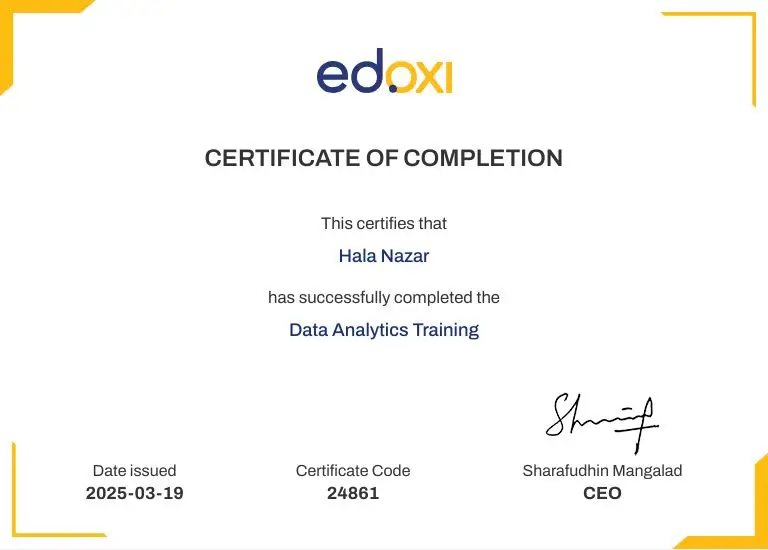
Course Completion Certificate

Upon completion of the course, you will gain an Edoxi C Programming course.

students-image

Edoxi is Recommended by 95% of our Students

Meet Our Mentor

Our mentors are leaders and experts in their fields. They can challenge and guide you on your road to success!

mentor-image

Afreen M

Afreen, with four years of dedicated teaching experience, has successfully trained over 100 students in programming languages like Python, SQL, and Java. She combines her technical expertise with a passion for education, tailoring her instruction to suit the unique needs of young learners. Her interests in reading and working on coding projects help her design engaging and practical learning experiences for her students.

Afreen’s teaching philosophy emphasizes hands-on learning, guiding children through projects like game development and calculator applications. Her balanced approach helps students build confidence in technology while mastering essential programming skills. By staying actively engaged with personal coding projects, she ensures her teaching remains current, practical, and effective, creating an encouraging environment where children can explore and understand coding concepts with ease.

Locations Where Edoxi Offers C Programming Course

Here is the list of other major locations where Edoxi offers C Programming Course

FAQ

Is prior programming knowledge required for joining this C Programming course?

No prior programming experience is needed. The course starts with fundamentals and gradually builds to more advanced concepts. Basic computer knowledge and logical thinking are sufficient prerequisites.

Which IDE is used during the C Programming training?

We primarily use Code Blocks and Turbo C environments during training. Both are industry-recognised development environments that provide all the necessary tools for learning C programming.

Will I build complete projects during the C Programming certification course?

Yes, you will develop eight practical projects, including employee management systems, banking applications, and file handling projects that demonstrate real-world C programming applications.

How is this C Programming course useful for an embedded systems career?
The C Programming course provides essential knowledge of memory management, pointers, and low-level operations that form the foundation for embedded systems programming and firmware development.
Can the corporate training be customised for our team's specific needs?

Absolutely. C Programming corporate training can be tailored to address specific industry applications, project requirements, or skill gaps identified in your technical team.

Can this C Programming training help me prepare for competitive programming competitions?

Yes, the course builds strong algorithm implementation skills, memory optimisation techniques, and problem-solving abilities that are directly applicable to competitive programming challenges.

What career opportunities are available after completing the C Programming certification course?

After completing the C Programming course, graduates can work in embedded systems, IoT, system software, and firmware roles across industries like telecommunications, aviation, and technology.

Does the C Programming certification training cover modern C standards like C11 or C17?

The C Programming course emphasises ANSI C (C89/C90), providing a strong foundation for embedded systems, while also covering modern C features widely used in industry applications.

What makes Edoxi's C Programming course different from free online tutorials?

Edoxi's differ because our C Programming course offers structured learning, hands-on debugging, guidance on complex topics, and industry-relevant projects.

What salary range can I expect after completing a C Programming certification course?
A C Programming course completion certificate can open doors to multiple tech roles, with salaries typically ranging from around $65,000 to over $150,000 per year. Note that salary varies based on experience level, job position, industry, and location.