Leave your message to get our quick response
edoxi automated message icon

Lean Six Sigma Green Belt Course

Professional business executive interacting with a digital interface highlighting sustainability, eco-friendly practices, and green growth concepts in a corporate environment.
Edoxi’s 40 hour online Lean Six Sigma Green Belt Training helps your organisation to equip your team to identify process inefficiencies, reduce waste and improve operational performance. Through practical DMAIC exercises, statistical analysis and workplace-focused projects, participants learn to solve business problems systematically and make data-driven decisions. Customise the programme to your organisation’s objectives with flexible online and onsite training options. Enquire now!
Course Duration
40 Hours
Corporate Days
5 Days
Learners Enrolled
50+
Modules
5
star-rating-icon1
star-rating-icon2
Course Rating
4.9
star-rating-4.9
Mode of Delivery
Online
Certification by
edoxi-accreditation-logo

What Do You Learn from Edoxi's Lean Six Sigma Green Belt Training

DMAIC Methodology Framework
Apply the Define, Measure, Analyse, Improve and Control approach to structure improvement projects, define business problems and set measurable targets.
Lean Principles and Waste Elimination
Identify unnecessary steps, delays and resource waste using process mapping, SIPOC diagrams, Kaizen and error-prevention techniques.
Statistical and Data Analysis Tools
Interpret process performance using Measurement System Analysis (MSA), Cp and Cpk indices, defects per million opportunities (DPMO) and Sigma levels.
Root Cause and Risk Analysis
Investigate why problems occur using Fishbone diagrams, 5 Whys, Pareto analysis, hypothesis testing and Failure Modes and Effects Analysis (FMEA).
Financial and Business Impact Measurement
Build evidence-based business cases, compare improvement costs and benefits, and assess the potential financial impact of proposed solutions.
Process Mapping and Systems Thinking
Map workflows and use spaghetti diagrams to identify unnecessary movement, bottlenecks and connections between upstream and downstream problems.
Improvement Design and Implementation
Generate, compare and prioritise solutions, plan pilot tests and define success measures before wider implementation.
Control and Sustainability
Develop control plans, standard operating procedures (SOPs), control charts and monitoring practices to help maintain process improvements.

About Our Online Lean Six Sigma Green Belt Certification Course

Edoxi’s 40-hour Lean Six Sigma Green Belt Course is designed for organisations that want to strengthen process improvement, operational efficiency and data-driven decision-making across their teams. The five-day corporate training programme is suitable for managers, process owners, quality professionals, project leaders and transformation teams working across manufacturing, banking, healthcare, IT, retail, logistics and other service industries.

The programme combines instructor-led learning with practical exercises, business simulations, team discussions and process improvement activities. Participants practise using organisational challenges to develop project charters, map workflows, investigate root causes and evaluate improvement options. Activities such as spaghetti diagram simulations, root cause debates and innovation workshops connect Lean Six Sigma concepts to workplace decisions.

A key part of the programme is a capstone project based on a real business problem. Participants define the problem, establish baseline performance, investigate root causes and develop a measurable improvement proposal. The project can help teams build a more structured case for operational change. Any financial benefits depend on the problem, the proposed solution and its implementation; they are not guaranteed by completing the training.The image given above shows the Lean Six Sigma DMAIC Roadmap. The roadmap visually represents the five structured phases—Define, Measure, Analyse, Improve, and Control—guiding participants from problem identification to sustained performance control.

The image given above shows the Lean Six Sigma DMAIC Roadmap. The roadmap visually represents the five structured phases—Define, Measure, Analyse, Improve, and Control—guiding participants from problem identification to sustained performance control.

Lean Six Sigma Industry Applicability Matrix

Lean Six Sigma can be applied across different sectors wherever organisations need to improve process consistency, reduce errors, manage delays or use resources more effectively. The following examples show how corporate teams can apply the methodology to common operational challenges.
 
Industry
Key Improvement Focus Areas
Manufacturing
Scrap reduction; Overall Equipment Effectiveness (OEE); production line balancing; inventory optimisation; supplier quality; lead-time reduction
Banking and Financial Services
Loan processing time; Know Your Customer (KYC) errors; claims processing; fraud detection processes; reconciliation accuracy; customer onboarding
Healthcare
Patient waiting times; surgical scheduling; billing errors; bed utilisation; infection-control processes
IT and Technology
Incident resolution time; deployment defects; release cycle optimisation; Agile sprint throughput; DevOps efficiency; service desk quality
Retail and E-commerce
Order fulfilment accuracy; returns reduction; store operations; demand forecasting; inventory turnover
Aviation and Logistics
Aircraft turnaround time; route optimisation; shipment damage; customs clearance delays
Construction
Project delays; rework reduction; cost variance; safety processes
Education
Admission cycle time; examination result accuracy; student grievance resolution
Energy and Utilities
Outage reduction; billing disputes; maintenance optimisation; asset utilisation

Through Lean Six Sigma Green Belt Training, teams develop a structured approach to problem-solving, gain confidence in interpreting process data and learn how to plan and monitor improvement initiatives. Organisations can use these capabilities to strengthen continuous improvement practices across departments.

To discuss the course fee, corporate training requirements, delivery options or certification details, contact Edoxi to explore a programme suited to your organisation.

Key Features of Edoxi's Lean Six Sigma Green Belt Course

Organisation-Focused Problem-Solving

Participants work with a relevant business challenge and use the DMAIC stages to define the problem, analyse evidence and develop an improvement proposal.

Team-Based Simulations and Business Exercises

Practical activities such as Pareto exercises, FMEA risk scoring and solution-prioritisation challenges encourage collaboration and structured decision-making.

Executive Presentation Practice

Participants organise their findings into clear business presentations, explain data-driven recommendations and practise communicating with decision-makers.

Cross-Functional Peer Reviews

Team members present their analysis, question assumptions and receive feedback to strengthen the logic and practicality of their improvement proposals.

Data Labs and Guided Reflection

Structured exercises give participants opportunities to practise analytical tools, review their decisions and identify areas for further development.

Industry-Specific Case Studies

Corporate teams can work with relevant examples and improvement challenges from their sectors, subject to the agreed training scope and customisation requirements.

Who Can Join Our Lean Six Sigma Green Belt Course?

Mid-Level Managers and Functional Heads

Leaders overseeing departmental operations who need structured tools to identify inefficiencies, reduce costs, and drive measurable performance improvements.

Process Owners and Operations Leaders

Professionals responsible for end-to-end process delivery in manufacturing, logistics, or service operations, seeking to standardise and optimise workflows.

Project Managers and Continuous Improvement Professionals

Those managing cross-functional initiatives who want to integrate Lean Six Sigma into their project governance and reporting frameworks.

Digital Transformation and Customer Experience Leaders

Professionals leading organisational change who require data-driven methods to align transformation efforts with business outcomes and customer expectations.

Quality, Compliance, and Supply Chain Professionals

Specialists in quality assurance, regulatory compliance, procurement, or supply chain management looking to embed systematic improvement practices.

Finance Business Partners and HR Operations Managers

Corporate professionals who need to quantify operational impact, build business cases for improvement, and lead cross-departmental efficiency initiatives.

Lean Six Sigma Green Belt Course Modules

Module 1: Define
  • Chapter 1.1

    • Lesson 1.1.1: Voice of Customer (VOC) and stakeholder analysis
    • Lesson 1.1.2: SIPOC diagram construction
    • Lesson 1.1.3: Project charter development and problem framing
    • Lesson 1.1.4: Critical to Quality (CTQs) and business case development
    • Lesson 1.1.5: Risk assessment fundamentals
Module 2: Measure
  • Chapter 2.1

    • Lesson 2.1.1: Detailed process mapping and data collection planning
    • Lesson 2.1.2: Operational definitions and baseline metrics
    • Lesson 2.1.3: Measurement System Analysis (MSA)
    • Lesson 2.1.4: Process capability indices (Cp, Cpk) and DPMO calculation
    • Lesson 2.1.5: Sigma level determination and control charts basics
Module 3: Analyse
  • Chapter 3.1

    • Lesson 3.1.1: Root cause analysis with Fishbone (Ishikawa) and 5 Why analysis
    • Lesson 3.1.2: Hypothesis testing and Pareto analysis
    • Lesson 3.1.3: Correlation versus causation and regression basics
    • Lesson 3.1.4: Failure Modes and Effects Analysis (FMEA)
Module 4: Improve
  • Chapter 4.1

    • Lesson 4.1.1: Brainstorming techniques and solution prioritisation matrix
    • Lesson 4.1.2: Pilot testing and Kaizen principles
    • Lesson 4.1.3: Poka-Yoke (error-proofing) and Design of Experiments introduction
    • Lesson 4.1.4: Cost-benefit analysis and risk mitigation planning
Module 5: Control
  • Chapter 5.1

    • Lesson 5.1.1: Control plans and Standard Operating Procedure (SOP) design
    • Lesson 5.1.2: Advanced control charts and visual management
    • Lesson 5.1.3: Handover planning and sustainability metrics
    • Lesson 5.1.4: Audit framework and governance structures

Download Lean Six Sigma Green Belt Course Brochure

Hands-On Activities and Real–World Projects in our Lean Six Sigma Green Belt Course

The programme uses practical exercises to help corporate teams apply the tools covered in each DMAIC phase. Activities can be connected to relevant workplace scenarios and improvement challenges. These include:

Projects

  • Mandatory Green Belt Capstone Project

    Each participant completes a capstone project focused on a real business problem, subject to the programme's project requirements and review process. The project involves identifying a relevant business problem, establishing baseline performance, conducting structured root cause analysis, proposing measurable improvements, assessing their potential financial or business impact, and presenting the findings to a review panel.

Case Studies

  • Live Voice of Customer Simulation

    Participants practise gathering customer and stakeholder feedback, identifying key needs and translating them into Critical to Quality requirements for project planning.

  • Spaghetti Diagram Simulation

    Map the movement of people, materials or information to identify unnecessary steps and propose more efficient workflows.

  • Root Cause Analysis Debate

    Work in teams to investigate possible causes, evaluate supporting evidence and defend conclusions. The exercise encourages participants to challenge assumptions before recommending solutions.

  • Innovation Sprint Workshop

    Generate and prioritise improvement ideas within a structured timeframe. Assess proposed solutions against practical considerations, risks and expected benefits.

  • Control Dashboard Design Workshop

    Develop a sample dashboard using performance indicators, control charts and visual management concepts to plan how improvements can be monitored over time.

Lean Six Sigma Green Belt Course Outcomes and Career Opportunities

Edoxi’s Lean Six Sigma Green Belt Training develops practical capabilities that corporate teams can use to support process improvement and operational decision-making. By the end of the programme, participants can:Completing our Lean Six Sigma Green Belt Training equips you with structured, data-driven problem-solving capabilities to lead measurable business transformation initiatives. By the end of the course, you can:

Course Outcome Image
Structure improvement projects around Define, Measure, Analyse, Improve and Control, with clear problem statements and measurable objectives.
Use Voice of Customer insights and Critical to Quality metrics to support project charters, define success criteria and align improvement work with business priorities.
Apply concepts such as MSA, Cp/Cpk, hypothesis testing, Pareto analysis and FMEA to investigate process performance and assess potential root causes.
Use Kaizen, Poka-Yoke, pilot testing and prioritisation techniques to assess solutions before recommending changes.
Develop control plans, SOPs, monitoring methods and governance practices to help teams maintain process standards after improvements are introduced.
Communicate findings, present recommendations and engage stakeholders in structured problem-solving and continuous improvement.

Career Opportunities After the Lean Six Sigma Green Belt Course

  • Continuous Improvement Specialist
  • Process Improvement Analyst
  • Quality Assurance Manager
  • Operations Manager
  • Business Process Analyst
  • Project Manager
  • Supply Chain Improvement Specialist
  • Risk and Compliance Analyst
  • Operational Excellence Lead

Lean Six Sigma Green Belt Training Options

Corporate Training

  • Customised 5-Day Lean Six Sigma Green Belt Corporate Training

  • Tailored Content for Industry-Specific Needs

  • Flexible Delivery: online, onsite, hotel depending on availability and agreed arrangements.

  • Fly-a-trainer option to deliver the programme at your organisation's location

Do You Want a Customised Training for Lean Six Sigma Green Belt?

Get expert assistance in getting you Lean Six Sigma Green Belt Course customised!

How to Get Certified in Lean Six Sigma Green Belt Course?

Here’s a four-step guide to becoming a certified Lean Six Sigma Green Belt professional.
Do You Want to be a Certified Professional in Lean Six Sigma Green Belt?

Join Edoxi’s Lean Six Sigma Green Belt Course

Why Choose Edoxi for Lean Six Sigma Green Belt Course

Edoxi’s Lean Six Sigma Green Belt programme combines structured learning with practical activities that can be aligned with corporate process improvement objectives. The major reasons to choose us include: 

Practical, Workplace-Focused Learning

Participants can practise applying DMAIC, process mapping and root cause analysis to business challenges rather than focusing only on theory.

Training for Corporate Teams

The programme is designed to support organisations that want to develop shared problem-solving methods and a more consistent approach to process improvement.

Project-Based Application

Practical exercises and the capstone project give participants opportunities to structure a problem, analyse evidence and propose improvements.

Industry-Relevant Customisation

Discuss adapting examples and case studies to your organisation's sector, workflows and learning objectives before the programme begins.

Flexible Corporate Delivery

Explore our live online and onsite training arrangements, including a Fly-Me-a-Trainer option where available.

Related Business and Quality Training

Organisations can also explore related programmes in quality management, facilities management, project management and corporate governance to support wider employee development.

students-image

Edoxi is Recommended by 95% of our Students

Meet Our Mentor

Our mentors are leaders and experts in their fields. They can challenge and guide you on your road to success!

mentor-image

Neena Raj

Neena Raj is an expert trainer with 24 years of experience in enhancing organizational performance through HR, soft skills, and productivity training. Her areas of expertise include organizational behavior and team dynamics, cross-cultural communication, performance management systems, and life coaching and development.

Neena has an MBA in Sales and Marketing from Loyola College, a Diploma in Psychological Counselling, and is currently pursuing a PhD in Psychology. She is also a Certified NLP Trainer and holds several other certifications, including Certified Human Resource Professional (CHRP), Certified Human Resource Manager (CHRM) and Total Quality Management Certification.

Her specialisations include public speaking, emotional intelligence training, Time Management, Leadership Skills and UAE labour law. Neena has delivered public speaking training for many of Dubai’s leading companies and government entities, including the Dubai Health Authority (DHA), Emirates Airlines, DP World and Dubai International Hotel.

Locations Where Edoxi Offers Lean Six Sigma Green Belt Course

Here are the major international locations where Edoxi offers Lean Six Sigma Green Belt Course

FAQ

Does our team need prior Lean Six Sigma experience to join Edoxi’s Lean Six Sigma Green Belt Course?
No specific prior Lean Six Sigma course is listed as a requirement. The programme covers core DMAIC concepts and process improvement tools. Edoxi should confirm any recommended professional experience or entry requirements before a corporate booking.
How is Edoxi’s Lean Six Sigma Green Belt Training delivered?
The course is listed as a 40-hour online programme, with corporate training planned over five days. Onsite or other delivery arrangements can be discussed with Edoxi and confirmed according to availability and the organisation's requirements.
What is the mandatory project in the Lean Six Sigma Green Belt Course?
The capstone project focuses on a real business problem. Participants define the problem, establish baseline performance, investigate root causes, propose a measurable improvement, assess potential business impact and present their findings for review.
How does Lean Six Sigma Green Belt differ from Yellow Belt and Black Belt?
  • Yellow Belt: Introduces core Lean Six Sigma concepts and supports improvement projects.
  • Green Belt: Develops skills in structured process improvement, data analysis and leading or contributing to improvement projects.
  • Black Belt: Typically covers more advanced analytical methods and leadership of complex improvement initiatives.
The precise scope and certification requirements vary by training and awarding body.
Can Edoxi customise Lean Six Sigma Green Belt Training for corporate teams?
Organisations can discuss customising case studies, workplace examples, schedules and delivery arrangements to match their learning objectives and sector. The final scope should be confirmed with Edoxi before booking.
Which industries can use Lean Six Sigma Green Belt methods?
Lean Six Sigma methods can be applied in manufacturing, banking, healthcare, IT, retail, aviation, logistics, construction, education, energy and other sectors. The tools are useful wherever teams need to investigate process problems and improve performance.
Can employees apply what they learn after the course?
Participants practise using process improvement tools and develop a capstone proposal based on a business problem. Applying the learning at work depends on the organisation's processes, available data, management support and opportunities to implement the recommendations.
How does Green Belt training support progression to Black Belt-level learning?
Green Belt training introduces structured problem-solving, process analysis, improvement planning and change management. These skills can provide a foundation for further study, but Black Belt entry requirements and certification pathways depend on the relevant awarding body.
What salary can professionals earn after Lean Six Sigma Green Belt training?
There is no single reliable global salary figure for everyone who completes Green Belt training. Earnings vary by country, industry, job title, experience and employer. Organisations should assess salary data for specific roles and markets rather than use course completion as a salary guarantee.
Is Lean Six Sigma Green Belt recognised globally?
Lean Six Sigma is used across many industries and countries as a process improvement methodology. However, recognition of a specific certificate depends on its issuer, assessment requirements and the employer or industry concerned. Edoxi’s listed award for this course is a Course Completion Certificate; external certification should be verified separately.
Who should attend Edoxi’s Lean Six Sigma Green Belt Corporate Training?
The programme is suited to corporate teams involved in operations, quality, process improvement, project management, supply chain, compliance and transformation. It can also be relevant to managers and professionals who need a structured approach to solving recurring business problems.
What tools are covered in the Lean Six Sigma Green Belt Course?
The course covers DMAIC, process mapping, SIPOC, Voice of Customer, Critical to Quality requirements, Fishbone diagrams, 5 Whys, Pareto analysis, hypothesis testing, MSA, Cp/Cpk, DPMO, control charts and FMEA, along with improvement and control-planning methods.
What career roles may benefit from Lean Six Sigma Green Belt skills?
Relevant roles can include Continuous Improvement Specialist, Process Improvement Analyst, Quality Assurance Manager, Operations Manager, Business Process Analyst, Project Manager, Supply Chain Improvement Specialist and Operational Excellence Lead. Suitability depends on the individual's wider qualifications and experience.
Which courses complement Lean Six Sigma Green Belt Training?
Related programmes listed by Edoxi include:
 
  • Facilities Management
  • Certified Scrum Master
  • Quality Management
  • CMQ/OE (Certified Manager of Quality/Organisational Excellence)
  • Future Entrepreneurs Programme
  • Hotel and Hospitality Management
  • Corporate Governance
The most relevant follow-on course depends on the organisation's development goals and each participant's role.
What certificate do participants receive after completing Edoxi’s Lean Six Sigma Green Belt Course?
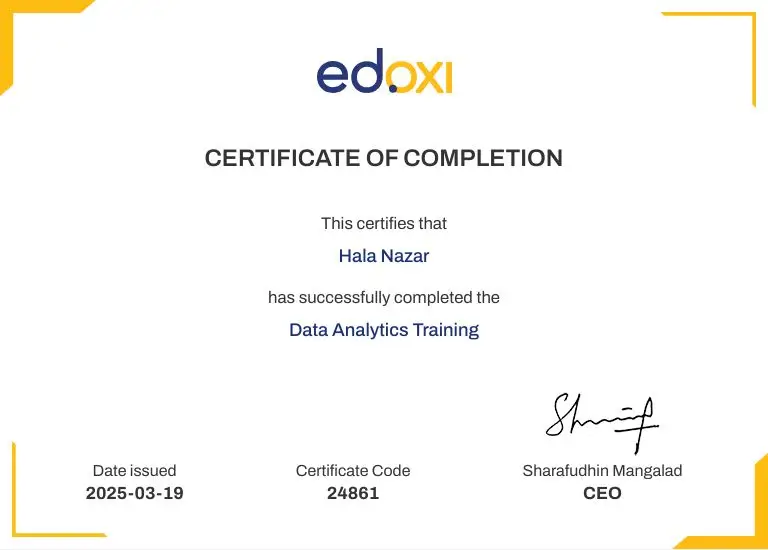
Participants who meet the course completion requirements receive Edoxi’s Course Completion Certificate. This confirms completion of Edoxi’s training programme; it should not be presented as a separate external professional certification unless an awarding-body arrangement has been verified.