Leave your message to get our quick response
edoxi automated message icon

Cloud Operations on AWS course

IT professional using virtual cloud platform with cybersecurity and data icons
Edoxi’s 40-hour online Cloud Operations on AWS training builds strong skills in managing, operating, and monitoring AWS cloud environments. The course is designed for IT professionals, system administrators, and cloud engineers. Participants learn to deploy AWS resources, manage infrastructure, automate operations, and monitor performance and security. Enrol now and build a successful career in cloud operations and AWS administration.
Course Duration
40 Hours
Corporate Days
5 Days
Learners Enrolled
200+
Modules
14
star-rating-icon1
star-rating-icon2
star-rating-icon3
Course Rating
5
star-rating-5
Mode of Delivery
Online
Certification by

What Do You Learn from Edoxi's Online Cloud Operations on AWS Training?

AWS Well-Architected Framework Implementation
Learn the five pillars of the AWS Well-Architected Framework to design secure, reliable, and efficient cloud systems. Apply these principles to real-world architecture scenarios.
Identity and Access Management (IAM
) Configure AWS IAM to control user access and authentication. Implement least-privilege policies to protect AWS resources.
Resource Deployment Automation
Create infrastructure as code using AWS CloudFormation for consistent deployments. Automate operational tasks with AWS Systems Manager to improve efficiency.
Monitoring and Performance Optimisation
Set up monitoring with Amazon CloudWatch to gain visibility into system performance. Configure metrics, alarms, and logs for proactive issue detection.
Auto Scaling and Load Balancing
Design scalable and resilient architectures using AWS Auto Scaling and Elastic Load Balancing. Ensure high availability while optimising resource usage.
AWS Services Administration
Manage core AWS services such as EC2, S3, and RDS. Apply best practices for secure and efficient day-to-day cloud operations.

About Our Online Cloud Operations on AWS Course

Edoxi’s 40-hour online Cloud Operations on AWS course equips IT professionals and system administrators with essential skills to manage and optimize AWS cloud environments. Delivered by experienced cloud trainers, the program follows current industry best practices and is carefully structured to meet the evolving needs of IT teams and professionals. The course is available in two formats: a 24-hour track for participants with prior AWS experience and a 40-hour track for beginners seeking foundational knowledge.

The course combines hands-on labs with practical exercises, allowing participants to deploy, manage, automate, and troubleshoot AWS systems for operational excellence.

The image below shows a visual overview of key AWS services Systems Manager, Auto Scaling, CloudWatch, and the Well-Architected Framework used in the Cloud Operations on AWS Course.
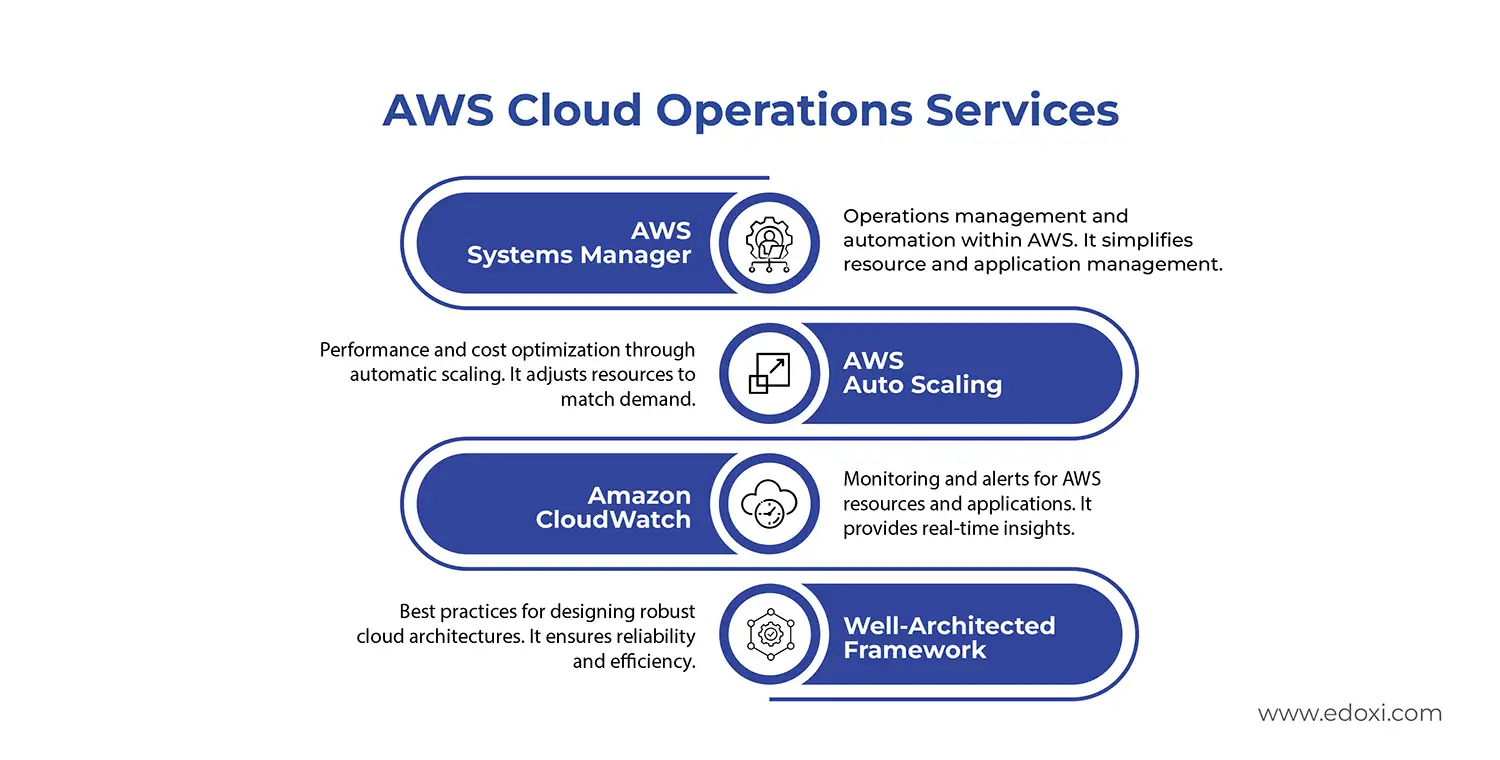
aws-cloud-operation-services

Upon completion, our Cloud Operations on AWS training prepares you for real-world cloud operations scenarios and equips you with the knowledge required to succeed in the SOA-C02 AWS SysOps Administrator  Associate certification exam.

Here is the table showing Cloud Operations on AWS exam details.

Exam Criteria Details
Exam Code SOA-C02
Exam Name AWS Certified SysOps Administrator – Associate
Duration 130 minutes
Number of Questions 65, Multiple Choice
Passing Score 720/1000
Fees 150 USD
Certification Validity 3 Years
Exam Administration Authority Amazon Web Services (AWS)

Participants can efficiently manage cloud resources, implement secure and cost-effective operations, and optimise AWS environments to meet modern business requirements. These skills are highly valuable for organisations across industries that rely on AWS for critical infrastructure.

Enrol now to advance your cloud career and become a capable contributor to your organisation’s AWS operations. For course fees, syllabus, or details on online, classroom, or Cloud Operations on AWS corporate training, contact Edoxi.

Our training prepares you for real-world CloudOps responsibilities and supports your journey toward earning the AWS SysOps Administrator – Associate certification (SOA-C02). 

Key Features of Our Online Cloud Operations on AWS Training

Dedicated AWS Lab Environment

Our pre-configured AWS labs give you secure, guided access to real cloud environments, helping you gain hands-on implementation experience from day one.

Comprehensive Learning Resources

We provide curated study materials, including official AWS documentation, white papers, lab guides, and reference PDFs to support continuous learning.

Infrastructure as Code Training

Practical projects using AWS CloudFormation help you build automation skills and deploy scalable cloud infrastructure with confidence.

Cloud Operations Automation Labs

Hands-on labs focus on monitoring, scaling, and resource optimisation using AWS Systems Manager and Amazon CloudWatch.

Exam-Focused Certification Support

Our training aligns closely with the AWS SysOps Administrator – Associate (SOA-C02) exam, supported by targeted practice questions and exam strategies.

Real-World CloudOps Capstone Project

A comprehensive capstone project simulates real cloud operations scenarios, enabling you to apply end-to-end CloudOps skills in a production-style environment.

Who Can Join Our Online Cloud Operations on AWS course?

System Administrators

IT professionals experienced in managing operating systems who want to move into AWS cloud environments.

DevOps Practitioners

Professionals aiming to strengthen infrastructure automation and cloud operations on AWS.

Network Administrators

Individuals with TCP/IP and HTTP knowledge looking to apply networking skills in the cloud.

Linux / Windows Administrators

Administrators with Linux command-line or Windows PowerShell experience expanding into cloud operations.

IT Support Specialists

Support professionals seeking to advance their careers with hands-on cloud operations skills.

Cloud Career Transitioners

IT professionals shifting from traditional infrastructure to specialised AWS cloud administration roles.

Cloud Operations on AWS Course Modules

Module 1: Introduction to Cloud Operations on AWS
  • Chapter 1.1: What is Cloud Operations

    • Lesson 1.1.1: Definition and Purpose of Cloud Operations
    • Lesson 1.1.2: Benefits of Cloud Operations for Modern IT Workloads
  • Chapter 1.2: AWS Well-Architected Framework

    • Lesson 1.2.1: Overview of the AWS Well-Architected Framework
    • Lesson 1.2.2: Pillars of the Well-Architected Framework
  • Chapter 1.3: AWS Well-Architected Tool

    • Lesson 1.3.1: Introduction to the Well-Architected Tool
    • Lesson 1.3.2: Using the Tool for Workload Reviews
Module 2: Access Management
  • Chapter 2.1: AWS Identity and Access Management (IAM)

    • Lesson 2.1.1: IAM Users, Groups, Roles, and Policies
    • Lesson 2.1.2: Best Practices for IAM
  • Chapter 2.2: Resources, Accounts, and AWS Organisations

    • Lesson 2.2.1: Managing Resources and Accounts
    • Lesson 2.2.2: Structuring Accounts with AWS Organisations
Module 3: System Discovery
  • Chapter 3.1: Methods to Interact with AWS Services

    • Lesson 3.1.1: Using AWS Management Console
    • Lesson 3.1.2: Using AWS CLI and SDKs
  • Chapter 3.2: Tools for Automating Resource Discovery

    • Lesson 3.2.1: Resource Discovery Using AWS Tools
    • Lesson 3.2.2: Integration with Third-Party Tools
  • Chapter 3.3: Inventory with AWS Systems Manager & AWS Config

    • Lesson 3.3.1: Overview of AWS Systems Manager Inventory
    • Lesson 3.3.2: Overview of AWS Config for Resource Tracking
Module 4: Deploy and Update Resources
  • Chapter 4.1: Cloud Operations in Deployments

    • Lesson 4.1.1: Deployment Considerations for Operations Teams
  • Chapter 4.2: Tagging Strategies

    • Lesson 4.2.1: Importance of Tagging
    • Lesson 4.2.2: Developing Effective Tagging Strategies
  • Chapter 4.3: Deployment Using Amazon Machine Images (AMIs)

    • Lesson 4.3.1: Creating and Managing AMIs
    • Lesson 4.3.2: Deploying Resources with AMIs
  • Chapter 4.4: Deployment Using AWS Control Tower

    • Lesson 4.4.1: Overview of AWS Control Tower
    • Lesson 4.4.2: Deploying Multi-Account Environments
Module 5: Automate Resource Deployment
  • Chapter 5.1: Deployment Using AWS CloudFormation

    • Lesson 5.1.1: Introduction to CloudFormation Templates
    • Lesson 5.1.2: Automating Infrastructure with CloudFormation
  • Chapter 5.2: Deployment Using AWS Service Catalogue

    • Lesson 5.2.1: Overview of AWS Service Catalogue
    • Lesson 5.2.2: Managing Approved Products and Portfolios
Module 6: Manage Resources
  • Chapter 6.1: AWS Systems Manager

    • Lesson 6.1.1: Overview and Capabilities of Systems Manager
    • Lesson 6.1.2: Operational Tasks Using Systems Manager
Module 7: Configure Highly Available Systems
  • Chapter 7.1: Distributing Traffic with Elastic Load Balancing

    • Lesson 7.1.1: Introduction to Elastic Load Balancing
    • Lesson 7.1.2: Types of Load Balancers in AWS
  • Chapter 7.2: Amazon Route 53

    • Lesson 7.2.1: Overview of Amazon Route 53
    • Lesson 7.2.2: Configuring DNS Routing Policies
Module 8: Automate Scaling
  • Chapter 8.1: Scaling with AWS Auto Scaling

    • Lesson 8.1.1: Setting Up AWS Auto Scaling
    • Lesson 8.1.2: Configuring Scaling Policies
  • Chapter 8.2: Scaling with Spot Instances

    • Lesson 8.2.1: Introduction to Spot Instances
    • Lesson 8.2.2: Cost Optimisation with Spot Instances
  • Chapter 8.3: Managing Licenses with AWS License Manager

    • Lesson 8.3.1: Overview of AWS License Manager
    • Lesson 8.3.2: Managing Software Licenses in AWS
Module 9: Monitor and Maintain System Health
  • Chapter 9.1: Monitoring and Maintaining Healthy Workloads

    • Lesson 9.1.1: Health Checks and Best Practices
  • Chapter 9.2: Monitoring AWS Infrastructure

    • Lesson 9.2.1: Using Amazon CloudWatch for Infrastructure Monitoring
  • Chapter 9.3: Monitoring Applications

    • Lesson 9.3.1: Application Monitoring Strategies and Tools
Module 10: Data Security and System Auditing
  • Chapter 10.1: Maintaining a Strong Identity and Access Foundation

    • Lesson 10.1.1: Security Best Practices for Identity and Access
  • Chapter 10.2: Implementing Detection Mechanisms

    • Lesson 10.2.1: Threat Detection Using AWS Services
  • Chapter 10.3: Automating Incident Remediation

    • Lesson 10.3.1: Automating Responses to Security Incidents
Module 11: Operate Secure and Resilient Networks
  • Chapter 11.1: Building a Secure Amazon VPC

    • Lesson 11.1.1: Designing and Configuring VPC Security
  • Chapter 11.2: Networking Beyond the VPC

    • Lesson 11.2.1: Hybrid Networking with AWS
Module 12: Mountable Storage
  • Chapter 12.1: Configuring Amazon Elastic Block Store (Amazon EBS)

    • Lesson 12.1.1: Overview of Amazon EBS
    • Lesson 12.1.2: Configuring EBS Volumes
  • Chapter 12.2: Sizing Amazon EBS Volumes for Performance

    • Lesson 12.2.1: Performance Considerations for EBS Volumes
  • Chapter 12.3: Using Amazon EBS Snapshots

    • Lesson 12.3.1: Creating and Managing Snapshots
  • Chapter 12.4: Using Amazon Data Lifecycle Manager

    • Lesson 12.4.1: Automating EBS Snapshot Management
  • Chapter 12.5: Creating Backup and Data Recovery Plans

    • Lesson 12.5.1: Backup Strategies on AWS
    • Lesson 12.5.2: Data Recovery Considerations
  • Chapter 12.6: Configuring Shared File System Storage

    • Lesson 12.6.1: Overview of Amazon EFS and FSx
Module 13: Object Storage
  • Chapter 13.1: Deploying Amazon Simple Storage Service (Amazon S3)

    • Lesson 13.1.1: Introduction to Amazon S3
    • Lesson 13.1.2: Configuring S3 Buckets and Permissions
  • Chapter 13.2: Managing Storage Lifecycles on Amazon S3

    • Lesson 13.2.1: Lifecycle Policies for S3
    • Lesson 13.2.2: Storage Classes and Cost Optimisation
Module 14: Cost Reporting, Alerts, and Optimisation
  • Chapter 14.1: Gaining AWS Cost Awareness

    • Lesson 14.1.1: Understanding the AWS Pricing Model
  • Chapter 14.2: Using Control Mechanisms for Cost Management

    • Lesson 14.2.1: Cost Explorer and Budgets
    • Lesson 14.2.2: Implementing Cost Control Policies
  • Chapter 14.3: Optimising Your AWS Spend and Usage

    • Lesson 14.3.1: Strategies for Cost Optimisation
    • Lesson 14.3.2: Tools for Monitoring and Optimisation

Download Cloud Operations on AWS Brochure

Real-World Lab Activities and Tools in Cloud Operations on AWS Course

The Cloud Operations on AWS programme provides extensive hands-on experience through real-world virtual lab projects that strengthen your operational expertise, automation skills, and cloud monitoring capabilities. These practical projects include

Auditing AWS Resources

Track and audit AWS resources using AWS Systems Manager and AWS Config. Learn compliance checks and security best practices.

Infrastructure as Code (IaC) Implementation

Design and deploy complete cloud environments using AWS CloudFormation. Build version-controlled and repeatable infrastructure workflows.

Operations as Code Automation

Automate routine tasks using scripts and managed services. Handle incident response and day-to-day cloud operations efficiently.

Application and Infrastructure Monitoring

Set up monitoring with Amazon CloudWatch. Track metrics, configure alerts, and analyse logs for operational insights.

Automated Backup and Recovery

Implement AWS Backup to manage scheduled backups and retention policies. Design recovery plans for critical workloads.

CloudOps Capstone Project

Apply all concepts in an end-to-end lab. Architect, deploy, monitor, and manage a full cloud operations solution in a simulated enterprise setup.

Cloud Operations on AWS course Outcomes and Career Opportunities

Our Cloud Operations on AWS online training program prepares you for roles in cloud administration and DevOps, focusing on AWS services and cloud infrastructure. By completing our Cloud Operations on AWS Course, participants will learn to

Course Outcome Image
Deploy and manage AWS resources across compute, storage, and networking services.
Automate cloud infrastructure using AWS CloudFormation and Systems Manager.
Monitor performance, security, and availability using Amazon CloudWatch and related tools.
Optimise resource utilisation with Auto Scaling, Load Balancing, and cost management strategies.
Implement backup, recovery, and disaster recovery solutions for cloud workloads.
Troubleshoot and resolve cloud infrastructure issues efficiently.

Job Roles After Our Online Cloud Operations on AWS Course

  • AWS Cloud Administrator
  • Cloud Operations Engineer
  • DevOps Engineer
  • Cloud Support Engineer
  • AWS Systems Engineer
  • Cloud Infrastructure Specialist
  • Site Reliability Engineer (SRE)
  • AWS Solutions Consultant
  • Cloud Security Administrator
  • Cloud Automation Engineer

Cloud Operations on AWS Training Options

Live Online Training

  • 24-40-hour Interactive Virtual Breakout Sessions

  • Flexible Scheduling for Teams

  • Digital Resources and Templates

  • Session Recordings for Reinforcement

Corporate Training

  • 3-5-day customised corporate training with flexible delivery options

  • Fly-Me-a-Trainer option available for global corporate teams

  • Organisation-specific security implementation support

  • Food and refreshments are provided for teams throughout the training

Do You Want a Customised Training for Cloud Operations on AWS?

Get expert assistance in getting your Cloud Operations on AWS

How To Get Cloud Operations on AWS Certified?

Here’s a four-step guide to becoming a certified Cloud Operations on AWS professional
Do You Want to be a Certified Professional in Cloud Operations on AWS?

Join Edoxi’s Cloud Operations on AWS Course

Why Choose Edoxi for Cloud Operations on AWS Course?

Edoxi is the best cloud operations on AWS training institute for several reasons, including the following

AWS Practical Learning

Our curriculum integrates official AWS best practices with real-world use cases, ensuring participants develop practical, job-ready cloud administration skills.

Course Customisation

We tailor the training duration and content to your organisation’s requirements. Choose from our flexible 24-hour or 40-hour program to match your team’s learning goals.

Trusted Provider of Corporate Cloud Training

Edoxi delivers expert-led AWS and Azure training to corporate teams. We are trusted by government entities, private sector firms, and large enterprises across Africa and the Middle East.

Complete AWS Learning Pathway

Our training integrates seamlessly with other AWS specialisations, offering a clear, continuous pathway for professional growth and multi-level cloud expertise.

Global Training Presence

With a strong presence across GCC countries—including the UAE, Saudi Arabia, Qatar, and Oman—Edoxi’s successful cloud training programs also extend into key European markets.

Hands-On Labs & Real Project Experience

You gain practical experience through guided labs and real-time AWS projects, ensuring you confidently apply cloud operations skills in workplace environments.

students-image

Edoxi is Recommended by 95% of our Students

Meet Our Mentor

Our mentors are leaders and experts in their fields. They can challenge and guide you on your road to success!

mentor-image

Manish Rajpal

Manish is a passionate Corporate Trainer, AI Consultant, and Cloud Solutions Architect. He empowers clients across the globe to build and maintain highly available, resilient, scalable, and secure solutions, now with a growing emphasis on AI-powered architectures. With over 15,000 professionals trained, Manish specialises in technologies including Amazon Web Services, Microsoft Azure, Microsoft Copilot and GitHub Copilot and increasingly, AI and Machine Learning.

Manish has led research and workshops focused on integrating AI into cloud environments, exploring use cases like intelligent automation, natural language processing, and responsible AI practices.

Locations Where Edoxi Offers Cloud Operations on AWS course

Here are the major international locations where Edoxi offers Cloud Operations on AWS course

FAQ

What are the prerequisites for the Cloud Operations on AWS course?

For the 24-hour course, a basic understanding of systems administration or development and command-line experience is recommended. The 5-day (40-hour) Cloud Operations on AWS training requires no prior experience.

Who should take this Cloud Operations on AWS training?

 System administrators, IT support staff, DevOps practitioners, network administrators, and beginners looking to start a career in AWS cloud operations.

Can I join Cloud Operations on AWS classes with no IT background?

 Yes, the 5-day Cloud Operations on AWS classes are designed for complete beginners and provide foundational knowledge.

How long is the Cloud Operations on AWS training course?

 You can choose between a 24-hour short course or a 40-hour intensive 5-day program.

What AWS services are covered in the Cloud Operations on AWS course?

Hands-on experience includes EC2, S3, RDS, Lambda, CloudWatch, CloudFormation, Auto Scaling, VPC, and AWS IAM.

Will this Cloud Operations on AWS training help me get certified?

 Yes, the course aligns with AWS exam objectives and prepares you for Cloud Operations on AWS certification, including the SOA-C02 SysOps Administrator – Associate exam.

Does the course include hands-on labs?

 Yes, practical labs simulate real-world cloud operations to reinforce learning and build confidence.

Will this Cloud Operations on AWS training improve my career prospects?

 Yes, the course is highly relevant for roles in finance, retail, government, and technology sectors, where AWS skills are in demand.

Can this training help me transition to AWS cloud operations?

 Absolutely. The course provides foundational knowledge, hands-on practice, and guidance to start a Cloud Operations on AWS career.

Can organisations arrange corporate Cloud Operations on AWS training?

 Yes, we offer customised 3-day or 5-day corporate training for IT teams, delivered onsite, online, or at our premises.

Will this Cloud Operations on AWS course teach cloud cost optimisation?

 Yes, participants learn cost optimisation strategies, including using AWS Trusted Advisor, resource tagging, and right-sizing resources.

Are security aspects covered in the Cloud Operations on AWS training course?

 Yes, the course includes security practices such as IAM configuration, network security, and AWS Well-Architected Framework implementation.

How does this Cloud Operations on AWS course improve employability?

 You gain hands-on skills, AWS certification readiness, and knowledge of best practices that employers highly value.

What job roles can I get after completing the Cloud Operations on AWS training?

 Roles include AWS Cloud Administrator, Cloud Engineer, DevOps Engineer, Systems Administrator, Cloud Support Specialist, and Network Administrator.

What salary can I expect after completing the Cloud Operations on AWS classes?

After completing the Cloud Operations on AWS classes, entry-level cloud professionals can earn around $70,000 per year, while experienced AWS administrators or engineers can make up to $130,000+ globally. In Dubai, salaries for AWS cloud operations roles are often above AED 250,000 per year.

Which other courses complement the Cloud Operations on AWS course and enhance career prospects?

 After completing the Cloud Operations on AWS course, you can boost your skills and career with related courses

  • AWS Solutions Architect 
  • AWS DevOps Engineer 
  • AWS Security Specialist 
  • Microsoft Azure Administrator 
  • Google Cloud Platform Fundamentals
  • Cloud Computing Essentials