Leave your message to get our quick response
edoxi automated message icon

Design Thinking Training Course

Professional design thinking concept with glowing light bulb above documents and colorful sticky notes in a creative workspace
Edoxi’s Design Thinking Training is a practical 30–40-hour online program focused on human-centred problem-solving and innovation. Learn to identify user needs, generate creative ideas, develop prototypes, and test solutions. Gain expert guidance in tools like Figma and Miro while exploring real-world challenges. Enrol now and build practical skills to create user-focused solutions across technology, healthcare, and education. 
Course Duration
40 Hours
Corporate Days
5 Days
Learners Enrolled
50+
Modules
7
star-rating-icon1
star-rating-icon2
Course Rating
4.9
star-rating-4.9
Mode of Delivery
Online
Certification by
edoxi-accreditation-logo

What Do You Learn from Edoxi's Design Thinking Training

User-Centred Problem-Solving

Learn design thinking methods to understand user needs and create meaningful, user-focused solutions.

User Research and Empathy Mapping

Explore user behaviour, conduct stakeholder analysis, and use empathy mapping to uncover valuable insights.

Problem Definition and Framing

Turn complex challenges into clear problem statements using affinity mapping and “How Might We” questions.

Ideation and Concept Development

Apply creative brainstorming techniques to generate innovative, practical, and scalable ideas.

Prototyping and Usability Testing

Build rapid prototypes, test ideas with users, and refine solutions based on feedback.

Collaboration and Co-Creation

Develop skills to facilitate workshops, encourage teamwork, and bring diverse perspectives together to drive innovation.

About Our Online Design Thinking Course

Edoxi’s Design Thinking Certification Training helps professionals develop human-centred problem-solving and innovation skills. This 30–40-hour online course combines practical learning with real-world applications. You learn to understand user needs, conduct research, generate creative ideas, build prototypes, and test solutions. These skills will help you approach complex business challenges with a structured design thinking process.

The course is led by Rashmi Malik, a Design Consultant, Trainer, and Mentor with over 14 years of cross-industry experience in Design Thinking, UX/UI, Product Design, and AI-driven creative technologies. Through interactive workshops, case studies, and innovation sprints, you’ll apply design thinking concepts to practical challenges. You then gain hands-on experience with tools such as Miro, MURAL, FigJam, and Figma. Key techniques include empathy mapping, “How Might We” problem framing, and iterative prototyping to develop and refine user-focused solutions.

Upon successful completion, you’ll receive an Edoxi course completion certificate to recognise your learning. Organisations can also benefit from flexible schedules and customised corporate Design Thinking Training tailored to their teams’ goals and requirements.

Enrol in Edoxi’s Design Thinking Training today to strengthen your problem-solving skills, turn ideas into practical solutions, and drive meaningful innovation.

What is Design Thinking?

Design thinking is a human-centred approach to solving problems and creating innovative solutions. It involves understanding user needs, exploring ideas, and testing solutions through practical experimentation. The World Economic Forum’s Future of Jobs Report 2025 identifies creative thinking as a core skill for 57% of surveyed employers. Edoxi’s Design Thinking Training helps professionals develop these skills through hands-on learning and real-world challenges.

Key Features of Edoxi's Design Thinking Training

Digital Collaboration Tools

Practise collaborative design activities using Miro, MURAL, FigJam, and Figma in an online learning environment.

Practical Templates and Toolkits

Access structured frameworks, ready-to-use templates, and resources to support design thinking activities.

Expert-Led Innovation Sprints

Participate in guided innovation sprints that encourage teamwork, rapid experimentation, and creative problem-solving.

Customer Journey Visualisation

Explore techniques for mapping customer experiences and identifying opportunities for service improvement.

Real-World Case Studies and Labs

Apply design thinking methods to industry-relevant scenarios through practical exercises and interactive labs.

Hands-On Prototyping Workshops

Participate in guided workshops to develop, review, and refine concepts using iterative design methods.

Who Can Join Our Design Thinking Certification Course?

Business Leaders and Strategists

Managers and decision-makers who want to solve business challenges and drive innovation.

UX/UI and Design Professionals

Designers looking to strengthen their human-centred design skills and improve user experiences.

Product Managers and Development Teams

Professionals aiming to build user-friendly products through research, collaboration, and iterative design.

Entrepreneurs and Startup Founders

Innovators seeking to validate ideas, understand customer needs, and develop market-ready solutions.

Marketing and Brand Professionals

Specialists looking to improve customer engagement and create more effective brand experiences.

Innovation Consultants and Change Managers

Professionals who want to apply design thinking to business transformation, organisational change, and innovation initiatives.

Design Thinking Course Modules

Module 1: Introduction to Design Thinking

  • Chapter 1.1: What is Design Thinking?

    • Lesson 1.1.1: Understanding the Human-Centred Approach
    • Lesson 1.1.2: Importance of Empathy in Innovation
    • Lesson 1.1.3: The Non-Linear Design Thinking Process
  • Chapter 1.2: Design Thinking in the Business Landscape

    • Lesson 1.2.1: Local Industry Applications (Tech, Healthcare, Finance)
    • Lesson 1.2.2: Case Examples from Top Tyre Companies

Module 2: Empathizing with Users

  • Chapter 2.1: User Research Fundamentals

    • Lesson 2.1.1: Conducting Interviews and Surveys
    • Lesson 2.1.2: Observational Techniques and Ethnography
  • Chapter 2.2: Empathy Mapping and Stakeholder Analysis

    • Lesson 2.2.1: Creating Empathy Maps
    • Lesson 2.2.2: Identifying Key Stakeholders and Pain Points

Module 3: Defining the Right Problem

  • Chapter 3.1: Synthesizing User Insights

    • Lesson 3.1.1: Affinity Diagramming
    • Lesson 3.1.2: Thematic Analysis Techniques
  • Chapter 3.2: Framing Design Challenges

    • Lesson 3.2.1: Writing Effective “How Might We” Questions
    • Lesson 3.2.2: Setting Problem-Solving Goals

Module 4: Ideation Techniques for Innovation

  • Chapter 4.1: Creative Thinking Frameworks

    • Lesson 4.1.1: Brainstorming & Mind Mapping
    • Lesson 4.1.2: SCAMPER and Gamified Ideation Tools
  • Chapter 4.2: Facilitated Innovation Sprints

    • Lesson 4.2.1: Running Ideation Workshops
    • Lesson 4.2.2: Using Miro, MURAL, and FigJam in Team Ideation

Module 5: Prototyping for Rapid Learning

  • Chapter 5.1: Building Prototypes Quickly

    • Lesson 5.1.1: Low-Fidelity vs High-Fidelity Prototypes
    • Lesson 5.1.2: Digital Tools for Prototyping (Figma, Canva)
  • Chapter 5.2: Iteration and Concept Testing

    • Lesson 5.2.1: Conducting Usability Testing
    • Lesson 5.2.2: Using Feedback to Refine Ideas

Module 6: Implementing Design Thinking in Real Business Contexts

  • Chapter 6.1: Real-World Case Studies

    • Lesson 6.1.1: Industry-Specific Projects
    • Lesson 6.1.2: Solving Local Business Challenges
  • Chapter 6.2: Design Thinking for Teams and Organizations

    • Lesson 6.2.1: Building a Culture of Innovation
    • Lesson 6.2.2: Facilitating Co-Creation Across Teams

Module 7: Final Capstone Project & Certification

  • Chapter 7.1: Capstone Application

    • Lesson 7.1.1: Define, Ideate, and Prototype a Real Problem
    • Lesson 7.1.2: Present and Test Your Final Solution
  • Chapter 7.2: Assessment and Certification

    • Lesson 7.2.1: Peer & Instructor Feedback
    • Lesson 7.2.2: Course Completion & Certification Process

Download Design Thinking Course Brochure

Lab Activities and Practical Application in Our Design Thinking Training

Edoxi’s Design Thinking Training combines hands-on workshops with practical exercises using tools such as Miro, MURAL, FigJam, and Figma. Key activities include

Empathy Mapping and User Research

Conduct user interviews, explore user behaviour, and create empathy maps to identify needs, challenges, and pain points.

Customer Journey Mapping and Stakeholder Analysis

Map user interactions across touchpoints and analyse stakeholder roles to identify improvement opportunities.

Problem Framing and Affinity Mapping

Turn research insights into clear “How Might We” questions. Use affinity mapping to organise findings and define key challenges.

Ideation Sprints and Brainstorming

Apply techniques such as SCAMPER, mind mapping, and dot voting to generate ideas and prioritise promising solutions.

Rapid Prototyping

Develop low-fidelity prototypes using Figma, sketches, or paper models to explore concepts and test assumptions quickly.

Usability Testing and Feedback

Test prototypes, gather user feedback, and refine your solutions through iterative improvements.

Final Group Design Sprint

Collaborate on a capstone project to address a real-world business challenge. Present your prototype and explain your solution to trainers and peers for feedback.

Design Thinking Course Outcome and Career Opportunities

The Design Thinking course helps you develop practical skills to solve problems creatively and drive innovation through a user-focused approach. Key course outcomes include

Course Outcome Image
Cultivate deep empathy for end-users to uncover unarticulated needs and pain points through qualitative research and observation.
Master the five-stage innovation framework: Empathise, Define, Ideate, Prototype, and Test.
Synthesise research findings into clear, actionable problem statements and human-centred challenge definitions.
Apply structured brainstorming techniques to generate diverse, creative solutions for complex problems.
Translate abstract concepts into low-cost, rapid prototypes to test viability early in the development cycle.
Conduct user feedback loops and usability tests to iterate, refine, and continuously improve solutions.

Career Opportunities After the Design Thinking Course

  • UX/UI designer
  • Product manager
  • Innovation consultant
  • Business analysis
  • IT project management
  • Service Designer

Design Thinking Training Options

Online Training

  • 30-40 hour online Design Thinking Course

  • Collaborative Group Learning Environment

  • Hands-On Innovation Workshops

  • Real-Time Application to Company Challenges

Corporate Training

  • Tailored Content for Industry Contexts

  • Flexible Scheduling for Minimal Disruption

  • Enterprise Innovation Framework Implementation

  • Training delivered at a selected hotel, client premises, or Edoxi

  • Team-Based Learning and Co-Creation

Do You Want a Customised Training for Design Thinking?

Get expert assistance in getting you Design Thinking Course customised!

How to Get Certified in Design Thinking Training Course ?

Here’s a four-step guide to becoming a certified Design Thinking professional.
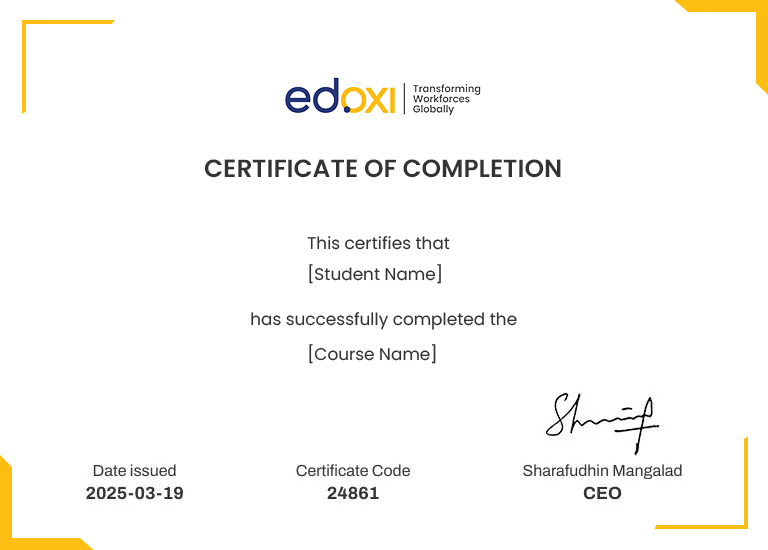
Do You Want to be a Certified Professional in Design Thinking?

Join Edoxi’s Design Thinking Course

Why Choose Edoxi for Design Thinking Training Course

Edoxi has delivered top design thinking courses for professionals and corporates since 2018. Here are some reasons why you should choose us for your training needs:

Proven Training Excellence

Since 2018, Edoxi has trained 75,000+ professionals through 700+ courses across 20+ training domains.

Expert-Led Training

Learn from Rashmi Malik, a Design Consultant, Trainer, and Mentor with over 14 years of experience in Design Thinking, UX/UI, Product Design, and AI-driven creative technologies.

Hands-On Learning Approach

Apply design thinking methods through interactive workshops, practical exercises, and real-world innovation challenges.

Industry-Relevant Case Studies

Explore applications across technology, healthcare, education, and retail to understand diverse user needs and business challenges.

Practical Digital Tool Training

Gain experience with Miro, MURAL, FigJam, and Figma to support collaborative ideation, visualisation, and prototyping.

Business-Focused Problem-Solving

Learn to develop user-centred solutions that address business challenges, improve customer experiences, and support innovation.

Innovation and Collaboration Skills

Build the confidence to facilitate workshops, guide brainstorming sessions, and encourage creative problem-solving within teams.

students-image

Edoxi is Recommended by 95% of our Students

Meet Our Mentor

Our mentors are leaders and experts in their fields. They can challenge and guide you on your road to success!

mentor-image

Rashmi Malik

Rashmi Malik is a Design Consultant, Trainer, and Mentor with over 14 years of cross-industry experience in Design Thinking, UX/UI, Product Design, and AI-driven creative technologies. She has led innovation-focused trainings and workshops for professionals, leaders, and creative teams across the UAE, India, and Europe, working with institutions like Master’s Union, Hero Vired, General Assembly (US), NID, IIAD, SOIL Institute of Management, and UIBS (Amsterdam).

Rashmi specializes in human-centered innovation, AI-integrated design workflows, product strategy, and collaborative methodologies, enabling organizations and individuals to embrace forward-looking design practices. Her career includes impactful roles as Tech Lead at Pearl Academy, Design Consultant across European campuses, and Senior Artist in Visual Development at Rockstar Games (GTA 6). With expertise spanning corporate trainings, design systems, generative design, and product innovation, Rashmi combines academic insight, industry practice, and cutting-edge technology to drive creativity, efficiency, and measurable impact.

Locations Where Edoxi Offers Design Thinking Training Course

Here is the list of other major locations where Edoxi offers Design Thinking Training Course

FAQ

What will I learn in a design thinking course?

When you enrol to learn design thinking, our design thinking course covers human-centred problem solving, user empathy mapping, ideation techniques, prototyping, and iterative testing.

What is covered in Edoxi’s design thinking course syllabus?

Edoxi’s design thinking course syllabus includes five core phases: Empathise, Define, Ideate, Prototype, and Test. Specialised tracks may focus on a design thinking syllabus low code/no-code prototyping approach or strategic innovation.

How do I choose the best design thinking certification for my career?

To select the best design thinking certification, look for programs accredited by recognised institutions that offer hands-on project experience, mentorship, and industry-aligned case studies.

What are the best design thinking courses available online?

The best design thinking courses combine flexible virtual schedules with interactive workshops, enabling professionals to master user research and framework execution remotely.

Is an online design thinking certificate program worth it?

Enrolling in Edoxi’s design thinking certificate program helps professionals gain verified credentials, build a portfolio, and transition into product design, innovation, or UX roles.

How does live design thinking training differ from self-paced learning?

Our Interactive design thinking training features live group activities, real-time feedback, and facilitated sprint exercises, whereas self-paced study relies on pre-recorded lectures.

What is a human-centred design thinking certification and who is it for?

A human-centred design thinking certification focuses on empathy-driven product and service development, making it ideal for UX designers, product managers, marketers, and business strategists.

What is the average salary range for professionals with Design Thinking skills and certification?

The average salary for a professional with Design Thinking skills and certification typically ranges from approximately $4,500 to $4,700 per year for entry-level roles, to over $17,000 to $18,000 per year for experienced strategists, consultants, and lead-level positions.