Request a Callback

+971 4380 1666
 Oct 29, 2026
To learn digital marketing from scratch, you do not need a marketing degree, coding skills, or expensive software. Start by understanding the fundamentals, including target audiences and how businesses promote their products online. Then practise by creating a sample website or choosing a business to work on.
Learn one skill at a time in this order: SEO, AI search, content marketing, social media marketing, paid advertising and analytics. Use free tools and courses from platforms such as HubSpot Academy and Google Skillshop to develop your skills and earn relevant certifications.
Next, build practical experience by completing projects such as keyword research, blog writing, social media content planning, email campaigns, and sample advertisements. Create a portfolio to demonstrate your work. Most beginners can build the fundamentals in about 12 weeks and aim to be ready for entry-level jobs in roughly three to six months of steady practice.
Start learning digital marketing today with a clear roadmap designed to build your skills step by step.
The roadmap has ten steps in four phases. Each phase builds on the one before it, and in-demand digital marketing skills, such as analytics, are worth revisiting throughout. Use the following 12-week plan to organise your learning and track your progress
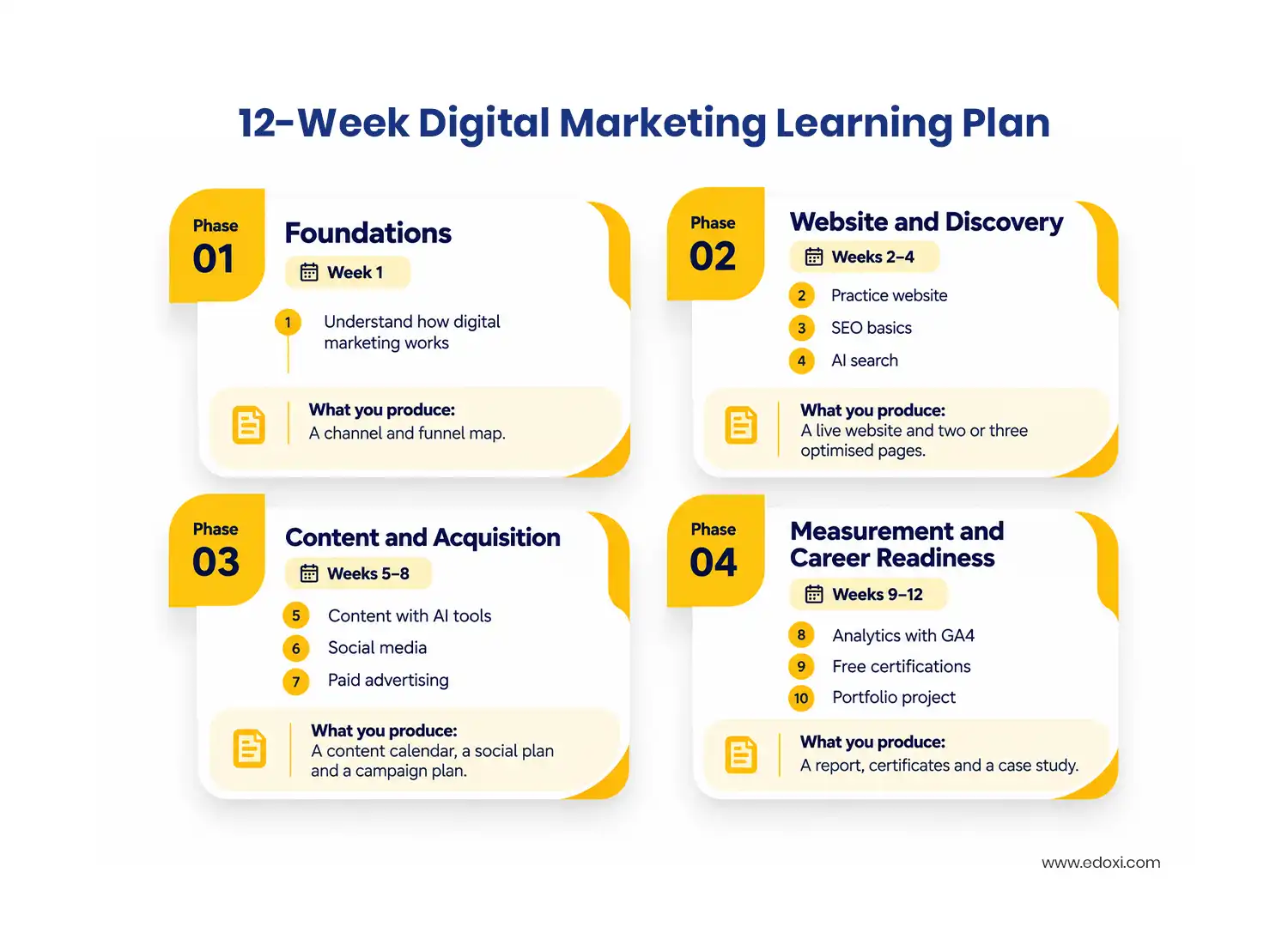
Following a digital marketing roadmap gives you a clear learning path and helps you build job-ready skills. Your progress depends on consistent practice, digital marketing training, real-world projects, and your ability to demonstrate what you have learned. For example, learning PPC (pay-per-click advertising) may require a small budget for hands-on practice, although you can start by creating mock campaigns for free.
Let's explore 10 practical steps to learn digital marketing from scratch, from understanding the basics to building a portfolio and preparing for your first job.
Before learning any tool, understand the big picture: how people discover a business online, decide to buy, and become repeat customers. This journey is often called the marketing funnel.
Learn these basics first:
A good starting point is What is Digital Marketing and How Does It Work?
The fastest way to learn digital marketing is to practise on something real. A simple website gives you a place to try SEO, content, ads and analytics, and becomes the core of your portfolio later.
You do not need coding skills for this step. Basic HTML helps later, but it is not required to start.
Your output: a live website with at least three pages, a contact form and Search Console connected.
Search engine optimisation (SEO) helps your pages appear when people search on Google. It is a useful foundational skill for many digital marketing roles, and its fundamentals still matter for how content is found in AI-assisted search.
Focus on:
Practise by optimising two or three pages on your website. Before you change anything, record each page's original state, then track impressions and clicks in Google Search Console over several weeks. Read "What is SEO: A Complete Guide" for more detail.
Your output: two optimised pages with a before-and-after record of the changes you made and the Search Console results.
Search is evolving. People still use traditional search engines, but they are also discovering information through AI-powered experiences such as Google AI Overviews, ChatGPT and Gemini. These tools can help users explore topics, compare products, evaluate services and find answers to specific questions.
For digital marketers, the goal is not simply to rank a webpage. It is to create reliable, useful content that search engines and AI systems can access, understand and potentially reference.
Before exploring AI-specific strategies, build a strong SEO foundation:
According to Google's official guidance on AI features and your website, established SEO best practices remain relevant to Google's AI search experiences. Google does not require special AI-specific optimisation to be eligible to appear in these features.
AEO focuses on making content easy to understand and useful for answering specific questions. This can include clear explanations, concise definitions, structured headings and well-organised supporting information.
2. Generative Engine Optimisation (GEO)GEO refers to approaches intended to improve how content is discovered, interpreted or referenced in generative AI experiences. It is an evolving industry term, not a guaranteed ranking method.
3. Query fan-outQuery fan-out describes a process in which an AI search system explores multiple related searches or subtopics to develop an answer to a user's original question. For example, someone searching for the best digital marketing course in Dubai may also need information about course fees, duration, practical training and digital marketing jobs and salary trends.
Understanding these concepts can help marketers create content that addresses the main question as well as the related questions behind it. However, none of these approaches guarantees that an AI tool will display, recommend or cite a particular website.
Your practical output: A simple AI search research log containing five questions, the sources displayed by each tool, the gaps you identified and the improvements you made to your website.
“The goal is not to write content just to appear in AI-generated answers. It is to answer real questions so clearly, accurately and usefully that both people and search systems can understand its value. Strong SEO fundamentals remain the starting point; AI search is another reason to make those fundamentals count.”
- Praveen Kurup, Digital Marketing Trainer, Edoxi
Content drives Search Engine Optimisation (SEO), social media and email, so learn to plan and create it well. AI tools such as ChatGPT, Claude and Gemini are used for prompting and can speed up research and first drafts, but the skill that matters is judging and improving what they produce.
Your output: two published, fact-checked articles and a short note describing how you checked and edited them.
Social media helps businesses build an audience, engage customers and generate leads. Learn how each platform works and which goals it suits.
You can learn social media marketing by running a two-week content plan for your website or brand on one or two platforms and recording what performs best.
Your output: a two-week plan with a stated objective, and a record of reach, engagement and clicks against that objective.
Paid ads let businesses reach people quickly, and the skills are valuable because budgets are at stake. Start with one platform before moving to others.
If possible, run a small test campaign with a modest budget. Even a short campaign teaches you more than reading about it. If a live campaign is unaffordable, build a complete campaign plan and a tracking specification instead.
Your output: A campaign plan (goal, audience, keywords or targeting, ad copy, budget) and a tracking specification, plus results if you ran a test.
Analytics shows what is working and what is not. Every digital marketing role uses data, so this step is essential.
Analytical thinking is among the skills employers value most, according to the WEF Future of Jobs Report 2025, and analytics is where marketers show it.
Your output: a monthly report that explains one finding and recommends one action.
Free certifications give your learning structure and add credible names to your CV.
Your output: one or two completed certifications, listed on your CV and LinkedIn profile.
Your portfolio is the proof that you can do the job. Bring together what you have learned into one or two clear projects.
A strong beginner portfolio includes:
If you can, offer to help a small business, charity or friend's project. Real results, even small ones, are more convincing than practice exercises.
Your output: one or two case studies you can explain in an interview in a few minutes.
Your timeline depends on your starting knowledge, weekly study time and access to practical projects. As a planning guide, someone studying 8 to 10 hours a week could use the first 12 weeks to learn the fundamentals and complete a portfolio project.
| Weeks | Focus |
Hours-per-week guide
|
| 1 | Digital marketing fundamentals and the funnel (Step 1) | 8–10 |
| 2–4 | Practice website, SEO basics and AI search (Steps 2–4) | 8–10 |
| 5–8 | Content, social media and introductory paid ads (Steps 5–7) | 8–10 |
| 9–12 | Analytics, certifications and portfolio (Steps 8–10) | 8–10 |
| Months 4–6 and beyond | Improve your projects, specialise in a channel and prepare for entry-level applications | Varies |
With about 8 to 10 hours of study a week, most beginners can cover the basics of all ten steps in around 12 weeks. Becoming confident enough to apply for entry-level roles usually takes about three to six months, depending on how much hands-on practice you do.
For a detailed guide, see: How Long Does It Take to Learn Digital Marketing?
You can cover the fundamentals without paying anything. A sensible free toolkit looks like this:
Free resources teach you the concepts. What turns them into skill is applying them to your own live website and documenting the results.
Beginners should learn the shared foundations in Steps 1 to 8 before committing to a specialisation. These are starting points rather than rigid categories.
| Specialisation | Suits people who enjoy |
Good first projects
|
| SEO and organic search | Research, writing, website structure and long-term performance analysis |
Optimise pages and report Search Console results
|
| Paid media | Experimentation, budgets, conversion tracking and numerical analysis |
Build a campaign plan and tracking specification
|
| Content and social media | Writing, storytelling, creative production and audience engagement |
Run a two-week content plan and review the results
|
| Analytics and marketing measurement | Data interpretation, reporting, measurement design and problem-solving |
Build a GA4 dashboard and a monthly report
|
Both paths can work. The right choice depends on your budget, how you learn best and how quickly you want results.
A course should add something free learning does not: trainer feedback, assessed practical work and a structured capstone. For example, Edoxi's Digital Marketing Course in Dubai covers this roadmap in 40 hours across eight modules, in the classroom or live online, with a live website project and a real-business capstone. The fee is AED 2,000. Check the course page for the current fee, curriculum and inclusions before you enrol.
Once you have a portfolio, start applying for entry-level roles and small projects at the same time.
If you are based in the UAE, read "How to Become a Digital Marketer in Dubai Without Experience" for local job-search advice.
Digital skills are changing quickly. The World Economic Forum's Future of Jobs Report 2025 found that employers expect 39% of workers' core skills to change by 2030, through skills being transformed, newly needed or becoming outdated. This is an employer expectation about skills, not a forecast that 39% of jobs will disappear.
The same report identifies AI and big data as the fastest-growing skills. Digital marketing sits where these changes meet: it is data-driven, increasingly AI-assisted, and needed by almost every business that sells online.
The good news for beginners is that the field rewards practical skill more than formal qualifications. If you can show that you improved a website's traffic, ran a campaign or built a useful report, you have something employers and clients value.
Learning digital marketing from scratch is about order and practice, not talent or a degree. Understand how digital marketing works, build a practice website, then learn SEO, AI search, content, social media, paid ads and analytics one step at a time.
Earn a few free certifications, build a portfolio that shows real results, and start applying before you feel completely ready. With steady practice, many beginners can be ready for entry-level applications within three to six months.
Learn the shared foundations first, then choose the area whose projects you enjoy most: SEO, paid media, content and social media, or analytics. See the specialisation comparison above.