Request a Callback

+971 4380 1666
 Jun 19, 2026
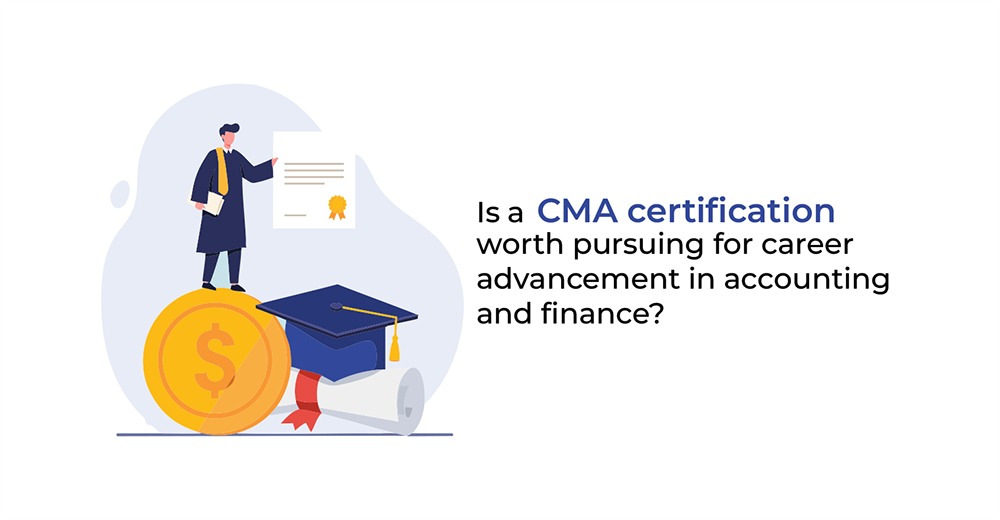
The corporate landscape is shifting rapidly. Automation, forecasting algorithms, and artificial intelligence technologies are quickly taking up transactions which used to be the basis of corporate accounting work.
According to statistics provided by the World Economic Forum, the number of white-collar middle-skilled employees, including accountants, bookkeepers, payroll staff, and data processors, is undergoing an acute decline.If you want to flourish in this industry rather than survive, today's financial analysts need to evolve from being regulatory historians to becoming strategic planners.Administered by the Institute of Management Accountants (IMA), the CMA is a globally recognised credential designed specifically to validate mastery in financial planning, analysis, control, decision support, and professional ethics.
Unlike public accounting paths that focus heavily on statutory compliance, auditing, and tax law, the CMA curriculum bridges the gap between pure numbers and operational strategy. The CMA examination is structured into two core parts:Part 1: Financial Planning, Performance, and Analytics: Part 1 covers external financial reporting, planning, budgeting, forecasting, performance management, cost management, internal controls, and technology/analytics.
Part 2: Strategic Financial Management: Part 2 delves into financial statement analysis, corporate finance, decision analysis, risk management, investment decisions, and professional ethics.
One of the most immediate metrics professionals utilise to determine whether a certification is worth pursuing is its direct impact on lifetime earning potential. The historical and ongoing data gathered via global compensation assessments paint a compelling financial picture.
Academic assessments evaluating the long-term economic value of professional credentials indicate a substantial "premium effect" for certified individuals over their uncertified peers.
A benchmark present-value study conducted by researchers Krippel and Mitchell revealed that a non-certified corporate accountant would have to work an additional three full-salary years over their career duration to match the cumulative lifetime earnings of a CMA holder.In monetary terms per hour, and taking into account the traditional benchmark measure of 300 hours of studying needed to complete both parts of the CMA exam, the lifetime gain is several thousand dollars in return for each hour spent. This suggests that the IRR from investing in one’s own education is rather high.While the CMA holds immense standalone power within corporate settings, holding it alongside a CPA or local equivalent unlocks top-tier compensation brackets.
A study following professionals who had several different combinations of certifications found that those who had both CPA and CMA certifications had considerably higher average yearly income at $125,094 than professionals who only had one certification, either CPA ($110,095) or CMA ($105,667).Beyond immediate salary differentials, the true value of the CMA shines when examining structural upward mobility within corporate financial leadership.
Traditionally, management accounting was viewed as bean-counting in the organisation. In today’s world, empirical studies have confirmed that the development of management accountants becoming active partners in the business internally depends largely on external pressures of management.
Furthermore, research highlights that companies where management accountants actively embody this strategic "business partner" mindset experience measurable, positive impacts on overall firm performance.|
Expert Quote on CMA Certification “A CMA certification goes beyond accounting; it builds strategic thinkers who can translate financial data into business decisions that drive growth and performance.” - Dr Robert Keller, CMA, Senior Finance & Strategy Consultant |
Many international companies today give bonuses, offer financial incentives, or even demand certifications such as the CMA for internal growth.
In leadership development programs at international conglomerates, there is a high focus on management accounting certification since these qualifications require professionals to develop a vast understanding of all aspects of business knowledge and management skills.According to mentors in corporate training programs, the need for strict examination requirements and the obligation for Continuing Professional Education (CPE) make professionals strive hard to develop technically and manage effectively.The accounting world is traditionally siloed by geography due to regional variations in tax structures, legal compliance paradigms, and auditing regulations.
For instance, a professional well-versed in US tax codes may face friction transitioning into European corporate ecosystems operating under entirely different statutory frameworks.The CMA, however, circumvents this geographic friction. Because the core principles of corporate efficiency, cost management, investment analysis, and financial strategy are universal across borders, the CMA acts as a highly portable passport for global career mobility.In the United States and Canada, the CMA serves as an elite differentiator for corporate ladders, especially within heavy manufacturing, logistics, defence contracting, and Fortune 500 tech firms. While the CPA remains essential for public audit sign-offs, corporate hiring managers increasingly favour CMAs for operational leadership roles.
Over the past decade, demand for the CMA designation has surged across the Middle East, particularly within the Gulf Cooperation Council (GCC) countries.
As nations like Saudi Arabia and the UAE diversify away from oil-dependent economies and build out massive corporate infrastructure initiatives, there is an immense premium placed on professionals holding verified, Western-accredited strategic financial certifications. Regions like Dubai have seen a 45% year-on-year jump in CMA-qualified professionals, who earn 35-40% more than their non-certified counterparts The Certified Public Accountant (CPA) in Dubai is a great option to advance in the financial sector.In rapidly expanding economies across India, China, and Southeast Asia, multinational corporations are setting up global capability centres (GCCs) and shared services hubs.
In these highly competitive corporate environments, holding a CMA Certification signals to international leadership that the candidate possesses the business English proficiency, analytical framework, and ethical foundation necessary to handle global operations.To fully determine whether the CMA Certification course is the right investment for your career path, it is helpful to contrast it with other premier financial credentials:
Comparison of CMA with CPA and CFA|
Metric |
Certified Management Accountant (CMA) | Certified Public Accountant (CPA) | Chartered Financial Analyst (CFA) |
|---|---|---|---|
|
Primary Domain |
Corporate Finance, Business Strategy, FP&A, Operations |
Public Accounting, Audit, Taxation, Regulatory Compliance |
Asset Management, Portfolio Analysis, Investment Banking |
|
Core Audience |
Corporate Accountants, Financial Managers, CFOs |
Public Auditors, Tax Consultants, Private Practices |
Investment Analysts, Portfolio Managers, Equity Research |
|
Exam Structure |
2 Parts (100% Computerized, Multi-choice & Essay) |
4 Parts (Varies by local jurisdiction) |
3 Levels (Rigorous, sequential testing) |
|
Core Focus |
Forward-looking strategic decision-making |
Retrospective financial verification & adherence |
External investment appraisal and macroeconomic analysis |
|
Average Salary (Approx.) |
$90,000 – $140,000+ (varies by role & experience) |
$70,000 – $130,000+ (higher in audit/tax firms) |
$85,000 – $150,000+ (higher in investment roles) |
Enhance your career prospects by earning a finance training certification like CMA and upgrading your professional skills.
The CMA certification course offers a demonstrably high statistical return on investment, but it is not a magical cure-all. Its worth depends entirely on your targeted career trajectory.
Pursue the CMA if:
You want to stay in the corporate industry: If your goals are set on climbing the corporate ladder to become a Controller, VP of Finance, or CFO, the knowledge validated by the CMA is directly applicable to your day-to-day work.Looking for CMA certification training near you?
Edoxi provides expert led CMA courses in major cities across the Middle East and Africa. Choose your location and explore dedicated CMA training programs tailored to your region.
If evaluated on modern global standards, the CMA designation is certainly worth the effort for individuals interested in a career in corporate accounting and financial management.
While traditional transactional accounting practices continue to be threatened by automation, the CMA designation serves as an indispensable safeguard.The CMA Certification helps develop professional competence by moving the scope of work beyond historical record-keeping and onto strategic collaboration with corporations.
With clear research showing higher career income growth, greater international mobility, and clear applicability to executive career paths, the CMA continues to provide one of the best career development tools available to those seeking success in corporate finance.Yes. While a CPA is necessary for public auditing, a CFO’s primary role is forward-looking corporate strategy and capital allocation. The CMA curriculum focuses directly on these areas financial planning, analysis, and strategic management, making it an elite credential for climbing to the executive C-suite.
No, automation actually increases the CMA's value. AI handles routine bookkeeping and transactional accounting, whereas the CMA trains you in high-level strategic data interpretation, risk management, and predictive forecasting, human skills that technology cannot easily replicate.
To earn the CMA credential, you must meet four core criteria:
Maintain an active IMA membership.
Hold a bachelor's degree from an accredited institution.
Complete two years of continuous, full-time professional experience in management accounting or financial corporate roles.
Pass both parts of the CMA exam within three years.
Yes. Unlike regional public accounting licenses that are tied to local tax and audit laws, the CMA is based on global corporate finance principles. It is universally recognised across North America, the Middle East, Europe, and the Asia-Pacific.