Request a Callback

+971 4380 1666
 Oct 12, 2026
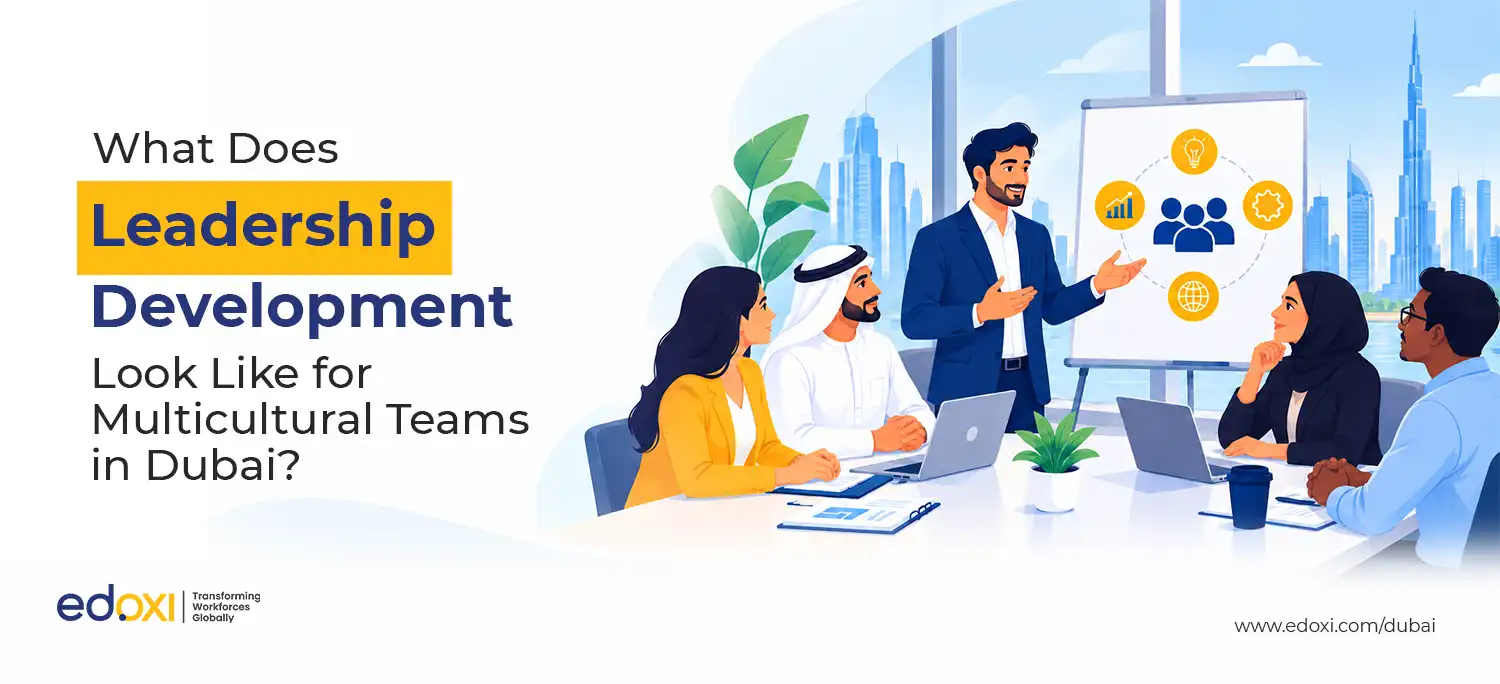
Leadership development for multicultural teams in Dubai goes beyond traditional management skills. Managers need to build cultural intelligence. They need to adapt how they communicate, manage conflict without jumping to cultural assumptions, set explicit team norms, and lead without stereotyping employees.
Leadership skills in Dubai are an everyday requirement and not a niche specialism. The UAE Ministry of Foreign Affairs reports that the country is home to more than 200 nationalities. Dubai's population reached roughly 3.83 million by the end of 2024, growing by around 170,000 residents in that year alone. Most organisations here manage teams whose members differ in language, professional background and expectations about how a leader should behave.
This guide covers what a multicultural leadership program should include, including core capabilities to build, how to structure a program, how to measure whether it worked, and workforce makeup needs to shape the design.
Leadership Development for Multicultural Teams is a structured process of building specific capabilities, cultural intelligence, adaptive communication, inclusive decision-making, conflict management and coaching. Together, these help managers get consistent performance from a team whose members bring different cultural assumptions to the same job.
Leadership development more broadly focuses on improving the knowledge, behaviours and capabilities managers need to lead people well. However, multicultural teams add another layer of complexity. Leaders must understand how cultural and contextual differences can influence communication, decision-making, feedback and collaboration, while avoiding the mistake of reducing individuals to stereotypes. The goal of corporate training programs is therefore to develop the ability to recognise differences, explore their causes and adapt leadership practices appropriately.
Related reading: What is corporate training: A complete guide
How Cultural Differences Influence Multicultural Leadership
Good multicultural leadership isn't a checklist of national traits. It's a set of habits: asking better questions, testing assumptions, creating explicit structure. These habits work regardless of which specific cultures are in the room. Effective leaders learn to ask:
Related Reading: Upskilling vs Reskilling: A Guide for Dubai Companies in 2026
For organisations in Dubai, this isn't abstract. It shows up in ordinary meetings. One employee may expect a decision communicated directly and immediately. Another may expect to be consulted first. Someone may avoid openly disagreeing with a senior manager in front of colleagues. Someone else may treat direct disagreement as a normal, expected part of a good discussion.
None of these behaviours automatically signals commitment, competence or attitude. They often reflect different expectations about hierarchy, communication and professional relationships. That's why multicultural leadership development can't just teach managers to "communicate better." It needs to teach them to communicate more deliberately.
Read: How Can Dubai Companies Prepare Emirati Talent for Workplace Success?
Diversity does not automatically guarantee or hinder team effectiveness; instead, it acts as a double-edged sword that increases a team's potential while adding complexity. On one hand, cognitive and functional diversity enhances problem-solving, innovation, and decision-making by introducing varied perspectives and preventing groupthink. On the other hand, demographic and surface-level differences can trigger social categorisation, creating "in-groups" and "out-groups" that lead to communication barriers, interpersonal friction, or alignment issues.
Ultimately, whether diversity translates into high performance depends on moderating factors such as task complexity, where complex, creative tasks benefit far more than routine execution and, most importantly, inclusive leadership that fosters psychological safety and a shared team identity.
A useful training program develops eight connected capabilities. Treating cultural awareness as a single standalone workshop is one of the most common ways these programmes underdeliver. Each capability below reinforces the others.
Cultural intelligence (CQ) is the ability to function effectively across cultural differences. It's usually broken into four dimensions:
In practice, cultural intelligence looks like small, repeatable habits:
The goal isn't to become an expert in every culture on the team. It's to get better at reading context before jumping to conclusions.
Teams differ in their expectations around directness, formality, hierarchy, interruptions and silence. They differ in meeting participation, in written versus verbal communication, and in how they expect feedback delivered. A manager who defaults to a single style will unintentionally favour some team members over others.
Adaptive communication doesn't mean changing the substance of a message. It means adjusting the delivery while keeping the content clear and the accountability intact. Compare:
Instead of: "Why didn't you tell me there was a problem?"
Try: "I want to understand what made it difficult to raise this earlier. Was there something about the process or communication that got in the way?"
The second version keeps accountability while creating room for the employee to actually explain what happened. A useful development exercise: have managers deliver the same workplace message three ways: direct verbal instruction, collaborative discussion, and written clarification followed by discussion. Then have them evaluate which produced the clearest outcome for that specific situation.
One of the most effective, and simplest, practices for multicultural teams is refusing to leave key behaviours to assumption. Teams that explicitly agree on how meetings run, how decisions get made, how disagreement should be raised, how fast people should respond to messages, and who owns final decisions remove a huge source of cross-cultural friction before it starts.
A simple team charter can be built around five short statements:
The result isn't a rigid rulebook. It's a shared operating system the whole team can point back to.
Conflict in a multicultural team isn't necessarily evidence that diversity is failing. It can just as easily stem from different expectations about authority, deadlines, acceptable disagreement or responsibility. The leadership skill is distinguishing task conflict, relationship conflict and genuine misunderstanding before assigning blame.
Say two colleagues clash: one reads the other's repeated questions as resistance, while the other sees them as responsible risk management. The useful leadership move is to investigate rather than label. What happened? What did each person expect? Where did the assumptions diverge? What agreement is needed going forward?
Culture is one possible factor here, never an automatic explanation. Professional experience, personality, language proficiency and prior international exposure all shape behaviour too.
Multicultural teams need leaders who make it genuinely safe to ask questions, challenge assumptions, admit mistakes, disagree professionally and raise concerns. This matters more, not less, where there are differences in language fluency or perceived hierarchy. A team can have a formal "open-door policy" while everyday behaviour quietly discourages dissent — for instance, if a manager interrupts less fluent speakers but lets senior employees speak uninterrupted.
Leadership training should teach managers to watch participation patterns rather than just announce inclusion. Who speaks first? Who speaks most? Who rarely speaks? Whose ideas get follow-up questions? Do junior employees ever challenge senior ones? These questions turn inclusion into something observable, not just aspirational.
Feedback needs to balance clarity, respect, accountability and context. It shouldn't soften the message, just deliver it well. A workable structure:
Describe the situation
Explain the impact
Ask for the other person's perspective
Agree on the change
Confirm what support they need
This separates feedback about behaviour from assumptions about personality or background. For multicultural teams, leaders should also actively choose whether feedback works better public or private, immediate or scheduled, verbal or written, individual or group. The right choice depends on the person and the issue, not a fixed rule.
Meetings often reward confidence, speed, fluency in the dominant language and familiarity with office politics. That means good ideas can fail to reach the decision-maker. Structured decision-making counters this:
Individual written input
Small-group discussion
Full-team discussion against clear criteria
A final decision, with the rationale explained
This creates multiple routes into the conversation. It reduces the risk that the most vocal person becomes the de facto voice of the whole team.
Multicultural leadership doesn't mean different rules for every employee; that undermines fairness. Leaders need a clear line between non-negotiables and flexible practices.
Fairness doesn't always mean identical treatment. It means applying legitimate standards consistently while allowing different approaches to reach the same outcome.
Related reading: How Corporate Training Programs Help to Improve Employee Skills?
A leader with cultural awareness but weak communication will still create misunderstandings. A leader who communicates well but can't manage conflict will struggle once cultural differences become contentious. The goal is integrated capability across all eight areas, not isolated skills. Here is a practical leadership development plan that you can follow;
| Leadership capability | What leaders develop |
Workplace application
|
| Cultural intelligence | Recognising and adapting to cultural context |
Adjust communication without stereotyping
|
| Communication adaptability | Delivering messages clearly across differences |
Meetings, feedback and escalation
|
| Explicit team norms | Establishing shared ways of working |
Team charters and operating agreements
|
| Conflict navigation | Separating behaviour from assumptions |
Resolving misunderstandings early
|
| Psychological safety | Making it safe to speak up |
Encouraging questions and dissent
|
| Inclusive decision-making | Creating structured routes for input |
Meetings and major decisions
|
| Coaching and feedback | Tailoring development to the individual |
One-to-ones and performance conversations
|
| Consistency and flexibility | Knowing what stays fixed vs. what adapts |
Policy application and team practices
|
A well-structured leadership training program moves through 7 stages:
Diagnose: Start with the organisation's actual friction points: where communication breaks down, which teams see recurring conflict, and where managers struggle with performance conversations, rather than running a generic leadership seminar.
Build cultural intelligence: Practise interpreting ambiguous workplace situations rather than memorising cultural stereotypes.
Practise communication and feedback: Use realistic scenarios: missed deadlines, disagreement with senior colleagues, unclear instructions, cross-cultural misunderstandings.
Develop inclusive team leadership: Cover inclusive meetings, decision-making, psychological safety and team norms together.
Practise conflict management: Train managers to distinguish task conflict, relationship conflict, communication problems and structural issues.
Apply it: Each manager leaves with two or three specific behaviours to implement immediately. For example, deliberately creating an extra channel for quieter team members to contribute in the next three meetings.
Measure and reinforce: Review after 30, 60 and 90 days: what changed, what got in the way, what employees noticed, what needs further coaching.
That last stage is the one most programmes skip, and it's the one that determines whether training produced behavioural change or just attendance.
Measurement shouldn't collapse into a single "leadership score." Useful indicators fall into four groups:
The connection back to organisational outcomes is what separates a training activity from a measured leadership investment.
Start with the business problem, not the training catalogue:
Construction. A multinational project may bring together managers, engineers, contractors and site workers from several countries. Leadership challenges typically centre on safety communication, hierarchy, escalation paths and language, where a misread instruction has real safety consequences.
Hospitality. Managers often lead highly international teams while maintaining consistent service standards across every shift. That means communication needs to flex by individual without ever compromising the guest experience.
Technology. Distributed teams frequently carry different expectations around meeting culture, documentation and decision-making speed, particularly where team members sit across time zones.
Professional services. Client-facing teams often need to adapt communication style internally and across client relationships that carry their own cultural expectations, adding a second layer to the same core leadership skills.
Organisations building leadership training in Dubai or broader corporate training in Dubai programmes typically find it more effective to build around these real scenarios than around generic leadership theory.
Leadership development for multicultural teams in Dubai works best when it moves beyond cultural awareness and into observable leadership behaviour. Managers need to communicate clearly, adapt to context, manage disagreement, create psychological safety and establish shared ways of working.
For HR and L&D teams, the priority isn't simply delivering cultural-awareness training. It's building measurable leadership capability that managers can apply in everyday workplace situations, grounded in the UAE's own legal and organisational context, including the equality and non-discrimination provisions in Article 4 of the UAE Labour Law.