Request a Callback

+971 43801666
 Aug 06, 2026
Key Takeaways
|
Dubai companies face a critical workforce decision in 2026: should they upskill their existing employees or reskill them for entirely new roles?
In 2026, every competitive workforce strategy lives or dies by that question.
AI, automation, and Dubai's fast-moving digital economy are changing job requirements faster than most HR teams can keep up. Waiting isn't really an option anymore.
This guide breaks down upskilling and reskilling in simple terms. You can understand the difference, when to use each one, and how businesses in Dubai are already putting both to work.
Table of Contents |
|
1. What is Upskilling?
2. What is Reskilling? 3. Upskilling vs Reskilling: What's the Difference? 3.1 Why Upskilling and Reskilling Matter for Dubai Companies in 2026? 3.2 When Should You Upskill and When Should You Reskill? 3.3 What Are the Benefits of Workforce Development for Dubai Businesses? 3.4 What Skills Are Most in Demand Across Dubai in 2026? 4. What Learning Methods Are Dubai Companies Using in 2026 for Upskilling and Reskilling Employees? 4.1 How Is Digital Transformation Driving Upskilling and Reskilling in Dubai? 5. FAQs: Upskilling vs Reskilling: A guide for Dubai Companies in 2026 |
Upskilling means teaching employees new skills within their current role.
For example, a marketing executive learning AI-powered analytics tools is upskilling. A finance manager learning advanced Excel modelling is upskilling too.
The goal is simple: make people better at the job they already have.
Upskilling builds workforce agility, ensures regulatory compliance, and drives economic growth in Dubai. For organisations, investing in continuous workforce development is the single most reliable strategy to future-proof operations and maintain a competitive edge.
"The illiterate of the 21st century will not be those who cannot read and write, but those who cannot learn, unlearn, and relearn."
- Alvin Toffler, Futurist and Author
Reskilling is different. It prepares an employee for a completely new role, often in a different department or function altogether.
Think of a customer service agent trained to become a data analyst. Or an administrative staff member moving into a digital marketing position. That's reskilling.
Both approaches matter. Neither one replaces the other.
Let’s get into the core differences between these two workforce strategies: upskilling enhances an employee's existing toolkit to elevate performance in their current role, whereas reskilling trains them in entirely new capabilities to transition into a completely different job function.
Upskilling vs Reskilling: Quick Comparison
| Factor | Upskilling | Reskilling |
| Goal | Strengthen current role | Prepare for a new role |
| Best for | Employees performing well but needing new tools or skills |
Employees whose roles are shrinking or changing
|
| Time to results | Faster, since it builds on existing knowledge |
Longer, since it starts from a wider skills base
|
| Business risk if ignored | Productivity gaps, outdated processes |
Job displacement, talent loss
|
| Common examples | Learning new software, advanced certifications |
Career pivots, department transfers
|
Dubai's economy is shifting quickly. The reasons why upskilling and reskilling matter for Dubai companies in 2026 are:
Demand for AI, digital, cloud, cybersecurity, and other specialised technical roles continues to outpace supply, increasing competition for skilled talent.
Employers report that general IT talent is relatively easy to find, but experienced AI, cloud, and cybersecurity specialists remain difficult to hire.
The World Economic Forum expects nearly 40% of workers’ core skills to change by 2030, making continuous learning a business necessity.
The World Economic Forum estimates that about 60% of workers worldwide will require upskilling or reskilling to remain effective in their roles.
Deloitte’s 2026 Global Human Capital Trends research estimates that around 1.4 million workers across the Gulf region will need reskilling in the near term.
Employers identify workforce skill shortages as the number one obstacle to digital and business transformation, making upskilling and reskilling a strategic priority for Dubai companies.
For Dubai businesses, this creates a clear choice: build skills internally through structured training, or keep competing for a shrinking pool of ready-made specialists.
|
Expert Insight “With this hyper-focused and specialised world that we are living in today, if we have to be hyper-specialised, AI can do better than us. The only way you can stand a chance is if you move from intelligence-specific to broad intelligence-developing critical thinking, adaptability, and cross-disciplinary skills." -H.E. Omar Sultan Al Olama (UAE Minister of State for Artificial Intelligence, Digital Economy, and Remote Work Applications) |
Here's a simple way to decide when you should upskill or reskill.
Choose upskilling when:
Choose reskilling when:
|
A practical example A Dubai logistics company automating parts of its warehouse operations could upskill its supervisors in data dashboards and reporting tools. At the same time, it could reskill warehouse staff whose manual tasks are being automated into roles in fleet coordination or customer support. Same company, two strategies, one workforce plan. |
To survive in the rapidly changing business environment of Dubai, it is essential for an organisation to either develop its existing strengths or train its people for completely new positions. This is explained through the following table:
Business Use Cases in Dubai
| Business Scenario |
Recommended Approach
|
| Adopting new AI or automation tools |
Upskilling for existing technical teams
|
| Digital transformation shrinking a department's workload |
Reskilling into growth areas
|
| Entering a new market or service line |
Reskilling select staff into new functions
|
| Preparing employees for leadership roles |
Upskilling through leadership and soft skills training
|
| Compliance or regulatory changes (finance, cybersecurity) |
Upskilling through certification programmes
|
The benefits of workforce development through customised corporate training in Dubai for businesses include significantly reduced recruitment costs and higher retention, while empowering companies to seamlessly adapt to rapid digital transformation.
Investing in continuous learning offers strategic advantages for organisations operating in Dubai's high-velocity market. Beyond simple workforce readiness, structured training directly strengthens operational resilience and bottom-line performance.
Benefits of Workforce Development for Dubai Businesses
| Benefit | Impact |
| Lower hiring costs |
Reduces dependence on expensive external recruitment
|
| Higher retention |
Employees stay longer when they see growth opportunities
|
| Faster adaptation |
Teams keep pace with digital transformation
|
| Stronger employer brand |
Attracts talent looking for career development
|
| Business continuity |
Reduces disruption from skills shortages
|
Discover how structured learning transforms workplace performance by reading our guide on How Corporate Training Programs Help to Improve Employee Skills.
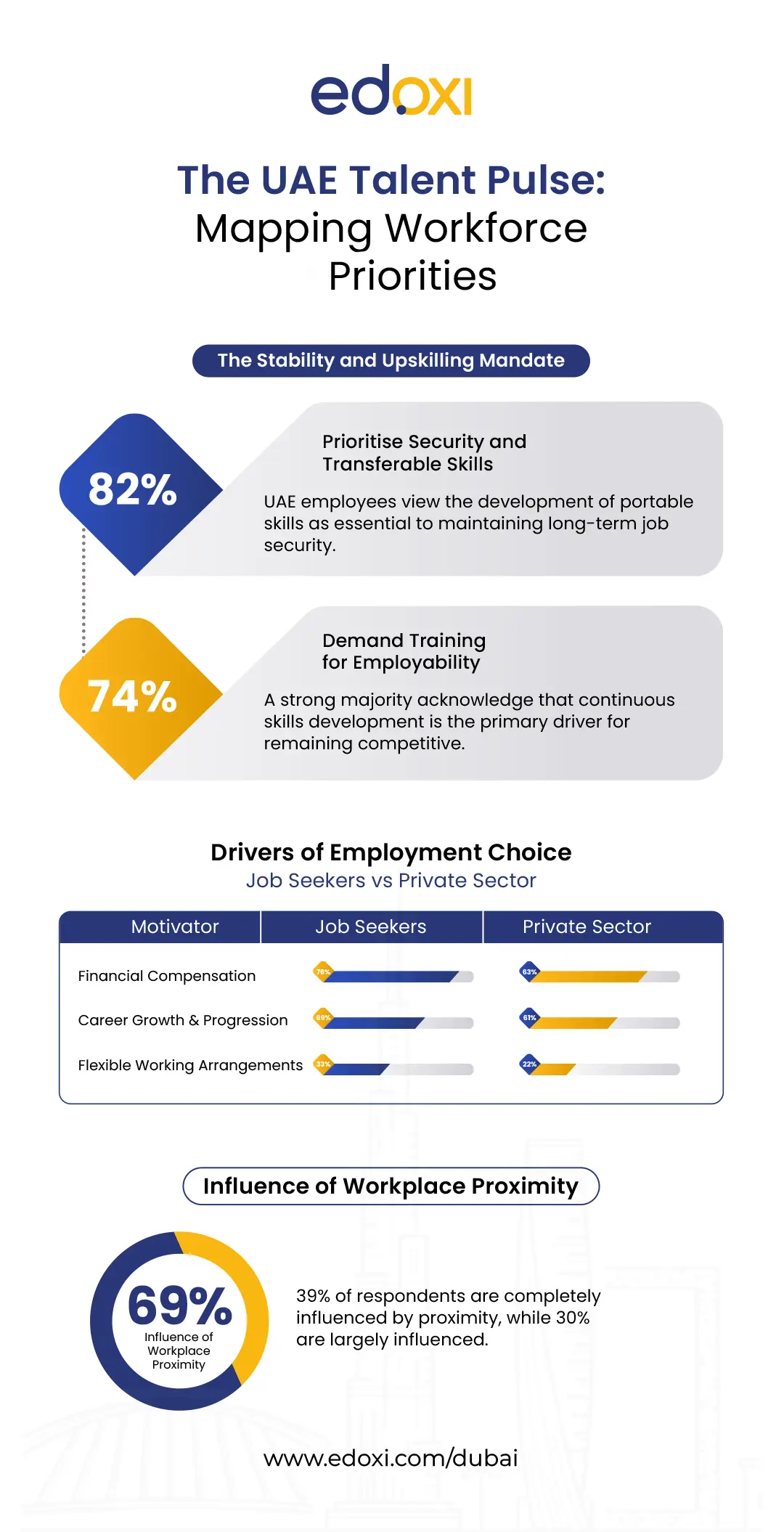
The workforce priorities in the UAE are illustrated in the infographics below:
The skills in demand in Dubai are rapidly evolving to align with national digital mandates, rapid tech integration, and ongoing infrastructure expansion.
Dubai's labour market requires a strategic mix of high-tech capabilities and strong leadership.
The table below outlines the core skill areas driving workforce demand across the emirate in 2026:
Skills in Demand Across Dubai in 2026
| Skill Area |
Why It's in Demand
|
| AI and machine learning |
Rising adoption across sectors, from finance to logistics
|
| Data analytics |
Businesses need faster, evidence-based decisions
|
| Cybersecurity |
Digital transformation increases exposure to risk
|
| Cloud and digital infrastructure |
Supporting large-scale smart city and government initiatives
|
| Leadership and people management |
Needed to manage hybrid teams and change
|
| Project management (like PMP or Primavera P6) |
Core to Dubai's construction and infrastructure growth
|
"Skill building is not a one-time event, but a lifelong habit. The organisations that thrive in the next decade will be those that turn learning into a continuous operational system rather than an occasional training program."
The learning methods used by Dubai companies in 2026 are adopting AI-driven personalised learning paths, mobile microlearning modules, immersive VR simulations, and hybrid corporate academies to upscale workforce capabilities efficiently.
Experienced corporate trainers often point out to L&D teams that technical skills alone aren't enough anymore.
Employees also need the judgement to apply new tools like AI responsibly within their day-to-day work. That combination of technical and human skills is exactly what most Dubai employers are now training for.
Learning Methods Dubai Companies Are Using
| Method | Best For |
| Instructor-led corporate training |
Structured, certification-based upskilling
|
| Blended learning (online + in-person) |
Teams with varied schedules
|
| On-the-job mentoring |
Reskilling into new departments
|
| Short certification courses |
Fast, targeted skill upgrades
|
| Custom corporate training programmes |
Company-specific reskilling needs
|
Structured, expert-led programmes tend to deliver faster, more measurable results than informal or self-guided learning, especially when a business needs employees ready within a set timeframe.
Dubai's digital transformation agenda is driving upskilling and reskilling, and it’s not slowing down. Government and private sector investment continues to push AI, cloud computing, and smart city initiatives forward, and this is reshaping what "employable" looks like across nearly every industry.
HR and L&D managers are already shifting from qualification-based hiring toward skills-based hiring. Formal degrees matter less than demonstrated, up-to-date capability. That shift makes continuous workforce training a permanent part of doing business in Dubai, not a one-off initiative.
Not sure whether your team needs upskilling or reskilling? Download Edoxi's free workforce skills training guide to find out.
Practical Recommendations for HR and L&D Leaders
Audit your current skills gaps before choosing a training path.
Map roles at risk of automation and plan reskilling routes for those employees early.
Invest in leadership and soft skills, not just technical training.
Partner with an established corporate training provider for structured, certified programmes.
Review your training strategy every 6-12 months, since skill demands are changing quickly.
Upskilling and reskilling aren't competing strategies. They work best together, as part of one broader workforce development plan.
Upskilling and reskilling both solve the same underlying problem: keeping your workforce ready for what's next. The right mix depends on where your business is heading, not a one-size-fits-all formula.
Dubai companies that treat workforce training as an ongoing investment, rather than a reaction to a skills gap, will be the ones best positioned for 2026 and beyond.
|
"In a world of relentless change, the only sustainable competitive advantage is the ability to grow your people faster than your competition." - Satya Nadella, CEO of Microsoft |