Request a Callback

+971 4380 1666
 Nov 04, 2026

Local SEO in Dubai helps businesses appear when people search Google for nearby products and services. From dentists in Jumeirah Lake Towers (JLT) to restaurants in Business Bay, customers use local search to compare options, check opening hours and get directions.
Google ranks local results mainly on relevance, distance and prominence. You can improve the accuracy and quality of your online presence, but no one controls every factor, and no one can guarantee a position on Google Maps. Everything in this guide is about strengthening the signals you can influence.
This guide explains how local SEO works in Dubai, how to optimise a Google Business Profile, which website improvements matter, how to measure results, and how to run a documented local SEO audit you can use as a portfolio project.
|
Table of contents
|
|
1. What is Local SEO?
2. How Google ranks businesses 3. What makes Dubai different 4. Google Business Profile checklist 5. Reviews, website and supporting signals 6. Measurement and reporting 7. Audit template and student audit project 8. 2026 checklist, common mistakes and FAQs |
Local SEO is the process of improving a business's visibility in geographically relevant search results. A search for "dentist in JLT" signals a need for a nearby service, while "how to become a dentist" is informational. Local SEO targets the first kind of intent through a business's Google Business Profile, website and wider online presence.
It applies to restaurants, clinics, salons, retailers, repair services and professional service providers across Dubai. Local SEO is one part of search engine optimisation (SEO), which in turn sits within wider digital marketing.
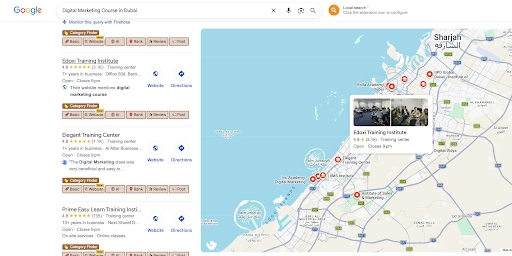
Screenshot of Google Maps showing search results for digital marketing course in Dubai.
Google's official guidance names three main factors.
Relevance is how closely a business matches the search. Your primary category, services and website content help establish what you offer. Choose the most accurate primary category, add secondary categories only for genuine activities, and describe services clearly.
Distance is how far the business is from the searcher, or from the location named in the query. You cannot change where people search from, so keep your location information accurate and focus on areas you genuinely serve. Each branch needs its own eligible profile for its real premises.
Prominence is how well known a business is. Google says it draws on information from across the web, such as links, articles and directories, along with review count and rating. The same Google help page also states that a business's position in web results is a factor and that SEO best practices apply, which is why website SEO supports Maps visibility.
Build prominence through reliable service, honest reviews, professional responses, legitimate local mentions and accurate listings on reputable platforms. Google does not publish the weight of each factor, and the balance can change by query and location.
Official source: Google Business Profile Help: How to improve your local ranking on Google
Local SEO in Dubai requires a location-focused strategy that considers neighbourhoods, accurate business addresses, Google Maps visibility, customer reviews, and multilingual search behaviour. With practical digital marketing training, businesses can learn to optimise their Google Business Profile, target local keywords, and improve visibility in Dubai’s competitive market.
In some Dubai areas, especially towers, malls and older neighbourhoods, a street address alone can be hard to pinpoint, and a landmark description such as "near the Co-op" is not an address Google can verify. A complete Dubai address can include the building name, street, neighbourhood, unit or shop number, floor, a nearby landmark and a Makani number. Dubai's Makani system gives building entrances unique 10-digit numbers to support precise navigation. Check that the Maps pin sits on the actual premises or entrance.
Makani helps customers find you; it is not a confirmed Google ranking factor. See Dubai Municipality: Open Data for Makani.
Google requires your profile to use your real-world business name, as it appears consistently on your signage, website and stationery. In Dubai, your trade licence is useful supporting evidence of that name. If the profile, signage and documents do not match, verification can become harder, so align them before you apply.
Many Dubai searches name a neighbourhood rather than the city: dentist in JLT, gym in Business Bay, salon in JVC, café in Dubai Marina, clinic in Al Nahda. Use these terms naturally where they describe your real location and services. A genuine Business Bay branch can have its own page with services, directions and contact details. Do not create pages for neighbourhoods where you have no real presence.
Businesses serving multilingual audiences can offer key information in both English and Arabic: service pages, directions, FAQs and support. Keep translations natural, and do not add an unofficial translated business name to your profile to target Arabic searches.
Businesses in shared buildings often have near-identical addresses. Provide the unit, floor and entrance directions, and add genuine photos of the storefront and signage. Each listing must meet Google's eligibility rules.
Cleaning, moving, plumbing and maintenance companies that travel to customers should hide their address and set a service area instead. A virtual office or mailing address alone does not make a business eligible for a profile, and a flexi-desk or coworking space must meet Google's rules on staffing, signage and receiving customers.
Read Google's guidelines for representing your business before creating or changing a profile.
This Google Business Profile Checklist follows Google’s official guidelines closely and is written so any business owner in Dubai can follow it step by step.
Fill in every important field accurately:
Upload real photos of:
Avoid stock images. Photos help customers decide and improve engagement.
Once a month, check and update:
Fix anything that could stop a customer from contacting or finding you.
|
Quick Tip for Dubai Businesses Keep your Name, Address, and Phone (NAP) consistent across your website, social media, and other directories. Inconsistent information is a common reason profiles get flagged. |
Reviews shape customer choice, and Google names review count and rating among the signals behind prominence. The aim is a steady flow of genuine feedback, not an inflated score.
Google's Maps prohibited and restricted content policy sets out four kinds of practice to avoid:
Incentives: offering money, discounts, gifts or other rewards for reviews, or buying reviews.
Selective solicitation: asking only customers likely to be happy, or discouraging negative reviews.
Pressure: requiring or pressuring customers to rate or review while they are on the premises.
Scripted or quota-driven requests: asking customers to include specific content, asking staff to collect a set number of reviews, or asking staff to gather reviews that name a particular staff member.
What works instead: ask every customer for honest feedback with a review link or QR code, reply professionally without disclosing confidential customer or patient details, and report only reviews that genuinely break the policy, not reviews that are simply negative.
A sudden rise in review volume is not a violation in itself. Check the policy page before you change your review process, because Google updates it.
The Business Profile links to the website, and Google uses the site to understand relevance and prominence. Five website basics support local SEO:
Yes, as supporting signals. Google says prominence draws on information from links, articles and directories across the web. List the business with identical details on reputable UAE business directories and industry platforms, Bing Places and Apple Business Connect, since some customers use Apple Maps or Bing. Local press coverage, partnerships and sponsorships build prominence too.
Relevant directories help customers find and verify your business, and Google lists directories among the information it uses for prominence. Prioritise reputable UAE directories, industry-specific listings, Bing Places, Apple Business Connect and professional associations. Correct inaccurate listings first, and skip bulk submissions to low-quality sites.
Google's AI Overviews and AI Mode may use a technique Google calls query fan-out, running related searches across subtopics to build an answer. Google says the same SEO fundamentals apply and there are no extra technical requirements for these features.
For a local business, that means pages Google can crawl and index, accurate business information, clear service and location pages, and structured data that matches what the page shows. There is no special AI shortcut, and nothing guarantees inclusion in AI answers. See Google's guidance on AI features and your website.
Measure results in separate layers. Never mix them. Always look at the numbers in context (Ramadan, summer, school holidays, opening hours changes, or other marketing activity can all move the figures).
| Layer | What to Measure | Where to Find It |
| 1. Search Visibility | Impressions, search queries, and clicks to your website (especially location pages) |
Google Search Console
|
| 2. Profile Discovery | How often people search for and view your Business Profile |
Google Business Profile → Performance
|
| 3. Profile Engagement | Call-button clicks, website clicks, and direction requests |
Google Business Profile → Performance
|
| 4. Website Behaviour | Sessions, engagement, and conversions that come from your profile |
Google Analytics 4 (GA4). Add UTM parameters to the website link in your Business Profile so you can see these visits clearly
|
| 5. Business Outcomes | Qualified enquiries, completed bookings, and revenue you can attribute |
Your CRM or booking system
|
Use this blank template. Fill it with real numbers from your accounts. Never present example figures as real results.
For each metric, record:
Metrics to include every month:
A good report always answers three questions:
What changed?
What is the evidence?
What will we do next?
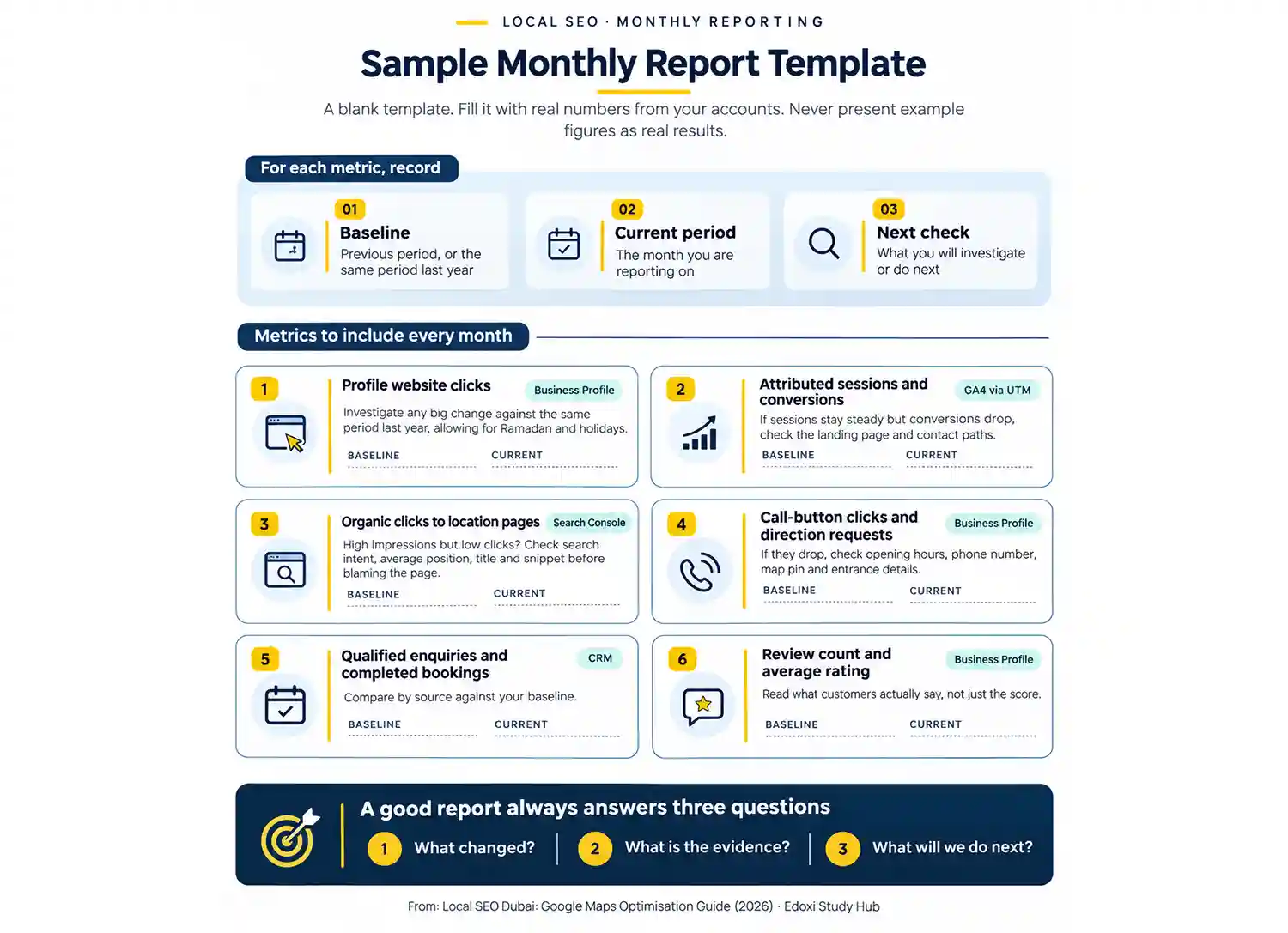
Local SEO monthly report template: six metrics to track with baseline, current period and next action for each.
A local SEO audit of a real Dubai business is one of the most practical portfolio pieces a student can build. Choose a small business, such as a café, salon or clinic, and document:
Search check. Search five relevant queries (for example, "café in Al Quoz") from near the business and note where it appears on Google Maps.
Profile review. Check the name, categories, hours, photos, description, attributes and pin accuracy against the guidance above.
Review analysis. Count reviews, average rating and response rate, and compare with the top three competitors.
Website check. NAP consistency, location page, LocalBusiness schema and mobile speed.
Recommendations. A prioritised list of ten fixes, with the reason for each.
Present it as a short report with screenshots. Label it clearly as an audit and recommendations, not results you achieved, unless the business owner actually implemented your changes. If you are new to the field, our guide on how to become a digital marketer in Dubai without experience explains how projects like this fit into a portfolio.
If you complete the audit project above, you should be able to show four things: that you can research local search intent, audit a profile and website against Google's guidelines, read Search Console, Business Profile and GA4 data correctly, and turn evidence into prioritised recommendations. You can build these skills on your own using the official sources in this guide.
If you prefer structured training, Edoxi's Digital Marketing Course in Dubai is a 40-hour, 8-module programme that covers local SEO, Google Search Console, GA4 and reporting, and ends with a campaign project for a real business.
For a shorter, SEO-only option, Edoxi's SEO Course in Dubai runs for 15 hours across 4 modules, including local SEO, Google Maps and local business listings, Google Analytics and Search Console, and tracking and reporting.