Request a Callback

+971 4380 1666
 Oct 20, 2026
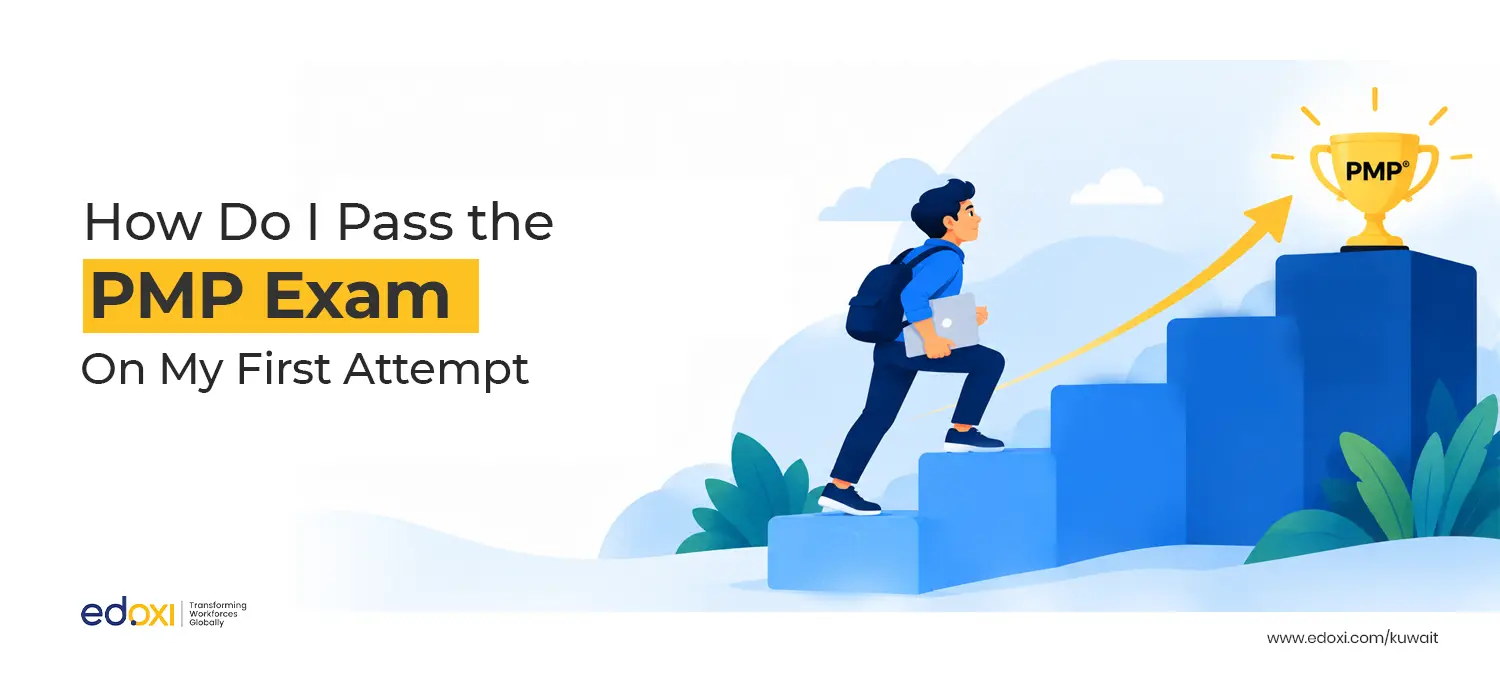
To pass the PMP exam on your first attempt, understand the exam structure, study every week, and practise scenario-based questions daily. Review every wrong answer, then take full-length mock exams under timed conditions.
Good habits beat long cramming. Steady weeks, honest review, and timed mocks build the calm you need on exam day.
Pilots do not learn to fly by reading about planes. They sit in a simulator, make mistakes, and fix them before the real flight.
The PMP exam works the same way. Many people read the guide twice and still struggle, because the test asks what you would do, not what you remember.
To pass the PMP exam on your first attempt, you need a plan that trains your decisions. This blog gives you one. It uses the 2026 exam format, simple steps, and real examples, with Kuwait in mind.
Table of Contents
| Nos | Contents |
|---|---|
| 1 | What Does It Take to Pass the PMP Exam on the First Attempt? |
| 2 |
Why Is the PMP Exam Difficult?
a) What Does a Situational Question Look Like?
|
| 3 |
What Is the PMP Exam Structure in 2026?
a) Which PMBOK Principles and Performance Domains Should I Learn?
|
| 4 |
What Should I Study for the PMP Exam?
a) Am I Eligible to Take the PMP Exam?
b) How Do Agile, Predictive, and Hybrid Approaches Show Up on the Exam?
|
| 5 |
How Do I Build a Realistic PMP Study Schedule?
a) What Should I Do in the First 30 Days?
b) What Should I Do in Days 31 to 60?
c) What Should I Do in Days 61 to 90?
|
| 6 | How Many Hours Should I Study for the PMP Exam? |
| 7 |
How Do I Practise PMP-Style Questions?
a) How Should I Analyse Incorrect Answers?
b) How Do Full-Length Mock Exams Help?
|
| 8 | What Score Do I Need to Pass the PMP Exam? |
| 9 | How Do I Prepare for PMP Exam Day? |
| 10 |
What Are the Most Common PMP Preparation Mistakes?
a) What Is the PMP First-Attempt Checklist?
|
| 11 | Key Takeaways |
| 12 | FAQs: How Do I Pass the PMP Exam on My First Attempt |
To pass the PMP exam on the first attempt, know the format, study on a fixed schedule, practise scenario questions, learn from every mistake, and finish with timed mocks.
PMP stands for Project Management Professional. It is a credential from the Project Management Institute (PMI). If the basics are new to you, this guide will explain what PMP certification is and who should pursue it.
The timing is right. PMI's Global Project Management Talent Gap report says demand for project talent could grow by 64% between 2025 and 2035. It also warns of a possible shortfall of up to 29.8 million project professionals worldwide.
Kuwait feels this too. Abdulaziz Al-Rabbah, Chairman of the Kuwaiti Association for Project Management, has said many companies in Kuwait lack enough experience in managing the projects they win.
He called for professional project practices (reported by Arab Times, citing Al-Jarida). The PMP exists to teach exactly those practices.
Most questions describe a situation, and more than one answer looks right. You must pick the best one.
You cannot memorise your way through this exam. Questions test judgement. The 2026 update also added case-based and graphic questions, so you read more and think more.
Our look at how difficult the PMP exam is shares what trips people up most.
A situational question is a short project story followed by four possible actions. You choose the best next step.
Here are two original examples.
Example 1. A sponsor asks you to add a feature halfway through the project. The team says the schedule will slip by two weeks. What do you do first?
A) Add it and ask the team to work overtime
B) Refuse the request
C) Assess the impact and take it through change control
D) Ask the sponsor for more budget
Answer: (C) Never accept or reject a change before you understand its impact.
Example 2. Two team members argue about who owns a task, and work is slowing. What do you do?
A) Report both to HR
B) Decide the owner yourself
C) Bring them together and help them agree
D) Wait and see
Answer: (C) Resolve conflict early and openly. Escalate only if that fails.
The 2026 PMP exam has 180 questions in 240 minutes. Of these, 170 are scored, and 10 are unscored pretest questions. Three domains share the content.
The updated exam launched on 9 July 2026 and follows PMI's new Examination Content Outline. Here is how the content splits.
PMP Exam Domains, Weightage and Key Areas
| Domain | Weight | What it covers |
|---|---|---|
| People | 33% | Leading teams, conflict, stakeholders, communication |
| Process | 41% | Scope, schedule, budget, quality, risk |
| Business Environment | 26% | Strategy, governance, compliance, change, benefits |
Notice the last row. Business Environment grew sharply from 8% in the old outline. Older study material may under-teach it, so check your resources against PMI's current outline.
The PMP exam syllabus guide shows how each area plays out across industries
Learn the three domains first. Then learn the PMBOK principles behind them: delivering value, engaging stakeholders, and tailoring your approach.
The exam is aligned with the PMBOK Guide 8th Edition, but the guide is a reference, not a question bank. Use PMI's outline as your map. Strong project management skills such as planning, communication, and risk handling make every domain easier.
Kuwait-focused research points the same way.
Faisal Alshammari et al. 2020, reviewing complex construction projects in Kuwait, recommended stronger teamwork, communication, resource management, planning, and risk management skills (ResearchGate)
Those map closely to the People and Process domains.
For the PMP exam, study the three domains, and learn Agile, predictive, and hybrid approaches inside each one.
To be eligible for the PMP exam, you need project leadership experience plus 35 hours of project management education. An active CAPM can replace the 35 hours.
The required months of experience depend on your education level, so check PMI's current rules before you apply. Still deciding if PMP fits your career? These reasons why project management is a top career choice can help.
Predictive plans everything upfront. Agile delivers in short cycles. Hybrid mixes both. The exam asks you to choose what fits the situation.
Predictive vs Agile vs Hybrid Project Management Approaches
| Approach | Best when | Example |
|---|---|---|
| Predictive | Requirements are fixed | Building a road |
| Agile | Requirements keep changing | Developing an app |
| Hybrid | Part fixed, part flexible | A hospital system with fixed hardware and evolving software |
Do not treat Agile as a side topic. Many questions never name the approach, so you must spot it from clues. Tools matter less than thinking, but knowing project management tools like boards and schedulers helps you picture the scenarios.
To build a realistic PMP study schedule, work in three 30-day blocks: learn, practise, then test. Study at the same times each week.
If you want structured support, PMP certification training in Kuwait also covers the 35 contact hours PMI requires, unless you hold an active CAPM.
Kuwait's national plan points the same way: Mohamed Al-Muzaini of the Public Authority for Manpower has explained that New Kuwait 2035 includes specialised training programmes for private-sector roles (reported by Kuwait Times).
| Phase | Main goal | Daily focus |
|---|---|---|
| Days 1-30 | Learn | Outline, 35-hour course, short notes |
| Days 31-60 | Practise | Scenario questions, error log |
| Days 61-90 | Test | Weekly full mocks, weak areas |
For the first 30 days, learn the outline, finish your 35-hour course, and build your core knowledge.
From day 31 to 60, practise questions by topic and start an error log. Also follow the steps given below:
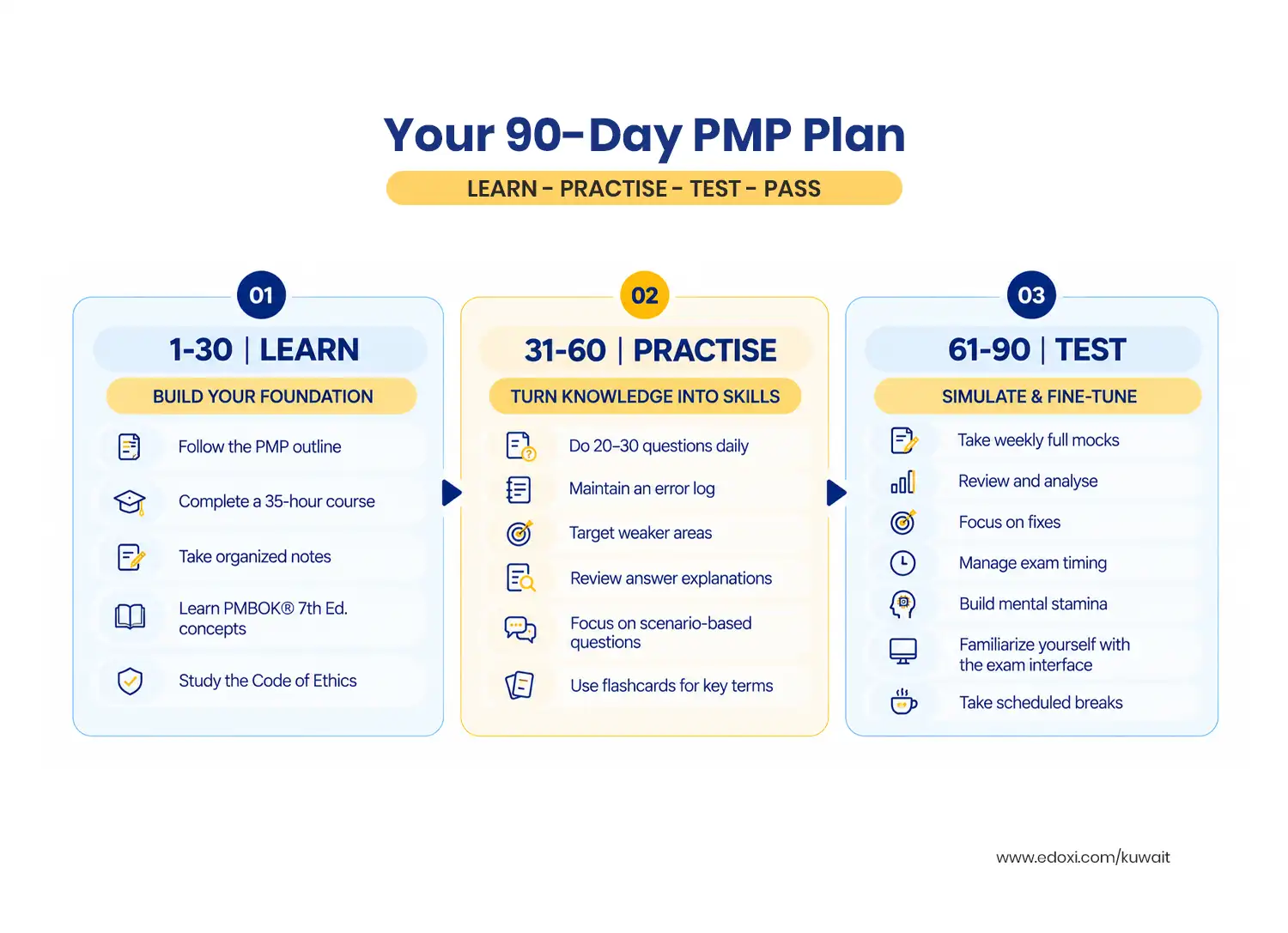
From days 61 to 90, sit full mocks, fix weak areas, and rest before the exam.
The complete 90-day PMP plan for passing the exam on the first attempt is given in the infographics below:
PMI sets no official study hours. A 100- to 120-hour plan, or 8 to 10 hours a week for about 12 weeks, is a useful starting point. Adjust it for your experience.
The right number depends on your experience, current knowledge, and mock results. These are planning estimates, not PMI rules.
PMP Study Time by Experience Level and Weekly Commitment
| Your situation | Hours per week | Likely duration |
|---|---|---|
| Experienced PM, used Agile | 6-8 | 8-10 weeks |
| Some project experience | 8-10 | About 12 weeks |
| New to formal project management | 10-12 | 14-16 weeks |
Hold CAPM already? You may skip the 35-hour education requirement. This list of top project management certifications shows how CAPM and others fit together.
Practise daily, in small sets, with a timer. Always read the explanation, even when you were right.
PMI sets no required number of practice questions. For planning, you could work toward 800 to 1,000 quality questions across all three domains, plus several full mocks. Quality beats quantity.
Fifty reviewed questions teach more than 200 rushed ones.
Use only questions written for the 2026 outline. Guided PMP exam preparation in Kuwait can help if you want expert feedback on your reasoning.
For each miss, name the cause: knowledge gap, misread question, or rushed guess. Then fix that cause.
Keep a simple log with four columns: topic, why you missed it, the rule you learned, and the date you retested it. Patterns appear fast. Maybe you always miss stakeholder questions. Maybe you ignore the words "first" and "best".
Full-length mock exams build stamina and pacing. At 240 minutes for 180 questions, you have roughly 80 seconds per question.
Take at least three or four mocks. Sit them in one block with no phone and no pauses. Flag hard questions and move on. Review every result within 24 hours.
PMI does not publish a numeric passing score. Your report shows one rating per domain: Above Target, Target, Below Target, or Needs Improvement.
You may have seen "61%" quoted. That is an old figure, and PMI stopped publishing pass rates because they were not a reliable measure of the exam. Do not chase one magic percentage.
Aim for steady, strong mock results in all three domains. Treat mock percentages as practice signals, not PMI scores.
Sleep well, check your ID and test setup, and read each question slowly. Flag hard ones and keep moving.
Studying with outdated material, reading without practising, skipping Agile, and booking the exam too early.
Tick these eight items, and you are ready for the first attempt.
☑ I know the 180-question, 240-minute format
☑ I have completed my 35 contact hours
☑ I study on fixed days each week
☑ I practise scenario questions daily
☑ I keep an error log
☑ I have scored well on three or more mocks
☑ I have studied Agile, predictive, and hybrid
☑ My exam day plan is ready
A clear plan and expert feedback make a first-attempt pass far more realistic. Explore Edoxi’s PMP certification course in Kuwait and map out your next 90 days.
Remember the core idea. If you want to pass the PMP exam on your first attempt, practise decisions, not just definitions. No course can guarantee a result, but a steady plan puts you in the best position.
Yes, PMP certification can still be worth it in 2026 for professionals who want to strengthen their project management knowledge, demonstrate recognized skills, and pursue project management roles. Its value depends on your experience, career goals, industry, and the demand for certified professionals in your target job market.
Yes, the PMP exam can be challenging because it tests practical decision-making, situational judgment, leadership, risk management, and project delivery approaches. Candidates need to understand how to apply project management concepts rather than simply memorize definitions.
Yes, passing the PMP exam in two weeks may be possible for experienced candidates who can study intensively, but it is an ambitious timeline. Your chances depend on your existing knowledge, daily study hours, mock exam performance, and familiarity with the exam format.
Yes, three months is a realistic PMP preparation timeline for many candidates. A structured plan can include reviewing the exam syllabus, studying project management concepts, practicing situational questions, taking full-length mock exams, and revising weak areas.
The best way to pass the PMP exam is to combine structured study, situational question practice, mock exams, and regular revision. Understand the exam content outline, learn how to approach scenario-based questions, review incorrect answers, and assess your readiness before scheduling the exam
A practical preparation plan should include:
PMI does not publish a fixed universal passing percentage for the PMP exam. Candidates are assessed based on their exam performance, so focus on understanding project management concepts and practicing realistic exam questions.
PMP exam dates in 2026 depend on appointment availability. After your application is approved, you can check available dates and book your exam through Pearson VUE
A practice score of 70–80% or higher on realistic mock exams is a useful preparation target, but it does not guarantee passing. Focus on consistent scores, understanding mistakes, and improving weak areas
PMI does not publish an official current worldwide PMP exam pass rate. Your preparation, project management knowledge, situational question practice, and mock exam performance are more useful indicators of readiness
The PMP test is challenging because it assesses practical decision-making, leadership, risk management, stakeholder engagement, and project delivery. Candidates must apply concepts to real-world scenarios rather than rely only on memorization
The PMP exam is generally considered moderately to highly challenging. Its difficulty depends on your project management experience, understanding of predictive and agile approaches, and ability to answer situational questions
Yes. Practice situational questions, understand why each answer is correct or incorrect, eliminate unsuitable options, and learn how to identify the best action a project manager should take first or next. Regular timed mock exams can improve your readiness
PMP certification validates project management knowledge, strengthens professional credibility, and may improve career opportunities. It can benefit professionals pursuing project manager, programme manager, project coordinator, and other project leadership roles. However, certification does not guarantee a job or salary increase
PMP eligibility depends on education, project management experience, and qualifying training. PMI's established pathways include:
Associate degree or qualifying vocational qualification: 48 months of experience.
Bachelor's degree or higher: 36 months of experience.
Degree from a PMI GAC-accredited programme: 24 months of experience.
Candidates generally need 35 hours of project management education or an accepted exemption, such as an active CAPM certification. Check the official PMI eligibility requirements for the latest rules applicable in 2026.
You can prepare for PMP certification in Kuwait through professional training institutes offering structured exam preparation, instructor-led classes, and mock exams. Edoxi Training Institute in Kuwait City provides professional training programmes, including project management training. Visit the Edoxi Kuwait website to enquire about PMP training schedules, course content, and eligibility requirements.
To find an authorized PMP exam centre in Kuwait, use the official Pearson VUE PMI page to check available locations and appointments after your application is approved. Confirm the exact centre address and exam date before travelling. Online proctored testing may also be available, subject to current PMI requirements