Request a Callback

+971 4380 1666
 Oct 20, 2026
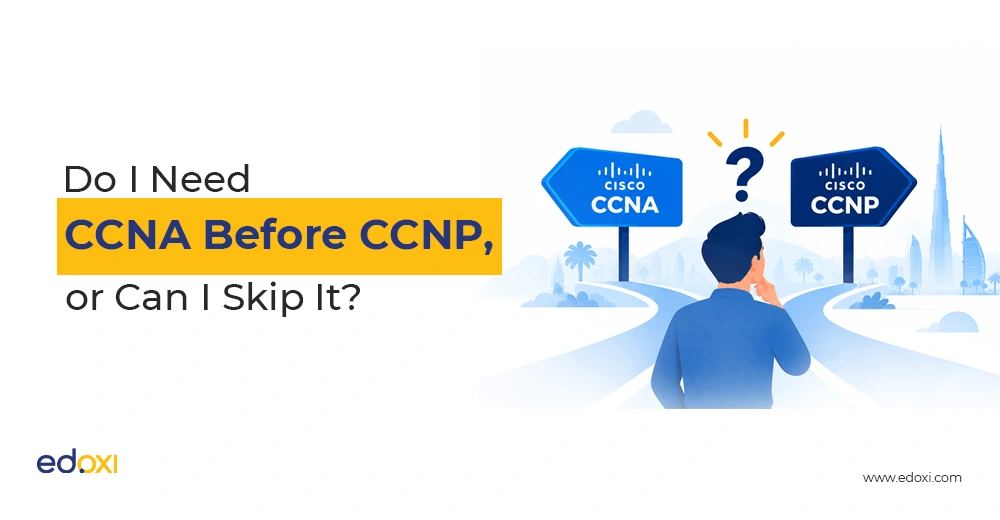
No, you do not need CCNA certification before CCNP. Cisco has no formal prerequisite requiring CCNA for CCNP Enterprise, so you can pursue the professional-level certification directly.
However, you should understand networking fundamentals, subnetting, VLANs, routing, and troubleshooting before starting CCNP preparation. If these skills are new to you, studying CCNA-level material first is the better path.
You can skip the CCNA certificate. You should not skip CCNA-level skills.
Imagine two people at the same desk. One has spent a year on CCNA labs. The other has fixed office networks for years but never took a Cisco exam. Both want CCNP. Who should start where? That is the heart of the CCNA vs CCNP question.
The rules say anyone can sit the exams. The real answer depends on what you can already do.
Networks matter more every year. In Cisco's 2025 global networking research, 91% of IT leaders said they plan to raise the share of their IT budget that goes to networking. So the choice of path matters wherever you work.
This blog explains whether you need CCNA before CCNP Enterprise, what Cisco's official requirements say, and how to choose the right starting point based on your current skills.
|
Table of Contents
|
|
1. Can You Skip CCNA and Go Straight to CCNP?
1.1. Is CCNA a Prerequisite for CCNP Enterprise? 2. What Is the Latest CCNA Exam, and What Does It Cover? 3. What Are the CCNP Certification Requirements? 4. CCNA vs CCNP: Which Certification Should You Choose? 4.1. How Difficult Is CCNP Compared with CCNA? 4.2. CCNA vs CCNP Career Opportunities: Which Opens More Doors? 5. Can Beginners Take CCNP Directly? 5.1. Is CCNP Suitable for Beginners? 5.2. Should I Skip CCNA? 6. What Skills Do You Need Before CCNP? 7. How to Prepare for CCNP Without CCNA Certification? 8. Which Cisco Certification Should You Take First? 9. Key Takeaways 10. FAQs: Do I Need CCNA Before CCNP, or Can I Skip It? |
Yes. Cisco does not require CCNA before CCNP.
Cisco removed prerequisites when it overhauled its certifications. Its learning team said it had "removed prerequisites, streamlined our training and certification paths" in the 2019 announcement. The change rolled out in 2020.
So the booking system will not ask for a CCNA. The exam will test your skills, though. Many learners still start with CCNA training because CCNP assumes you already know those basics.
No. Cisco's CCNP Enterprise exams each list "None" under prerequisites.
Other CCNP tracks, such as Security, have their own pages. Check the official page for your track before you plan.
“Being certified didn’t get me the job, but becoming certified did.”
- Hank Preston, Networking professional and CCNA, CCNP, and CCIE certification holder
The CCNA is one exam, 200-301, lasting 120 minutes. It has no concentration options. Its topic list changes on 3 February 2027.
Cisco says the last day to test on v1.1 is 2 February 2027. Use these topics as your skills checklist before you decide to skip.
For CCNP Enterprise, pass two exams: one core exam and one concentration exam of your choice.
Cisco's CCNP Enterprise page sets out the CCNP Enterprise requirements:
Cisco updates this list, so check the page before you book. Notice what is missing. No line says "hold CCNA first." To see what the entry level covers, read this guide on CCNA certification.
CCNA proves networking foundations. CCNP Enterprise proves deeper, more specialised enterprise skills. Choose by the skills you have today.
CCNA vs CCNP Enterprise: Key Differences at a Glance
| Feature | CCNA |
CCNP Enterprise
|
| Level | Associate | Professional |
| Exams | One (200-301) |
Two (core + concentration)
|
| Focus | Networking basics, IP services, security, automation |
Enterprise infrastructure, assurance, security, automation, plus one chosen specialty
|
| Formal prerequisites | None | None |
| Suited to | People building a networking base |
People already working with enterprise networks
|
Think of learning to drive, then learning to drive a truck through a busy city.
CCNP is harder. It goes deeper and covers more specialised topics.
It also requires you to pass two exams. The benefits of CCNA show up here. It eases you into the same topic areas at a gentler pace.
The career opportunities depend on your experience and the roles in your market.
CCNA shows you have the foundation. CCNP Enterprise shows greater skills in a chosen area. Roles and pay vary by employer and country, so read job listings where you plan to work.
Certification also shows up in employer surveys. Pearson VUE's 2026 Value of IT Certification Employer Report, published in April 2026, surveyed 505 IT and HR leaders in seven countries.
It found that 78% chose professional certification as their leading upskilling investment. It also found that 93% reported a positive return on investment from certified IT employees.
The report covers IT certification in general, not Cisco alone.
“They help me to stand up with confidence and authority.”
- Micheline Murphy, Network professional with CCNA and CCNP Certifications
You can book the exam. Booking is not the same as being ready to pass it.
CCNP exams assume you already understand how traffic moves across a network and why a VLAN exists. A beginner who skips those basics will spend most of their study time catching up.
A structured CCNA course is one way to build that base first.
Not as a first step. CCNP suits people who already work with networks or have solid lab practice.
Without that, the topics pile up fast. It does not mean you can never get there. It means the road has one more stop.
Skip it only if you can do the things below. Skills matter more than years of experience.
You are ready to skip CCNA if you can:
Subnet an IPv4 network by hand
Configure VLANs and trunks
Explain how OSPF picks a path
Write and test ACLs
Troubleshoot a network fault step by step
If several of these feel shaky, review CCNA topics first.
You need CCNA-level knowledge: TCP/IP, the OSI model, IPv4 and IPv6, subnetting, VLANs, STP, OSPF, ACLs, and troubleshooting.
These basics carry real weight. In the same Cisco study, 97% of respondents said a modernised network is critical to rolling out AI, IoT, and cloud. Those networks still run on subnetting, switching, and routing.
CCNP Enterprise then goes deeper into virtualisation, network assurance, security, and automation. If you are still weighing a networking path, this piece on whether a CCNA career is the right choice helps.
Find your gaps, fix CCNA-level topics, practise in labs, then study the ENCOR blueprint.
Test yourself: Try a CCNA practice test and note weak spots.
Close the gaps: Some learners need a few weeks, others a few months. Let your practice results decide.
Build labs: Use Cisco Packet Tracer or a virtual lab every week.
Study ENCOR: Follow Cisco's published exam topics.
Pick a concentration: Choose the one closest to your work.
If step two drags, a CCNA certification training batch gives you a trainer who can spot weak points early.
Start with the level that matches your demonstrated skills, not your job title.
CCNA vs CCNP: Which Path Should You Choose?
| Your Networking Experience |
Suggested first step
|
| New to networking |
CCNA-level fundamentals first
|
| Some exposure, but shaky on subnetting, VLANs, or OSPF |
Review CCNA topics, then CCNP
|
| Work on enterprise networks and pass the skills checklist |
CCNP Enterprise, starting with ENCOR
|
| CCNA holder |
Move to CCNP when you can apply concepts in labs and troubleshooting
|
Plan for the long run too. The World Economic Forum's Future of Jobs Report 2025 expects 39% of workers' existing skills to change or become outdated between 2025 and 2030.
It also says 59 of every 100 workers will need training by 2030. Moving from CCNA-level skills to CCNP-level skills is one way to keep learning in step.