

Request a Callback

+971 4380 1666
 Nov 06, 2026
The best upskilling strategies for Kuwait organizations include conducting a skills gap analysis, aligning training with business goals, prioritising AI and data skills, and combining structured courses with on-the-job practice.
Track progress using clear KPIs and review the training plan every six months.
You can buy a new laptop for your team by Thursday. You cannot buy a new skill by Thursday. Skills grow slowly, and they grow best with a plan.
That is why upskilling strategies for Kuwait organizations matter now. Kuwait is investing in AI, cloud, and cybersecurity. Companies that train their people will use these tools well. The rest will own tools nobody knows how to use.
This blog is a short and practical guide to upskilling strategies for Kuwait organizations. Use it as a checklist.
| Nos | Contents |
|---|---|
| 1 |
What Are the Best Upskilling Strategies for Kuwait Organizations?
a) How Does Upskilling Differ from Reskilling?
b) Why Is Employee Upskilling Important for Kuwait Businesses?
|
| 2 |
How Can Kuwait Organizations Identify Employee Skill Gaps?
a) Which Skills Should Organizations Assess First?
b) How Can Performance Reviews Reveal Training Needs?
|
| 3 |
Which Skills Should Kuwait Organizations Prioritise in 2026?
a) Why Are AI and Data Analytics Skills Important?
b) Which Leadership and Management Skills Do Employees Need?
c) How Can Employees Improve Project Management and Technical Skills?
|
| 4 |
How Can Companies Build an Effective Employee Upskilling Plan?
a) How Can HR Teams Align Training with Business Goals?
i) How Should Organizations Choose Training Methods?
ii) How Can Companies Balance Training with Daily Work?
|
| 5 |
Which Corporate Training Methods Work Best for Kuwait Businesses?
a) Is Instructor-Led Training Better Than Online Learning?
b) When Should Organizations Choose Customised Corporate Training?
c) How Can Mentoring and On-the-Job Training Improve Skills?
|
| 6 |
How Can Upskilling Support Kuwait Vision 2035?
a) How Can Digital Skills Support Kuwait’s Economic Diversification?
b) How Can Organizations Prepare Employees for AI-Driven Workplaces?
c) How Can Organizations Measure Employee Training ROI?
i) Which KPIs Measure Upskilling Success?
ii) How Can Businesses Track Productivity and Skill Improvement?
|
| 7 | How Can Kuwait Companies Overcome Common Upskilling Challenges? |
| 8 |
a) How Can Companies Manage Training Budgets and Employee Time?
i) How Can Organizations Encourage Employees to Apply New Skills?
|
| 9 |
How Can Kuwait Organizations Choose the Right Corporate Training Partner?
a) What Should Companies Check Before Selecting a Training Provider?
b) Why Do Industry-Relevant Training and Practical Projects Matter?
|
| 10 | Key Takeaways |
| 11 | FAQs: Upskilling Strategies for Kuwait Organizations |
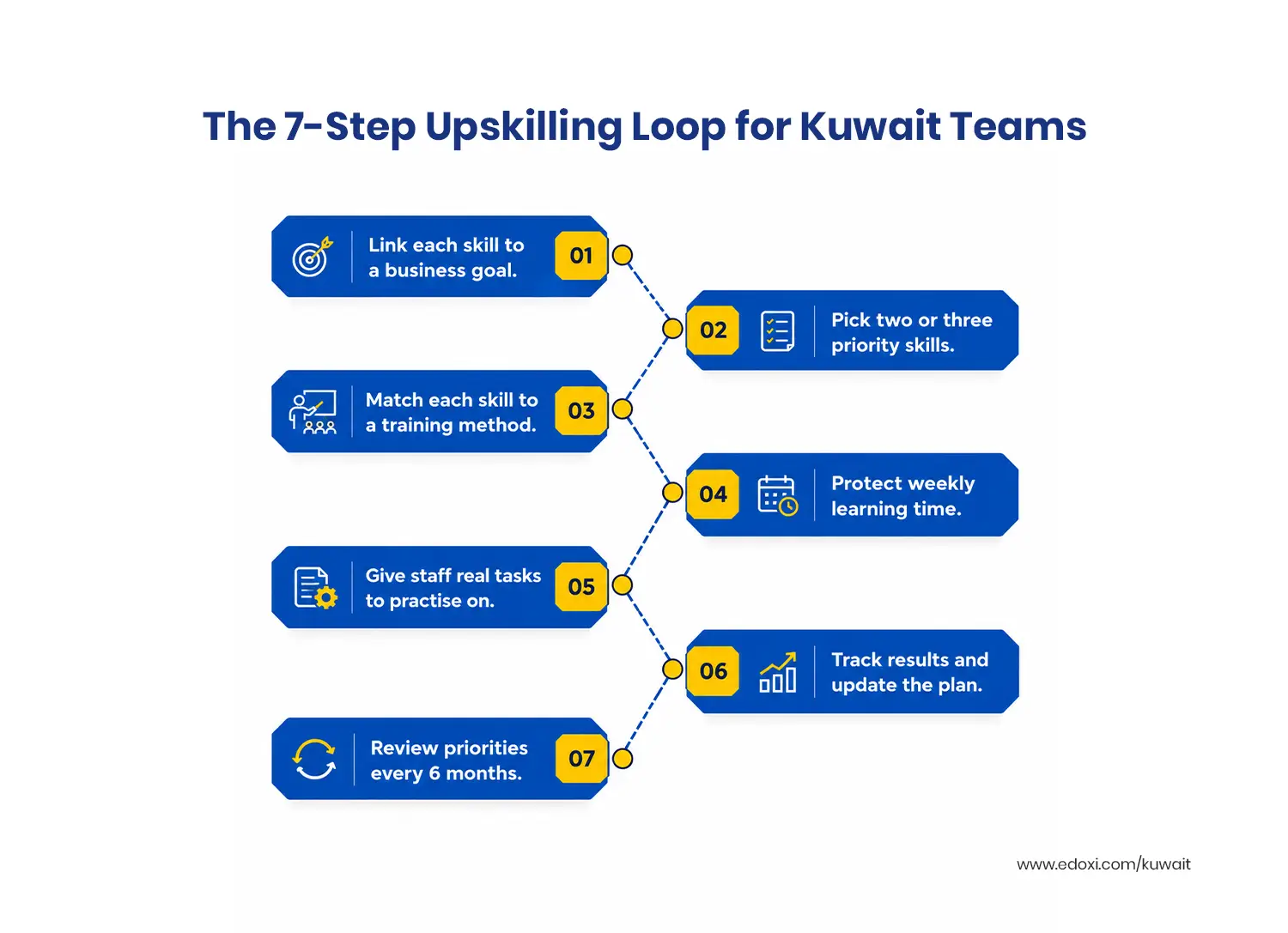
The best upskilling strategy for Kuwait organizations is a repeatable loop. We call it the Kuwait Workforce Upskilling Loop: diagnose the gap, tie skills to results, train by role, apply the learning, then measure and review.
The Kuwait workforce upskilling loop follows these 7 steps below:
Diagnose the skills gap.
Map skills to business outcomes.
Prioritise high-impact capabilities.
Deliver role-based training.
Apply learning to live work.
Measure performance at 30 and 90 days.
Review priorities every six months.
Skip one step and the plan leaks.
Here is a representation of the 7-Step Kuwait workforce upskilling loop in the following infographics.
Upskilling improves skills a person already uses. Reskilling teaches skills for a different job. A finance officer learning Power BI is upskilling.
A store clerk moving into IT support is reskilling. Most teams need more of the first. This guide to upskilling and reskilling has more examples.
Employee upskilling is important for Kuwait businesses because skills decide how well a company uses new tools and keeps good people.
In PwC’s 2025 Middle East Workforce Hopes and Fears Survey, 69% of Middle East employees had learned new skills in the previous 12 months, compared with 56% globally.
This highlights the growing importance of continuous learning and workforce development.
That is worker opinion, not a measured employer gap, but it points the same way. The benefits of upskilling include faster work and stronger loyalty.
Omar Al-Omar, Kuwait’s Minister of State for Communications Affairs, said at the September 2025 launch of the second Digital Skills Development Initiative: “Investing in human capital is a sustainable and renewable investment.”
Kuwait organizations can identify employee skill gaps by comparing the skills each role needs with the skills your people have today. That comparison is an employee skill gap analysis.
Run the employee skill gap analysis in four steps:
List the five to eight skills each key role needs.
Rate each person with a manager score, a self-score, and a short practical test.
Compare the scores with the role standard.
Rank the gaps by business impact, not by headcount.
For assessment, organizations should start with skills tied to their biggest goals. For most teams, that means digital tools, technical know-how, leadership, and communication.
Ask each manager to name the three tasks that slow the team down, then trace each task to a skill. This list of skills employers want in Kuwait makes a handy checklist.
Look for patterns to see how performance reviews reveal training needs. One weak review is a conversation. The same weakness in six reviews is a training need.
Tag review comments by skill, count them, then confirm the top gaps with a short practical test.
Put AI and data skills first, then leadership, project management and cybersecurity. These support digital transformation across Kuwait’s public and private sectors.
| Skill | Who needs it | Example by sector |
|---|---|---|
| AI and data analytics | Finance, HR, operations | Finance: faster monthly reports. Operations: AI-assisted admin tasks |
| Cybersecurity and cloud | IT teams; basics for all staff | IT: secure cloud files. All staff: spot phishing emails |
| Leadership | Team leads, supervisors | Construction: site supervisors coach crews and give clear feedback |
| Project management | Engineering, construction, IT | Construction: planners track delays across a building project |
They help staff work faster and decide with facts, not guesses.
The ILO’s March 2026 report, AI Adoption Shapes Productivity in Kuwait, produced with KCCI, found that 65% of large firms had AI training programmes, compared with just 29% of SMEs.
In PwC’s February 2026 Kuwait viewpoint, PwC adds that AI could add up to 8.3% to Middle East GDP over a decade, but only if capability keeps pace.
Team leaders need coaching, feedback, and change management. A new tool without manager support is easy to ignore.
Train supervisors first, so they can guide everyone else.
Pair a short course with a live project. Someone learns Power BI faster when the dashboard is for their own team.
Pick courses that match real work, which is why industry-relevant skills matter in Kuwait’s job market.
An effective employee upskilling plan in Kuwait needs a business goal, the skills behind it, methods, a timeline, an owner, and KPIs. Keep it to one page.
The loop above is the method. This 90-day roadmap is the schedule.
|
Days |
Action | Expected output |
|---|---|---|
| 1-15 | Assess skills and set business goals | Skills gap report |
| 16-30 | Select priorities and training methods | Approved training plan |
| 31-60 | Deliver training and practical assignments | Completed learning and work samples |
| 61-90 | Review performance and calculate benefits | KPI report and next-step plan |
HR teams can align training with business goals by starting from the goal, not the course. Then turn the goal into a training action with a KPI:
Many HR teams map this with providers of corporate training in Kuwait.
Haya Al-Wadani, then Director General of Kuwait’s Central Agency for Information Technology, said in 2019 that a key aim was to “develop the skills and abilities of government employees.”
Since 2019, developing the digital competency of workers has become a global priority, with employers progressively supporting the idea of training personnel.
The World Economic Forum’s Future of Jobs Report 2025 found that 85% of surveyed employers plan to prioritise workforce upskilling by 2030, highlighting the importance of continuous employee training as job skills evolve.
Match the method to the skill. Hands-on skills need practice. Knowledge skills suit online lessons. Leadership skills need coaching.
Use one method per skill at first, then add more.
Block two to three hours a week for learning and put it in the calendar. Short modules beat long workshops for busy teams.
Stagger groups so no team goes empty. Staff can also learn to balance upskilling with full-time work.
Discuss Your Team's Training Needs
A mix works best in corporate workforce training. Use classroom sessions for complex skills, online lessons for basics, and mentoring for daily practice.
| Method | Use when | Watch out for |
|---|---|---|
| Classroom | The skill is hands-on or needs group practice, such as cybersecurity labs | Scheduling and cost |
| Online | The topic is basic, and staff need a flexible pace | Low completion without deadlines |
| Hybrid | Staff need theory first, then guided practice | Needs a clear calendar |
| Customised | Your tools, data or rules are unique | Needs a clear brief and sample tasks |
| Mentoring | The skill is a daily habit, such as report writing | Mentor time |
Neither wins every time. Instructor-led training suits hands-on skills. Online learning suits basics and busy schedules.
Current corporate training trends in Kuwait lean towards a blend of both.
Choose it when your tools, rules, or data are unique, or when a whole team needs the same skill. A tailored course uses your own examples, so learning sticks.
If staff also need a recognised credential, a professional certification course in Kuwait can run alongside it.
Pair each learner with an experienced colleague. Meet weekly, set one small task, and review it together. Mentoring turns lessons into habits.
The main cost is mentor time, so count it in your plan.
Kuwait Vision 2035 aims for a more diverse, digital economy, and that needs skilled people in every sector. Company upskilling is how your workforce joins that plan.
Recent programmes show the direction.
The Central Agency for Information Technology (CAIT) and Google Cloud launched the second edition of the Digital Skills Development Initiative in September 2025, covering cloud, AI and cybersecurity (Kuwait Times).
In November 2025, CAIT and Microsoft launched Kuwait Skills, which aims to train over 30,000 employees, 4,000 technical specialists, and 350 leaders (Arab News).
Those are targets, not completed results.
Training bodies such as PAAET also feed the talent pipeline. These are national, public-sector programmes, so private firms should borrow their structure, not assume they can enrol.
Digital skills let firms offer new services, cut costs and compete beyond oil. A trained team can run digital services and protect systems at home.
An ILO report on skills needs in Kuwait surveyed 240 firms from October to December 2021. Treat it as historical baseline evidence, not current 2026 workforce data.
Google Cloud CEO Thomas Kurian said in 2023 to Gulf News that Kuwait’s Vision 2035 aims to “transform Kuwait into a digital society and diversify its economy.”
Organizations prepare employees for AI-driven workplaces by teaching the basics to everyone, then going deeper for daily AI users. Set clear rules, such as which data never goes into public tools.
Start with one daily task, like drafting reports, and grow from there.
Compare the benefit with the full cost over a set period. Financial benefits can be hours saved, fewer errors, or more sales.
Operational and people gains, such as fewer delays or lower turnover, count too. Cost includes trainer fees, staff time, and tools. Then estimate how much of the gain training caused.
The formula is: ROI % = (benefit − cost) ÷ cost × 100.
Example: training costs KWD 5,000 in fees, staff time, and tools.
Over six months, it saves KWD 8,000 in reporting hours and error fixes. ROI is 60%.
The KPIs that measure upskilling success are:
Record a baseline before training. Check again at 30 and 90 days. Ask managers to score the same three tasks each time.
Kuwait Skills uses quarterly reports for the same reason. Copy the habit, not the scale.
Kuwait companies can overcome upskilling challenges by prioritising high-impact skills, setting aside weekly learning time, using cost-effective training methods, and applying new skills to real work.
Track progress at 30 and 90 days to measure results and improve the training plan.
Most problems are budget, time, and low use of new skills.
Start small, protect learning time, and give real tasks fast.
Train fewer people on the most valuable skills first. For example, train the five finance staff who build monthly reports before the whole department.
Mix low-cost online lessons with a few paid workshops. Pilot with one team, show results, then expand.
Staff can also learn to choose the right upskilling course for their role.
Give a real task within two weeks of training. Ask managers to follow up. Celebrate small wins in team meetings.
Skills fade when nobody uses them.
Pick a partner with trainers from your field, practical projects, proof of results, and delivery in Kuwait.
Companies should check the following factors before selecting a training provider:
Score each provider from 1 to 5 on those points.
Then ask three questions.
A construction planner learns scheduling faster on a live building project than from slides.
A finance team learns Power BI faster when the first dashboard is its own monthly report.
A project on your own data proves the skill works in your setting.
Strong upskilling strategies for Kuwait organizations come down to a few habits:


