Request a Callback

+971 4380 1666
 Oct 15, 2026
Key Takeaways
|
Emiratisation is reshaping corporate training across the UAE. Every large private company now needs a clear plan to grow and develop its Emirati workforce. This shift is not a compliance box to tick. It is about building real skills inside real jobs.
UAE workforce priorities have moved fast over the past few years. Digital transformation, AI adoption and new national targets all push companies to rethink how they train staff. Upskilling and reskilling Emirati employees now sit at the centre of most corporate learning strategies.
This guide answers the question in the title directly. It explains what Emiratisation means for training, which skills matter most, and how UAE businesses can build training programmes that actually work, with a strong focus on Dubai and the wider UAE market. See what this blog contains in detail below:
| Table Of Contents |
|
1. What Is Emiratisation, And Why Does It Matter For UAE Businesses?
2. How Is Emiratisation Changing Corporate Training In The UAE? 3. Why Is Upskilling And Reskilling Emirati Talent So Important? 4. What Key Skills Are UAE Companies Building Through Corporate Training? 5. How Can Companies Align Corporate Training With Emiratisation Goals? 6. Why Does Continuous Learning Matter For Long-Term Workforce Development? 7. What Challenges Do Companies Face, And What Are The Practical Fixes? 8. How Can Corporate Training Support Long-Term Emirati Talent Development? 9. Frequently Asked Questions 10. More Questions People Ask About Emiratisation And Training |
Emiratisation is the UAE's federal policy that requires private companies to hire and develop UAE nationals in skilled roles. It matters because it ties a company's growth, its work permits and its financial contributions directly to how well it builds Emirati talent.
Emiratisation, called Tawtin in Arabic, sits at the heart of the UAE's economic vision. The Ministry of Human Resources and Emiratisation, known as MOHRE, sets and monitors the targets for every eligible company.
Companies with 50 or more employees must raise their share of Emirati staff in skilled roles by two percentage points every year. This target splits into two check-ins each year: a mid-year deadline and a year-end deadline. By the end of 2026, the cumulative target for this four-year cycle reaches 10%.
Smaller firms, with 20 to 49 staff, face a different rule. If they operate in one of 14 priority sectors, such as IT, finance, real estate, healthcare, or education, they must hire a fixed number of Emiratis rather than meet a percentage.
Missing these targets is expensive. Companies pay a monthly financial contribution for every unfilled Emirati seat. That's why Emiratisation matters so much for corporate training. Filling a seat with an untrained hire does not solve the real problem. A well-planned Corporate Training programme does.
Don’t have a clear idea about corporate training. Here is a complete guide on what corporate training is.
Emiratisation Quota Milestones For Large Companies (50+ Employees)
| Deadline In The Cycle | Cumulative Emirati Representation Target |
Monthly Penalty Per Unfilled Skilled Role
|
| Mid-Year Deadline | 8% | AED 9,000 |
| Year-End Deadline | 10% | AED 9,000 |
Figures reflect the current four-year Emiratisation cycle for companies with 50 or more employees. Always check MOHRE's official channels for the latest confirmed rates.
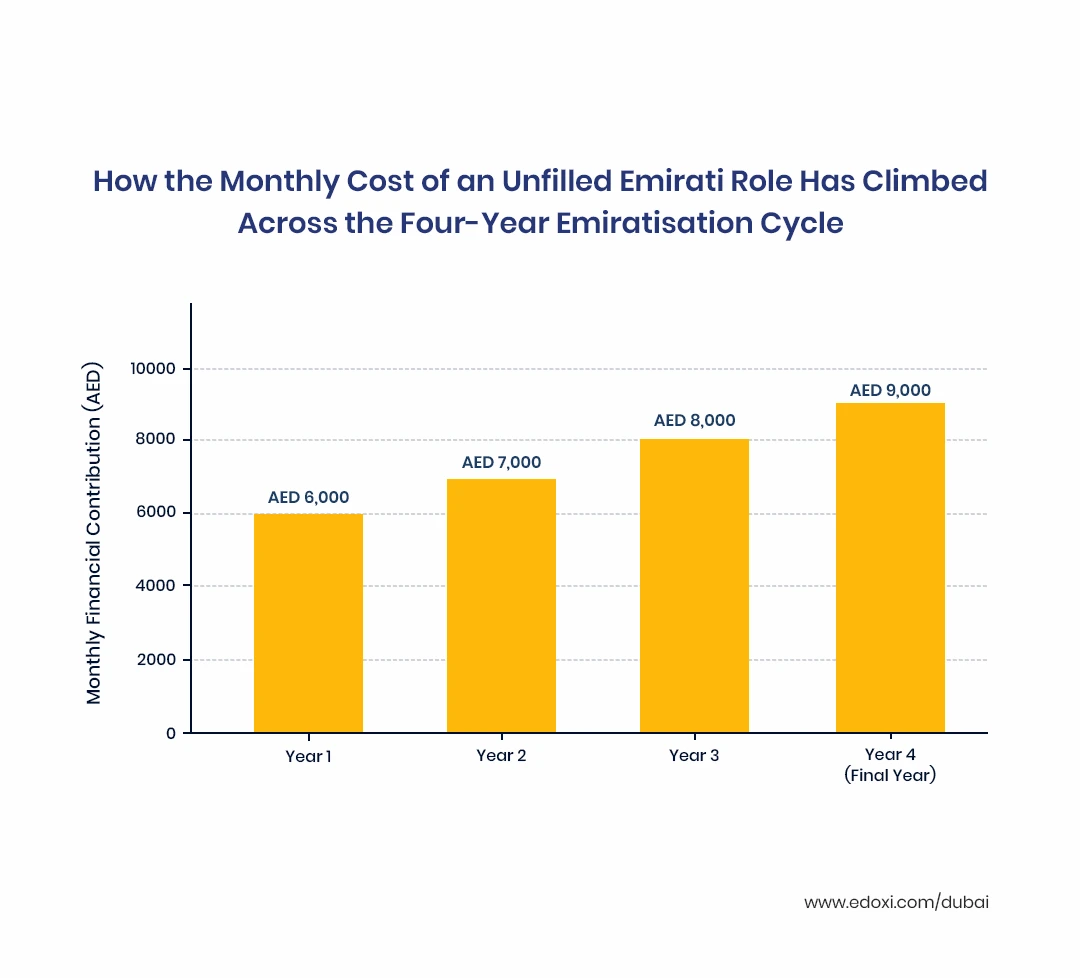
The cost of an unfilled skilled role has risen every year of the current cycle, making trained, genuine hires the far cheaper option.
Bar chart showing the monthly financial penalty per unfilled Emirati skilled role rising each year of the four-year Emiratisation cycle, from AED 6,000 in Year 1 to AED 9,000 in Year 4.
Emiratisation is pushing UAE companies to move from ad-hoc training toward structured, role-based learning that is planned, measured and tied to career growth.
Quotas force a different mindset. A company cannot simply hire an Emirati employee and hope things work out. The role must meet strict skill and salary rules, so the employee needs real, job-ready capability from day one, or very soon after.
This shift shows up clearly in the numbers. The UAE's corporate learning and development market is already valued at around USD 1.5 billion, and it is forecast to keep growing steadily as more firms invest in Employee Training to meet national workforce goals.
Here’s how Dubai companies can prepare Emirati talent for workplace success.
| Metric | Current Level |
Projected By 2032
|
| Market Value | Approx. USD 1.5 Bn |
Approx. USD 2.89 Bn
|
| Annual Growth Rate (CAGR) | — | Approx. 9.80% |
| Paid Learning Engagements | — |
Approx. 4.59 million
|
Market figures are indicative projections drawn from UAE corporate education and workforce development research, and should be read as directional trends rather than guaranteed outcomes.
Upskilling and reskilling matter because a job only counts toward Emiratisation if it meets a strict skilled-role test. A trained, capable employee helps the business. An untrained hire, placed only to fill a quota, helps no one.
To count as a skilled role, a job must sit within occupational levels one to five, covering managers, professionals, technicians, clerical staff, and service or sales roles. The employee needs at least a diploma. The role must also meet a minimum monthly salary.
The federal Nafis programme softens the cost of this investment. It pays salary top-ups directly to Emirati employees, alongside training incentives, for up to five years. This makes Employee Upskilling a far more affordable strategy than most employers first assume.
Reskilling matters just as much as upskilling. Many Emirati employees move into new departments or new industries entirely. A structured reskilling plan, built around a genuine Training Needs Analysis, helps them land safely in a role where they can actually succeed. Here is a guide on upskilling vs reskilling for Dubai Companies.
UAE companies are building four main skill groups through Emiratisation training: digital skills, technical skills, leadership skills and soft skills. Each group answers a different part of the skilled-role requirement.
Digital skills sit at the top of most training plans. Generative AI, data analytics, and everyday AI tools such as Microsoft Copilot now shape how UAE offices work. Employees who understand these tools move faster into genuine, high-value roles.
Technical skills vary by sector. Finance teams often need certifications in areas such as IFRS or anti-money laundering compliance. Healthcare teams often need medical coding and licensing preparation. IT teams often need cybersecurity and cloud certifications.
Leadership training matters because Emiratisation is not only about entry-level hiring. Companies also need Emirati staff ready for management. Strong leadership training builds a genuine succession pipeline, not just a headcount number.
Soft skills complete the picture. Business communication, emotional intelligence, and teamwork help new hires settle into a company's culture quickly. These skills also reduce staff turnover, which protects a company from losing its Emiratisation progress.
Companies align training with Emiratisation goals by starting with a genuine Training Needs Analysis, then building role-based courses that map directly to real, skilled positions rather than generic modules. See how corporate training programs help to improve Employee Skills.
A practical training pipeline usually follows a clear sequence, moving from diagnosis to delivery to proof of results.
Career pathways and mentoring reinforce this structure. When an Emirati employee can see a clear route from training to promotion, retention improves, which in turn protects a company's Corporate Training in UAE investment over the long run.
Continuous learning matters because Emiratisation is not a one-year project. It is a rolling national plan, and skills that feel current today can fall behind within a couple of years, especially in fast-moving fields such as AI and data analytics.
A company that treats training as a single event risks losing ground every year. A company that builds a continuous learning habit keeps its workforce genuinely competitive, not just technically compliant.
| Training Area |
Workforce Benefit
|
| Digital Skills Training |
Builds innovation capacity and supports data-driven decisions
|
| Technical Skills Training |
Lifts day-to-day productivity and speeds up role readiness
|
| Leadership Training |
Strengthens succession planning and management depth
|
| Soft Skills Training |
Improves communication, teamwork and staff retention
|
A simple way to match training spend to the outcome each area is designed to deliver.
The biggest challenges are a shortage of qualified trainers, difficulty matching training to the correct occupational level, and the temptation to rush a hire just to meet a deadline. Rushed, unstructured hiring also raises the risk of falling foul of anti-fraud rules around fictitious employment.
The fix for most of these challenges is the same: slow down at the planning stage, and speed up at the delivery stage.
Corporate training supports long-term Emirati talent development by turning a national policy into a practical, everyday skill-building habit. It cannot guarantee Emiratisation compliance on its own, and no responsible training provider should claim otherwise. What it can do is prepare employees to genuinely succeed in skilled, career-grade roles.
Emiratisation is encouraging UAE organisations to plan workforce development with far more structure than before. Training that focuses on digital, technical, leadership and soft skills, delivered continuously rather than once, gives Emirati employees the best chance of thriving, and gives businesses a workforce built for the long term. Corporate Training Courses from an experienced UAE provider can support that journey, without ever replacing a company's own broader Emiratisation strategy. See how Edoxi's Corporate Training helps Dubai companies build high-performing teams.
Fourteen priority sectors face fixed hiring targets for companies with 20 to 49 employees, including information technology, financial services, real estate, healthcare, education and construction.
Large companies pay a monthly financial contribution for every unfilled skilled role, and this figure has climbed steadily year on year across the current four-year cycle, as shown in the chart above.
Upskilling builds deeper expertise in an employee's current role, while reskilling prepares an employee to move into a different role or department entirely. Emiratisation programmes usually need a mix of both.
Classroom training suits soft-skill and team-building sessions, online training suits technical certifications, and on-site training suits companies that want staff to learn on their own systems and workflows. Check out: What is the best corporate training delivery mode for Dubai teams?