Request a Callback

+971 4380 1666
 Oct 14, 2026
Key Takeaways
|
Generative AI is changing jobs in Dubai by reshaping tasks first, not by wiping out professions overnight. Routine, repetitive work moves to AI, while judgement, creativity and client relationships stay firmly human.
Dubai's job market is moving fast on this shift. The UAE has climbed to 13th place globally for AI hiring, up from 21st in 2021, and AI-related job postings have tripled in the same period.
For professionals across finance, marketing, IT and HR, the real question is not “will AI take my job?” It is “which of my tasks will change, and what should I learn next?” This guide answers that question with Dubai-specific evidence. Here is what this blog covers:
| Table of Contents |
|
1. What Exactly Is Changing About Jobs in Dubai Because of Generative AI?
2. Is Generative AI Replacing Dubai Jobs, or Just Changing How People Work? 3. Which Job Functions in Dubai Face the Highest AI Impact? 4. How Is Generative AI Reshaping Key Industries Across Dubai? 5. Which AI Skills Do Dubai Professionals Need Right Now? 6. Why Are AI Skills Alone Not Enough to Future-Proof a Dubai Career? 7. How Can Dubai Professionals Future-Proof Their Careers Step by Step? 8. Should You Focus on Upskilling or Reskilling for the AI Era? 9. What Could Dubai's AI Job Market Look Like Beyond 2027? 10. How Can AI Training Help You Adapt to Dubai's Changing Job Market? 11. What Should Dubai Professionals Do Next? 12. Frequently Asked Questions 13. Questions Dubai Professionals Are Asking |
Generative AI changes tasks and workflows first. Job descriptions follow later. It absorbs repetitive, data-heavy work such as drafting reports, summarising documents and screening applications. Professionals then spend more time on decisions, strategy and relationships, the parts of a job AI cannot safely take over. Learn more about what Generative AI is and how it works.
Dubai treats this shift as a workforce-wide priority, not a niche IT issue. In April 2026, Digital Dubai launched the AI Workforce Transformation Programme (AI+), delivered with the Dubai Government Human Resources Department and the Dubai Centre for Artificial Intelligence under the Dubai Future Foundation.
The programme trains 50,000 government employees across leadership, managerial and operational tracks, with its Director General describing the aim as “empowering government employees to effectively harness technology.”
This scale of investment signals what Dubai employers expect from their own teams too: practical, everyday comfort with AI tools, not just awareness that they exist.
For most roles, AI changes how work gets done rather than removing the job outright. Global research on this split describes a “two-track” labour market. Around a fifth of jobs are being “professionalised”, where AI handles routine tasks and human expertise becomes more valuable. Roughly half are being “democratised”, where AI lowers the skill barrier and more people can perform tasks that once needed specialist training.
In Dubai, technology, media and telecoms lead this shift, with close to 10% of job postings now requiring AI skills. Financial services, professional services, energy and manufacturing are close behind and expanding AI recruitment steadily, according to PwC's 2026 AI Jobs Barometer. See how AI is transforming the Dubai Job Market.
Globally, the most AI-exposed companies also tend to grow their headcount, not shrink it, though this pattern varies by employer and sector, so it should not be read as a guarantee for every Dubai business. Here are the 10 jobs most at risk of being replaced by AI.
Impact varies sharply by function, not by industry alone. The table below shows where generative AI is doing the most work today, and which human skills stay essential regardless.
High AI Impact in Dubai by Job Function
| Job Function | AI Impact | Typical AI Use |
Human Skills Still Needed
|
| Writing & content | High | Drafting, summarising, first-pass SEO copy |
Brand voice, originality, strategy
|
| Customer service | Moderate to high | Chatbots, first-response drafting |
Complex complaints, empathy
|
| Software development | Moderate | Code generation, debugging support |
System design, architecture calls
|
| Data analysis | Moderate to high | Cleaning, visualising, first-pass insight |
Business interpretation, decisions
|
| HR & recruitment | Moderate | CV screening, interview scheduling |
Interviewing, culture fit, negotiation
|
| Marketing | Moderate to high | Campaign drafts, ad copy variants |
Brand strategy, creative direction
|
| Finance | Moderate | Reporting, reconciliation, first checks |
Risk judgement, client advice
|
| Management & leadership | Low to moderate | Meeting summaries, reporting |
Vision, motivation, accountability
|
Job Function vs AI Impact, based on global and UAE labour-market research (PwC 2026 AI Jobs Barometer).
Technology, financial services and professional services in Dubai are adopting AI fastest, but the shift is spreading across the wider economy. Professional Services and Energy remain the UAE's largest overall employers, at roughly 16.7% and 19.4% of all job postings respectively, and both are increasing their AI hiring.
The financial impact runs well beyond hiring numbers. Forecasts point to AED 39 billion in added retail output and AED 39 billion in added construction output by 2030, alongside a projected 14% GDP contribution from full AI adoption in finance by 2035. These are forecasts, not certainties, but they show why Dubai employers across sectors are budgeting for AI adoption now rather than later. Therefore, get better insights on how AI is transforming jobs and industries in the UAE by 2031.
Six skills consistently come up across UAE hiring data and workplace research. These include:
AI literacy: understanding what generative AI can and cannot reliably do.
Prompt engineering: writing clear instructions that produce accurate, useful AI output.
Data literacy: reading, questioning and correcting AI-generated analysis.
Domain expertise: applying AI output correctly within your own field.
Judgement and ethics: catching errors, bias and inappropriate AI use before they cause harm.
Communication and leadership: translating AI-driven insight into decisions your team and clients trust.
These skills pay. PwC's data shows why some sectors reward AI capability far more than others.
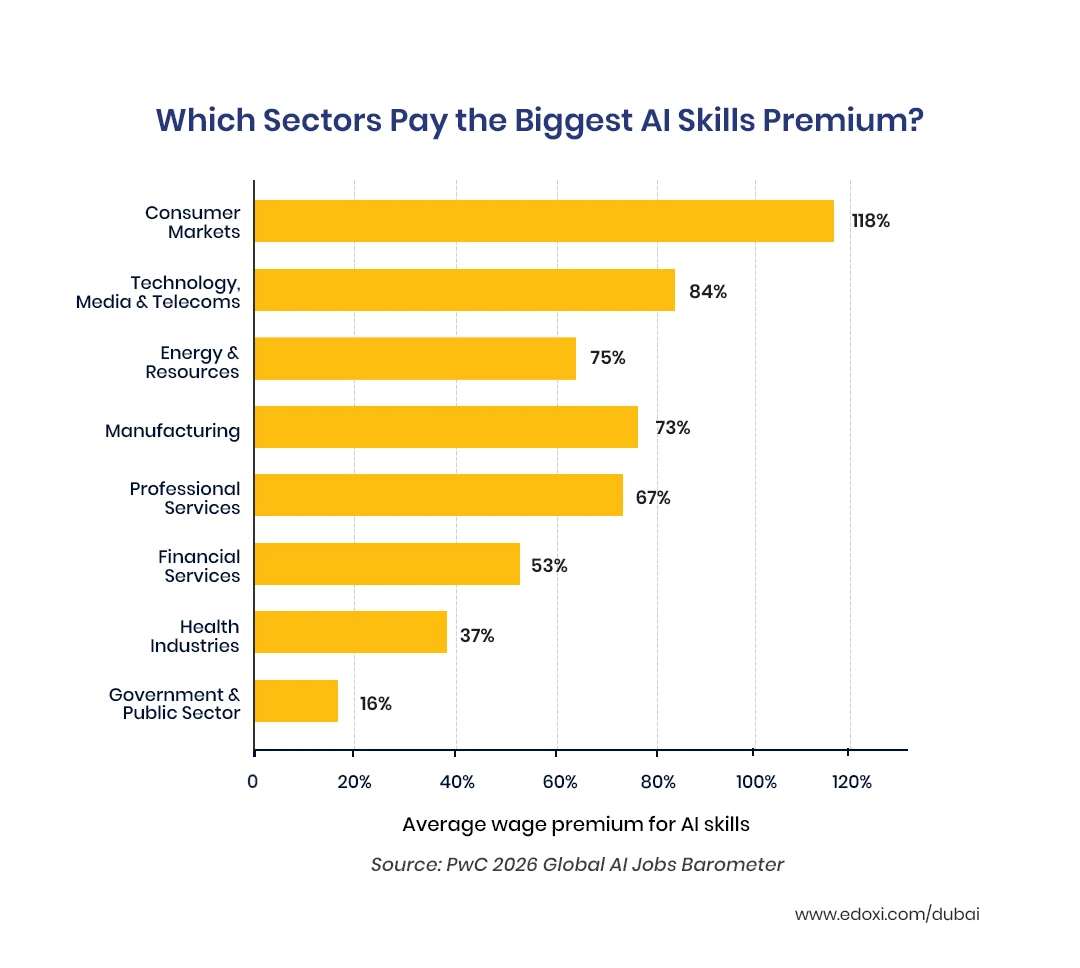
AI wage premium by sector, UAE and global data, 2025 (Source: PwC 2026 Global AI Jobs Barometer).
Consumer markets and technology lead on wage premiums, but every sector shown pays more for AI-literate talent. A structured Generative AI Course in Dubai builds these six skills together, rather than teaching tools in isolation.
AI tool skills alone get commoditised quickly, because anyone can learn the same tool. What holds its value is AI capability combined with deep domain expertise. This is exactly what drives the “professionalised” track: recruiters who use AI to screen CVs still need judgement for contract negotiation, and analysts who use AI for first-pass modelling still need business context to make the call.
Human-centred capabilities also matter more as AI takes on routine work. Empathy, ethical judgement, creativity and steady leadership are consistently the hardest things for generative AI to replicate, and research shows demand for these abilities rising fastest in AI-exposed roles. Learn the advantages and disadvantages of AI.
A simple, repeatable framework works better than trying to learn everything at once.
Understand — learn what generative AI does well, and where it still makes mistakes.
Experiment — try AI tools on low-risk tasks inside your current role.
Apply — build AI into your everyday workflow, with human review built in.
Measure — track the time saved and the quality of the output honestly.
Specialise — combine your domain expertise with AI fluency to stand out.
Keep learning — revisit your skills every few months, since AI tools change quickly.
The right choice depends on how much your current role is changing.
Most Dubai professionals need upskilling first. Reskilling becomes the priority only when a role's core tasks are almost entirely automatable, which current evidence shows applies to a minority of jobs. Therefore, learn why you must upskill in the age of Artificial Intelligence.
Recent history gives the clearest guide to what comes next. UAE AI hiring has already tripled in a few years, and that trend shows no sign of reversing.
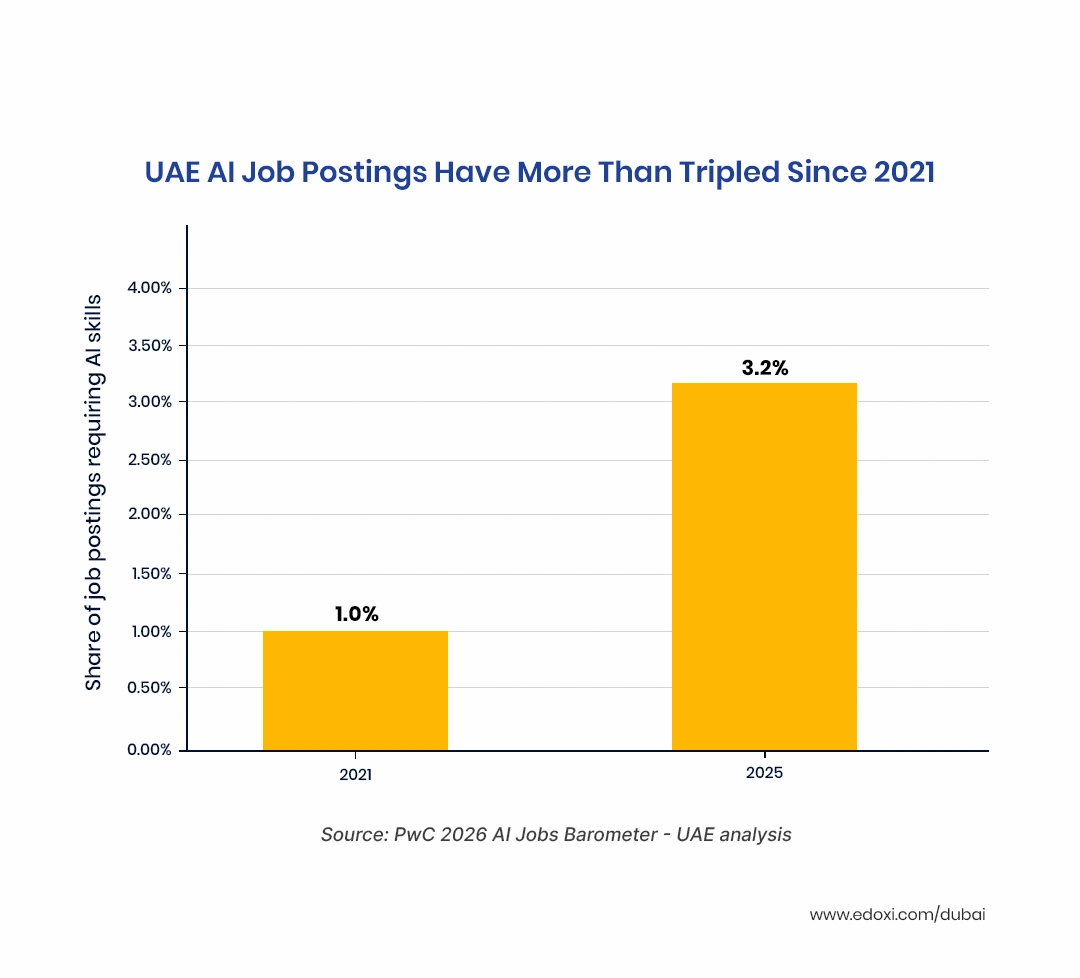
Share of UAE job postings requiring AI skills, 2021 vs 2025 (Source: PwC 2026 AI Jobs Barometer, UAE analysis).
Looking further ahead requires more caution. The table below separates near-term evidence from longer-range scenarios.
Dubai Job Market Beyond 2027
| Outlook Phase | Timeframe |
What the Evidence Suggests
|
| Near-term consolidation | 2027–2029 |
Programmes similar to Dubai's AI+ initiative scale further. AI literacy becomes a standard hiring expectation across sectors.
|
| Structural workforce growth | 2030–2032 |
The UAE workforce is projected to grow by around 12%, partly on AI-linked roles. Sectors such as finance, retail and construction see AI-driven output gains.
|
| Deeper transformation | 2033 onward |
Longer-range scenarios point to broader human-AI collaboration as the working norm, though these remain informed projections rather than settled facts.
|
Illustrative outlook based on current UAE labour-market trends. Later phases are scenarios, not guarantees.
Structured training compresses the learning curve considerably. Instead of teaching yourself through trial and error, a good course covers AI literacy, prompt engineering and applied practice in one place, so you reach workplace-ready faster.
AI training does not guarantee a new job, a promotion or a salary jump on its own. It does give you evidence of practical capability that Dubai employers are actively hiring and paying more for right now. Check out the current average Generative AI Engineer salary in Dubai.
Generative AI is not a threat to wait out. It is a shift in tasks that rewards professionals who adapt early. Focus first on AI literacy and prompt skills, then pair them with your existing domain expertise and human judgement. Dubai's job market already rewards this combination with faster hiring and stronger wages, and that trend looks set to continue. Here’s a step-by-step guide on how to become a Generative AI Engineer in Dubai.
Current evidence points to task change rather than mass job replacement. AI-exposed companies in Dubai and globally are, on average, growing headcount rather than shrinking it, though this varies by sector and role.
Prompt engineering means writing clear instructions that get accurate, useful results from generative AI tools. It matters because poorly worded prompts waste time and produce unreliable output, so it is now a core AI literacy skill across UAE workplaces. See why Prompt Engineering skills are in high demand in Dubai.
Technology, media and telecoms lead UAE AI hiring, with nearly 10% of job postings requiring AI skills. Financial services, professional services, energy and healthcare are close behind and expanding AI recruitment steadily.
PwC's 2026 AI Jobs Barometer found UAE professionals with AI skills can earn salary premiums of up to 92% in some sectors, with a global average premium of 62% for AI-skilled workers.
Dubai launched the AI Workforce Transformation Programme (AI+) in April 2026 to train 50,000 government employees in practical AI skills. It sits under the Dubai Future Foundation, alongside the wider UAE National AI Strategy.