Request a Callback

+971 4380 1666
 Nov 20, 2026
PAAET Kuwait helps the workforce by running applied colleges and vocational institutes that teach job-ready skills. It reviews programmes against labour market needs, works with government bodies, and adds new courses where demand appears.
This gives young Kuwaitis practical training that supports Kuwait Vision 2035.
Imagine a hiring manager in Kuwait City with two CVs on the desk. Both candidates hold a degree. One can also build a simple dashboard, spot a phishing email, and run a small project. Who gets the call?
That small scene explains the skills gap. Diplomas still matter, but employers now ask what you can do on day one.
PAAET sits right in the middle of this shift. This guide covers what it does, which skills are rising, where the gaps remain, and how you can stay job-ready.
Work is changing faster than most syllabuses. Employers want digital, technical, and problem-solving skills, and Kuwait wants a less oil-led, less government-led economy.
The World Economic Forum's Future of Jobs Report 2025 says employers expect 39% of workers' core skills to change by 2030. Kuwait feels this shift too.
Kuwait Times reported in July 2026 that non-Kuwaitis make up 96.4 percent of private-sector staff. The same report says the public sector employs 80.1% of the Kuwaiti workforce.
Vision 2035 aims to change this balance. That needs citizens with skills private employers want. It is why skill development has moved from an extra to a core career plan.
PAAET is the Public Authority for Applied Education and Training. Kuwait created it by law in 1982 to run technical, vocational, and applied education.
The Public Authority for Applied Education and Training (PAAET) was established under Law No. 63 of 1982, bringing applied education and training together in one body.
Today it runs two types of institutions:
The list changes over time, so check the official site for the latest.
PAAET teaches applied skills, reviews programmes against job demand, and partners with government bodies. These steps keep training linked to real roles.
The key ways PAAET supports Kuwait's workforce are:
PAAET launched training programs to strengthen employee skills under the title “Advancement and Ambition” on November 12, 2026.
The main aim behind this program is to develop employee skills, improve job performance, and promote institutional excellence.
The key topics include AI, strategic planning, time management, employee behaviour, public speaking, and managing work pressures.
“Career success requires more than academic qualifications, intelligence and skills. It also depends on diligence, discipline, continuous training and the ability to apply knowledge and experience effectively when carrying out duties.”
Dr Hassan Al-Fajjam, PAAET Director General, Kuwait (November 12, 2026, Kuwait Times)
The following infographic highlights five key ways PAAET is shaping Kuwait’s future workforce through skills development, employability, and vocational education.
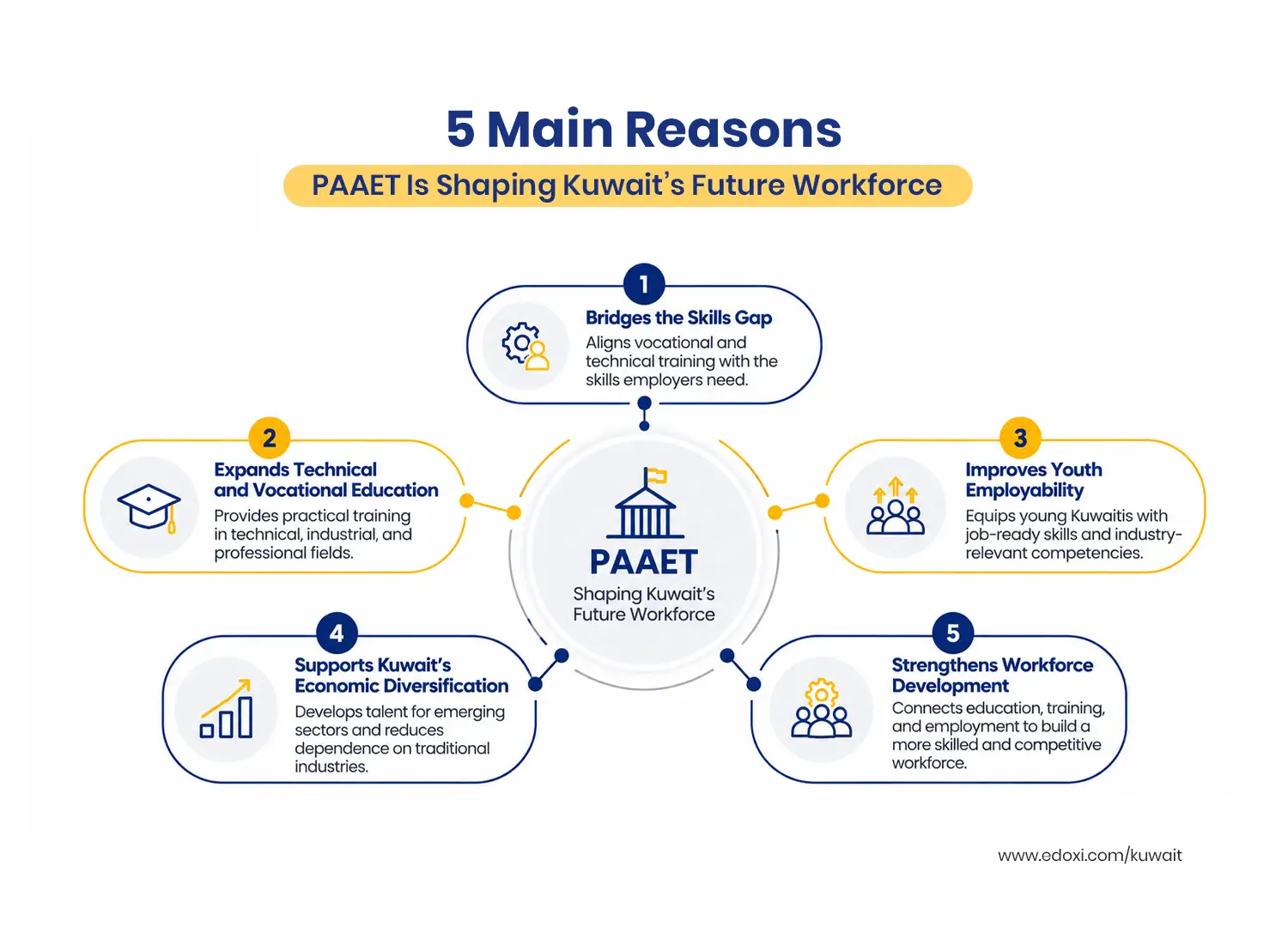
Bridges the Skills Gap– Aligns vocational and technical training with the skills employers need.
Expands Technical and Vocational Education– Provides practical training in technical, industrial, and professional fields.
Improves Youth Employability– Equips young Kuwaitis with job-ready skills and industry-relevant competencies.
Supports Kuwait’s Economic Diversification– Develops talent for emerging sectors and reduces dependence on traditional industries.
Strengthens Workforce Development– Connects education, training, and employment to build a more skilled and competitive workforce.
PAAET reviews programmes often. It pauses courses the market no longer needs and adds new ones when demand appears.
Director General Dr Hassan Al-Fajjam said PAAET reviews its programmes regularly, suspends specialisations no longer required, and introduces new ones when demand emerges.
New programmes from 2026/2027 include real estate finance, a training programme for Kuwait Municipality and an air traffic controller specialisation.
Pressure also comes from the top. Kuwait's higher education minister told PAAET to cut admissions in oversupplied fields and expand programmes linked to real demand.
Mainly government bodies. Recent talks involved the Public Authority for Manpower and the General Administration of Customs.
PAAET and the Public Authority for Manpower discussed skills verification and sharing data on future job trends. Separate talks with Customs covered programmes built around customs work.
Rabab Al-Osaimi, Director General, Public Authority for Manpower: Called for close coordination with training institutions and a precise database of labour market needs. (Kuwait Times)
Mohammad Al Muzaini, Public Authority for Manpower: "Kuwaitization is central to the National Vision 2035."
Digital skills, AI and data, cybersecurity, project management, and technical trades. The WEF expects technological skills to grow in importance faster than any other skill group.
Key Skills, Their Importance, and Career Opportunities in Kuwait
| Skill area | Why it matters | Example roles |
|---|---|---|
| Digital skills | Every office now runs on software | Admin, HR, sales |
| AI and data | Decisions rely on data | Analyst, AI engineer |
| Cybersecurity | Banks and government hold sensitive data | Security analyst |
| Project management | Big projects need delivery skills | Project coordinator |
| Technical/vocational | Industry needs hands-on talent | Technician, engineer |
They are the base for every other skill. Without them, advanced training is harder.
Think email, spreadsheets, cloud tools, and online meetings. Most roles already assume you know them.
You do not need to be a coder to start. Learn to ask good questions of data first. If you want to go deeper, here is how to build a career in artificial intelligence step by step.
More services are online, so more data needs protection. Every employee shares that duty.
Strong passwords and careful clicking are a start. Specialist roles go much further.
Project management turns plans into finished work on time and on budget.
Kuwait has many large public and private projects. People who can plan, track, and report are always useful.
Industry cannot run without skilled hands. Electricians, technicians, nurses, and navigation staff are core to the economy.
Hands-on learning works best when it mixes labs, tools, and coaching. Good training methods make skills stick.
PAAET offers practical, job-linked education. It adapts courses to demand, builds training facilities, and works with employers.
| Gap | PAAET response |
|---|---|
| Courses out of step with jobs | Regular reviews and new programmes |
| Oversupply in some fields | Reduced admissions |
| Weak employer link | Data sharing with the Manpower Authority |
| Facilities | A new Applied Studies building combining academic and practical training; PAAET launches admissions campaign to guide students |
PAAET also entered the Times Higher Education Arab University Rankings for the first time in 2026. A ranking does not prove job outcomes, but it shows the authority is being measured.
Employers carry part of the load. Even a well-trained graduate needs a clear plan for new employee training in the first months.
School leavers suit applied programmes. Working professionals suit short skill courses. Employers suit structured in-house training.
Career and Training Pathways Based on Your Current Stage
| You are... | Best next step |
|---|---|
| A school leaver | Explore PAAET colleges and institutes |
| A graduate | Add a practical skill or certification |
| A working professional | Take a focused upskilling course |
| An employer | Build a training plan for your team |
Public sector pull, a private sector built on expatriate labour, fast-changing skills, and uneven course demand.
No single college can fix this alone. Companies matter too, and strong employee training closes gaps that classrooms cannot.
Pick one in-demand skill, learn it by doing, prove it with a project or certificate, and refresh it every year.
Check what a skill pays before you invest. For example, the AI engineer salary in Kuwait shows how fast-growing roles are priced.
Audit your skills. List what you do well and what job ads ask for.
Choose one gap. Do not chase five skills at once.
Practise on real tasks. Use work problems as projects.
Prove it. Build a portfolio or earn a recognised certificate.
Review each year. Skills expire, so keep learning.
Many firms support this with corporate training programs. Ask your manager what is on offer. No course can guarantee a job, but focused practice improves your odds.
Edoxi Kuwait supports workforce development by helping learners and working professionals build practical, industry-relevant skills in artificial intelligence, data analytics, cybersecurity, cloud computing, digital marketing, project management, finance and other technology-driven fields.
Its Kuwait training centre provides professional development and certification-focused learning designed to help people keep their skills aligned with changing workplace requirements.
This role is relevant to Kuwait’s wider workforce-development priorities. As businesses adopt AI, automation, cloud technologies and data driven decision-making, professionals increasingly need to update their technical and business skills throughout their careers.
Professional training can help bridge the gap between existing qualifications and the practical capabilities employers need.
Edoxi brings established professional training experience to its Kuwait operations. Its published credentials include 75,000+ professionals trained, 700+ professional courses, 10+ international accreditations and training reach across 20+ countries.
Edoxi also identifies relationships and authorisations involving recognised organisations such as PMI, CompTIA, EC-Council, ISACA, Autodesk, PECB, Qualifi and AI CERTs.
Its Kuwait centre is presented as a PAAET-licensed private training centre, providing an important local regulatory trust signal for learners and organisations evaluating professional training options in Kuwait.
The workforce impact of professional training is best understood through the skills learners can apply after training. For example:
Edoxi’s contribution is therefore not simply the delivery of individual courses. Its broader value is in providing continuous professional learning and practical skill development, helping individuals and organisations respond to changing technology and employment requirements.
Kuwait’s transition toward a more knowledge- and technology-driven economy increases the importance of developing adaptable human capital.
Training providers such as Edoxi can contribute to this ecosystem by making professional certification, technology training and workforce upskilling more accessible locally.
In simple terms: Edoxi Kuwait helps people prepare for the future of work by connecting professional learning with practical skills that are increasingly relevant to Kuwait’s technology-driven and evolving job market.
PAAET Kuwait is one of the country's main routes from classroom to career. It cannot close the gap alone, but its focus on applied skills moves Kuwait in the right direction. Your part is to keep learning.
PAAET supports Kuwait Vision 2035 through applied education, technical training, and human capital development. Its programmes help prepare qualified professionals who contribute to economic diversification, productivity, technological advancement, and national development.
Graduates can improve employability through practical experience, professional certifications, digital skills, communication, and industry-specific software knowledge. Complementary training in AI, data analytics, project management, and cybersecurity can strengthen their qualifications.
The official website of Kuwait's Public Authority for Applied Education and Training is https://www.paaet.edu.kw/. Students can access institutional information, colleges, training institutes, admission announcements, and electronic services.
PAAET provides electronic student services, including online registration, academic advising, student ID requests, class schedules, certificate requests, learning management access, and other academic administration services.
PAAET develops Kuwait's workforce through applied education, vocational training, and technical programmes. Its colleges and institutes prepare students with practical competencies relevant to changing industry and employment requirements.