Request a Callback

+971 4380 1666
 Nov 12, 2026
PMP Mock Test: Key Questions AnsweredHow many questions are on the PMP exam?
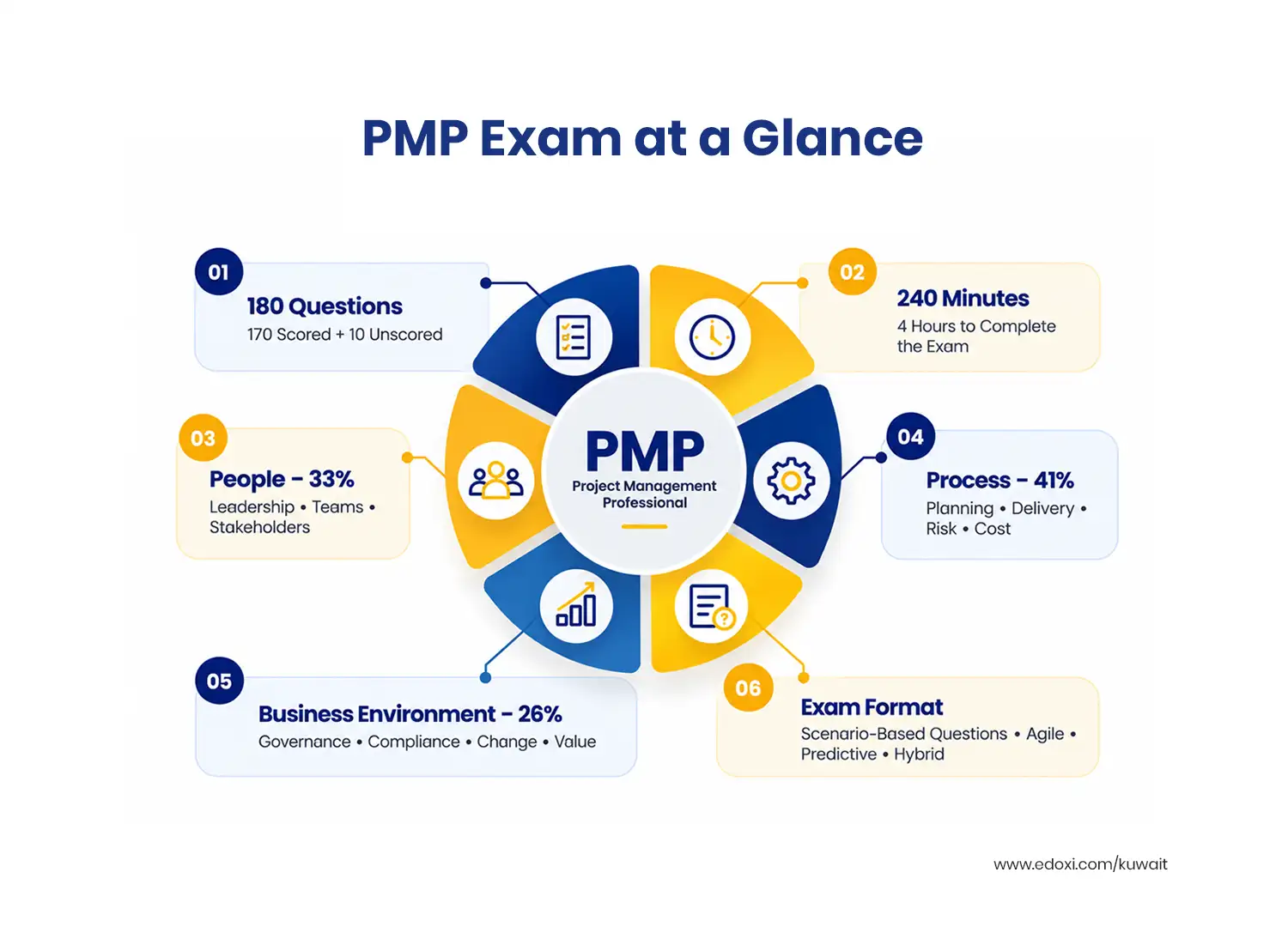
Quick Answer: 180 in total. Of these, 170 are scored, and 10 are unscored trial questions
What score should I aim for in mock tests?
Quick Answer: A 75%+ mock score can be used as a preparation benchmark, but it is not an official PMI passing score
Are PMP mock questions harder than the actual exam?
Quick Answer: It depends on the provider. Good mocks feel close to the real exam, and poor ones are too easy or too tricky
|
Nobody learns to drive from the rule book alone. You need a car, a road, and someone beside you saying, "Brake earlier."
A PMP mock test works the same way. You can read for weeks. But the first time you face 180 questions on a running clock, your brain behaves differently. A mock test shows you that early, when a mistake costs nothing.
This guide covers what a mock test is and how real it feels. You also get ten original practice questions and a plan for how many mocks to take. We close with what it all means for professionals in Kuwait.
| Nos | Contents |
|---|---|
| 1 | What Is a PMP Mock Test? |
| 2 | How Closely Do PMP Mock Questions Match the Real Exam? |
| 3 |
What Types of Questions Are Asked in the PMP Exam?
a) How Do Situational Questions Work?
b) What Are Agile and Hybrid Scenarios?
c) What Are Predictive Project Management Scenarios?
d) What Do Stakeholder and Team Questions Test?
|
| 4 | What Do PMP Sample Questions Look Like? |
| 5 | How Can You Use PMP Mock Tests Effectively? |
| 6 | What Mistakes Do People Make in PMP Practice Tests? |
| 7 | How Many PMP Mock Tests Should You Take? |
| 8 | Why Does PMP Exam Preparation Matter in Kuwait? |
| 9 | Key Takeaways |
| 10 | FAQs: PMP Mock Test and Sample Questions |
A PMP mock test is a practice exam that matches the real one in length, timing, and style. It tests your knowledge and your stamina.
You sit it in one go. The timer is on, and you have no notes. At the end, you get a score for each domain. That score tells you where to spend your next study hours.
Think of it as a health check, not a final grade. A good mock covers the full range of project management work, not only formulas.
Good mocks match the style, not the exact wording. PMI does not release its exam questions, so every mock is an imitation.
The updated exam launched on 9 July 2026. It also added case study sets and graphic-based questions. Check any mock against the current PMP exam syllabus before you trust it.
PMP Exam Domains and Weightage
| Domain | Weight | What it covers |
|---|---|---|
| People | 33% | Teams, conflict, leadership, stakeholders |
| Process | 41% | Planning, schedule, cost, risk, delivery |
| Business Environment | 26% | Compliance, governance, change, value |
Source: Project Management Institute - New PMP Exam Outline
Business Environment went from 8% to 26% of the exam. A mock written for the old outline leaves a big gap in your practice (PMI).
Be careful with any site that sells "actual PMP exam questions." Real questions are protected. Use original practice material only.
The complete picture of the PMP exam is illustrated in the infographic below:
Most questions are situational. You read a project problem and pick the best response. Four themes appear again and again:
Situational Questions
Agile and Hybrid Scenarios
Predictive Project Management Scenarios
Stakeholder and Team Questions
Situational questions describe a problem and ask what to do first or next. Often, two answers look right, and you choose the better one.
Read the last line first. Then read the story. Look for words like "first," "best," and "next."
Agile and hybrid scenarios cover sprints, backlogs, and product owners. They also cover projects that mix agile work with fixed plans.
Expect questions about who decides what. Think about team ownership and short feedback loops.
Predictive project management scenarios are plan-driven projects. They test scope, schedule, cost, risk, and simple earned value maths.
Learn the formulas, but also learn when to use them.
Stakeholder and team questions test your people skills, such as handling conflict, engaging stakeholders, and communicating clearly.
People are 33% of the exam. Strong project management skills include listening and negotiation, not only scheduling.
PMP sample questions look like the ten below. These are original practice questions we wrote for learning. They are not from PMI and are not real exam questions.
Q1 (Agile). Midway through a sprint, the product owner asks for a new feature. The team has already committed to its sprint work. What should the project manager do?
A. Add it now and extend the sprint
B. Add it to the backlog for the next planning session
C. Ask the team to work overtime
D. Escalate to the sponsor
Answer: (B) The sprint scope stays protected, and new requests go into the backlog to be prioritised. Teams often keep that backlog in project management tools. A breaks the sprint commitment. C hurts the team. D is premature, since nothing is blocked.
Q2 (Predictive). A project has PV of 50,000, EV of 40,000, and AC of 45,000. What is the CPI?
A. 0.89
B. 1.13
C. 0.80
D. 1.25
Answer: (A) CPI is EV divided by AC, so 40,000 ÷ 45,000 gives 0.89. B flips the formula. C is the schedule index (EV ÷ PV). D divides PV by EV, which means nothing here.
Q3 (Stakeholder). A key stakeholder skips meetings, then criticises decisions later. What should you do first?
A. Remove them from the stakeholder register
B. Meet them one-to-one to understand their concerns
C. Report them to the sponsor
D. Send longer reports
Answer: (B) Find the cause before you act. A ignores a person who may hold real influence. C escalates too soon. D adds paper without fixing the gap.
Q4 (Team). Two developers disagree about the technical approach, and work is slowing. What is the best first step?
A. Choose the approach yourself
B. Bring them together to compare facts and agree on a solution
C. Move one developer to another project
D. Escalate to the functional manager
Answer: (B) Collaboration usually produces lasting agreement. A may work fast but can cause resentment. C removes the person, not the problem. D is a later step.
Q5 (Hybrid). A project delivers fixed hardware plus flexible software. Which approach fits best?
A. Fully predictive
B. Fully agile
C. Hybrid: milestone plan for hardware, iterations for software
D. Wait until requirements are final
Answer: (C) Each part gets the method that suits its nature. A makes software too rigid. B ignores hardware lead times. D wastes time.
Q6 (Business Environment). Midway through delivery, a new data-protection rule affects your project. What comes first?
A. Ignore it until project closure
B. Assess the impact on scope, risk, and schedule, then use change control
C. Tell the team to carry on
D. Cancel the project
Answer: (B) Assess first, then handle it formally. A and C risk a compliance breach. D is an extreme reaction before you know the impact.
Q7 (Risk). A risk on the register has now happened. The team already agreed a response plan for it. What should the project manager do first?
A. Record it in lessons learned and move on
B. Carry out the agreed risk response
C. Call a meeting to brainstorm new options
D. Ask the sponsor for extra budget
Answer: (B) The team planned this response for a reason, so use it. A is a closing activity and fixes nothing now. C wastes time when a plan already exists. D may be needed later, but only if the plan fails.
Q8 (Predictive). An activity on the critical path runs 3 days late. Another path has 5 days of float. What happens to the project end date?
A. No change
B. It moves out by 3 days unless the team recovers the time
C. It moves out by 5 days
D. It moves out by 8 days
Answer: (B) Critical path delays move the end date, day for day. A ignores that the activity has zero float. C uses the wrong path's float. D adds two numbers that don't belong together.
Q9 (Agile). Every morning, team members wait for the project manager to hand out their tasks. What is the best response?
A. Keep assigning tasks to stay in control
B. Coach the team to pick up work themselves from the backlog
C. Give all tasks to the strongest developer
D. Ask for stricter daily reports
Answer: (B) Agile teams organise their own work, and a servant leader builds that habit. A keeps the team dependent. C creates a bottleneck and burnout risk. D adds control, not ownership.
Q10 (Business Environment). Mid-project, a market shift cuts the expected benefits of the product. The sponsor wants to continue as planned. What should the project manager do?
A. Continue as planned
B. Review the business case with the sponsor and stakeholders, then recommend continuing, changing, or stopping
C. Stop work immediately
D. Cut quality to save cost
Answer: (B) Projects exist to deliver value, so a drop in benefits calls for a fresh decision. A ignores new facts. C reacts before the review. D hurts the product and doesn't fix the value problem.
Take them timed, review every answer, track your weak domains, and retake only after you have studied.
Learn first: Finish a round of study before your first full mock.
Sit it like the real thing: Use the full 240 minutes, with no phone and no pauses.
Review everything: Read the explanation for wrong answers and for lucky right ones.
Log your weak spots: Note the domain and the reason, such as "misread the question."
Fix, then retest: Study the gap, then try fresh questions.
Feedback speeds this up. Good PMP training puts an instructor beside you who explains why an answer works.
The common ones are memorising answers, skipping the review, ignoring the clock, and using outdated mocks.
Also, be sure PMP suits your goal. It is one of many project management certifications, and the right pick depends on your role.
Most candidates take four to six full-length mocks, plus short topic quizzes. This is a rule of thumb, not a PMI rule.
| Your situation | Full mocks | Focus |
|---|---|---|
| New to project management | 5-6 | Learn concepts between mocks |
| Experienced PM | 3-4 | Exam style and the new domain weights |
| Retaking the exam | 4-5 | Weak domains from your report |
Quality beats quantity. One mock that you review well teaches more than three you rush. A sound plan makes the effort behind PMP certification count, which is why a PMP certification deserves a proper schedule.
If you're still weighing the effort, this guide on why PMP certification is important for your career breaks down what it can change for you.
Kuwait is running large projects under its Vision 2035 plan, and delivery skills are in demand. A recognised credential helps you show those skills.
The demand is global too. PMI’s global project management talent gap report says up to 29.8 million more project professionals will be needed worldwide by 2035.
The report also links to the World Economic Forum's Future of Jobs Report 2025, which ranks project managers among the fastest-growing roles.
Choosing a career in project management looks sensible against that backdrop.
Arab Times opinion digest, January 2026: Running major strategic projects "requires exceptional and rare skills and expertise."
Systematic review of construction delays in Kuwait (ResearchGate): Researchers describe project delays as a lasting problem. Time overruns in Kuwaiti construction projects range from 20% to 80%.
Buildings Journal pilot study on Kuwait government projects: Poor contractor monitoring and weak consultant project management teams ranked highest among delay factors.
All three point the same way. Employers need people who plan, monitor, and communicate well. Mock tests can help candidates practise the judgement, prioritisation, and decision-making skills required in scenario-based questions.
Many candidates also pick a PMP course in Kuwait because PMI requires 35 hours of project management education unless you hold an active CAPM. Think of that course as one part of the plan, with mocks as the other.
Mocks also help you follow the future of project management, where AI, hybrid work, and business value now sit inside the exam.
Take care with promises. No mock score, course, or certificate guarantees a job. They improve your odds and your readiness.