Request a Callback

+971 4380 1666
 Oct 17, 2026
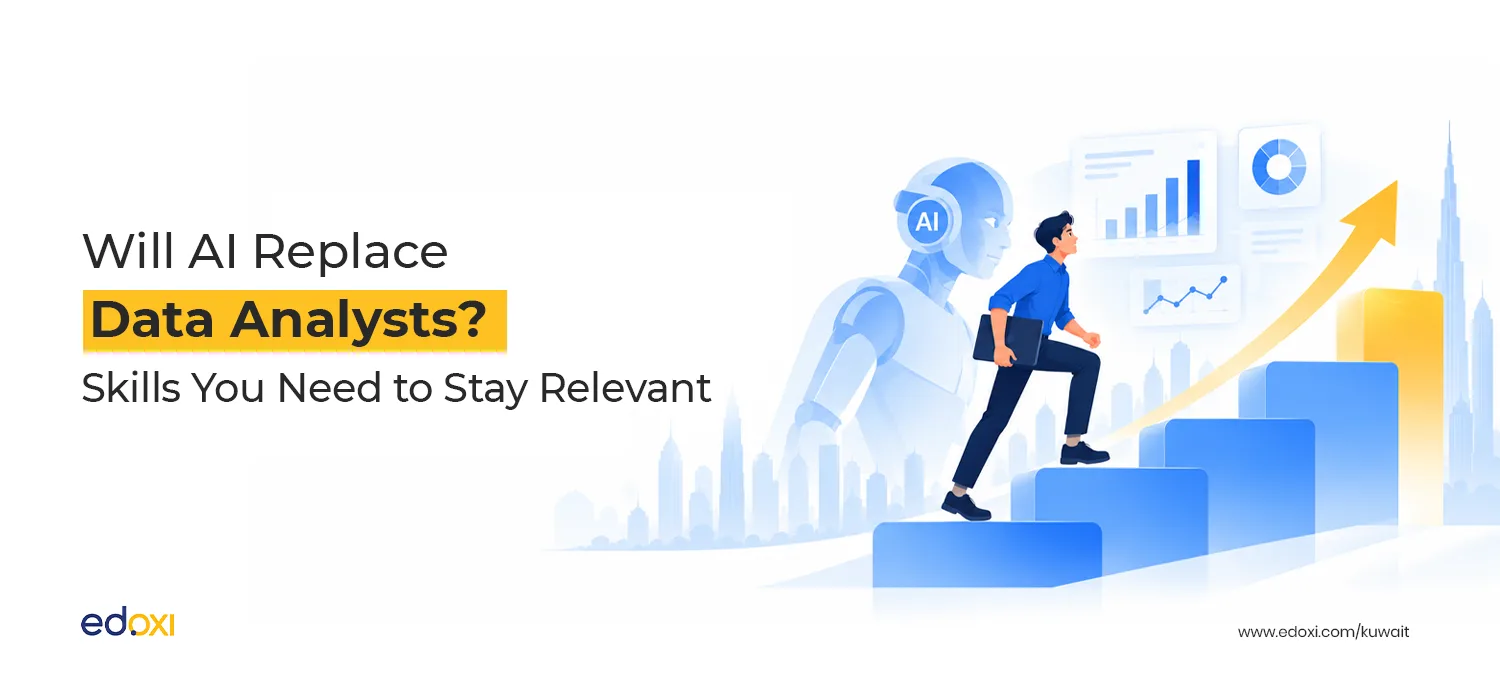
AI will automate parts of the analyst's job, such as cleaning data, drafting SQL, and building charts. It is unlikely to remove the need for analysts who can check results, understand the business, and explain decisions.
Roles will change. No one can promise exact job numbers, so build skills that stay useful.
When calculators reached offices, many feared accountants would disappear. Accountants stopped adding columns by hand and started giving advice.
Analysts face a similar shift. So, will AI replace data analysts? Some tasks, yes. The whole role, not on current evidence. This blog shows what changes, which skills gain value, and how to prepare in Kuwait.
Table of Contents
| Nos | Contents |
|---|---|
| 1 | Will AI Replace Data Analysts in the Future? |
| 2 |
Which Data Analyst Tasks Can AI Automate?
a) How Is Basic Automation Different from Advanced Analytics?
b) How Is AI Changing the Day-to-Day Work of Data Analysts in Kuwait?
|
| 3 |
What Still Needs a Human Data Analyst?
a) Where Does Business Judgement Come In?
b) Why Does Validation Still Matter?
c) How Should Analysts Communicate Results?
d) What Makes a Future-Ready Data Analyst?
|
| 4 | Which Analyst Skills Become More Valuable as AI Spreads? |
| 5 | What Skills Should Data Analysts Learn to Stay Relevant? |
| 6 | Will AI Replace Entry-Level Data Analysts? |
| 7 |
How Can Data Analysts in Kuwait Prepare for AI-Driven Workplaces?
a) What Are Kuwaiti Employers Already Doing with Analytics?
b) Which Official Programmes Can Help?
c) What Steps Can Data Analysts Take This Quarter to Stay Relevant in the AI Era?
|
| 8 | Key Takeaways |
| 9 | FAQs: Will AI Replace Data Analysts? |
Some tasks, yes. The full role is unlikely to disappear by 2030 on current evidence. The WEF Future of Jobs Report 2025 lists data analysts and scientists among fast-growing roles, up about 41%. Outcomes still vary by employer.
A job is a bundle of tasks. AI removes some of them, so the bundle changes. Some companies will do more with smaller teams. That is a real risk, and it is why skills matter.
The same WEF report expects 170 million new jobs and 92 million lost jobs worldwide by 2030. It also says 39% of workers' skills will change. Many Kuwait firms are building AI-ready teams for this reason.
For the long view, read about the future of data analytics.
Six tasks are most exposed: cleaning, basic SQL, charts, reports, pattern spotting, and simple forecasts. Rule-based work automates easily. Complex modelling still needs people to own the assumptions.
What AI Can Automate vs. What Data Analysts Still Need to Own
| Task | What AI can do | What you still own |
|---|---|---|
| Data cleaning | Spots duplicates and gaps | Rules for what is "wrong" |
| Basic SQL | Drafts queries | Testing joins and filters |
| Visualisation | Builds charts quickly | Choosing a fair chart |
| Reports | Drafts summaries | Facts, context, sign-off |
| Pattern finding | Flags trends and outliers | Deciding if they matter |
| Basic forecasting | Runs standard models | Assumptions and limits |
Basic automation follows fixed rules, like a monthly report template. Advanced analytics, like demand forecasting, needs judgment calls that AI can support but not own.
A weekly sales email is easy to automate. A forecast for a new product with no sales history is not. Someone must choose the data, set the assumptions, and defend the range.
Routine reporting sits closest to automation, as the list of jobs at risk of AI replacement shows.
The order of work changes. AI drafts first, and you review second. Here is a clear before-and-after comparison of how AI changes the day-to-day workflow of data analysts in Kuwait.
How AI Is Changing Everyday Data Analyst Tasks
| Step | Before AI | AI-assisted |
|---|---|---|
| Cleaning | Manual fixes, line by line | AI suggests fixes, you approve |
| SQL | Write every query | AI drafts, you test |
| Dashboard | Build from blank | AI proposes layout, you refine |
| Weekly report | Write from scratch | AI drafts text, you add insight |
Accountability. AI can propose answers, but someone must define the question, verify the data, and stand behind the result when leaders, auditors,s or regulators ask.
AI can use business context if you supply it. It can still misread assumptions you did not state.
Say sales fall in March. AI may call it a decline. An analyst knows Ramadan shifted buying patterns and compares like-for-like.
AI answers can sound confident and be wrong, so someone must reconcile them with source data.
A faulty join can double revenue in a report. Check totals against source systems, test queries on a small sample, and keep a note of what you verified.
The same pattern appears in AI and software engineering, where reviewers guide and correct machine output.
Give a clear recommendation, the main risk, and what you are unsure about, in plain words.
Leaders do not need 40 charts. They need "Open the branch" or "Wait one more quarter", with reasons. This sits at the heart of the data analyst role and responsibilities.
Kuwait's Oil Minister, Tareq Al-Roumi, said at the opening of the Kuwait Oil Company AI Innovation Center: "No matter how fast and accurate AI is, human intelligence surpasses it." Read it as support for human oversight. It does not mean every analyst task is safe.
This is an editorial framework, not a research finding. A future-ready analyst combines technical accuracy, business judgement, and AI-assisted productivity.
When Should Data Analysts Use AI vs Human Judgment?
| Situation | Lean on AI | Keep a human in charge |
|---|---|---|
| Tidying a large file | ✔ | Review the output |
| Drafting a routine query | ✔ | Test it |
| Choosing a key metric | ✔ | |
| Using private customer data | ✔ | |
| Presenting to executives | ✔ |
The three capabilities needed to become a future-ready data analyst in Kuwait are listed in the infographics below:
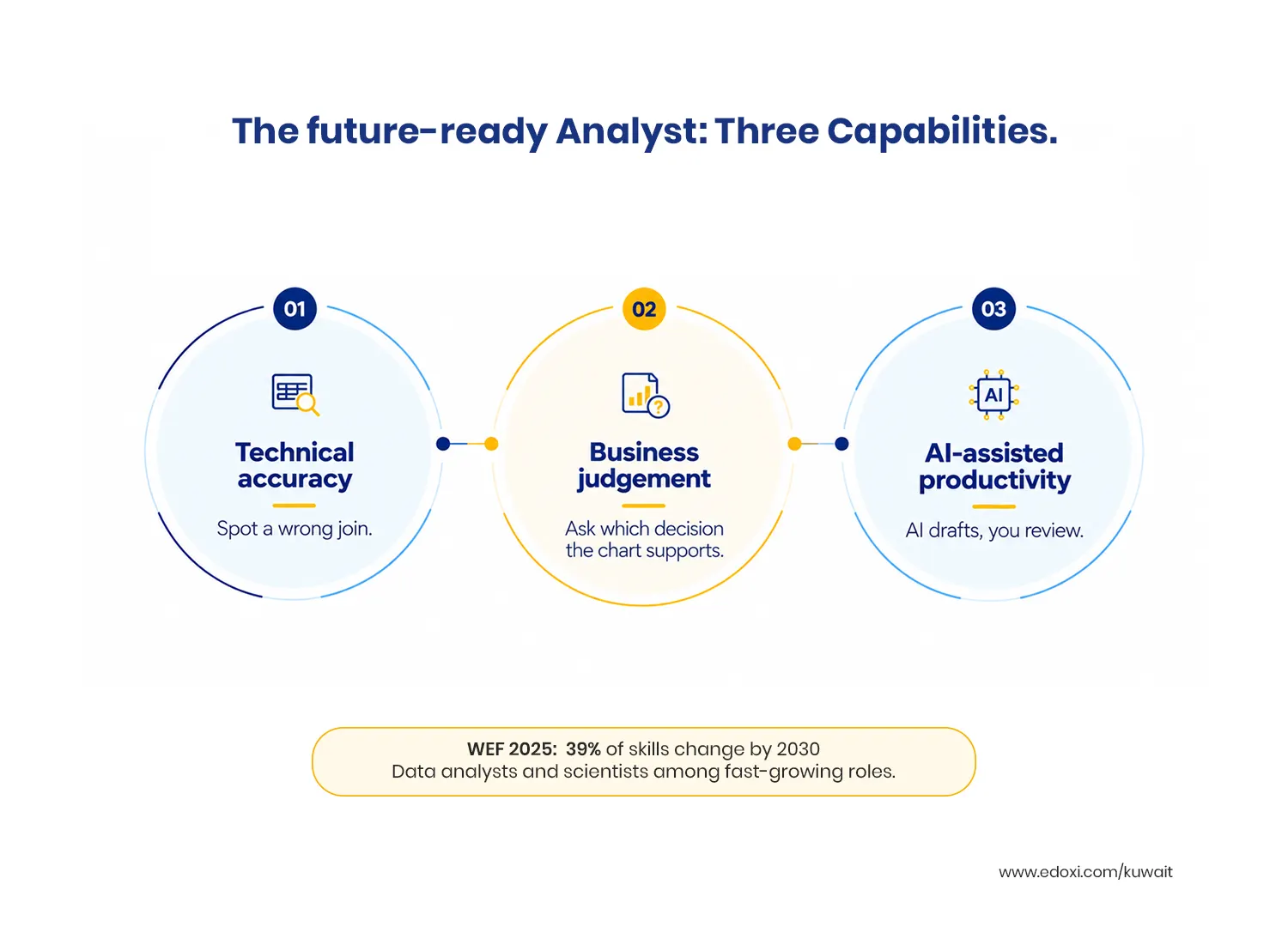
Skills for checking, framing, and explaining gain value: data-quality checks, domain knowledge, privacy awareness, and communication skills.
Producing the first draft is getting cheaper. Trusting it is not.
(Mohammad Rashed Albous, 2024. "Hyper-personalized banking in the GCC: A Kuwaiti context with UAE perspectives," Modern Finance, Modern Finance Institute.)
Everyday AI use belongs on this list too. AI skills for professionals include prompting, verification, and secure data handling.
Hands-on AI Training in Kuwait lets you practise them on real examples
To stay relevant as a data analyst in Kuwait, start with SQL and Excel, add a BI tool and statistics, then Python. Build storytelling and AI literacy alongside all of them.
| Priority | Skill | What "good" looks like | Proof to show |
|---|---|---|---|
| 1 | SQL | Joins, aggregates, window functions; you can fix AI-written queries | 5 solved case queries |
| 2 | Excel | Pivot tables, lookups, clean models | A tidy reporting file |
| 3 | Power BI / Tableau | Clear dashboards with filters and KPIs | One published dashboard |
| 4 | Statistics | You explain averages, spread, bias, and significance | A short test write-up |
| 5 | Python | You clean and automate with pandas | A notebook on GitHub |
| 6 | Business knowledge | You name the decision behind each chart | A one-page recommendation |
| 7 | Data storytelling | Headline first, caveat second | A 3-minute walkthrough |
| 8 | AI literacy | You know where AI fails and what not to paste in | A prompt and review log |
A structured data analytics course in Kuwait can put these in a sensible order.
Mapping your own skills gaps first saves time.
Entry-level work is changing first, because routine tasks are easiest to automate. Candidates who show checking, business thinking, and AI use have an edge.
How Junior Data Analysts Can Adapt to AI and Build Higher-Value Skills
| Junior task | How to adapt |
|---|---|
| Weekly sales report | Add a "why it changed" note |
| Ad hoc SQL pulls | Document how you tested each one |
| Data cleaning | Log every rule and exception |
Portfolio project to try:
Take a messy sales file, using public or sample data.
Clean it with AI help and log every check.
Build a Power BI dashboard.
Write one page: what you found, what you are unsure about, and what to do next.
If you see no callbacks for data analyst roles, a project like this gives recruiters something to read. It also helps if you later build a career in AI.
Learn the tools Kuwaiti employers use in public, build one project in their sector, and use official skills programmes.
Banks and oil companies are investing in analytics platforms and AI, so tool and domain skills transfer directly.
Banking: Kuwait Finance House unified its data on Microsoft Fabric, which feeds Power BI.
Microsoft's case study reports a 96% cut in risk processing time. This is a company-reported figure.
National Bank of Kuwait won a 2025 award for self-service analytics using Tableau Data Management.
Oil and gas: Kuwait Oil Company opened an AI Innovation Center with Microsoft. Named use cases include predictive maintenance and production optimisation.
KFH's Acting Group CEO, Abdulwahab Al Rushood, told Global Finance in 2024 that banking's future in Kuwait and the region will be shaped by data analytics and AI applications.
Two government-backed programmes target AI, cloud computing programmes, and data skills, mainly for public-sector staff.
The Kuwait Skills programme, run by the Central Agency for Information Technology with Microsoft, aims to train over 30,000 employees, 4,000 technical experts and 350 leaders.
Minister Omar Al-Omar called such skills "essential for positioning Kuwait as a leader in the digital and knowledge economy."
Google Cloud and the same agency run a second digital skills initiative, whose first edition covered cloud computing, data analysis and machine learning.
Not sure where you fit? See who should learn AI in Kuwait.
The wider shift is covered in how AI will shape the future of work.
Pick one sector, learn its main tool, and build one project around a real business question.
Banking points to Power BI or Tableau plus risk and customer metrics. Energy points to operations data, SQL, and maintenance logic.
AI is automating repetitive data analytics tasks, including basic data cleaning, routine report generation, simple SQL queries, and standard dashboard creation. These tools help analysts work faster but still require human oversight to verify accuracy and interpret results
AI cannot fully replace human judgement, business understanding, critical thinking, and accountability in data analytics. Data analysts are still needed to validate insights, understand business problems, explain findings, and recommend decisions based on real-world context
Data analysts who rely only on repetitive reporting may face greater automation risks, while professionals who combine technical expertise with business knowledge and critical thinking may be better positioned to adapt. No data analytics role is completely safe from AI, so continuous learning is essential.