Request a Callback

+971 4380 1666
 Aug 12, 2026
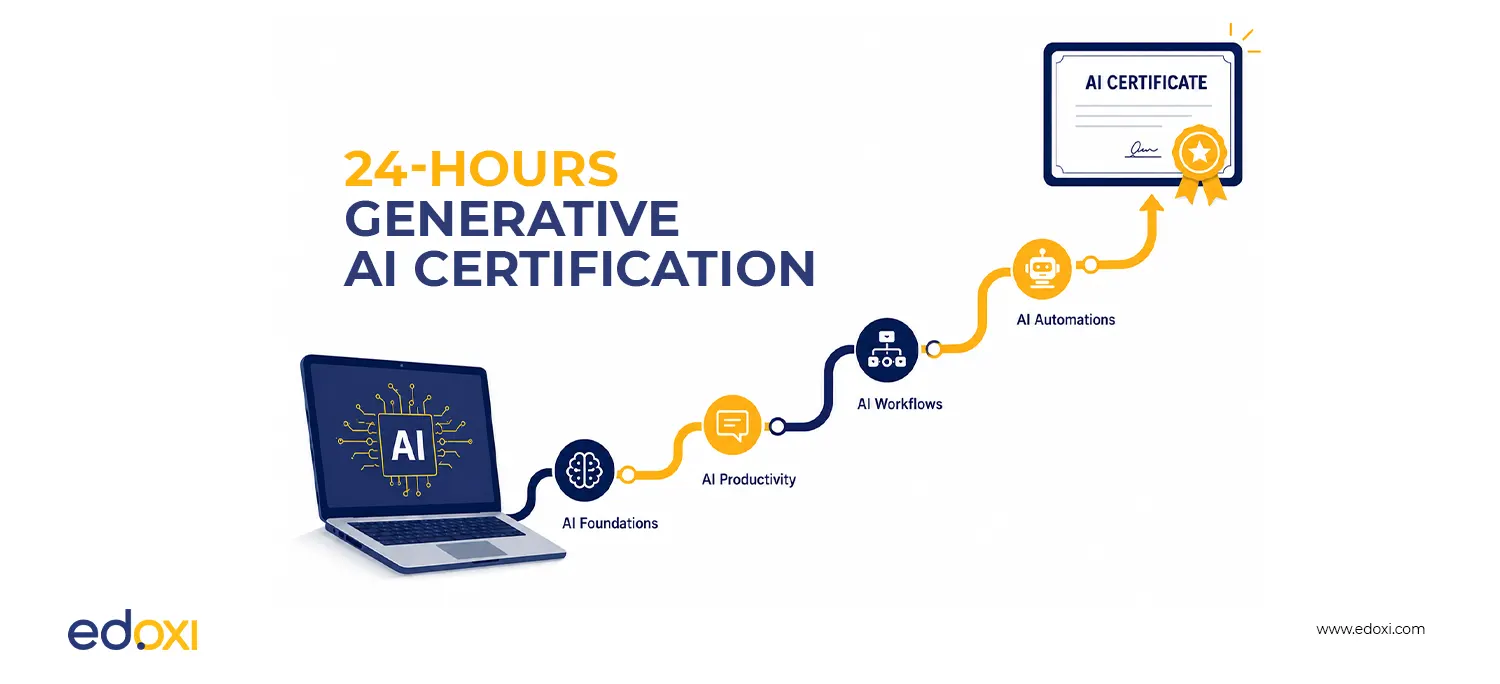
Yes, but you need effective training, not just random YouTube videos. The infographic here shows a clear 25-module program divided into 4 sections. This Generative AI course will help you learn about large language models and complete a final project, all within 24 structured, hands-on hours.
If you're a marketer in Dubai, a recent graduate, or a manager wanting to boost your team's skills, you might be wondering how this training works. This guide explains how the 24 hours are organized, so you can decide if it aligns with your learning goals.
Most people don't fail at learning Generative AI because they lack time. They fail because they learn tools in the wrong order, jumping into ChatGPT prompts before understanding how a language model actually reasons, or building a workflow before they've grasped the basics of tokens and context windows.
Stanford's 2026 AI Index puts this in perspective: generative AI hit 53% population-level adoption in around three years, a faster climb than either the personal computer or the internet managed. Millions of people are already using these tools daily, often self-taught, in far less than 24 focused hours. The gap isn't exposure, it's structure.
That's the entire logic behind this infographic: foundations first, then tools, then workflows, then governance. Each block only works because the one before it has already been laid down.
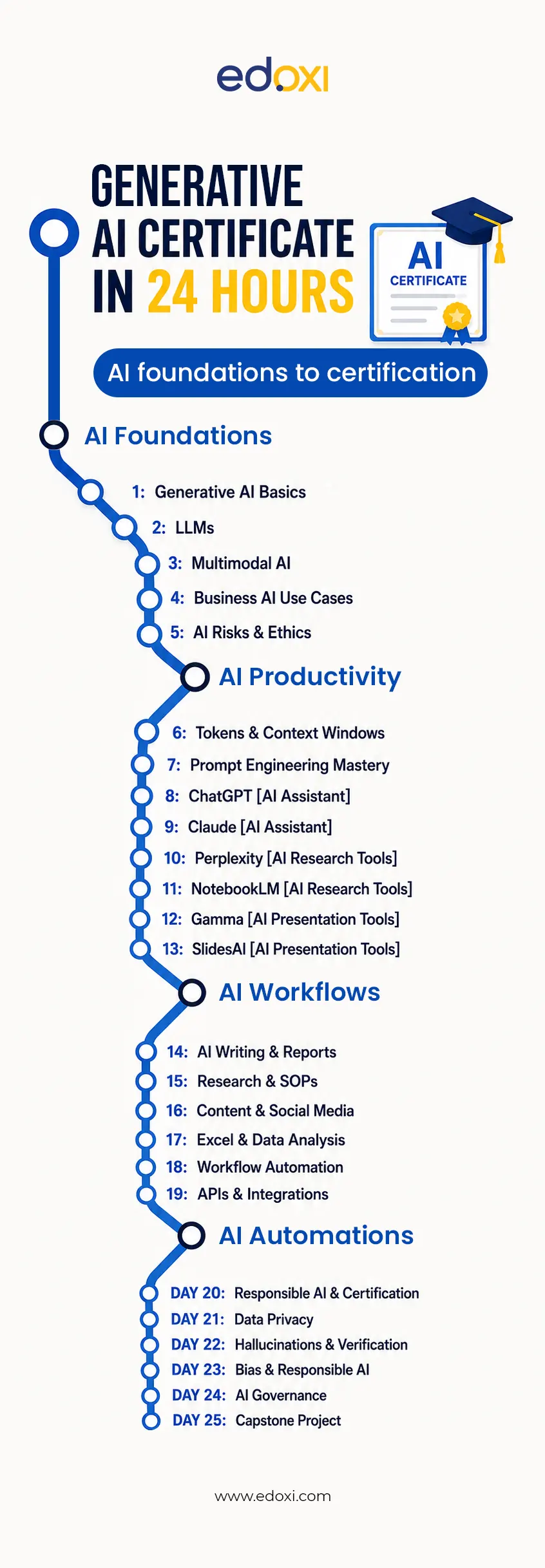
The Generative AI certification runs across 25 modules, grouped into four blocks, delivered in 24 live instructor-led hours, and finishing with a capstone project. Here's what each block actually covers.
You start with concepts, not tools, because understanding how generative models work is what makes every tool afterwards make sense instead of feeling like guesswork.
| Module | Topic | What you'll walk away with |
| 1 | Generative AI Basics |
A plain-English grasp of how generative models create text, images and code
|
| 2 | LLMs |
How models like GPT, Claude and Gemini are trained and how they reason
|
| 3 | Multimodal AI |
How AI now reads images, audio and video, not just text
|
| 4 | Business AI Use Cases |
A mapped list of AI applications relevant to your own role
|
| 5 | AI Risks & Ethics |
Awareness of limitations, biases and responsible-use principles
|
This is where it turns hands-on. You'll learn the mechanics behind every prompt ( tokens and context windows), then move straight into the assistant, research, and presentation tools employers list most often.
| Module | Tool or Skill | Category |
| 6 | Tokens & Context Windows | Core mechanics |
| 7 | Prompt Engineering Mastery | Core mechanics |
| 8 | ChatGPT | AI Assistant |
| 9 | Claude | AI Assistant |
| 10 | Perplexity | AI Research Tool |
| 11 | NotebookLM | AI Research Tool |
| 12 | Gamma | AI Presentation Tool |
| 13 | SlidesAI | AI Presentation Tool |
|
"A year from now you'll wish you had started today." — Karen Lamb |
Block 3 focuses on moving from single tasks to complete processes. This is where Generative AI really starts to save us hours instead of just minutes. Here’s a breakdown of each module:
You may also learn what Generative AI is and how it works, and how AI is helping to identify skills gaps and future Jobs.
The final block is what separates a casual Generative AI user from a certified, employer-trusted one. Governance, privacy and verification skills are increasingly non-negotiable as regulation tightens globally and across the UAE.
All 25 modules are compressed into 24 live, instructor-led hours, so momentum never breaks between foundations and application. You leave with a working certificate, not a half-finished playlist.
You may also check out the top 10 artificial intelligence skills you must learn in 2026.
The compressed timeline isn't the risk. Skipping structure is. These are the FIVE mistakes that turn a 24-hour certificate into 24 wasted hours:
Jumping straight into tools before understanding how LLMs actually reason and fail.
Treating every AI answer as fact instead of verifying it before you publish, send, or decide.
Finishing with a certificate but no real project to show for it.
Skipping data privacy and governance basics, especially in regulated UAE and EU-facing roles.
Learning tools in isolation rather than as part of a full workflow.
Most structured, employer-recognised programmes run 20–30 contact hours. Anything much shorter tends to skip governance and verification; anything much longer usually strays into full machine learning territory you don't need for applied, workplace use.
Foundations first (how models work), then core mechanics (prompting, tokens), then the tools themselves, then workflows that combine them, then governance. Learning tools before concepts is the single biggest reason self-taught learners stall out.
Recognition comes down to what the certificate actually proves. A structured, project-based Generative AI Certificate that ends in a real capstone carries far more weight with UAE hiring managers than a completion badge from a passive video course.
A Generative AI course teaches the material. A Generative AI certificate verifies you can apply it, usually through assessment or a capstone project. The 24-hour format only counts as a genuine certificate if that verification step is built in.
Yes. The roadmap is built for marketers, managers, analysts and business owners, not just developers. Block 1 exists specifically to bring non-technical learners up to speed before the tools show up in Block 2.
A Generative AI certificate in 24 hours isn't a shortcut. It's what happens when the learning order is done properly: foundations, then tools, then workflows, then governance, capped off with a real project. Skip the structure and 24 hours won't get you anywhere near certified. Follow the roadmap above and it will.